Key Takeaways
- Plan 5,000 units as a practical MOQ for custom color, logo, sleeve, and retail box work
- Use 2.0-2.2 mm borosilicate glass wall thickness for a better balance of weight and breakage resistance
- Specify 316 stainless steel for tea filter and lid contact parts when positioning the bottle as premium
- Book 30-45 days production after artwork approval, plus 3-7 days for pre-shipment inspection
Your wellness customer wants a clean glass bottle; your ops team is staring at leak rates, cracked cartons, and courier drops from 1.2 m. That is where 316 stainless steel borosilicate glass bottle wholesale sourcing stops being a catalog pick. We run the cap torque test at 8–10 kgf·cm, and QC pulled the sample last month because one silicone gasket sat 0.6 mm proud.
Take a real order: 5,000 units for a sustainable retailer launching in Europe and North America. You need a custom glass water bottle that looks premium, clears basic compliance checks, and leaves China on a fixed vessel date, not “about next week.” The wrong question is only asking for the lowest FOB price; we’ve seen this go sideways when a buyer approved thin 5-ply export cartons and then flagged 37 breakages after UPS handling.
Start With The Actual Buyer Brief
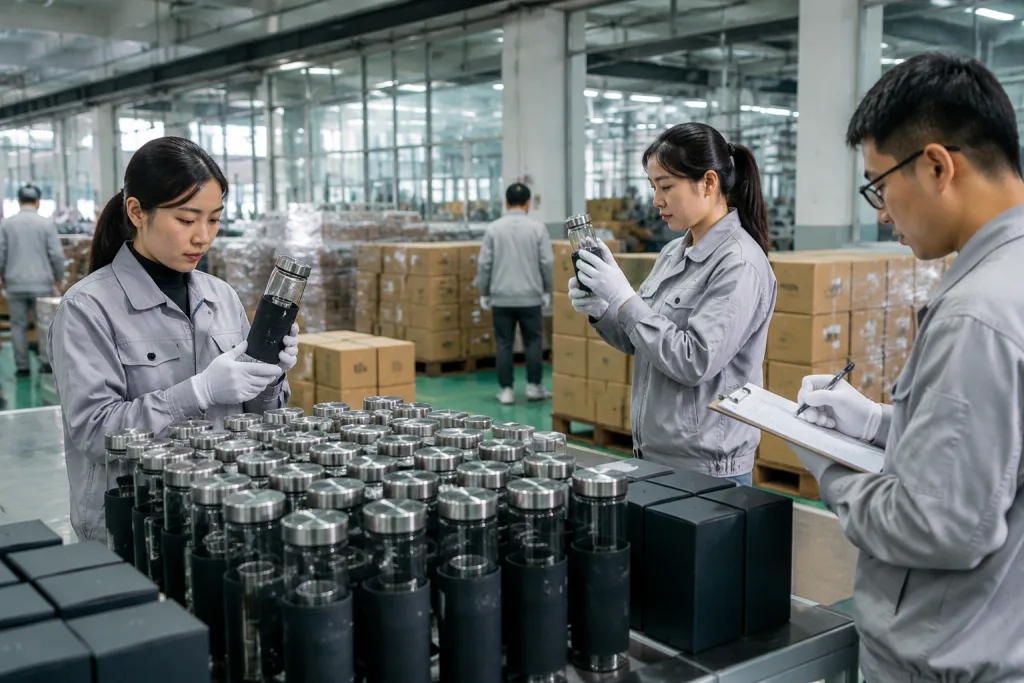
A good borosilicate glass bottle factory should not start with a pretty rendering. We start with the sell-through plan, the use case, the carton drop risk, and the return reason buyers hate most: “lid leaks after 2 weeks.” For this brief, we are sourcing for a wellness retail chain asking for a 600 ml bottle with a 316 stainless steel infuser, bamboo-look lid, silicone sleeve, and custom retail box. The landed cost is tight. The math does not work if the bottle looks like a gift item in the PDF but feels like a promo giveaway when QC pulls the sample from the line.
The first decision is capacity. For wellness and sustainable retailers, 500 ml, 550 ml, and 600 ml are the cleanest sizes to sell; our EU buyers placed 7 repeat POs on 600 ml last year versus 2 on 750 ml. A 750 ml bottle reads better for fitness, but it becomes heavier and needs stronger packaging. For borosilicate glass bottle bulk orders, that extra 150 ml can add roughly 60-90 g per unit depending on wall thickness and base design. We check this on a 0.1 g digital scale after annealing, because one buyer flagged a “premium weight” sample that later pushed the master carton over 15 kg.
For this order, we would specify 600 ml, high borosilicate glass, 2.0 mm nominal wall thickness, 316 stainless steel filter, food-grade silicone sealing ring, and a sleeve covering around 55-65% of the bottle height. If you want a borosilicate glass bottle customizable for different retail channels, keep the same glass body and change sleeve color, lid finish, logo method, and box artwork. Simple wins here. That cuts mold risk and can move repeat orders from 18 days to 12 days once the sleeve Pantone and box dieline are approved; we still measure sleeve fit with a 0.02 mm caliper because loose silicone creeps during packing.
At BottleForge Industrial in Hangzhou, Zhejiang, a normal MOQ for a customized glass water bottle like this is 3,000 units for existing glass shapes and 5,000 units when you need custom sleeve color plus printed retail packaging. Our glass bottle line can assemble and pack about 180,000 units/month across mixed models, but capacity still depends on sleeve molding, printing queue, and inspection level. We run AQL 2.5 for visible defects, and we have seen this go sideways when a PO says “bamboo lid” while the approved sample is bamboo-look PP; that one typo can stop 42 cartons at final inspection.
Lock The Material Stack Early
316 stainless steel borosilicate glass bottle wholesale sounds like one SKU on a PO. It is not. You are buying a glass tube, a metal drinking-contact set, and the silicone parts that decide whether the carton comes back with leakage photos. QC pulled a 500 ml sample last month where the glass passed, the 316 mesh passed, but the silicone ring sat 0.4 mm loose in the lid groove. The buyer flagged “water smell” on the claim sheet. Wrong question to ask: “Is it 316?” Ask what every wet-touch part is made from.
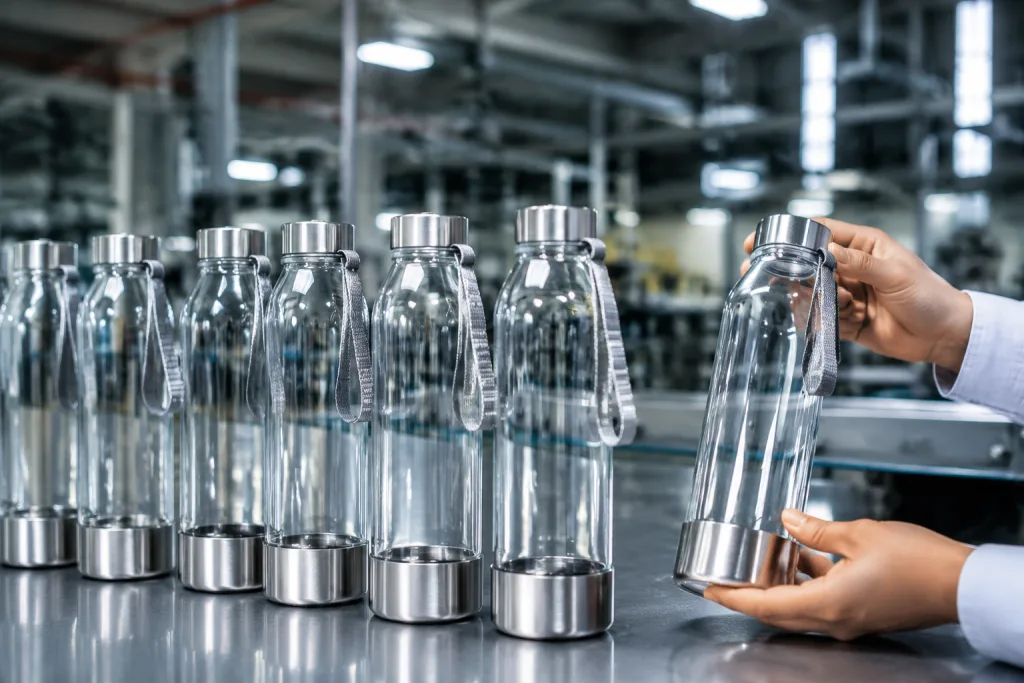
For the glass, specify high borosilicate with typical thermal shock resistance around 120°C temperature difference. It still breaks if the line drops it onto a steel table. What it does better than soda-lime glass is handle hot tea, cold rinsing, and normal kitchen temperature swings. For retail, we run 2.0-2.2 mm wall thickness on most 500-750 ml bottles, checked with a digital caliper at the shoulder and lower body. Below 1.8 mm, the bottle looks slim in photos but gets nervous during sleeve fitting and carton compression. Above 2.5 mm, the math gets ugly because each carton gains weight and air freight buyers start pushing back.
For stainless steel, 304 is common and acceptable for many lids and strainers. If your label says premium tea infuser, wellness, or long-life reusable bottle, use 316 stainless steel for the infuser mesh and every beverage-contact part. We have seen this go sideways when a supplier used 316 mesh but 304 for the inner lid plate; the salt-spray check looked fine, then the buyer’s lab asked why the BOM did not match the sales copy. If the decorative lid shell uses stainless steel, confirm the grade on the BOM, because 8 out of 20 samples we checked in one sourcing round mixed 304 and 316 to hold cost.
- Glass: high borosilicate, 2.0-2.2 mm wall, mouth finish checked with a go/no-go gauge so the silicone seal seats without rocking.
- Metal: 316 stainless steel for filter and beverage-contact parts, with mesh edge rolled clean so no burr cuts the silicone ring.
- Seal: LFGB or FDA-grade silicone ring, usually 50-60 Shore A hardness, measured after color matching because pigment can shift feel.
- Sleeve: food-contact safe silicone if it touches the mouth area; standard protective silicone can work on the lower body if the buyer approves the layout drawing.
China has over 200 borosilicate glass bottle manufacturers if you count small assembly shops, but fewer control glass forming, lid sourcing, silicone molding, and final leak testing under one roof. Ask for a bill of materials before approving the sample. We ship better when the BOM is locked before artwork, not after a PO typo turns “316 filter” into “SS filter” and purchasing starts shopping the cheaper version.
Price The Order Without Guessing
For a 5,000-unit borosilicate glass bottle wholesale order, your quote should spell out every included part. We price it line by line. A realistic FOB China range for a 600 ml bottle with 316 stainless steel infuser, silicone sleeve, one-color logo, and printed retail box is often around USD 3.20-5.80 per unit, depending on lid construction, sleeve coverage, packaging, and inspection requirements. If a quotation is USD 2.10 for the same specification, do not ask how they made it cheaper. That is the wrong question. Ask what they removed. Last month QC pulled a 600 ml sample where the PO said “316 filter,” but the supplier sheet listed 304 stainless on the exploded-view drawing.
Cost usually moves in five places. The glass body is the base, and a 2 mm wall is not priced like a 2.5 mm wall after annealing loss is counted. The lid and filter can change cost fast, especially if the lid has bamboo, powder-coated stainless steel, or molded plastic inserts. The sleeve cost depends on silicone weight and Pantone matching; we run the sleeve on a gram scale because 8 g extra silicone across 5,000 pcs is 40 kg of material. Branding cost changes by method: silkscreen printing is cheaper for simple logos, laser engraving is cleaner on stainless steel lids, and decal work gives more color but adds handling risk. Packaging is where buyers push back first, then complain after the first courier damage report.
For a sustainable retailer, do not use a thin white box and hope it survives. We have seen this go sideways. Use 350 gsm kraft paperboard or stronger, with an inner corrugated divider if shipping through e-commerce channels. If the product goes to retail stores by pallet, a standard color box plus export carton may be enough. If you are also selling online, drop-test packaging around 76 cm is a sensible baseline, even if you are not formally certifying to a courier standard. On the line, we check the divider height against the bottle shoulder with a steel ruler; a 3 mm gap is enough for the glass to knock the cap during a rough truck transfer.
Cheap packaging saves USD 0.15 and can create USD 6.00 in replacement cost. The math does not work.
A serious borosilicate glass bottle manufacturer in Zhejiang should quote tooling, sample cost, unit price, carton dimensions, gross weight, and lead time in one sheet. We ship better when those numbers are locked before artwork approval. For example, a 24 pcs export carton at 14.8 kg gross weight changes freight planning compared with a 12 pcs carton at 8.2 kg, even if the unit price looks the same. You need those numbers before your margin calculation is real, and before someone types the wrong CBM on the PI.
Approve Samples Like A Buyer
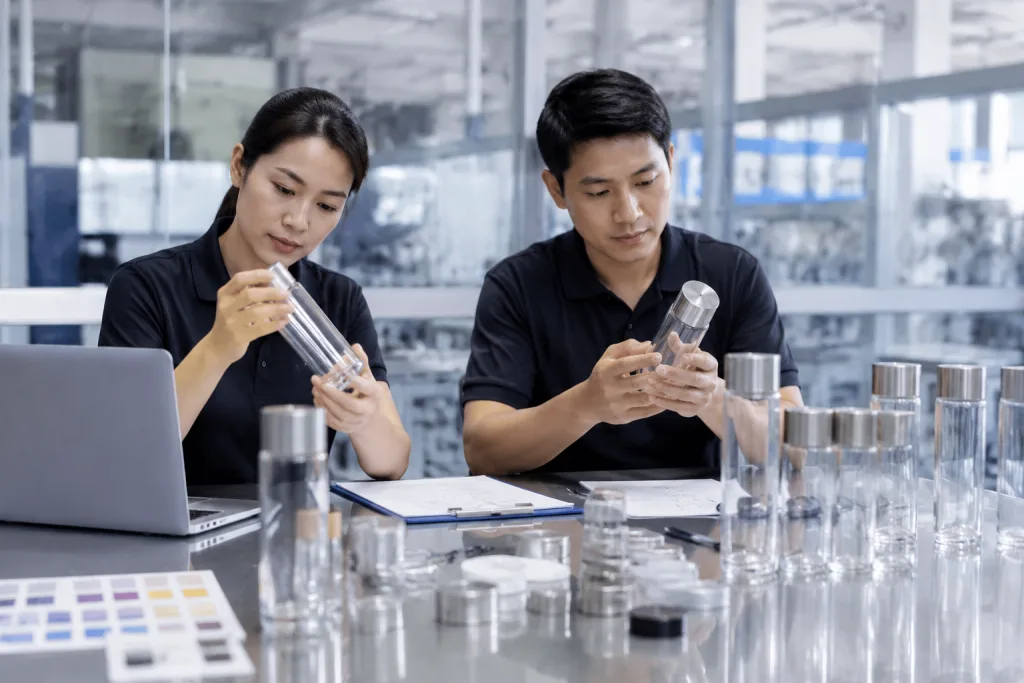
For a borosilicate glass bottle custom project, sample approval is not just checking whether the logo sits straight. This is where we stop mass production arguments before the line starts. We normally run a pre-production sample after artwork, Pantone color, 316 stainless steel lid material, silicone sleeve texture, box layout, and barcode position are locked. Last month QC pulled a 600 ml sample where the barcode was 4 mm too close to the box crease, and the scanner missed it twice. If you are a distributor glass water bottle buyer supplying 3 or 4 retailers, do not approve from photos alone. We've seen this go sideways.
For this scenario, request 6-10 physical samples. Keep 2 in your office, send 2 to your retail buyer, use 2 for basic drop and dishwasher checks, and leave 1 signed sample with the factory. The signed sample becomes the production reference. Simple as that. On the sample tag, write capacity, glass weight in grams, sleeve Pantone number, logo size in mm, lid material, filter grade, packaging version, and approval date. We also mark the sample with a red QC seal and the buyer's PO number, because one typo on a PO can mix up matte black and glossy black lids.
Check the bottle filled to nominal capacity and also to overflow capacity. A 600 ml bottle may hold 650 ml to the rim, and your packaging copy should not confuse those numbers. We use a 1,000 ml measuring cylinder on the bench, not a guess from the mold drawing. Test the lid with warm water, turn it upside down for 30 minutes, then shake it 20 times. If there is a leak in the sample stage, the math doesn't work: production will not magically become tighter after 5,000 pcs are already packed.
For logo work, a custom borosilicate glass bottle with sleeve printing needs rub testing. We run alcohol wipe checks and 3M tape checks on common print areas, usually 10 back-and-forth rubs on the logo and the seam edge. For laser engraving on stainless steel, inspect edge darkness and alignment; a 1.5 mm shift looks small on the drawing but looks cheap on the shelf. For a borosilicate glass bottle promotional order, buyers often accept simpler packaging, but retail shelves need stricter approval because consumers compare finish quality in 5 seconds.
Set QC Before Production Starts
Set QC terms before you pay the deposit on a bulk glass water bottle order. Once 42 cartons are sealed and stacked on the pallet, the math gets ugly: discount, rework delay, or a fight over who pays. For glass drinkware, we run final inspection under ANSI/ASQ Z1.4, general inspection level II, with AQL 2.5 for major defects and AQL 4.0 for minor defects. Critical defects should be 0. QC needs the checklist before the line opens, not after the packing tape gun is already moving.
Write the defect list into the PO. Critical defects include glass cracks, sharp mouth edge, metal burrs inside the infuser, foreign matter sealed into the bottle, and failed leak test. Major defects include wrong logo color, obvious sleeve deformation, lid threading problems, capacity outside agreed tolerance, and carton marking errors. Minor defects include small cosmetic dots, light sleeve color variation within approved tolerance, or tiny print imperfections outside the main logo area. We once had a buyer flag “matte black” on the artwork while the PO said “black matt”; that one typo held 600 lids at the spray line for 2 days.
For this 5,000-unit customized borosilicate glass bottle order, we would run incoming checks on glass bodies, mid-line checks after sleeve fitting and logo printing, then final random inspection after packing. A practical leak test is 100% on assembled bottles for export retail projects: fill, invert for 30 minutes, then check the lid seam and silicone ring. Slow work. Still cheaper than retailer claims. For breakage, inspect export carton compression quality and confirm each bottle is locked inside the retail box; QC pulled one sample last month where the inner tray had 3 mm side play, enough to crack shoulders during truck transfer.
If you sell in the EU, ask for REACH-related material declarations and LFGB or equivalent food-contact testing where applicable. For the US, request FDA food-contact compliance statements and consider ASTM packaging checks if your retailer requires them. Around 7 out of 10 borosilicate glass bottle vendors in China can show documents, but check whether they are current, product-specific, and tied to the actual material batch. Generic certificates are common. This is where we push back: a 2021 test report for “glassware” does not cover today’s 316 stainless steel infuser, silicone gasket, and painted sleeve unless the materials match the batch records.
Plan Branding And Channel Versions
A retail borosilicate glass bottle needs channel discipline from the first spec sheet. If the same bottle goes to wellness stores, corporate gifting buyers, and Amazon-style marketplaces, we usually run 3 channel versions while keeping one glass body and one 316 stainless steel lid structure. This is where a customizable glass water bottle platform cuts tooling cost; changing a silicone sleeve Pantone or box insert is cheaper than opening a new 65 mm mold.
For wellness retail, use muted sleeve colors, one clean logo position, and kraft or FSC-style packaging only if the paper claim is backed by supplier documents. For corporate gifting, the same bottle can carry laser engraving on the 316 stainless steel lid and ship in a plain gift box; buyers often ask for no barcode on the visible panel. For online marketplaces, the carton needs stronger protection, a scannable barcode area, and sometimes FNSKU labeling on the unit or master carton. Decide this before production. We have seen this go sideways when a PO says “Amazon ready” but the buyer flags the missing FNSKU after 38 cartons are already sealed with BOPP tape.
Branding methods have limits on the line. Silkscreen printing on glass looks sharp, but QC pulled samples after a 3M tape test when the curing temperature was set 8°C too low. Printing on silicone sleeves handles daily use better, though 0.3 mm logo gaps can fill in during pad printing. Laser engraving on stainless steel is clean and durable, but it needs enough flat lid area; a curved cap edge makes the artwork look stretched. A borosilicate glass bottle promotional project often works best with one-color printing to hold cost, while a premium customized glass water bottle can justify engraving plus a molded sleeve badge.
If you are a borosilicate glass bottle distributor, keep SKU logic simple. One glass body, two capacities, four sleeve colors, and two lid options is already 16 combinations. Add three box languages and the math gets ugly fast. We usually advise borosilicate glass bottle distributors to validate 2-4 hero SKUs first, then expand after sell-through data from 30-60 days. Zhejiang factories can move fast, but slow-moving custom inventory still ties up your cash; we ship bottles, not miracles.
Ship It Without Creating Claims
After production passes inspection, shipping is not a race to the cheapest container slot. Glass tells the truth. If the inner tray is thin or the carton flute is soft, the claim lands on somebody’s desk. For a 5,000-unit 600 ml order, we usually calculate 8-11 cubic meters after checking the final 6-piece master carton with a tape measure, not a catalog size from last year’s 550 ml model. Gross weight can easily reach 2.8-3.6 kg per 6-piece carton. Your forwarder needs the real L/W/H in cm, carton weight, and pallet height if we run pallets; one buyer once sent a PO with “ctn: TBD” and the booking was short by 1.6 CBM.
For Europe and North America, most buyers use FOB Ningbo or FOB Shanghai when sourcing from Hangzhou, Zhejiang. Ningbo often makes better sense for Zhejiang factories because the truck run is shorter, while Shanghai works if your forwarder is already consolidating mugs, lids, or promo items there. For smaller replenishment orders, LCL works, but loose cartons are where we’ve seen this go sideways. I prefer palletized LCL for first orders, even if the math adds USD 0.08-0.15 per bottle, because QC can check corner boards, stretch film tension, and the “FRAGILE” mark on all 4 sides before the truck leaves.
Production lead time for this kind of bulk borosilicate glass bottle order is normally 30-45 days after deposit and artwork approval. Add 5-10 days if you require new sleeve tooling, custom lid tooling, or third-party lab testing. Book pre-shipment inspection when at least 80% of goods are packed and 100% are finished. Not earlier. Do not inspect loose semi-finished goods and call it final QC; the wrong question is “does the bottle look okay,” because the real claim risk is often a 1.5 mm lid gap, weak divider board, or barcode label placed on the wrong carton face.
A dependable borosilicate glass bottle supplier will send packing photos, carton marks, pallet photos if used, and loading photos. For distributor borosilicate glass bottle programs, ask the supplier to keep golden samples and 2 cartons from the batch for at least 60 days after shipment. We keep them on the QC rack with the PO number, color code, and carton mark taped to the side. If a retailer reports a problem, QC pulls the sample and compares silicone ring fit, print position, and break pattern, which separates production defects from warehouse handling damage much faster.
Send Us Your Glass Bottle Spec Sheet
Share capacity, logo method, target price, and market. We will return a practical FOB China quote with MOQ and lead time.
Frequently asked questions
What MOQ should I expect for a 316 stainless steel borosilicate glass bottle wholesale order?
For an existing bottle shape with your logo and standard packaging, a realistic MOQ is 1,000-3,000 units. For a borosilicate glass bottle customizable with silicone sleeve Pantone color, 316 stainless steel infuser, printed retail box, and carton marks, plan around 5,000 units. New glass molds or custom lid tooling can push the MOQ to 10,000 units because the factory must amortize tooling, setup loss, and material purchasing. At BottleForge Industrial in China, we usually advise new wellness brands to start with existing molds and customize color, logo, and packaging first. That keeps sampling faster and lowers the chance of overbuying before you have real sell-through data.
Is 316 stainless steel necessary, or is 304 stainless steel enough?
304 stainless steel is common and works for many drinkware parts. 316 stainless steel has better corrosion resistance, especially around tea, fruit infusions, light acidity, and long-term moisture exposure. If your bottle includes a removable tea filter or infuser that directly contacts beverages, 316 is a better premium specification. It may add roughly USD 0.15-0.45 per unit depending on filter size, mesh structure, and lid design. If your product positioning is sustainable wellness retail, the added cost is usually easier to defend than explaining why the filter stained or corroded early. For decorative outer parts that do not touch liquid, 304 may still be acceptable.
How do I compare borosilicate glass bottle manufacturers fairly?
Give every borosilicate glass bottle manufacturer the same spec sheet: capacity, glass thickness, stainless grade, lid material, sleeve coverage, logo method, retail box structure, carton pack, testing requirements, and Incoterm such as FOB Ningbo. If one borosilicate glass bottle supplier quotes USD 3.40 and another quotes USD 5.10, check whether both include 316 stainless steel, silicone sleeve, retail box, leak testing, and export cartons. Ask for carton size, gross weight, sample lead time, production lead time, and certificate list. A good quote is not just a low unit price. It should tell you enough to calculate landed cost, compliance risk, and retailer readiness.
What quality tests matter most for a custom glass water bottle?
Start with visual inspection, mouth smoothness, capacity check, lid fit, leak testing, logo adhesion, sleeve fit, and packaging drop resistance. For a customized glass water bottle retail order, we recommend 100% leak testing after assembly and AQL final inspection before shipment. Use AQL 2.5 for major defects and 4.0 for minor defects, with critical defects set at 0. Critical defects include cracks, sharp edges, metal burrs, and contamination. For EU sales, request food-contact documentation such as LFGB where applicable and REACH-related declarations for materials. For US sales, request FDA food-contact compliance statements from your borosilicate glass bottle vendor.
Can one bottle design serve retail, promotional, and distributor channels?
Yes, but you need to plan the platform carefully. Use one proven glass body and change the sleeve color, lid finish, logo method, and packaging. For retail, use stronger branding and a printed box. For borosilicate glass bottle promotional orders, one-color logo printing and a simpler kraft box may be enough. For distributor glass water bottle programs, keep SKUs limited at first: for example, 600 ml in 3 sleeve colors and 2 lid options. That gives 6 SKUs, which is manageable. If you launch 20 versions immediately, you may win a catalog page but lose money in slow-moving inventory.