Key Takeaways
- For most 500-750 ml bottles, 0.40-0.50 mm 304 stainless steel is the practical B2B range
- A 3,000 pcs MOQ usually supports Pantone coating, logo printing, and retail packaging
- Vacuum bottle lead time is normally 35-45 days after artwork and deposit approval
- Use AQL 2.5/4.0 inspection plus LFGB, FDA, or REACH documents for Europe and North America
If you are searching for a 304 stainless steel water bottles supplier, you are not buying 1 bottle. You are checking 0.5 mm vs 0.6 mm wall thickness, 1,000 pcs MOQ, carton drop-test packing, laser vs silk-screen logo, FDA/LFGB reports, and whether the factory still replies after the 30% deposit lands. That is the real B2B problem.
From our Hangzhou office in Zhejiang, we see buyers pay 8–12% extra for the wrong spec more often than they receive a bad bottle. The buyer flagged this last month on a PO: “matte balck” coating, 500 ml body, PP lid, but no coating standard written. A canteen promo order and a distributor drinkware program should not run the same steel grade, lid structure, powder coating, or AQL 2.5 inspection plan. The math doesn't work.
Start With The Real Spec
A solid 304 stainless steel water bottles supplier will slow you down before they quote. We do the same. If a canteen supplier sends one price without checking capacity, insulation type, coating process, lid material, carton drop test, and target compliance market, that number is not a working quote. It is bait. Last month QC pulled a 750 ml sample where the PO said “304 body,” but the drawing only marked 304 on the inner shell; that 1-line typo changed the cost sheet by 11 percent.
For B2B custom drinkware, the main price drivers are easy to see once the spec is written. A single-wall customized canteen can be built with 0.40 mm inner-grade 304 stainless steel and sold FOB Ningbo around USD 2.10-3.20 at 3,000 pcs, depending on lid and finish. A double-wall vacuum bottle normally moves into USD 4.20-7.50 FOB range because it needs inner and outer shells, vacuum pumping, copper plating on some models, 100 percent leak testing, and longer production time: we usually plan 12 days for single-wall production versus 18 days for a standard vacuum bottle after approved sample. The line checks wall thickness with a digital micrometer; if the buyer asks for “heavier feel” after mold confirmation, the math does not work without changing material weight.
Use this head-to-head view before asking a canteen factory for samples. It saves arguments later.
| Spec choice | Best use | Watch point |
|---|---|---|
| Single-wall 304 | Canteen promotional programs and outdoor giveaways where low weight matters | No hot liquids unless the warning text is printed on the bottle and insert card |
| Double-wall vacuum 304 | Retail, corporate gifts, and distributor canteen lines with repeat orders | Higher defect cost if vacuum fails; QC should run hot-water and leak checks before packing |
| 304 inner with 201 outer | Budget custom canteen projects with tight FOB targets | Check corrosion risk on outer shell, especially for coastal markets |
| Full 304 inner and outer | Premium customized drinkware with stronger material claims | Costs 8-15 percent more; buyers often flag this only after seeing the PI |
Our Zhejiang production partners can run about 450,000 stainless units per month across standard bottle and tumbler lines, but capacity only helps when your specification is locked. Changing from matte powder coating to gradient spray after sampling can add 7-10 days and force a new adhesion test. We run a cross-hatch test with 3M tape on coated samples; if the coating lifts at the rim, the buyer will reject the shipment no matter how fast the factory packed the cartons.
304 Versus 201 And 316
304 stainless steel is the safe middle spec we run for most reusable water bottle jobs. It has enough nickel and chromium for coffee, tea, lemon water, and sports drinks, and it holds up better than 201 in our 48-hour salt-spray check on the outer shell. It also costs less than 316. For Europe or North America sourcing, 304 gives the buyer a cleaner label claim and fewer after-sales emails; last month QC pulled a 500 ml sample with a 0.38 mm inner wall, and the buyer flagged the carton mark before they questioned the steel grade.
201 stainless steel can be cheaper by roughly USD 0.25-0.60 per bottle on some shapes. Looks tempting. For a canteen promotional campaign, though, the math doesn't work if 2 percent of users send rust photos after beach use or gym locker storage. If the outer shell is 201 and the bottle sees salt air, sweat, or dishwashing chemicals, complaints rise fast. We have seen this go sideways on a 10,000 pcs tender where the PO said "SS bottle" but the approved spec sheet buried "201 outer / 304 inner" in 8-point text. Some canteen manufacturers use 201 outer shells for low-price tenders. That is not automatically dishonest, but it must be declared on the product spec sheet.
316 stainless steel is stronger against corrosion, especially around salt and chlorides, but it is the wrong question to ask for most custom canteen orders. It may add 12-25 percent to shell cost, and not every canteen manufacturer keeps 316 coils in stock; our coil rack usually holds 304 in 0.4 mm and 0.5 mm thickness, while 316 needs pre-order and can move lead time from 18 days to 30 days. For marine, medical, or high-end outdoor retail, 316 can be justified. For a 5,000 pcs distributor drinkware order going into office wellness kits, 304 is the practical choice.
Ask your canteen vendor for a material declaration, not just a verbal promise. Good documents should show stainless steel grade, food-contact test reports such as LFGB for Europe or FDA-related extraction testing for the US, plus a production lot reference tied to the item code on the PO. We ship with lot stickers on master cartons, usually 12 kg per carton for 500 ml bottles, so the paperwork should trace back to the line. If your canteen vendors cannot connect the report to the factory name or product type, treat it as decoration, not evidence.
Use-Case Fit By Buyer Type
The right bottle changes by buyer type. A brand owner needs review-safe packaging and finish consistency, a canteen distributor needs parts that fit the same lid for 18 months, and a promotional products importer needs a giveaway that passes AQL 2.5 without eating the margin. This is where we see buyers burn 8-12% of the PO value. They ask for a premium retail bottle when the job is a low-risk conference handout, or they buy a 0.38 mm wall promo bottle and expect Amazon-style reviews. Wrong question to ask. QC pulled one sample last month with a logo 2 mm off-center, and the buyer cared more about that than the steel grade.
For a canteen distributor building a stock program, choose stable molds first. A 500 ml, 750 ml, and 1,000 ml family works best when all three sizes share one lid, one silicone gasket, and one carton insert; our warehouse team can count those parts with a 0.01 g scale instead of sorting 6 lid types by eye. For canteen distributors selling to schools and gyms, powder coating with laser engraving usually survives better than low-cost silk screen on high-touch surfaces. We run 100-crosshatch tape tests on coated samples before approval. MOQ is normally 1,000 pcs per color for existing colors and 3,000 pcs for custom Pantone coating.
For a brand owner launching customizable drinkware online, flexibility matters more than the lowest FOB price. You may need FNSKU labels, barcode stickers, master carton marks, and drop-test packaging, but each item must be locked on the PO; we once had “matte black” typed as “mate black,” and the line stopped for 6 hours while sales confirmed the finish. If you sell through marketplace fulfillment, keep carton weight below 15 kg when possible. Ask for inner polybag or paper wrap rules before mass production, because repacking 2,000 pcs after final inspection is slow and the math does not work.
For a corporate gift buyer, speed and logo accuracy matter. A custom canteen with one-color silk screen can finish faster than a full customized canteen with gradient coating and retail box, because the screen plate is approved in 1 day while gradient coating needs spray-gun adjustment and color-limit samples. Typical timing from Zhejiang, China is 7 days for pre-production sample, 35-45 days for mass production, and 28-38 days ocean transit to West Coast North America depending on vessel schedules. We ship faster only when artwork is clean: vector logo, Pantone code, print size in mm. The buyer flagged a 1.5 mm logo shift on a 5,000 pcs gift order, so do not treat placement as decoration only.
For a custom growler or distributor growler project, test the lid harder than the body. A 64 oz customized growler often fails commercially because of cap leakage, weak handle design, or poor thread tolerance, not because the stainless shell is bad. We run a 24-hour inverted leak check and a 1.2 m drop test on the packed sample before green-lighting the mold. Threads need to feel smooth after coating too; we have seen this go sideways when powder build-up added 0.15 mm and the cap started biting after 20 turns.
Decoration Changes The Risk
Logo decoration is not just a marketing choice. It changes rejection rate, cost, and lead time. On one 6-logo canteen customizable program, QC pulled 18 bottles from the line because the logo sat 2 mm low after the fixture pin loosened. Mockups looked fine. Production did not.
Laser engraving is the safer choice for powder-coated 304 bottles. It burns through the coating and shows the metal underneath, so there is no ink adhesion fight. We run it on a rotary laser jig for distributor canteen orders with 20 or 30 logo versions because the setup is repeatable. The catch is simple: no color. Cost is often USD 0.12-0.35 per position depending on logo size and order quantity.
Silk screen printing is cheaper for simple one-color marks, usually USD 0.05-0.15 per position. It fits canteen promotional orders where the buyer is pushing for a low unit price, but adhesion testing is not optional. We normally recommend a 3M tape test and alcohol rub test on coated bottles; last month, QC found ink lift after 25 alcohol rubs on a matte black sample. Multi-color silk screen needs tighter registration, and curved bottles make small text risky below 5 pt.
Heat transfer and water transfer can create full-color artwork, but they add setup cost and give defects more places to hide. If you are ordering 10,000 pcs for retail, that math can work. If you are testing a 1,000 pcs customized drinkware launch, artwork complexity can eat the margin before the first carton leaves Hangzhou. We have seen this go sideways when a buyer approved 0.3 mm gradient lines that the transfer film could not hold cleanly.
For packaging, plain white box may cost USD 0.12-0.25. A printed retail box can be USD 0.28-0.65, plus plate fees if offset printing is used. If you need FSC paper, REACH compliance on coating, or Prop 65 review for the US, say it before sampling; do not hide it in the PO notes after artwork approval. A responsible canteen manufacturer in China will build those requirements into the quote instead of pretending they are free later.
Factory Comparison Table
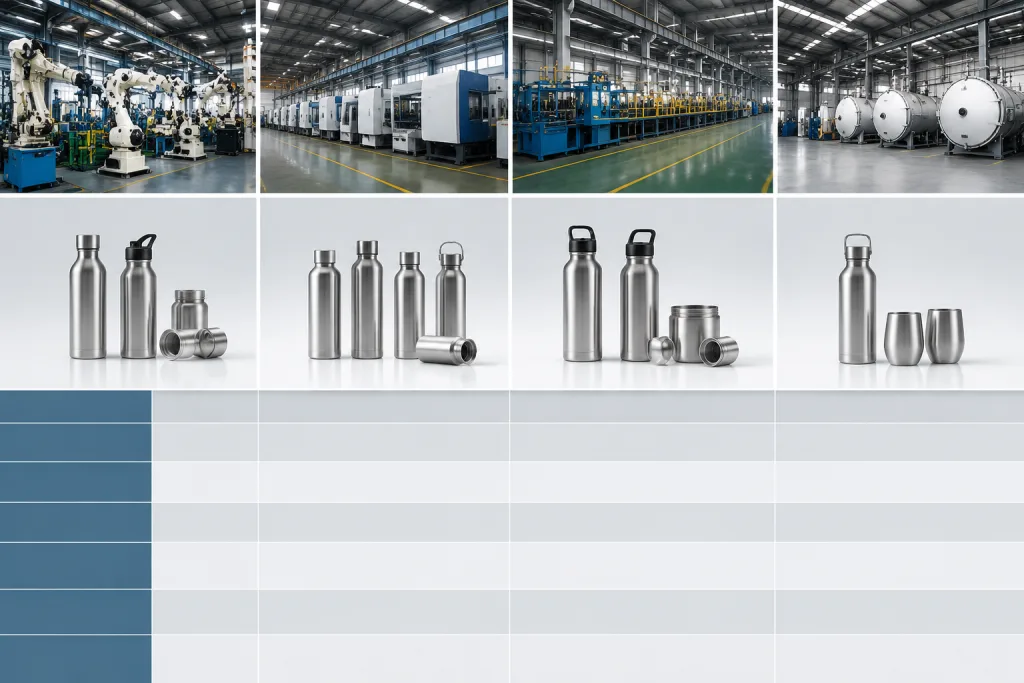
Do not line up canteen suppliers by unit price alone. This is the wrong question to ask. We have seen a USD 0.18 cheaper bottle cost USD 0.42 more after the buyer flagged a shifted logo, 5-ply cartons tested at only 11 kg edge crush, and the factory blocked our inspector at 9:30 a.m. Use one spec table and make every canteen vendor answer it line by line.
| Buyer question | Better answer | Risky answer |
|---|---|---|
| Monthly output | 300,000-600,000 stainless units, with model-by-model line plan | Big capacity, no number |
| MOQ | 1,000 pcs stock color, 3,000 pcs custom color | Any quantity, same price |
| Inspection | AQL 2.5 major, 4.0 minor, 100 percent leak test on the line | Factory checks everything |
| Compliance | LFGB, FDA, REACH, BSCI or ISO 9001 available before PO | Certificate after order |
| Payment | 30 percent deposit, 70 percent before shipment | Full payment before production |
A real canteen factory should say which steps we run in-house and which steps go outside. Deep drawing, welding, polishing, vacuum pumping, powder coating, printing, and packing do not always sit under one roof; in Zhejiang, coating often moves to a partner workshop 12-25 km away. Outsourcing is normal, but control cannot be outsourced. Ask who signs the QC sheet at coating and printing, because QC pulled the sample last month for 0.6 mm logo drift after the bottle body was already clean.
For large distributor drinkware programs, request a production schedule with fixed checkpoints: material arrival, body forming, surface treatment, logo, assembly, packing, final inspection, and ETD. Dates matter. After deposit and artwork approval, a capable supplier should give each checkpoint within a 3-day window, not “around next week”; we ship 40HQ orders where 12 days vs 18 days changes the vessel booking and the buyer’s promo launch. If they cannot date the line plan, the math does not work.
Pricing And Incoterm Traps
FOB price is usually the cleanest quote to compare. We ship most bottle orders this way because it shows the factory-side cost, while your forwarder controls ocean freight, customs, and final delivery. EXW looks lower on paper, then the buyer gets hit with Yiwu/Hangzhou inland trucking, export declaration, and Ningbo port handling as separate lines. DDP is comfortable, but we’ve seen this go sideways when the quote assumes the wrong HS code or VAT treatment; one German buyer flagged a DDP offer that was USD 0.62 cheaper per bottle until their broker checked the tax line. Use DDP only when the supplier has shipped the same product category into your country at least 3 times with the same logistics channel.
For 304 stainless bottles, small changes move cost fast. A 750 ml vacuum bottle in full 304, 0.50 mm outer wall, powder coating, laser logo, and color box may quote around USD 5.20-6.80 FOB Ningbo at 5,000 pcs. Change to 0.40 mm outer wall, plain box, and stock color, and the price may drop by USD 0.45-0.90. That sounds nice. But QC pulled one 0.40 mm sample last May and the shoulder dented after a 1.2 m drop test on the line. Change to a custom growler with swing handle, large lid, and 64 oz capacity, and the math changes because stainless weight and carton CBM jump together.
Be careful with unusually low quotes from canteen vendors. They may be using thinner steel, mixed-grade stainless, cheaper lid seals, or lighter cartons. None of that shows in a polished sample photo. Ask for bottle weight tolerance, such as 750 ml bottle net weight 310 g plus or minus 10 g, and put the same line on the purchase order. We once caught a PO typo showing 301 g instead of 310 g; that 9 g gap would have paid for a thinner outer shell across 8,000 pcs. Weight is not a perfect quality measure, but it stops silent material cutting.
Confirm spare parts early. A customizable growler with a special lid is a problem if replacement lids require 5,000 pcs MOQ. For distributor growler programs, we run 1-2 percent extra lids and gaskets with the first shipment; on a 3,000 pcs order, that means 30-60 sets packed in a marked spare-parts carton. The buyer may push back on the small extra cost, but the math doesn't work when one missing gasket creates a retail return.
Quality Controls Worth Paying For
Quality control should be boring. If your supplier makes it sound like magic, ask for the actual checklist with sign-off boxes. For 304 stainless drinkware, we check incoming coil with an XRF gun, then inspect the weld seam, polishing marks, vacuum performance on insulated models, coating adhesion by 3M tape pull, logo position in mm, leakage, capacity, odor, carton drop results, and final AQL inspection.
At BottleForge Industrial in Hangzhou, Zhejiang, we run 100 percent leak testing at assembly, then random final inspection using AQL 2.5 for major defects and 4.0 for minor defects unless the buyer specifies tighter levels. Each bottle sits upside down for 30 seconds after the torque tester confirms the lid is closed to spec. For retail programs, buyers sometimes request AQL 1.5 major. That is workable, but the math does not disappear: tighter sorting adds labor and can delay shipment by 1-2 days.
Define major defects clearly. A leaking lid, sharp burr, wrong logo, rust spot, failed vacuum, or wrong capacity should be major. Tiny dust under coating can be minor if it stays within the agreed visual standard, often 30 cm under normal light on the QC table. We have seen this go sideways when a buyer flagged 0.3 mm specks after the container was already booked; by then, nobody enjoys the call.
For compliance, match the destination. Europe often requires LFGB, REACH, and packaging waste documentation depending on importer responsibility. North America buyers often ask for FDA food-contact support, Prop 65 review, CPSIA if children use the bottle, and ASTM-related checks for kids products. If you buy kids bottles, do not reuse adult bottle documents and hope nobody asks. QC pulled one sample last year where the PO said “kids straw lid,” but the file attached was for a 500 ml adult tumbler; that project needed fresh documents tied to the product, not generic PDFs.
Send your bottle spec and target landed cost
We will reply with MOQ, FOB pricing, lead time, decoration options, and practical risk notes for your 304 stainless program.
Frequently asked questions
What MOQ should I expect from a 304 stainless steel water bottles supplier?
For existing molds and stock colors, 1,000 pcs per model is realistic from many China suppliers. For custom Pantone powder coating, retail box printing, or a fully customized canteen with unique accessories, expect 3,000 pcs per color. New mold work can start around 5,000-10,000 pcs depending on size and complexity. A custom growler lid or handle mold may require tooling fees from USD 800 to USD 3,500. If a canteen vendor accepts 300 pcs with full custom color and low price, check whether it is using leftover stock, manual repainting, or non-standard packaging.
Is 304 stainless steel always food safe for water bottles?
304 stainless steel is widely used for food-contact drinkware, but the grade alone is not the full answer. You also need safe lid plastic, silicone gaskets, coating, ink, and packaging materials. For Europe, ask for LFGB and REACH documents. For the US and Canada, ask for FDA food-contact support and any market-specific requirements such as Prop 65 review. The inner surface should be clean, pass odor checks, and have no polishing paste residue. AQL inspection should include capacity, leakage, burrs, rust spots, and visual contamination. Good canteen manufacturers can link reports to a product family and material list.
How long does custom drinkware production take after sample approval?
A normal 304 stainless steel bottle order takes 35-45 days after deposit, artwork approval, and color confirmation. A simple canteen promotional order with stock color and one-color logo may finish in 25-30 days if production lines are open. A canteen customizable retail program with Pantone coating, laser engraving, color box, and barcode labeling usually needs 40-50 days. Pre-production samples take about 7-10 days. Ocean freight from Ningbo or Shanghai to North America commonly adds 28-38 days to West Coast ports and longer to inland warehouses.
Should I buy from a trading company or a canteen factory?
A factory gives you better control over production details, but a capable trading team can be useful when your order uses several product categories. The key is transparency. Ask whether deep drawing, vacuum pumping, coating, logo printing, and packing are in-house or subcontracted. A canteen factory should provide production photos, QC records, and inspection access. A trading company should still name the manufacturing site and manage AQL inspection properly. For distributor drinkware orders above 5,000 pcs, we prefer direct factory control or a supplier that has audited production partners in Zhejiang or nearby China industrial clusters.
What is the best logo method for a customized canteen?
For durable daily-use bottles, laser engraving on powder coating is usually the safest method. It costs around USD 0.12-0.35 per logo and does not peel. Silk screen is cheaper, often USD 0.05-0.15 per position, and works well for simple canteen promotional logos, but it needs adhesion testing. UV print gives more color, but curved surfaces and dishwasher exposure can create risk. For a customized growler or premium retail bottle, combine powder coating with laser engraving or a metal badge if budget allows. Always approve a physical pre-production sample, not only a digital mockup.