Key Takeaways
- A basic 500 ml 304 bottle usually lands around USD 2.40-4.20 FOB China at 3,000-5,000 pcs
- Custom mold work adds 25-45 days before mass production starts
- Laser engraving is often slower but cleaner than 1-color silkscreen for premium runs
- A realistic repeat-order lead time is 30-45 days after deposit and artwork approval
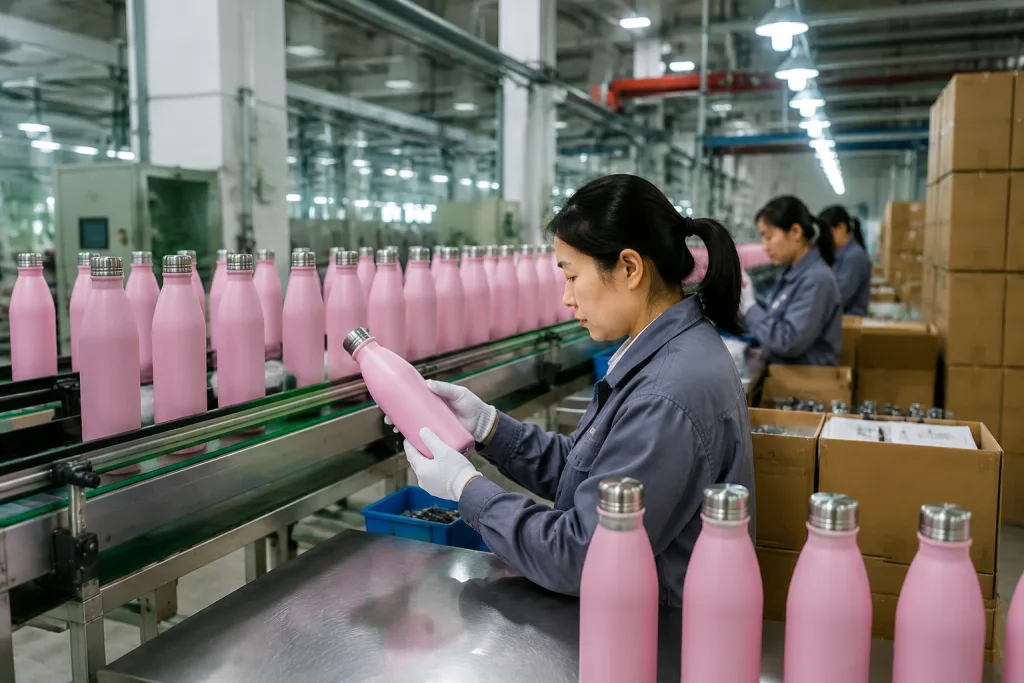
If you are looking for a 304 stainless steel water bottles manufacturer, finding a name card is the easy part. Ningbo, Yongkang, Wuyi, and Guangzhou alone can give you 200 options before lunch. The harder question is whether a USD 3.20 quote, a 3,000-piece MOQ, or a 45-day lead time matches your bottle shape, logo method, lid tooling, and sales channel. We check this on the line with a digital caliper, not a brochure.
We manufacture custom drinkware in Hangzhou, Zhejiang, and we see the same mistake almost every week: buyers compare quotes without matching steel grade, vacuum performance, decoration process, carton spec, inspection level, or payment term. The math does not work. Last month QC pulled a sample with 304 stainless marked on the PO, but the supplier had quoted thinner outer wall steel and a lighter 5-layer carton; that cheap canteen customized project became expensive before mass production even started.
Start With The Real Unit Cost
For a 304 stainless steel water bottles manufacturer, the quote is not one number. It is material, tube forming, laser welding, vacuum pumping, polishing, powder coating, logo work, packing, inspection, and freight term all stacked together. We see this every week. If one canteen supplier quotes USD 2.15 and another quotes USD 3.10, the cheap canteen factory is not automatically smarter; the math often hides a thinner outer wall, a lighter lid, or no drop-test allowance. Last month a buyer flagged a USD 0.42 gap, and QC pulled the sample: the body was 18 g lighter than the approved bottle.
For a straight-wall 500 ml double-wall vacuum bottle in 304 stainless steel, a practical FOB China range is USD 2.40-4.20 at 3,000-5,000 pieces. A 750 ml bottle usually moves to USD 3.10-5.20. A 1,000 ml sports bottle with handle lid, powder coating, and individual color box may sit around USD 4.60-7.50. A custom growler or customized growler with 1.9 L capacity, wide mouth, and heavier body can reach USD 8.50-14.00 depending on lid and finish. On our line, the 500 ml sample is checked with a 0.01 g scale and a digital caliper before we talk about mass price, because a 0.1 mm wall change can move both cost and dent resistance.
The largest cost driver is not always steel. For common sizes, 304 sheet may account for 25-35% of the FOB price. Coating and decoration can add 8-18%. Lids can be the part buyers underestimate: a basic PP screw cap may add USD 0.18-0.35, while a leakproof straw lid with silicone seals may add USD 0.65-1.20. Retail packaging can add USD 0.20-0.90 per unit if you require 350 gsm color box, insert card, barcode label, and 5-ply export carton. We have seen this go sideways when the PO says “color box” but the artwork file needs spot UV and a molded pulp tray; that is not the same carton cost.
When you compare canteen vendors, request a costed specification sheet. It should list capacity, inner wall grade, outer wall grade, wall thickness, coating, lid material, silicone grade, decoration method, packing, carton quantity, and FOB port. Ask for the wall thickness in mm, lid weight in g, MOQ by color, and carton size in cm, not just a nice product photo. Ningbo and Shanghai are common ports for Zhejiang factories, and the FOB port changes inland trucking cost. We ship both, but a Hangzhou pickup to Ningbo is not priced the same as a Shanghai booking during a tight vessel week.
MOQ Tiers Change The Math
MOQ is where 7 out of 10 custom canteen projects get priced wrong. A canteen manufacturer may accept 500 pieces for a sample market launch, but that is not mass-production pricing. The math doesn't work. At low quantities, the powder coating line still needs color changeover, the laser logo jig still needs setup, carton artwork still needs a plate check, and QC still pulls samples by AQL 2.5 even if the order is only half a pallet.
At BottleForge Industrial in Zhejiang, our usual MOQ for existing 304 stainless steel bottle shapes is 1,000 pieces per color for simple logo work, with a practical production MOQ of 3,000 pieces when you need stable pricing. For mixed colors, 500 pieces per color may be possible if the total order reaches 3,000 pieces. We run this on the line often: black, white, and army green sound easy, but each powder change can cost 45-60 minutes plus 2-3 kg of powder waste before the color settles. For a private mold, expect 5,000-10,000 pieces for the first order because tooling, fixture adjustment, and trial loss are real costs.
A useful way to think about MOQ tiers is this: 500-999 pieces is a validation run, 1,000-2,999 pieces is a promotional or distributor canteen run, 3,000-9,999 pieces is normal wholesale production, and 10,000+ pieces is where price negotiation becomes meaningful. For canteen promotional campaigns, distributors often want 1,000-2,000 units fast. We ship those. The buyer flagged it last month when a PO asked for custom PMS coating, retail box printing, and a new flip lid with a 12-day launch window; that should have been 18-22 days if they wanted first-article approval before packing.
If you are a canteen distributor or distributor drinkware buyer, MOQ also affects SKU planning. Five colors at 1,000 pieces each means 5,000 units of inventory, five carton markings, five barcode files, and sometimes five FNSKU labels for marketplace shipment. QC pulled the pre-pack sample on one Amazon order because the carton mark showed “matte balck” instead of “matte black,” and that typo held 86 cartons for relabeling. Fewer colors with stronger sell-through beats a wide color range that locks cash in slow inventory.
Decoration Adds Cost And Days
Logo choice looks simple on a PDF. On the line, it changes both price and ship date. A canteen customizable project with one-color silkscreen on a smooth powder-coated bottle may add USD 0.08-0.18 per unit and 2-4 production days, assuming the logo sits on a straight wall and the screen fixture does not need rework. Laser engraving normally adds USD 0.12-0.35 per unit, depending on logo size and bottle curve, but it gives a cleaner premium finish and avoids ink adhesion complaints; QC once pulled 32 bottles from a 500-piece trial because the logo crossed the shoulder radius by 3 mm.
Heat transfer, water transfer, and full-wrap UV printing cost more because the rejection rate moves. A full-wrap design can add USD 0.45-1.50 per unit and 5-10 days because artwork alignment, curing, and scrap are harder to control. If you want a wood grain customized canteen, gradient finish, or retail gift set, build extra time into your calendar. We can run fast, but artwork proofing is where buyers lose days; last month one PO said “logo centered,” while the approved mockup placed it 28 mm above the base. That went sideways.
For a custom canteen order, send vector artwork in AI, EPS, or PDF. Include logo size in millimeters, placement from the bottle base or shoulder, PMS color, and whether the logo should face the drinking side or the opposite side. Missing placement instructions still cause too many delays; in our factory, 6 out of 10 decoration questions are about logo position, not production capacity. The canteen vendor then sends a digital proof, but a physical pre-production sample is still better when the order is over USD 10,000. The math doesn't work if you save 3 days on proofing and then reject 2,000 printed bottles.
For North American and European B2B buyers, decoration must survive real use, not just look good under office lighting. We usually test coating with cross-hatch adhesion, 3M tape pull, and 50-100 dishwasher cycles when the customer claims dishwasher-safe positioning. Be careful with that claim. 304 stainless can take abuse, but many powder-coated vacuum bottles are hand-wash recommended; after 50 dishwasher cycles, QC often finds edge whitening around the base ring and lid contact marks.
Tooling Is Not Just A Mold
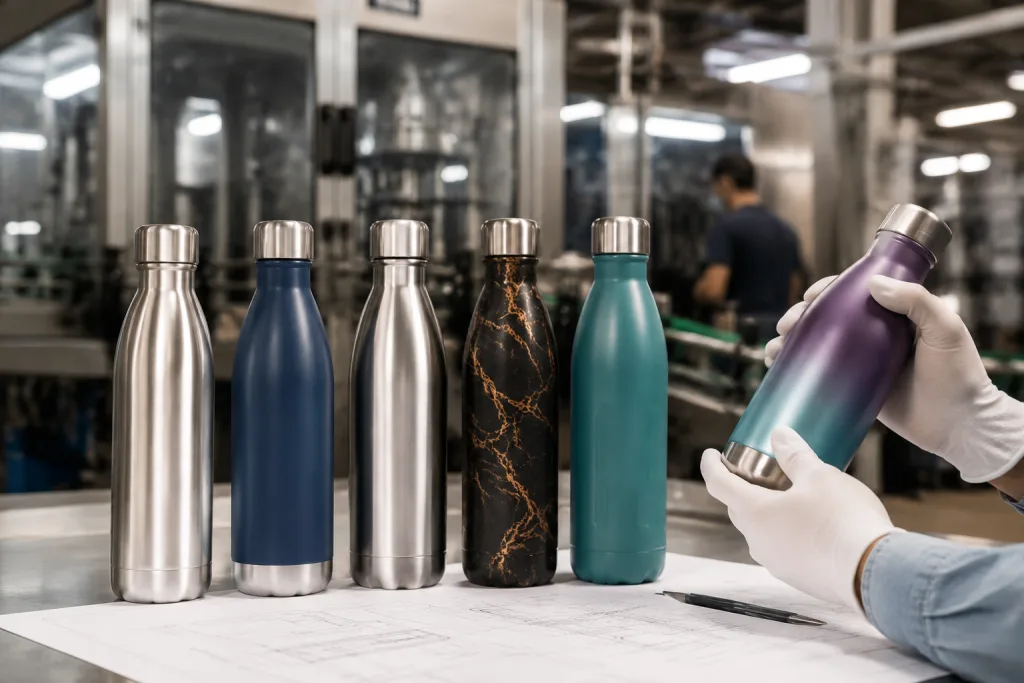
Customizable drinkware usually falls into three buckets. Existing bottle with your logo. Existing body with a new lid, color, gift box, or straw set. New body shape or new capacity. The third one is where buyers get surprised, because tooling is not one mold sitting on a shelf; we run cutting dies, necking fixtures, welding jigs, polishing holders, and test gauges on the line. Last month a PO even called a 750ml bottle “700ml” in one line and “25oz” in another, so QC stopped the sample before artwork placement.
For an existing shape, sampling can be 7-12 days after artwork confirmation. For a new lid or handle accessory, prototype tooling may cost USD 800-3,000 and take 15-25 days. For a new stainless steel bottle body, tooling and forming fixtures may cost USD 3,000-12,000, sometimes more for complex curves, integrated grip zones, or unusual neck geometry. Development time is usually 25-45 days before you even approve the golden sample. The slow part is often not CAD; it is adjusting the 0.3mm neck tolerance after the first trial run, then checking the lid fit with a torque meter and water bath leak test.
A custom growler or customizable growler carries extra risk because capacity, pressure expectation, cap seal, and carry handle strength all matter. If you want a beer growler, say so early. If it is only for water, tea, or cold brew, say that too. These use cases change cap design, silicone hardness, thread engagement, and leak testing. We’ve seen this go sideways when a buyer asked for a “sports bottle” quote, then the marketing team sold it as a beer growler; QC pulled the sample at 1.2 bar because the cap hissed after 6 minutes. A serious canteen manufacturers team will ask annoying questions before quoting. That is a good sign.
Tooling ownership should be written clearly on the proforma invoice. If you pay full tooling cost, ask whether the mold is exclusive, how long the factory stores it, and whether there is a minimum annual order to keep it active. In China, vague tooling ownership causes arguments later. Put it in writing before the deposit, not after your product starts selling. We usually list mold number, storage term, exclusivity, and MOQ on the PI; if that line is missing, the math does not work when a second customer asks for the same 304 stainless body six months later.
Lead Time From Deposit To Port
For standard customized drinkware using an existing 304 bottle body, we usually quote 30-45 days after deposit, approved artwork, and confirmed packaging files. That assumes the 304 stainless coil is in stock, the powder color is a normal Pantone match, and nobody changes the logo after the pre-production sample is signed off. Logo changes hurt. Last October, QC pulled a sample with a 0.4 mm shifted laser mark after the buyer revised the AI file, and the line lost 2 days waiting for re-approval. During peak season, especially August to November for holiday shipments, add 7-15 days.
A normal schedule looks like this: artwork proof 1-3 days, sample production 7-12 days, sample shipping 3-6 days by courier, buyer approval 1-3 days, material and component preparation 7-15 days, mass production 15-25 days, final inspection 1 day, and booking to FOB Ningbo or Shanghai 2-5 days. If you skip a physical sample, you may save 10 days, but the risk moves to your side. We’ve seen this go sideways when a PO showed “matte black” while the carton mark file said “gloss black”; the packing team followed the carton file until the merchandiser caught it at the sealing machine.
Our Hangzhou, Zhejiang production network can handle about 450,000 stainless steel bottle units per month across standard shapes, with project allocation depending on coating color, lid type, and inspection requirements. That number is real, but it does not mean every urgent order can jump the line. Powder coating capacity, not welding capacity, is often the bottleneck. A 12,000 pcs order with two spray colors may wait behind a 35,000 pcs retail program already loaded on the coating rail, even if the bottle body is ready.
For a distributor growler or distributor canteen program, plan backwards from the warehouse date, not the factory finish date. This is the wrong question to ask if your team only asks, “When can you finish production?” Ocean freight to the US West Coast may take 18-30 days port to port in normal conditions, while Europe can run 28-40 days. Add customs clearance, inland trucking, and your own receiving time. If you need Amazon FBA preparation, barcode labeling, carton weight limits, and master carton dimensions must be confirmed before production packing starts; we check carton size with a tape measure on the packing table before mass sealing, not after 800 cartons are stacked.
Quality Checks Buyers Should Price In
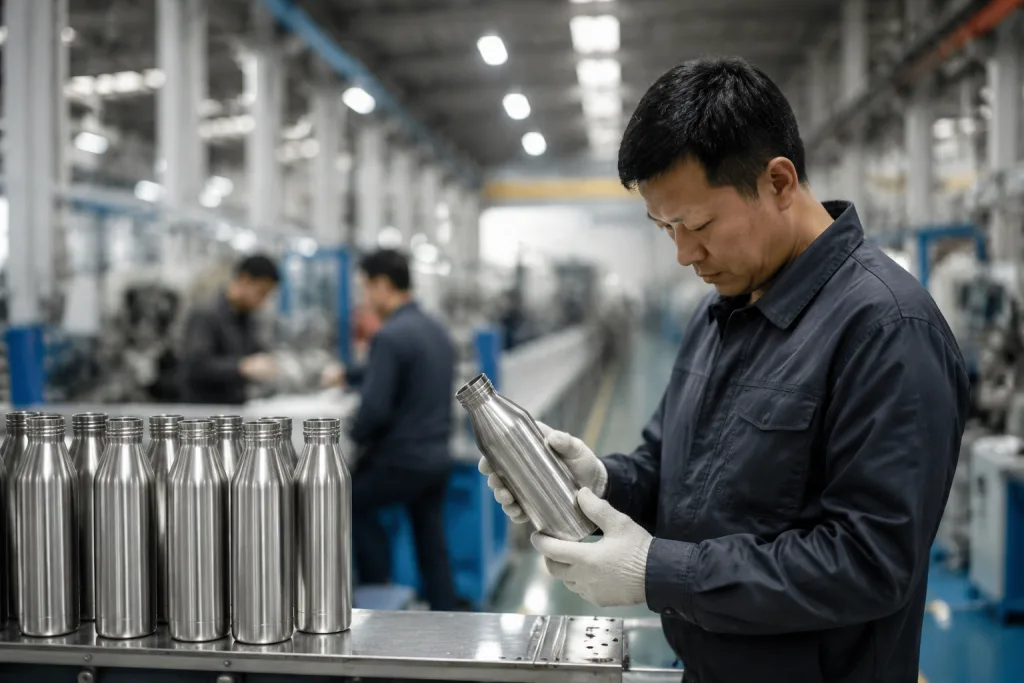
Quality costs money. Bad quality costs chargebacks. For 304 stainless steel bottles, price in material verification, capacity check, vacuum insulation test, leak test, coating inspection, logo inspection, carton drop test, and AQL final inspection. On our line, QC pulled 32 pcs from a 3,000 pcs lot last month and caught two lids with silicone flash before packing. If a canteen suppliers quote leaves these checks blank, ask for the inspection plan, not a nicer sentence.
Confirm food-contact 304 stainless steel on the inner wall with a PMI gun or mill certificate tied to the coil batch. Some projects use 201 stainless steel on the outer wall to save about USD 0.18-0.35 per 500 ml bottle, but the buyer should know that before the PO is signed. For premium programs, we prefer 304 inner and 304 outer, or clear labeling in the spec sheet. For Europe, ask for LFGB or EU food contact testing if your importer requires it. For the US, FDA food-contact expectations and California Proposition 65 screening may apply. REACH is common for European retail programs, mainly coatings and plastic components.
Vacuum performance should be checked by hot water retention, not by tapping the bottle and guessing. We run 95°C water, close the cap at the torque setting, then measure the drop after 6 or 12 hours with a probe thermometer. For a solid 500 ml double-wall bottle, 60°C+ after 6 hours is a fair result, though cap design and 23°C room temperature change the number. Leak testing usually means inversion and shake testing for 1-3 minutes. Straw lids need their own test because the air vent and silicone valve can pass a dry check, then leak when the bottle sits sideways in a backpack.
For final inspection, AQL II with critical 0, major 2.5, minor 4.0 is a practical starting point for B2B wholesale. Big retailers often push stricter AQL, BSCI factory audit, ISO 9001 documentation, ASTM packaging checks, or their own chemical test list. Tell your canteen vendor before sampling, because the math does not work if testing is added after mass production starts. We have seen this go sideways: one buyer flagged a missing Proposition 65 line on the PO after cartons were printed, and the shipment sat 12 days longer while labels were reworked.
How To Compare Factory Quotes
Comparing a canteen manufacturer, canteen vendors, or a trading company only by the lowest FOB price is the wrong question to ask. Ask every supplier to quote on the same sheet. Capacity, steel grade, wall thickness, lid material, silicone type, coating, logo method, packaging, MOQ, sample time, mass lead time, payment term, audit status, and port should be visible, with no blanks. We run quote checks in Excel, and one buyer once sent a PO with “304 steel” in the email but “201 stainless” in the attachment. QC caught it before sample tooling.
Wall thickness is where quotes start to drift. About 7 out of 10 vacuum bottle projects we see use roughly 0.4-0.5 mm stainless steel before forming, but the hand feel changes after stretching, welding, polishing, and vacuuming. A 0.4 mm straight bottle may pass a photo review. It can still dent when distributor cartons get stacked 5 layers high. A 0.5 mm body feels stronger, but it adds steel cost and carton weight; on one 10,000 pcs order, the buyer flagged the freight jump before approving the PI. No perfect answer here. Match it to your shelf price.
Payment terms belong in the cost comparison. A normal first order from China is 30% deposit and 70% balance before shipment after inspection. For repeat buyers with stable volume, we may discuss 30/70 against bill of lading copy or other terms, but not on the first order. If a new supplier offers soft payment terms and the lowest price on the same day, the math doesn't work. We have seen this go sideways when the line used a cheaper lid gasket to cover the gap, and QC pulled the sample after a 24-hour leak test.
If you are new to sourcing from China, choose the factory that explains the trade-offs before you pay the deposit. A good 304 stainless steel water bottles manufacturer should tell you when your target price is too low for the specification, when your lead time is too tight, and when your requested decoration will create rejects. For powder coating with laser logo, we usually confirm color by Pantone code and check logo position in mm on the pre-production sample. Direct talk protects your margin better than a polished catalog.
Get a costed quote for your bottle program
Send capacity, quantity, logo file, packaging plan, and target market. We will return MOQ, FOB pricing, and lead-time options.
Frequently asked questions
What MOQ should I expect for custom 304 stainless steel bottles?
For an existing bottle shape, a practical MOQ is 1,000 pieces per color and 3,000 pieces per order for stable pricing. Some canteen suppliers accept 500 pieces, but the unit price may be 15-35% higher because coating setup, logo screens, carton printing, and inspection are spread over fewer units. For a private mold or new lid, expect 5,000-10,000 pieces on the first order. If you are a canteen distributor testing a new market, start with 1-2 colors instead of five. That keeps inventory cleaner and avoids paying high setup costs across too many SKUs.
How much does a custom logo add to the bottle price?
A one-color silkscreen logo usually adds USD 0.08-0.18 per unit on a standard powder-coated bottle. Laser engraving is often USD 0.12-0.35 per unit, depending on logo size and curve. Full-wrap UV, heat transfer, or water transfer artwork can add USD 0.45-1.50 per unit and 5-10 production days. For canteen promotional orders, simple decoration is usually the better choice because it protects the launch date. For premium customized drinkware, laser engraving or a small metal badge can justify a higher retail price.
Is 304 stainless steel always used for both walls?
Not always. Many factories use 304 stainless steel for the inner food-contact wall and 201 stainless steel for the outer wall to reduce cost. That can be acceptable if it is disclosed and fits your price point. For premium custom drinkware, we recommend 304 inner and 304 outer because it supports stronger positioning and reduces corrosion complaints in humid or coastal markets. Ask your canteen factory to state the material clearly on the quotation and invoice. If needed, request third-party material testing before shipment, especially for European retail or regulated distributor programs.
How long does production take after I approve the sample?
For existing 304 stainless steel bottle shapes, mass production normally takes 30-45 days after deposit, artwork approval, and packaging confirmation. During peak season, add 7-15 days. Sampling is usually 7-12 days, plus 3-6 days for courier delivery to Europe or North America. A new mold or custom lid can add 25-45 days before the normal production clock starts. If your order needs FNSKU labels, color boxes, or retailer carton markings, approve those files before production starts, not during packing week.
What should I ask before choosing a canteen vendor?
Ask for capacity, steel grade, inner and outer wall specification, approximate wall thickness, lid material, silicone grade, coating type, decoration method, MOQ, sample time, mass lead time, packing details, FOB port, audit status, and AQL inspection standard. A serious canteen vendor should answer these without hiding behind catalog language. Also ask whether the factory has experience shipping to your market, because REACH, LFGB, FDA expectations, BSCI audits, and retailer packaging rules can affect both cost and timing. The cheapest quote is rarely cheapest if it misses testing or rework.