Key Takeaways
- A workable RFQ should include 304 grade, capacity, finish, logo method, packaging, MOQ, and target FOB price within 24 hours
- For custom drinkware, expect 7-10 days for logo samples and 25-35 days for bulk production after deposit
- Use AQL 2.5/4.0 inspection and define PO line items before paying the 30% deposit
- BottleForge Industrial supports 80,000-120,000 stainless bottles per month with MOQ from 1,000 pcs per model
Buying from a 304 stainless steel water bottles factory is not hard. Buying the right bottle at the right landed cost takes tighter control. We see problems start before the line opens: RFQs with no capacity tolerance, artwork sent as a JPG instead of AI/PDF, packaging left as “standard,” and POs that say “custom bottle” but miss the steel grade, finish, carton mark, or whether the buyer wants 500 ml measured to the brim or usable fill.
If you are a canteen distributor, brand owner, or promotional importer, you need a sourcing path that turns an idea into a bulk shipment QC can actually check. From our Hangzhou, Zhejiang factory base, we run into this every week: the buyer who locks drawings, MOQ, color code, and carton layout before sampling usually saves 7 to 12 days on the first order. One buyer flagged a PO typo last month—“304” became “340”—and that small catch stopped the math from going sideways before we cut the laser logo sample.
Start the RFQ with controlled facts
A good RFQ is not a mood board. It is a short spec sheet we can cost without guessing at the sample table. For a 304 stainless steel water bottles factory, line one should lock the product: single-wall or double-wall vacuum bottle, 304 inner steel, 304 or 201 outer steel if your market accepts it, capacity, lid type, finish, logo method, packing style, and destination port. We run the first check with a digital caliper, a wall-thickness gauge, and the costing sheet open; missing one item can shift the quote by USD 0.18 to USD 0.45 per bottle.
A clean RFQ line looks like this: “750 ml double-wall 304 stainless steel bottle, powder coated, leakproof screw lid with silicone ring, one-color silkscreen logo, individual kraft box, 24 pcs/carton, FOB Ningbo, first order 3,000 pcs.” Good line. It tells a canteen supplier far more than “send price for customized canteen.” Last month a buyer wrote “matte black bottle” but forgot powder coat or spray paint; QC pulled the sample later and the color passed, but the scratch test failed after 30 strokes on the coating jig.
Your first PO planning sheet should include these line items:
- Material: SUS304 inner wall, food-contact silicone gasket, BPA-free PP lid, plus outer steel grade if price control matters.
- Body size: target capacity with ±5% tolerance, mouth diameter in mm, total height, base diameter, and whether it must fit a car cup holder.
- Finish: powder coating, spray paint, mirror polish, or brushed steel, with Pantone code or approved sample if color matching is tight.
- Decoration: laser engraving, silkscreen, heat-transfer, UV print, or full-wrap artwork, with logo size in mm and print position from the bottom seam.
- Packaging: white box, color box, kraft box, insert card, barcode, FNSKU if needed, plus carton drop-test requirement if Amazon stock is involved.
- Commercial terms: MOQ, FOB China port, payment terms, sample charge, lead time, and whether the order needs pre-shipment inspection under AQL 2.5.
In Zhejiang, about 8 out of 10 canteen manufacturers can quote within one working day when these points are complete before 3 p.m. If the RFQ is loose, the first price will look cheap, then climb after artwork, coating, packaging, and compliance details are added. The math does not work the other way. We have seen this go sideways when a PO said “gift box” but the buyer meant a 350 gsm color box with foam insert; the carton weight jumped by 1.6 kg, and the freight quote had to be reopened.
Check the factory before the sample
About 7 out of 10 new buyers ask for samples too early. This is the wrong question to ask first. Before you pay a sample fee, check whether the canteen manufacturer can support your sales channel, carton spec, and after-sales risk. A gift campaign can run a simple white box with 5-layer export cartons; a retail shelf program usually needs 80 cm drop-test packaging, EAN barcodes, carton labels, and color held within a ΔE 1.0-1.5 range on repeat batches. We have seen this go sideways when the buyer approved a nice sample, then flagged the master carton because the PO said “matte black” and the artwork file said “satin black.”
Ask the 304 stainless steel water bottles factory for hard operating details. At BottleForge Industrial in Hangzhou, Zhejiang, our normal stainless bottle capacity is 80,000-120,000 units per month, depending on coating and logo complexity. Standard MOQ starts at 1,000 pcs per model for existing molds, while new mold work for a custom growler or unusual lid structure needs a separate tooling discussion. Typical bulk lead time is 25-35 days after deposit and approved pre-production sample; if the logo needs both laser engraving and 2-color silk screen, we run the sample line slower and check position with a 0.5 mm tolerance gauge before release.
Your factory check should cover:
- Audit status: BSCI, ISO 9001, or buyer-specific social audit availability, with the latest report date and factory name matching the PI.
- Food safety: LFGB, FDA, REACH, and EU food-contact test experience, including which lab issued the report and whether the tested item was a bottle, lid, gasket, or coating.
- Quality system: incoming steel inspection, vacuum testing, coating adhesion checks, and AQL final inspection, with QC records for 304 stainless thickness, leak rate, and 3M tape test results.
- Export capability: FOB Ningbo or Shanghai documents, HS code knowledge, packing list accuracy, and photo loading records, including carton count, gross weight, and pallet photo before the container seal is closed.
If you are a canteen vendor or distributor growler buyer, ask whether the factory keeps spare lids and silicone gaskets available. Boring part. Big problem later. Replacement components only matter when a retailer asks for 2,000 extra lids three months after delivery, and the math does not work if the lid mold is idle for a small 300 pcs remake.
Turn artwork into sample instructions
Sampling is where 7 out of 10 customized drinkware projects either stay clean or start burning time. Don’t send a logo file and write “make nice.” That PO line is a problem. Send artwork in AI, PDF, or EPS format, call out Pantone colors, logo width in millimeters, placement from the bottle base or centerline, and the decoration method we should run. Last month QC pulled a 304 stainless sample where the buyer wrote “front logo,” but the artwork showed it 18 mm too close to the lower radius. A canteen customizable by laser engraving has different limits from one using silkscreen or full-color UV print.
For a matte powder-coated 750 ml bottle, laser engraving is durable and usually adds USD 0.20-0.45 per piece, depending on logo size and order quantity. One-color silkscreen can cost less on 3,000 pcs runs, but it needs a screen setup and small 1.5 mm text often fills in on the line. Full-wrap heat transfer can look retail-ready, but it gives the factory more places to lose control: seam alignment at ±1.5 mm, film adhesion after tape test, color variation, scratch resistance. We’ve seen this go sideways when the buyer approved a PDF render instead of a physical sample.
Your sample PO line items should include:
- Sample type: blank stock sample for shape check, logo sample for decoration, or full pre-production sample with coating, lid, carton, and barcode.
- Quantity: usually 2-5 pcs per color or logo version, with 1 pc kept at the factory as the golden sample.
- Cost: often USD 50-150 for logo samples, refundable only if the PI says so in writing.
- Timing: 3-5 days for blank samples, 7-10 days for logo samples after artwork approval; powder coating rework can push this to 12 days.
- Courier: DHL, FedEx, or UPS account number, with customs value stated clearly so the carton does not sit at export clearance.
A good sample approval is not about liking the look. Approve or reject by dimensions, capacity, color, surface finish, logo position, lid fit, leak test, and packaging. On our bench, we run a 24-hour inverted leak test and check logo position with a steel ruler before packing the sample. If you are building a custom canteen line for canteen distributors, photograph the approved sample from four sides and attach those images to the bulk PO.
Price the bottle as a full system
A bottle price is not just steel plus labor. We price a 304 stainless steel water bottles factory order by the full build: wall thickness checked with a 0.01 mm digital caliper, vacuum structure, coating system, lid tooling, logo process, inner box, carton gauge, and inspection standard. A 500 ml single-wall canteen with a 1-color logo is not in the same cost lane as a 1,200 ml vacuum insulated growler with a handle lid and color box. Different line. Different scrap risk.
For a practical FOB China range, standard double-wall 304 stainless bottles often sit around USD 3.20-6.50 per piece at 3,000-5,000 pcs, based on capacity and finish. Large stainless growlers, especially 1.9 L or 2 L, usually run USD 8.50-14.00 per piece. These are working ranges, not promises. They help you catch quotes that do not pass smell test. Last month a buyer flagged a canteen offer 25% below the other 4 suppliers; the math did not work after we checked the outer wall grade, powder coating thickness, PP lid material, carton burst strength, and whether AQL 2.5 inspection was included.
When you compare canteen suppliers, make every quote use the same commercial base. We have seen this go sideways because one PO said “FOB Shanghai” in the email subject but “EXW Hangzhou” in the attachment.
- Incoterm: FOB Ningbo, FOB Shanghai, EXW, or DDP if your forwarder requests it.
- Currency: USD is standard for export from China; RMB quotes often hide exchange-rate buffers.
- Payment: common terms are 30% deposit and 70% before shipment after inspection; QC pulled the sample before balance payment on our line.
- Carton: 5-layer export carton for heavier bottles; do not assume 3-layer is enough, especially above 12 kg gross weight.
- Testing: specify whether LFGB, FDA, or REACH testing is included or billed separately; SGS lab lead time can add 5-7 working days.
For distributor canteen programs, ask for price breaks at 1,000, 3,000, 5,000, and 10,000 pcs. A 5,000 pcs order can cut unit cost by 8-15% because logo setup, carton printing plates, and line changeover get spread across more bottles. The wrong question is “what is your best price?” Ask what MOQ makes the press setup and packing line time sensible. On our floor, a color-change washout on the powder booth burns about 45 minutes before the next batch starts.
Write a PO that protects you
A purchase order should read like a production instruction, not an accounting document. Once the 30% deposit is paid, a missing detail turns into a price argument or a remake request. We have seen this go sideways over a 1 mm logo position tolerance. Put the product spec on the PO, tie it to the approved sample number, name the exact artwork file, spell out the carton packing, set the inspection rule, lock the ready date, and write the remedy if the line misses it.
For a canteen distributor, the PO line items should be direct:
- Item: 750 ml double-wall 304 stainless steel water bottle, model BF-750V.
- Quantity: 5,000 pcs, with 2% over/under shipment only if approved.
- Color split: 2,000 black, 2,000 white, 1,000 navy; Pantone references attached.
- Logo: laser engraving, 45 mm wide, centered opposite seam, artwork file “ClientLogo_V3.ai.”
- Packaging: individual kraft box, care leaflet, 24 pcs/carton, carton mark and SKU label attached.
- Inspection: AQL 2.5 for major defects, AQL 4.0 for minor defects, critical defects not accepted.
- Delivery: FOB Ningbo, ready date 30 days after deposit and approved pre-production sample.
For Amazon or retailer shipments, add FNSKU, suffocation warning for polybags if used, master carton weight limit, and carton drop-test expectations. We run the carton on a 76 cm drop test when the buyer asks for retail-ready packing, and the math does not work if a 24 pcs/carton master goes over the carrier’s kg limit. For promotional campaigns, add the event deadline and late-shipment penalty if your contract requires it. A customized canteen order stays controllable when sales, engineering, printing, QC, packing, and logistics are reading the same PO instead of six email threads.
Control bulk production without micromanaging
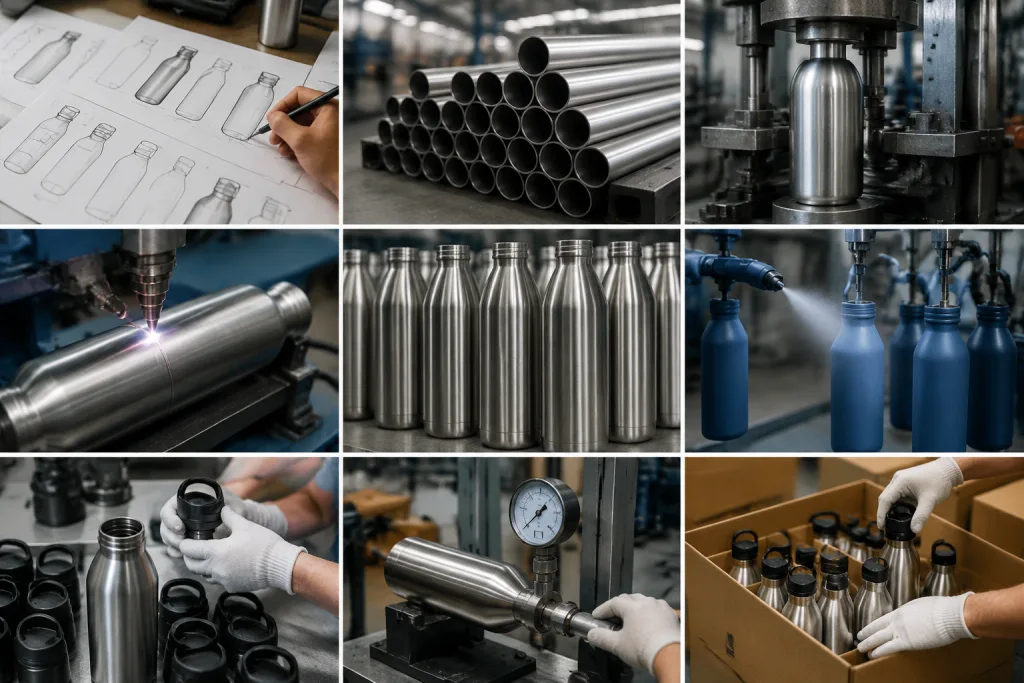
You do not need to stand beside every bottle on Line 3. You need control points. For bulk custom drinkware, we run material prep, body forming, welding or spinning, polishing, vacuum process if double-wall, leak and temperature testing, surface coating, logo application, assembly, packing, and final inspection. One rushed station can ruin the order; last May, QC pulled 32 bottles with 0.4 mm burrs on the mouth after a polishing wheel was changed too late.
Ask your canteen manufacturer for three production updates: material arrival, first finished units from the line, and pre-shipment packing photos. Make them useful. For material arrival, ask for coil or tube tags showing 304 stainless; for first finished units, ask for 10 pcs on a QC table with calipers and logo position checked; for packing, ask for carton marks before the container is booked. For vacuum insulated bottles, request a thermal retention test report from the batch. A simple internal test is hot water at around 95°C, ambient room temperature, and temperature reading after 6 hours. Requirements vary by design, but the factory should have a fixed method recorded on a test sheet, not “our worker said it is OK.”
Common major defects include leaking lids, wrong steel grade, poor vacuum performance, sharp mouth edges, heavy dents, wrong logo, and coating peeling. Minor defects include small dust points, slight shade variation, or tiny print specks within agreed limits. AQL inspection gives both sides a shared language. For 5,000 pcs, inspectors normally pull a statistical sample size based on ANSI/ASQ Z1.4 or ISO 2859-1, then judge critical, major, and minor defects separately. We have seen this go sideways when a buyer calls every 0.2 mm dust point a major defect after goods are packed; the math does not work once 417 cartons are sealed.
If you are buying from several canteen vendors, keep one defect classification sheet across all orders. Put photos in it: pass sample, reject sample, maximum scratch length in mm, logo offset limit, and lid torque issue if the buyer flagged it before. A distributor drinkware program runs smoother when your China supply base knows exactly what you reject and what you accept. Zhejiang factories are used to export QC, but the buyer still needs to draw the line before mass production starts.
Ship, reorder, and improve the line
The last 7 days before shipment are where paperwork errors wipe out good production work. Check the commercial invoice, packing list, carton dimensions, gross weight, HS code, shipping marks, and loading plan before the forwarder books space. We have seen a PO typo list “matte black” while the carton mark said “black matt”; QC caught it beside the sealing machine before 312 cartons were relabeled. For stainless steel vacuum bottles, 8 out of 10 shipments move as general cargo, but your forwarder still needs exact carton counts and CBM. A typical 750 ml bottle packed 24 pcs/carton may run around 0.055-0.070 CBM per carton, depending on box design.
Before paying the 70% balance, choose the inspection route in writing: your own QC team, a third-party inspector, or a factory report with dated photos, carton-drop video, barcode scan video, and weighing scale shots. Simple rule. For new canteen suppliers, third-party inspection is worth the USD 200-350 cost; the math works when one failed lid gasket can trigger 500 customer complaints. Last month QC pulled the sample from line 3 and found 2 scratched powder-coated bodies in 80 pcs, which is exactly the kind of finding you want before balance payment. For repeat orders with stable performance, reduce inspection frequency after 3 clean shipments, but do not remove it completely.
After delivery, send feedback within 30 days: retail returns by SKU, lid complaints with photos, color comments under store lighting, carton damage rate, and barcode scan failures by warehouse. This helps the factory adjust the next canteen customized order. If you plan a broader line, keep the same body and change lids, colors, or artwork. Five new molds is usually the wrong question to ask; one shared 304 stainless body with 3 lid options is cheaper and easier to control on the line. A customizable growler for outdoor channels, a sports bottle with straw lid for gyms, and a travel tumbler with slide lid for office buyers can share coating colors and packaging structure, making your distributor growler or canteen promotional program easier to replenish.
The best factory relationship is not built on squeezing the last USD 0.03 from the first order. We ship better when RFQs are clear, PO details are firm, samples are locked, inspections are honest, and reorders from China follow the same spec sheet your sales team approved. We have seen this go sideways when a buyer changed the Pantone code by email after mass coating; the line had already run 6,000 pcs. Clear specs beat clever bargaining.
Send us your bottle RFQ and artwork
We will review specifications, MOQ, sample timing, packaging, and FOB China pricing before you commit to tooling or bulk production.
Frequently asked questions
What MOQ should I expect from a 304 stainless steel water bottles factory?
For existing molds, a realistic MOQ is usually 1,000 pcs per model and color, though some factories may accept 500 pcs with a higher unit price. For a canteen customized with a standard logo and standard color, 1,000-3,000 pcs is normal. If you need a new bottle shape, special lid, or custom growler mold, tooling charges and higher MOQ apply, often 5,000 pcs or more. At BottleForge Industrial, MOQ starts from 1,000 pcs for many stainless models, with better FOB pricing at 3,000 and 5,000 pcs.
How do I confirm the bottle is really 304 stainless steel?
Ask for a material declaration first, then confirm with third-party testing if the order is important. 304 stainless steel normally contains around 18% chromium and 8% nickel, but you should rely on lab testing rather than a magnet test. The PO should state SUS304 for the food-contact inner wall. For EU programs, request LFGB or EU food-contact migration testing. For North America, FDA food-contact compliance is common. If a canteen supplier offers a price far below market, confirm whether the outer wall is 201 stainless or 304.
Which logo method is best for customized drinkware?
For stainless bottles, laser engraving is the most durable and works well on powder coating or bare steel. It is a strong choice for distributor drinkware, corporate gifts, and outdoor canteen promotional orders. Silkscreen is cost-effective for simple one-color logos at higher quantity, but it can scratch more easily than engraving. UV print and heat transfer support full-color artwork, but you should test adhesion and abrasion before bulk. For most first orders of 1,000-5,000 pcs, laser engraving or one-color silkscreen is the lowest-risk option.
What lead time should I put in my purchase order?
For an existing 304 stainless bottle mold, plan 7-10 days for logo samples after artwork approval and 25-35 days for bulk production after deposit and approved sample. Complex full-wrap printing, custom color matching, new packaging, or peak-season production can add 5-15 days. Sea freight to Europe or North America then adds several weeks depending on port and vessel schedule. Your PO should state both the production ready date and Incoterm, such as FOB Ningbo, so there is no confusion between factory completion and arrival at your warehouse.
Can one factory handle bottles, canteens, and growlers together?
Yes, if the factory has the right tooling and assembly experience. Many canteen manufacturers can produce stainless sports bottles, travel tumblers, custom canteen items, and customized growler models in the same supply chain. The key is not the product name; it is structure, capacity, lid design, coating, and testing. A 500 ml bottle and a 2 L growler need different forming, vacuum, and carton controls. If you are building a distributor canteen range, ask for a product matrix with MOQ, capacity, lid options, FOB price bands, and lead time for each model.