Key Takeaways
- 304 stainless steel is the right baseline for most insulated bottles; specify 0.5 mm body wall or 0.6 mm if you need a premium feel
- A realistic factory MOQ is 1,000 to 3,000 pcs per SKU, with 25–35 days lead time after artwork approval
- FOB China pricing for a plain 500 ml bottle often starts around USD 2.20–3.80, while complex powder coat or gift packaging lifts cost fast
- Ask for REACH, LFGB, and a salt-spray or dishwasher test report before you place drinkware bulk or drinkware wholesale orders
If you are buying 304 stainless steel water bottle bulk, do not treat it like a commodity. That is the wrong question to ask. The job is to balance food-contact safety, 0.5 mm or 0.7 mm wall thickness, finish quality, and landed cost against your sell price and reorder plan. A cheap sample can still hide a bad TIG weld, a thin liner, or a coating that starts failing after 20 dishwasher cycles.
Here in Zhejiang, we see the same pattern every week: a buyer comes in with a target price, then QC pulls the sample and finds the cap thread is off by 0.3 mm or the logo sits 2 mm too high. We run that risk check early because the math does not work if you fix problems after packing. For a stable program in China, lock the spec first, then decoration, then the shipping model. That is how you avoid paying twice.
Start with the spec, not the price
I’ll rewrite the section in place, keep the HTML exactly as-is, and tune the prose to sound like a sourcing-side sales engineer.Most procurement mistakes happen before you send the RFQ. We’ve seen buyers lock onto a 500 ml quote at USD 2.40, then get burned because the steel grade, body thickness, cap type, and coating line were never fixed. For 304 stainless steel water bottle bulk, 304 is only the starting point; the rest of the spec decides whether you ship a retail-ready bottle or a thin shell that QC will reject at the line.
Use three questions to lock the spec:
- Single-wall bottle, vacuum bottle, or handled bulk canteen?
- Need 18/8 inner and outer steel, or is the outer shell doing printed decoration only?
- Is the target office, gym, hiking, promo, or private label retail?
A single-wall canteen wholesale order for event use can run lighter and cheaper. A vacuum-sealed model for premium retail may need a 0.6 mm liner, copper coating, and a 2.5-hour hot retention claim test. We had a buyer push back on a 0.4 mm wall last month; the math did not work, and the sample dented after a 1.2 m drop test. If your brand promise is “best wholesale drink bottle,” do not approve a thin body just to save 12 cents. In Zhejiang, factories can hit aggressive pricing, but only when the spec is tight.
Practical rule: if sell-through depends on perceived quality, start at 0.5 mm wall thickness, 304 inner, and 304 or 201 outer only when the customer will never see the seam. For bulk drinkware and drinkware wholesale programs, repeat order performance matters more than the first sample price. QC pulled one sample with a 0.8 mm cap gap last week, and that kind of typo on the PO turns into a claim later.
Choose the right form factor
Different buyers need different bottle families. Shape decides tooling, cap cost, and how many units we can load into a 40HQ. A straight-sided 500 ml bottle usually packs 24 pcs per export carton and sits clean on a 1,100 mm pallet; a wide-mouth vacuum tumbler may drop to 12 pcs because the lid and handle eat carton space. We see this on the line every month. If you are buying bulk drinkware for a 6-SKU rollout, use one cap platform across sizes unless the channel truly needs a different mouth.
Here is the trade-off we use when checking a new RFQ:
- Water bottle: best for everyday retail, office desks, gym bags, and school programs where the buyer cares about carton count and leak testing.
- Canteen bulk: a better fit for camping sets, military-style promos, and rugged programs that need a shoulder strap or thicker powder coating.
- Growler bulk: built for brewery merch, mainly 32 oz and 64 oz formats with wider mouths for fast filling.
- Beer tumbler bulk: good when the customer wants an open-drink feel, not the heavier body and handle of a growler.
- Alcohol flask bulk: smaller and lower-cost, usually 6 oz or 8 oz, with most orders driven by gift boxes or lifestyle retail.
For beer programs, naming affects search and retail planning: beer growler bulk, beer growler in bulk, beer growler wholesale, and beer growler wholesale bulk sit in the same sourcing family. The parts are not the same. Cap gasket OD, mouth width, and handle clearance change the cost. A brewery buyer usually asks for a 64 oz growler with a carry handle and a wide mouth for filling; last quarter QC pulled a sample with a 1.2 mm gap under the handle weld, and the buyer flagged it before shipment. A promo buyer may only need a brushed flask with laser engraving. Cheaper, faster.
If you are building a catalog, decide early whether wholesale canteen, wholesale growler, and wholesale drinkware need separate SKU groups. One tooling platform can reduce mold cost by 15–25 percent across sizes, but the math does not work if every PO changes the neck finish by 0.5 mm or asks for a new lid thread. We run the thread gauge before mass production for this reason. We have seen this go sideways when a buyer approved 3 lid drawings, then tried to mix caps across 500 ml, 750 ml, and 1,000 ml bodies.
Check materials and safety documents
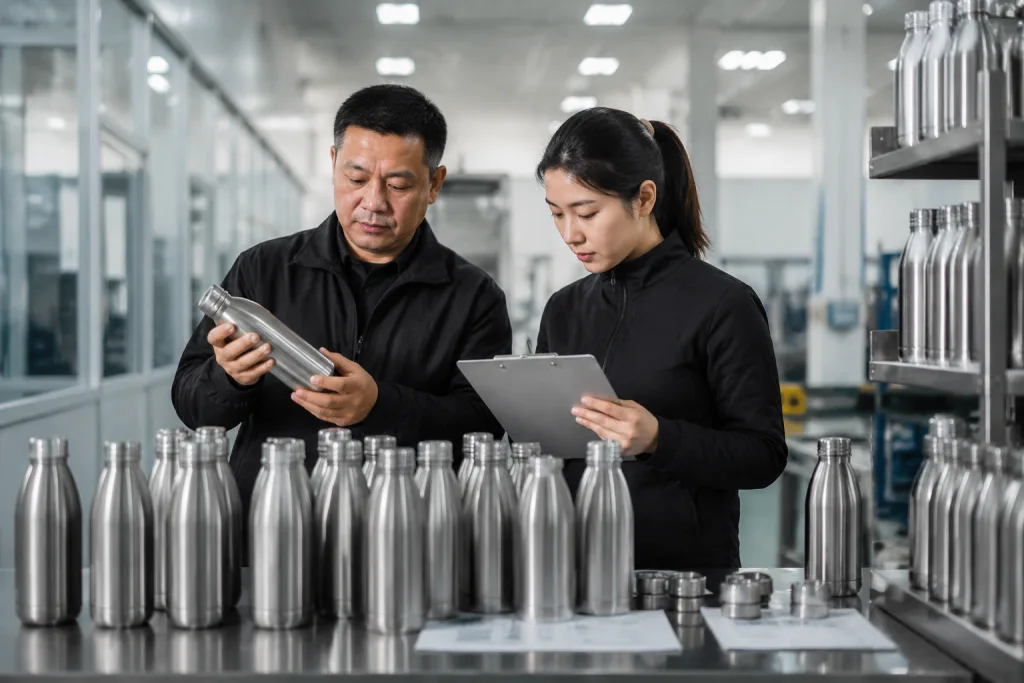
304 stainless gets accepted on most bottle programs because it resists rust and handles food contact when the line uses the right sheet, welding gas, and cleaning process. “304” on a spec sheet is the wrong place to stop. Ask for the mill material certificate, then check the inner wall finish with a bore light, the weld bead at the shoulder, and any coating that might touch the beverage path. On one 12,000 pcs run, QC pulled 8 bottles after a 3M tape rub test because the powder coat near the bottom radius started to lift after dishwasher cycling.
For Europe and North America, we normally prepare these documents before the buyer’s lab asks twice:
- REACH declaration covering paint, silicone parts, and plastic accessories
- LFGB or relevant food-contact documentation for the bottle body, lid, straw, and gasket
- FDA-compliant material statement for the US market
- Dishwasher test with cycle count, leak test at the cap, and vacuum retention report if the bottle is insulated
If you are sourcing alcohol flask wholesale bulk, use the same checks. A flask looks simple, but taste transfer and weak weld sealing turn into chargebacks fast. For alcohol flask in bulk orders, ask for an odor test after 24 hours closed and a line finish check inside the neck; we run this with a small LED inspection pen because rough polishing marks hide there. For drinkware wholesale, a clean seam weld is not decoration. It prevents returns.
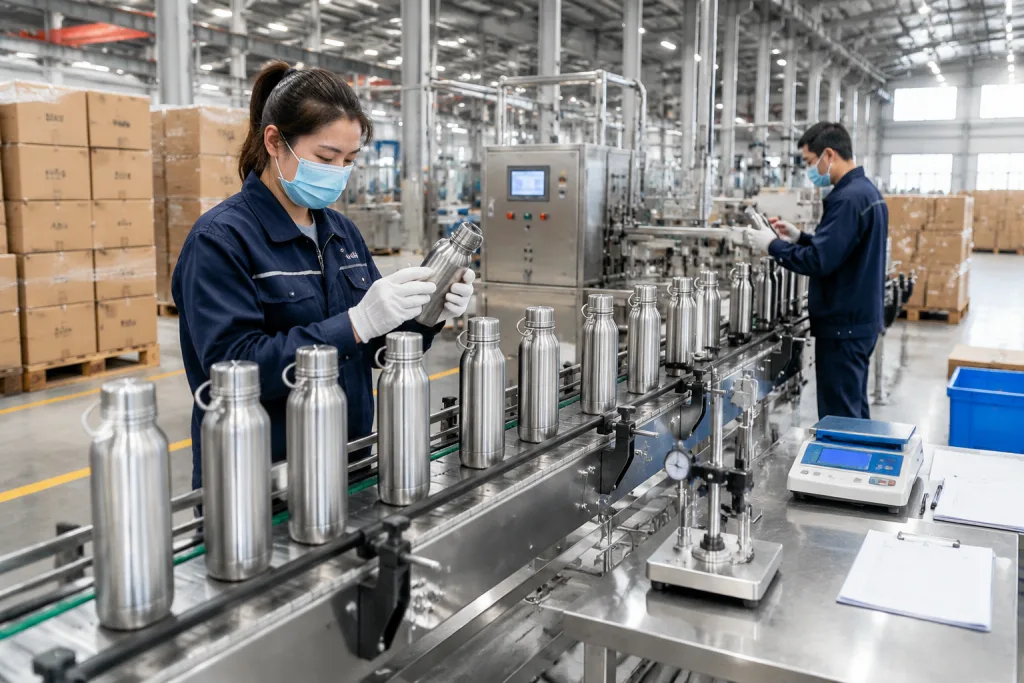
In our Zhejiang factory, the QC team runs incoming material checks with a handheld XRF analyzer, in-process leak testing at the assembly table, and finished-product AQL sampling before cartons are sealed. On mainstream bottle programs, a normal acceptance target is AQL 2.5 for major defects and 4.0 for minor defects, but about 6 out of 10 retail brand owners ask for 1.5 on visible defects when the product is retail boxed. The buyer flagged one PO typo last quarter where “matte black” became “mate black”; small wording mistake, 3 pallets held.
Price the landed cost, not the quote
About 7 out of 10 buyers compare FOB numbers and stop there. That is where margin disappears. A plain 500 ml stainless bottle at USD 2.20 FOB can become USD 4.60 landed once you add print, carton, inland trucking, ocean freight, duty, and last-mile handling. We saw this last month on a Costco-style sample run: the bottle passed the 24-hour leak test, but the buyer’s spreadsheet missed the inner-box weight by 42 g. For a retail program, price backwards from shelf price or Amazon target price, not forwards from the factory quote.
On our costing sheet, these 4 lines move the price fastest:
- Finish: brushed steel keeps the line moving; multi-color powder coat needs color changeover, masking, and extra oven time.
- Decoration: one-color silkscreen is the low-cost option; laser engraving adds machine time, and full-wrap transfer needs tighter artwork control at the seam.
- Packaging: white box saves space in the master carton; magnetic gift box or molded pulp tray adds material cost and carton volume.
- Cap system: bamboo lids, straw caps, and flip lids can add USD 0.20–0.80 each, before spare gaskets or individual polybags.
For bulk growler and growler wholesale orders, carton size often beats bottle price. This is the wrong question to ask if you only compare ex-factory. A 64 oz beer growler bulk order may cost more in freight per unit than a slimmer drink bottle even if the ex-factory price is only slightly higher. On one 64 oz carton we run, the master carton footprint was 455 x 455 mm, so the container loaded out by cube before weight. The same freight problem shows up in beer tumbler wholesale programs with double-wall construction.
When a buyer asks for beer tumbler wholesale bulk or alcohol flask wholesale bulk, I ask for a landed-cost sheet with 4 columns: FOB, test/pack, freight, and duty. No sheet, no real margin. We ship from Zhejiang, and the FOB quote can be turned in the same day, but the math does not work if duty rate or carton CBM is guessed. QC pulled a sample last week where the PO said “black lid” and the approved sample had matte charcoal; that kind of small miss becomes expensive after packing.
Know the MOQ and lead time logic
Factory MOQ is tied to machine setup and purchasing, not a sales slogan. For a standard 304 bottle, a practical MOQ is 1,000 to 3,000 pcs per design if you want a workable FOB price. Push below 500 pcs and the math doesn't work: the laser logo jig change, color box loss, and 2–3 hours of line cleaning get spread across too few bottles. Ask for capacity proof. A serious factory in Zhejiang should show monthly output by line, not just say “we can rush it.”
At our Hangzhou facility, monthly output is 300,000 units across 6 drinkware lines, and we run a repeat bottle order in 25–35 days after sample approval and deposit. Custom colors, new lids, or retail packaging move that to 40–45 days because the line waits for powder coating panels, lid trial fit, and barcode carton printing. QC pulled a sample last month where the buyer's PO had “matte black” but the approved Pantone was 426C. That cost 3 days. If your seasonal launch has a fixed delivery window, add two weeks for pre-production approval and one week for port handling.
For canteen bulk or canteen wholesale programs, the fastest route is usually a stocked cap and a common body shape from an existing mold, such as a 70 mm mouth or 85 mm base. For growler wholesale or wholesale growler, the cap and handle need more checking; one loose handle pin at 1.2 mm tolerance can fail a drop test. We've seen this go sideways when a buyer accepts a “fast” promise without seeing the production calendar. If this is your first 304 stainless steel water bottle bulk order, ask for the carton spec and the booked inspection slot before you trust the date.
Good buying habit: ask for monthly output by line, the current queue with order numbers hidden if needed, and the earliest EXW or FOB date in writing. We ship smoother when the buyer gets those 3 items before paying the deposit. That request filters out weak suppliers in China fast.

Protect retail quality with the right QC
Retail buyers catch the small stuff first. The cap has to thread cleanly after 20 open-close turns on the line. The bottle cannot rock more than 1 mm on a flat stainless table. Powder coat should pass a coin scratch at the shoulder and base without lifting at the edge. QC pulled the sample last month because the weld line looked wavy under a 600 mm inspection lamp, even though the brochure photo looked perfect. These details decide reorders. Not the catalog copy.
For a private-label launch, lock the inspection rules before we cut steel or book coating slots. This is the wrong question to ask: “Can you check quality before shipment?” By then, the math doesn't work. We run a control plan from the golden sample, and the buyer signs off with dimensions, Pantone code, and cap torque written on the sample tag. A solid plan includes:
- Pre-production sample sign-off with photo reference, including logo position in mm and approved lid color
- In-line leak test at 100 percent if the item is vacuum insulated, with failed pieces marked before packing
- Final random inspection under AQL 2.5 or stricter, with cap fit, coating, odor, and barcode scan checked
- Carton drop test for export packaging, usually 10 drops after the master carton reaches target kg
If you need custom logo work, compare silkscreen and laser engraving before the PO is clean. A brushed bottle with laser engraving looks premium and survives daily wear better than print, but it costs more and can add 3 days to a 12-day production slot. For branded drinkware wholesale, one-color print often works for promo channels; engraved branding fits premium corporate gift orders where the buyer flags tiny ink breaks at 30 cm viewing distance.
The more complex the SKU, the more you need a factory that understands export paperwork, REACH, and carton labeling. We have seen this go sideways over one PO typo: “matte black” on the order, “black” on the carton mark, then the marketplace asks for photos and the shipment sits. A Zhejiang supplier should not just ship bottles; it should catch the customs code, warning label, barcode, and outer carton format before loading into a 40HQ for the US, Germany, or Canada.
Match the bottle to your channel
The best wholesale drink bottle for Amazon is rarely the right bottle for a brewery gift shop. Channel fit decides the spec. Amazon buyers usually push us on +/- 1 mm height variation, lighter inner boxes, and FNSKU labels that scan on the first pass with a Zebra DS2208. Retail distributors care more about shelf face and crushed-corner rates after a 10-carton drop check. Corporate buyers chase logo position and Pantone repeatability; QC pulled a sample last month because the laser mark sat 3 mm off center. Ignore the channel and you pay for features the customer will not pay back.
Use this shortcut:
- Amazon or DTC: clean packaging with 1 barcode side, stable 30-day supply planning, cartons ready for FNSKU or UPC labels.
- Promotional use: lower decoration cost per logo, 18-day lead time when we run stock colors, practical bulk canteen or flask shapes that pack 24 pcs per carton.
- Brewery and beverage merch: beer growler wholesale bulk with a handle that passes a 12 kg pull test, leak-proof lid, branded carton for taproom shelves.
- Outdoor retail: vacuum insulation, powder coat checked by cross-cut tape test, lid compatibility that does not create after-sales noise.
For alcohol flask bulk and alcohol flask wholesale, gift presentation often beats raw steel cost. We have seen buyers reject a cheaper flask because the EVA tray smelled like glue after 48 hours in a sealed carton. For beer tumbler bulk, grip and condensation control sell faster than thick-wall construction; the math does not work if you add 35 g of steel just to sound “premium.” For bulk canteen and wholesale canteen, durability and price usually beat complex artwork. Good procurement teams start with channel economics, not the prettiest sample on the table.
If you want a clean launch in China or from China, keep the SKU count tight. One 500 ml bottle, one 750 ml bottle, and one growler format are easier to control than six mixed shapes, especially when the PO has two lid colors and one typo in the carton mark. We run fewer molds, QC checks fewer drawings, and the line changes over 2 times instead of 6. Simple programs cost less to inspect, cost less to freight, and reorder faster when sales data finally tells the truth.
Send your bottle spec for a factory quote
Get a fast FOB quote, MOQ, and lead time from our Zhejiang team with material, coating, and packaging options matched to your channel.
Frequently asked questions
What MOQ should I expect for 304 stainless steel water bottle bulk orders?
For a standard private-label order, expect 1,000 to 3,000 pcs per SKU. Below 500 pcs, the unit price usually rises sharply because setup, packing, and decoration costs are spread too thin. If you want multiple colors, count each color as a separate SKU. In Zhejiang, repeat orders can sometimes be split from stock parts, but new lids or custom cartons still need normal production time.
What is a realistic FOB price for a 500 ml bottle?
A plain 500 ml 304 stainless bottle often lands around USD 2.20 to 3.80 FOB China depending on wall thickness, finish, and cap. Add roughly USD 0.12–0.40 for one-color print, USD 0.20–0.80 for upgraded lids, and more for gift packaging. If someone quotes far below that, check whether the steel grade, coating, or packing spec has been downgraded.
Which compliance documents should I request?
Ask for REACH, LFGB or equivalent food-contact documentation, FDA material statements for US sales, and test reports for leak, dishwasher, and corrosion if relevant. For Europe, coating chemistry matters as much as the steel. For North America, make sure the carton and label content match the import paperwork. A proper factory in China should be able to provide these without hesitation.
How do I compare canteen wholesale and growler wholesale options?
Compare use case first. A wholesale canteen is usually better for camping, military-style, and rugged promo programs. A wholesale growler is built around brewery merch and beverage filling, so the mouth width, handle, and seal matter more. Beer growler bulk formats often need stronger carton protection than a straight bottle. Ask for the finished unit weight, carton count, and freight cube before you decide.
Is laser engraving better than print for branding?
Laser engraving is more durable and usually looks premium on brushed steel, but it costs more and can slow output. One-color silkscreen is cheaper and works well for promo or volume drinkware wholesale orders. If your brand sells on retail shelves, engraving can justify the extra USD 0.15–0.40 per unit. For high-volume beer tumbler wholesale bulk or flask programs, print often wins on margin.