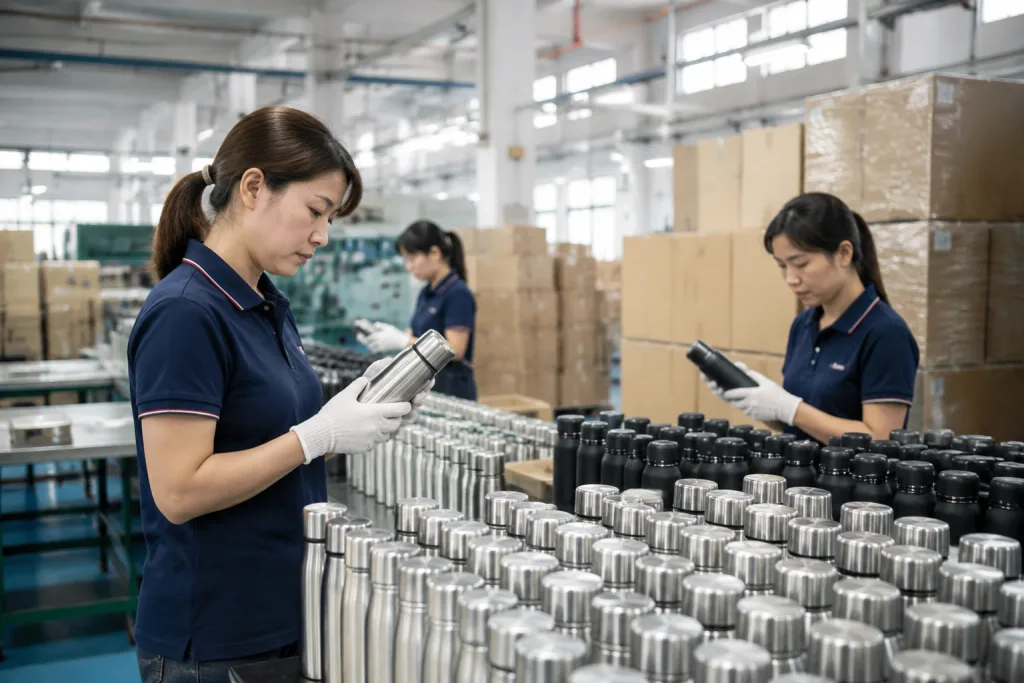
Key Takeaways
- For most custom drinkware orders, 1,000-3,000 pcs per color is the realistic MOQ for stable pricing
- 304 stainless steel is the baseline for food-contact inner walls; 316 is usually optional, not standard
- Powder coating adds roughly USD 0.35-0.80 per bottle but improves grip and shelf appearance
- A written AQL plan, usually 2.5 for major defects and 4.0 for minor defects, should be agreed before deposit
Buying from a 304 stainless steel vacuum insulated bottle supplier is not picking a body shape from a PDF catalog. You are fixing the steel grade, inner-wall thickness, vacuum gap, lid gasket material, logo process, carton drop-test spec, and the defect rate your customer may complain about after 6 months; last week QC pulled a 500 ml sample with a 0.28 mm inner wall when the buyer’s spec called for 0.30 mm.
If you are a canteen distributor, brand owner, or drinkware buyer in Europe or North America, finding a factory in China is the easy part. The hard part is deciding which trade-offs you accept before the price looks good. We see this go sideways. At BottleForge Industrial in Hangzhou, Zhejiang, we run into the same 3 mistakes on the line: a PO that says “750 ml” while the artwork says “700 ml,” a laser logo designed with 0.15 mm strokes that fill in after polishing, and no written AQL standard before mass production starts.
Start With Four Buying Decisions
Before you ask a canteen supplier for pricing, lock four decisions with your team: product use, target cost, decoration level, and compliance market. If these stay loose, the quote comparison is noise. We once received a PO saying “matte black bottle” while the approved sample was Pantone Black 6C powder coat; QC pulled the sample, and the buyer flagged the finish after cartons were already packed.
First, define use. A gym bottle and a retail travel tumbler do not run on the same lid set, coating test, or export carton. A school customized canteen needs better dent resistance, while an outdoor custom growler needs a stronger handle and tougher carton drop result. A 500 ml bottle may use 0.4 mm inner wall and 0.5 mm outer wall stainless steel, while a 64 oz customized growler often needs thicker construction and stronger handles. Same category, different build. Do not compare them as if they are the same SKU; the math does not work.
Second, set a target FOB range. For a basic 500 ml double-wall 304 bottle from China, you may see USD 3.20-5.20 FOB depending on lid, finish, and order quantity. A premium 1,000 ml powder-coated model with laser logo and retail box may sit around USD 6.00-9.50 FOB. If your landed cost ceiling is fixed, say it early. On our line, changing from a PP flip lid to a carry-loop lid can move the packing height by 8-12 mm, which changes carton count and freight cost.
Third, decide how branded the bottle must be. Silkscreen, laser engraving, heat transfer, full wrap printing, embossed lids, and custom packaging all affect MOQ and lead time, but not in the same way. We run laser logos from 1,000 pcs more easily than full wrap printing at the same quantity, because print registration and scrap rate become the headache. Fourth, identify the sales market. REACH, LFGB, FDA food-contact expectations, Prop 65 labeling, or ASTM child-related testing can change material selection and documentation; we have seen buyers lose 12 days waiting for a missing food-contact report that should have been requested before sampling.
Choose 304 Steel With Evidence
A serious 304 stainless steel vacuum insulated bottle supplier should not use “304” as a loose sales word. Ask if the inner wall, outer wall, or both walls are 304. On price-driven promo jobs, we see 304 inside and 201 outside in about 6 out of 10 buyer RFQs below USD 3.20 target FOB. That can pass for some promotional drinkware, but you need it written on the spec sheet before the sample is approved. QC pulled one sample last month where the PO said “304 body,” while the material tag on the coil rack showed 201 for the outer shell.
For food-contact surfaces, 304 stainless steel is the common baseline because it contains roughly 18% chromium and 8% nickel, giving better corrosion resistance than 201. Salty drinks, acidic beverages, and outdoor programs with 12 to 18 months of repeat use need a 304 inner wall. No shortcut there. If your product is a custom canteen for hiking, school, or corporate wellness kits, do not allow substitution without written approval. We run XRF checks on incoming sheet, and a 0.5 mm inner wall marked 201 is an immediate stop, not a “discuss later” item.
Ask your canteen manufacturer for material test reports, not just a catalog claim. Acceptable support can include SGS, Intertek, or TÜV test reports for heavy metals, migration, and food-contact compliance. If you sell in the EU, REACH and LFGB-related testing may be requested by your retailer. For the United States, FDA food-contact material expectations and CPSIA considerations may matter if the bottle is marketed to children. The wrong question is “is it food grade?” Ask for the report number, tested material description, and issue date. We have seen this go sideways when a buyer uploaded a report for PP lid parts, while the retailer asked for stainless steel body migration data.
Vacuum performance also needs evidence. A typical test is filling the bottle with 95°C water, closing the lid, and measuring temperature after 6, 12, or 24 hours at room temperature. A practical 500-750 ml bottle should still hold useful heat after 12 hours. For cold retention, insulation results depend heavily on lid design and bottle mouth diameter, so ask for test conditions, not just a “24 hours cold” claim. On the line, we use a digital probe thermometer and record room temperature, fill volume, and lid torque; a wide-mouth 750 ml bottle with a flip lid will not test the same as a narrow-mouth screw-cap model. The math does not work if the supplier quotes one retention number for every shape.
Match Construction To The Channel
Different channels need different builds. For a trade-show canteen order, we run a clean logo, low MOQ, and 30-day delivery, but the buyer usually cares most about logo position within 1.5 mm on the rotary laser jig. For an outdoor retail growler, the math changes: stronger welded handle, thicker powder coating checked by film gauge, tighter cap sealing, and a K=A five-layer carton for parcel drops.
For a standard vacuum bottle, check the wall gauge with a micrometer, then look at mouth diameter, lid thread quality, gasket material, and base design. A wide mouth takes ice cubes and cleans faster, but heat loss goes up and some users spill while walking. A narrow mouth holds temperature better. It is less flexible as a sports bottle. A flat base sits well on shelves; a silicone boot cuts dents, but we have seen dirt trapped under loose boots when the fit is off by 0.3 mm.
Capacity changes how buyers judge the item. A 350 ml bottle is usually a gift or kids SKU, and QC pulled the sample last month because the straw length missed the bottom by 6 mm. A 500-750 ml bottle fits most corporate, school, and commuter programs. A 1,000 ml customizable canteen works for outdoor and fitness buyers. A 1.9 L or 64 oz customizable growler needs extra checks on handle torque, cap leakage, and carton compression; this is where cheap specs go sideways.
At our Zhejiang facility, a stable line can produce about 300,000-450,000 stainless drinkware units per month depending on coating mix and decoration load. That capacity matters when a canteen distributor needs a repeat order before peak season, especially if their PO has a color typo like “Pantone Black C” and the line is already loaded. Small factories may quote aggressively. The wrong question is only asking price: if they subcontract coating or lids without control, your repeat color and gasket fit can drift between batches.
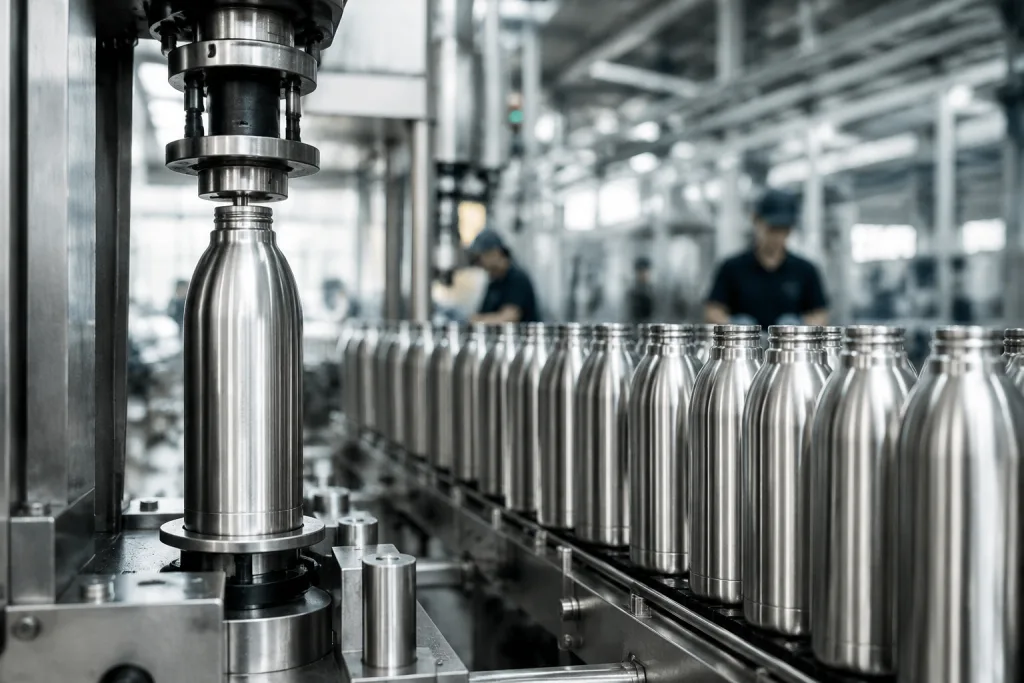
Decoration Is A Cost Decision
Customizable drinkware gets expensive when the logo choice is made by taste instead of landed cost. A one-color silkscreen logo on a flat bottle wall is cheap, quick, and works for 800 pcs canteen customized programs where the buyer just needs staff names or a company mark. Laser engraving looks cleaner on 304 stainless or powder coating, and it survives daily washing better, but the result changes with coating color, laser power, and engraving depth; last month QC pulled a black 750 ml sample where the logo came out brown, not silver. Full wrap heat transfer catches the eye. It also raises defect rates around curves and seams, especially when the film overlaps by 2-3 mm.
Start with the selling channel. For distributor canteen orders going into corporate gifting, one neat logo position is often enough, usually 35 mm wide on the front face. For retail customized drinkware, the buyer will ask for PMS color matching, shelf-ready packaging artwork, barcodes, warning labels, and hang tags with the correct hole size for the peg. For ecommerce, the wrong question is “which finish looks best?” Ask which finish survives parcel handling. We have seen matte coating go sideways after 6 drop-test cycles when each bottle only had a thin PE bag and a weak retail box.
MOQ changes with decoration, not just bottle size. A simple laser logo may start from 500-1,000 pcs on existing stock colors, and we run that on the fiber laser without stopping the coating line. Custom powder coating usually needs 1,000-3,000 pcs per color because the booth cleaning, color powder loss, and sample approval all cost money. Full custom mold lids, embossed badges, and special handles can push MOQ to 5,000-10,000 pcs because tooling, injection setup, and color control are involved; the math does not work for 600 pcs when one lid mold alone takes 18-25 days.
Be careful with “free logo” offers from canteen vendors. The cost is usually buried in the unit price, or the method is limited to one small position, such as 25 x 40 mm on the front. Ask for decoration area in millimeters, setup cost, repeat order cost, and acceptable artwork format before you issue the PO. Vector AI, PDF, or EPS files reduce prepress mistakes; we once received a PO spelling the brand two different ways, and the buyer flagged it only after the film output was done. A pre-production sample with the real logo is worth the 5-7 days it takes.
Compare Quotes Without Getting Trapped
A low FOB quote only means something when the spec is the same. Match steel grade, capacity tolerance, lid material, coating type, logo method, packing, carton size, test reports, inspection standard. Small gaps hide money. Last month QC pulled a 750 ml sample that measured 716 ml brimful on the scale, while the buyer’s RFQ said 750 ml usable volume. If one canteen supplier includes a color retail box and another quotes 24 pcs bulk in a K=K carton, that price gap is not a saving.
Use a plain RFQ table. Put the capacity, measured brimful volume, inner steel grade, outer steel grade, wall thickness target, lid plastic grade such as PP or Tritan, gasket silicone, finish, logo size, individual packing, master carton quantity, Incoterm, requested lead time. We check wall thickness with a digital caliper and record it in mm before the pre-production sample is signed. For FOB Ningbo or FOB Shanghai from Zhejiang, normal production lead time is 35-50 days after deposit and sample approval for a customized canteen. Rush orders happen, but squeezing coating cure time or final inspection is where we have seen orders go sideways.
Payment terms change risk, not just cash flow. A common China export structure is 30% deposit and 70% balance before shipment after inspection. For larger distributor drinkware programs, some buyers negotiate balance against bill of lading copy, based on credit history. If you need Amazon FBA preparation, FNSKU labeling, carton weight limits, or palletization, put it in the RFQ before we price. We had one PO with “FNKSU” typed wrong, and the line had to stop while the buyer corrected the label file. Adding FBA labels after production can delay shipment by 3-5 days and create extra handling charges.
Do not judge a canteen manufacturer only by catalog size. This is the wrong question to ask. A factory with 40 similar bottle shapes, clear mold numbers, and steady AQL records may beat a canteen factory showing 400 SKUs with unclear tooling ownership. You need repeatability more than novelty. If the same 304 stainless body comes off the line within the agreed tolerance for three repeat orders, that matters more than a pretty catalog page.

Lock Quality Before Production
Write the QC terms before the deposit leaves your account. For vacuum insulated bottles, the checklist should cover appearance, capacity, leakage, vacuum performance, coating adhesion, logo position, odor, lid fit, and packaging. We run capacity checks with a graduated cylinder, and for a 500 ml bottle the buyer usually accepts ±10 ml after the first sealed sample is signed. A common AQL setting is 2.5 for major defects and 4.0 for minor defects, with critical defects at 0. Retail chains can tighten it, but the math does not always work: tighter AQL adds inspection hours, more carton opening, and sorting cost on the line.
Define major defects in plain words. Leakage, failed vacuum, sharp edges, wrong logo, severe coating peel, rust marks on the inner wall, and broken lids belong in major or critical. Minor defects include 0.3 mm dust points in coating, slight color variation within the approved Pantone tolerance, or carton scuffs when the inner polybag and egg-crate divider still protect the bottle. QC pulled the sample once for a logo that was 4 mm off center; the buyer flagged it because the retail display showed the front face. If defects are not defined, every claim turns into a debate.
Ask for three checkpoints, but spell out what each one means. Incoming material control should check 304 stainless steel sheets, silicone rings, lids, and powder coating before cutting starts. In-process inspection should catch welding marks, mouth roundness, vacuum pull, and coating thickness while the line can still adjust the fixture. Final random inspection should include batch vacuum testing, salt spray testing for selected components, cross-cut coating adhesion tests, and torque checks on lids. Finding vacuum failure after 3,000 bottles land in Canada or Germany is the wrong problem to buy.
Documentation matters. For a canteen customizable program sold through retail or distribution, keep approved samples, artwork confirmation, material reports, packing list, carton marks, and inspection photos in one folder. We have seen this go sideways from a PO typo: “mat black” instead of “matte black,” and nobody wanted to own the repaint cost. At BottleForge Industrial in Hangzhou, China, we ask buyers to sign a golden sample and inspection checklist before mass production. It cuts arguments and makes repeat orders faster.
Send Your Bottle Spec And Target FOB
Share capacity, finish, logo method, MOQ, and destination market. We will return a practical quotation with lead time and compliance options.
Frequently asked questions
What MOQ should I expect from a 304 stainless steel vacuum insulated bottle supplier?
For existing bottle shapes, a realistic MOQ is usually 500-1,000 pcs for laser logo on available colors, and 1,000-3,000 pcs per color for custom powder coating. If you want a custom lid, molded handle, special silicone boot, or full private-label packaging, expect 5,000 pcs or more. Very low MOQs can work for sampling, but unit cost may rise by 20-40% because setup, coating loss, and inspection time are spread across fewer units. For a distributor canteen program, it is better to start with 2-3 proven colors than 8 colors at thin quantities.
Is 304 stainless steel enough, or should I request 316 stainless steel?
304 stainless steel is enough for most vacuum insulated bottle programs, including corporate gifts, sports bottles, travel bottles, and general customized drinkware. It is widely used for food-contact inner walls because of good corrosion resistance and stable cost. 316 stainless steel adds molybdenum and improves resistance in more aggressive environments, but it usually increases cost and is not necessary for normal water, coffee, or tea use. If your custom canteen is marketed for marine use, salty drinks, or very long outdoor storage, 316 may be worth discussing. Otherwise, specify 304 inner wall clearly and verify it with test reports.
How long does custom drinkware production take in China?
For a standard 304 stainless steel vacuum bottle with logo and normal packaging, plan on 35-50 days after deposit and sample approval. Add 5-10 days if you need custom powder coating, retail box proofing, or special compliance testing. New mold development for a customized growler, special lid, or unique handle can add 30-60 days before mass production. Sea freight from China to Europe or North America often adds 25-40 days port to port, depending on route and season. If you need goods for a fixed launch date, build the calendar backward and leave at least 10 days for inspection and export paperwork.
What should I check in a pre-production sample?
Check more than appearance. Measure actual capacity, weight, mouth diameter, lid fit, gasket seating, coating feel, logo size, logo position, odor, and carton packing. Fill the bottle with hot water and test leakage by turning it upside down for at least 30 minutes. If possible, run a simple heat-retention comparison over 6-12 hours. Confirm the color under normal daylight, not only under factory lighting. For canteen promotional orders, also check whether the logo remains readable at the final size. Once you approve the pre-production sample, it should become the golden sample for AQL inspection.
How do I choose between canteen manufacturers and trading companies?
A trading company can be useful if you buy many categories in small quantities. A direct canteen manufacturer is usually better when you need repeat color control, stable vacuum performance, private-label packaging, and faster technical feedback. Ask whether the supplier controls stainless forming, vacuuming, polishing, coating, assembly, and final inspection in-house or through subcontractors. Some processes, such as coating, are commonly outsourced, but the supplier must still own the QC standard. For a long-term canteen distributor or distributor growler program, visit the factory by video or in person, review monthly capacity, and ask for recent inspection reports.