Key Takeaways
- A 500 ml 304 vacuum bottle typically lands at USD 3.20-6.80 FOB Ningbo or Shanghai before retail packaging upgrades
- 1,000 units is a realistic MOQ for one color; 3,000-5,000 units gives better material and printing efficiency
- New mold or private-shape development can add USD 1,500-8,000 and 35-60 days before mass production
- Plan 45-70 days total for sampling, approval, production, inspection, and China port delivery
If you buy custom drinkware for retail shelves, corporate programs, or distributor stock, finding a factory is the easy part. The hard question is why one 304 stainless steel vacuum insulated bottle manufacturer quotes USD 3.20 and another quotes USD 6.10 for a bottle that looks the same in a PDF. Last month, a buyer flagged a 500ml bottle where the wall thickness measured 0.38 mm with our digital caliper, while the cheaper sample came in closer to 0.30 mm. Same photo. Different bottle.
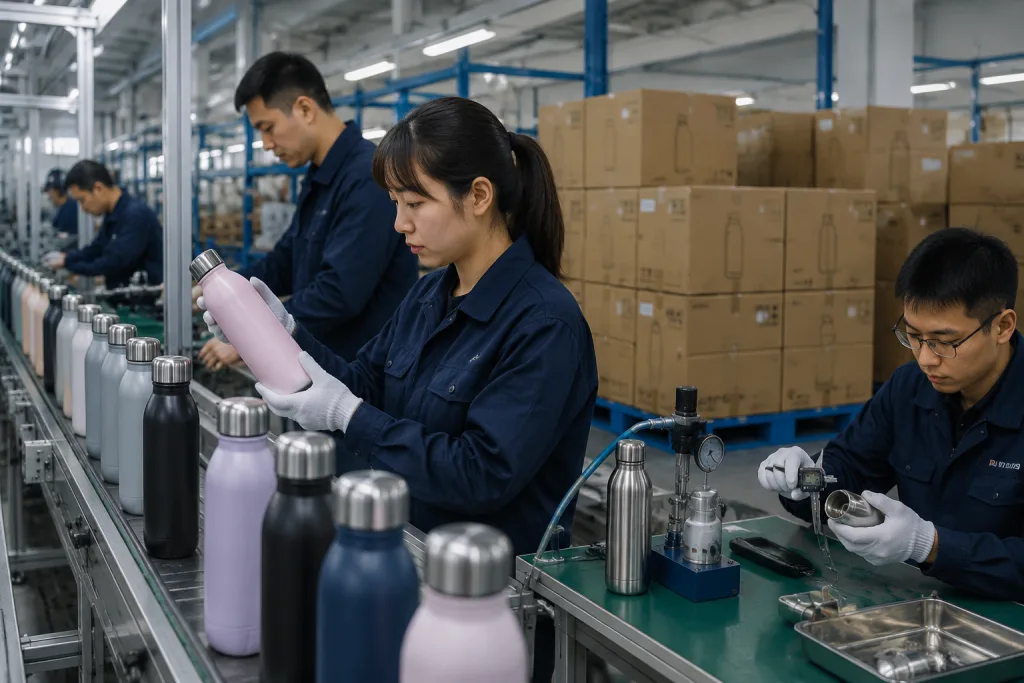
Price gaps usually sit in steel gauge, lid construction, finish loss rate, testing scope, packaging, and order size. At our Zhejiang, China production base, a normal MOQ starts at 1,000 units per color, and a repeat order usually ships in 30-40 days after deposit and artwork approval. We run the line differently for matte powder coating than for plain brushed steel because the reject rate can jump from 2% to 7% if the curing oven is not dialed in. Cheap is not always wrong, but comparing only the unit price is the wrong question to ask.
What the base bottle really costs
For a standard 304 stainless steel vacuum insulated bottle, the factory price starts with the body, not the logo. This is the wrong question to ask first. A common 500 ml bottle with 304 stainless steel inside and outside, double-wall vacuum construction, and powder coating usually lands around USD 3.20-4.80 FOB at 3,000 units. At 1,000 units, the same item is usually USD 0.30-0.70 higher because the steel cutting, coating line setup, carton packing, and inspection time get spread across fewer bottles. On our line, changing from silver to matte black still means washing the spray booth and resetting the powder gun, even if the PO only shows one Pantone code.
Wall thickness matters. Most retail and corporate orders we run use 0.4-0.5 mm stainless steel for the inner wall and 0.5-0.6 mm for the outer wall. If you ask for a lighter promotional bottle, the quote often uses thinner material. If you need better dent resistance for outdoor retail, heavier gauge adds cost and shipping weight; the math does not work if the target carton must stay under 12 kg. QC pulled one 500 ml sample last month with a 0.38 mm outer wall, and the buyer flagged the dent beside the shoulder after a 76 cm drop test. Neither choice is automatically wrong, but you should know what you are buying.
The vacuum process also changes price. A reliable canteen factory tests vacuum performance after welding and again after coating. We run the first check on the vacuum tester before polishing, then QC checks heat retention after coating with 95°C water for 6 hours. Rejects from welding leaks, coating scratches, and lid fit issues are real costs. A cheap canteen supplier can bury those losses by accepting loose defects, and we have seen this go sideways when 4% of lids rocked on the thread gauge. A serious canteen manufacturer prices for a controlled defect rate and AQL inspection, usually AQL 2.5 for major defects and AQL 4.0 for minor cosmetic issues.
As a Zhejiang manufacturer, we prefer quoting by construction: capacity, steel grade, wall thickness, lid material, finish, and packing. If your RFQ only says “custom canteen, matte black, logo,” you will receive quotes that are not comparable. We ship cleaner quotes when the buyer gives a 2D drawing, target carton size, and lid photo; one recent PO even had “304 stainelss” typed wrong, so our merchandiser confirmed the steel grade before releasing the BOM.
MOQ tiers and price behavior
MOQ is not a punishment. It is line math. A canteen manufacturer sets it to cover line changeover, powder coating loss, color matching, and carton production. For about 7 out of 10 customizable drinkware projects we quote, 1,000 units per color is the practical entry point. Below that, we can run a sample lot or pilot order, but the unit price gets ugly because the line still needs artwork checking on the laser file, a jig setup on the rotary fixture, and full QC with calipers and leak testing.
At 1,000 units, a customized canteen with one-color logo sits near the high end of the quote range. At 3,000 units, price often drops by 5-12%. At 5,000-10,000 units, steel purchasing and coating yield improve again, sometimes another 3-8%, depending on color and lid type. We run the powder booth at about 180-200°C, and a hard-to-match matte beige can waste 18-25 kg of powder before the shade card is approved. For distributor drinkware programs, mixed forecast planning matters. Split colors, yes. Split them too hard and the math doesn't work.
- 1,000 units: good for a first market test or a regional corporate program where the buyer still expects 100% carton drop-test photos.
- 3,000 units: better for distributor canteen orders with 2 steady colors, because the line loses less time between coating batches.
- 5,000+ units: stronger pricing with smoother packaging sourcing, plus better shipping consolidation when we load 40HQ containers.
Custom growler and customized growler projects often need a higher MOQ if the body is large, the cap is specialized, or the finish needs manual handling. A 1.9 L growler uses more steel, takes more space on the coating rack, and packs fewer pieces per carton. QC pulled one 1.9 L sample last month with a 0.35 mm rim ovality issue after polishing, so the bigger body is not just “more volume.” The minimum can still be 1,000 units, but the price gap between 1,000 and 3,000 units is often wider than on a 500 ml bottle.
If you are a canteen distributor or distributor growler buyer, ask suppliers to quote at 1,000, 3,000, and 5,000 units in the same table. Put color, lid, logo method, carton spec, and delivery term on the same PO line; we once had a buyer type “mat black” instead of “matte black,” and purchasing held the coating approval for 2 days. You will see the real cost curve fast.
Logo and finish cost drivers
Decoration is where custom drinkware budgets get messy fast. We see it on about 7 out of 10 RFQs after the buyer adds a second logo position or moves the mark across the bottle seam. Laser engraving is clean, durable, and usually adds USD 0.15-0.45 per unit depending on logo size and position; our line checks the mark with a 0.5 mm placement tolerance on the first 20 pcs. Silkscreen printing can be cheaper for a simple one-color mark, often USD 0.08-0.25 per unit, but ink coverage, bottle curvature, and curing time decide the real cost. Heat transfer and full-wrap graphics cost more, commonly USD 0.40-1.20 per unit, because artwork alignment and defect control are harder. QC pulled one 750 ml sample last month because the wrap drifted 1.8 mm near the back joint. Small miss, big argument.
Powder coating is now the main retail finish for stainless bottles. Standard colors cost less because powder inventory and line settings are already stable; we run black, white, navy, and olive most weeks without changing the spray gun setup. Custom Pantone-matched coating may require a minimum powder purchase, usually adding USD 80-200 per color or increasing MOQ. Metallic, rubberized, gradient, and speckled finishes look good in sales photos, but they raise rejection risk. A 3% finish defect rate on a simple matte color can become 6-10% on a demanding effect finish, especially after the 3M tape test and 60-minute hot water check. The math does not work if the buyer wants a luxury finish but prices it like stock matte black.
For canteen promotional projects, the cheapest route is a stock body, standard powder color, and one-position logo. That is the setup we ship fastest because the body tooling, carton insert, and logo jig are already sitting beside the line. For premium customized drinkware, you may want laser engraving on powder coating, debossed silicone grip, custom lid color, and retail sleeve. That can add USD 0.50-2.00 per unit before freight. We have seen this go sideways when a buyer approves the bottle price, then adds a silicone grip with a 1.2 mm raised logo after the PO is typed.
Do not approve decoration from a flat PDF only. Ask for a pre-production sample or at least a decorated golden sample under normal warehouse lighting.
A canteen customizable program with several brand owners should lock a logo placement guide. Use fixed dimensions, for example 38 mm wide logo, 22 mm below shoulder, centered opposite the lid hinge. If every customer changes the logo size, side position, and print method, your canteen vendors will treat each order as a new setup instead of a repeatable program. We once caught a PO typo that said “right side logo” while the approved sample showed left side; that single word would have stopped packing for 12 hours.
Tooling, lids, and packaging
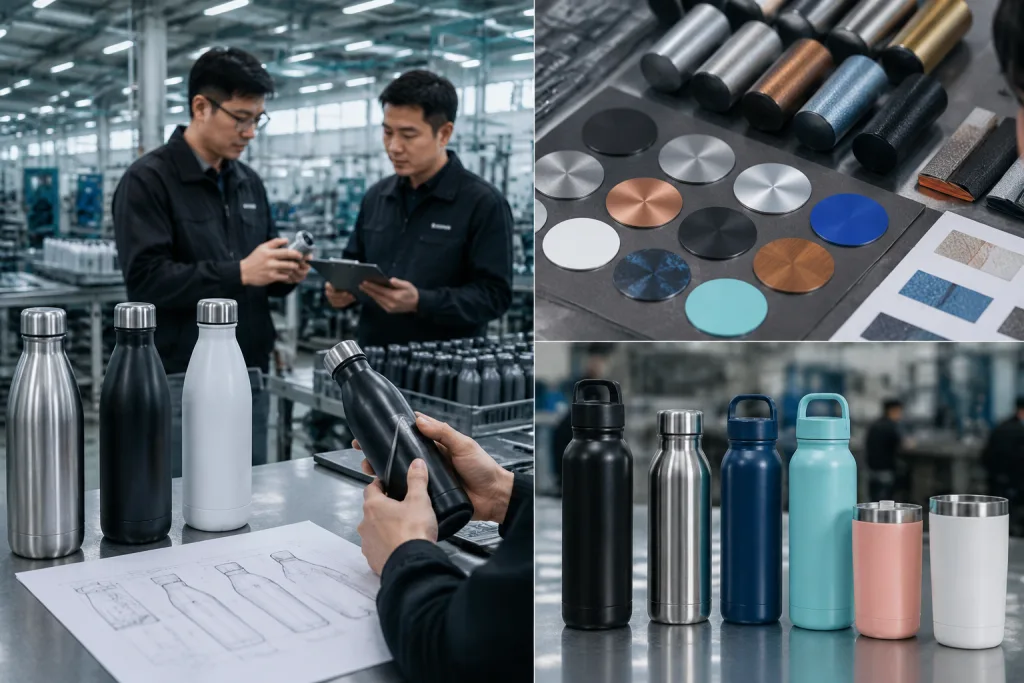
The body shape sets the tooling bill. Use our existing bottle body and we usually do not charge a body mold fee; you still pay for samples, decoration screens, and color matching if the Pantone chip is not in our coating room. For a private shape, new tooling can run from USD 1,500 for a simple lid insert or silicone gasket to USD 8,000 or more for a bottle body, lid assembly, and welding fixtures. Tooling time is normally 25-45 days before sample testing, and QC will still pull the first vacuum sample for heat-retention and leak checks before we quote mass production timing.
Lids get buyers into trouble. A basic screw lid may use PP with a silicone seal, but a carry-loop lid, straw lid, chug lid, or leak-resistant one-touch lid means more pins, springs, gaskets, and hand assembly on the line. For Europe and North America, we normally recommend food-contact compliant PP, Tritan where transparency is needed, and LFGB or FDA-grade silicone. If the bottle is for children, talk about ASTM, CPSIA, and small-parts concerns before the PO; we have seen a 6 mm loose plug stop a shipment after the buyer flagged it during pre-production review.
Packaging can move the landed cost more than the bottle engineer expects. A plain white box may add USD 0.12-0.25, while a printed retail color box can add USD 0.25-0.60 depending on paper weight and MOQ. Gift tubes, molded pulp trays, hang tags, barcode labels, and FNSKU labels all add labor, so the math does not work if the buyer budgets packaging like it is just paper. For Amazon FBA-style distributor drinkware, carton size, master carton weight, scannable labels, and drop-test performance matter as much as the bottle; last month QC rejected 2 cartons because the FNSKU label was readable on the desk scanner but wrinkled after the 80 cm drop test.
At BottleForge Industrial in Hangzhou, Zhejiang, our bottle lines can support about 300,000 units per month across stainless thermos, sports bottle, travel tumbler, and canteen customized orders. Capacity is not instant availability. During March-June and September-November, coating and packaging slots fill quickly, especially for canteen suppliers serving holiday retail programs in China and export markets. We run powder coating, laser marking, and final packing on separate schedules, so one typo on a PO, like “matte balck” instead of matte black, can cost 3 days if the color sample has already been signed off.
A realistic 45 to 70 day timeline
A custom canteen order does not start with the inquiry email. It starts when the spec sheet is tight enough for costing: bottle model, 304 stainless thickness, lid type, coating, logo method, packing, and target test standard. If we run a standard body with one-color silk screen, quotation takes 1-2 working days. If the buyer asks for a custom lid, soft-touch powder coat, or FDA/LFGB review across two markets, 3-5 working days is more realistic. The wrong question is “how fast can you quote?” Ask whether the quote includes the gasket material, inner carton size, and the 0.5 mm wall-thickness assumption QC will later check with a caliper.
Sampling takes 7-12 days for a stock bottle with logo. A custom color powder coating sample takes 10-18 days, because the coating line needs a small-batch spray slot and a cured panel match, not just a Pantone number on paper. New tooling or a private lid can add 35-60 days before you see a functional sample. After sample approval and deposit, mass production commonly takes 30-40 days for 1,000-5,000 units, and 40-55 days for 10,000+ units or mixed-color programs. We have seen this go sideways when a PO says “matte black” but the approved sample tag reads BK-23 with 60-degree gloss at 12 GU.
Inspection should not be skipped. A final random inspection usually takes one day on-site plus report time. For vacuum bottles, the checklist should cover measured capacity by water fill, unit weight on a digital scale, coating adhesion by 3M tape test, logo position within a set mm tolerance, lid torque with a torque meter, leakage test, vacuum performance after hot-water hold, carton drop condition, and barcode scan where needed. About 8 out of 10 canteen distributors we ship for use AQL 2.5/4.0, but critical defects such as leakage should be zero tolerance in the inspection plan. QC pulled a sample last month with a clean carton and good logo, but the silicone ring sat 1 mm proud and failed the upside-down test.
After inspection, FOB delivery to Ningbo or Shanghai port normally takes 2-5 days depending on warehouse location and booking. Our Hangzhou warehouse to Ningbo is usually 1 truck day if the forwarder releases the SO before 15:00; Shanghai can take 2 days when the driver waits for container pick-up. Sea freight to Europe or North America is outside the factory lead time, but plan it before you approve the sample. If you are working backward from a retail launch date, build the schedule from the shelf date, not from the factory production date. The math does not work if marketing wants a June 1 display and purchasing only sends deposit on April 25.
Compliance and documents affect price
For B2B buyers, compliance is not a checkbox for the last week before shipment. It changes material selection, lab fees, and sometimes the order we run the line. For the EU, buyers ask for LFGB, REACH, and food-contact declarations; in our 2024 RFQs, 7 out of 10 EU importers asked for at least 2 of those before confirming artwork. For the US, FDA food-contact expectations, CPSIA for children’s products, Prop 65 review, and ASTM-related safety questions depend on the product and sales channel. Canada has its own packaging and labeling expectations too. Small detail, big cost: QC pulled a 500 ml sample last month where the carton label showed “304 stainless” but the PO typo said “304 stainess,” and the buyer flagged it before booking inspection.
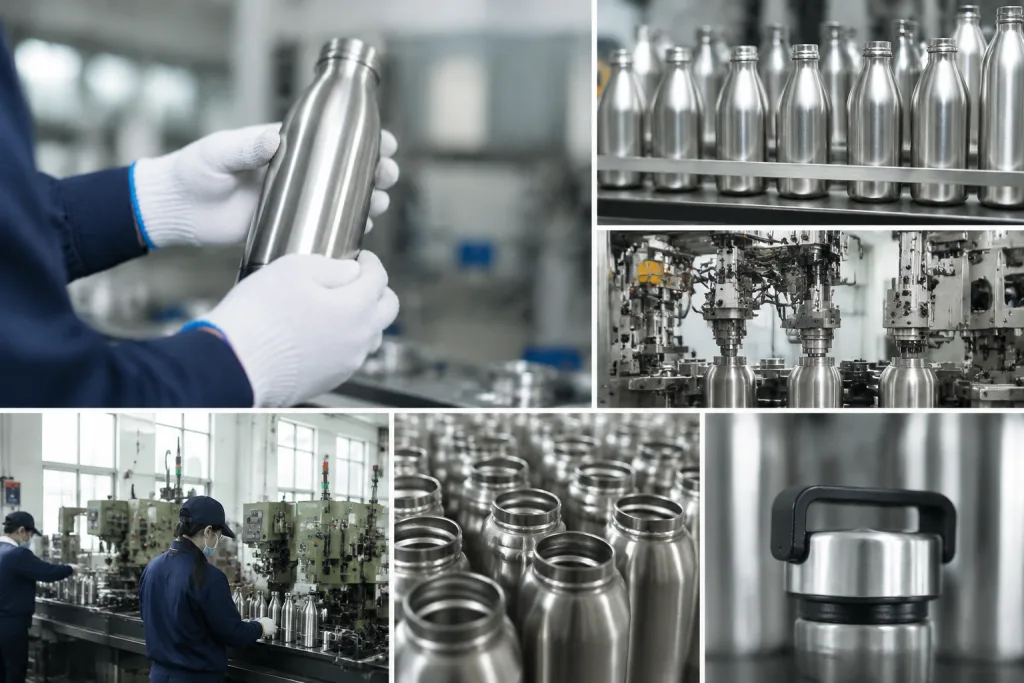
A responsible canteen vendor should provide material declarations for 304 stainless steel, silicone, plastic lid components, coating, and inks. If you need third-party lab testing, budget roughly USD 250-900 per test set depending on market and item complexity. A multi-lid customized drinkware range costs more to test than a single stainless bottle because each food-contact component may need review; 1 bottle with 3 lids can mean 4 contact surfaces on the lab worksheet. The math does not work if the RFQ price assumes one report for everything. On our side, we check silicone rings with a 0.02 mm caliper before sending samples, because a swapped gasket supplier can make an old LFGB report useless.
Factory audits also matter for larger distributors. BSCI, ISO 9001, or customer-specific audits do not make a bottle automatically good, but they reduce operational risk. If your retailer requires a social audit, say it during RFQ, not after PP sample approval. We have seen this go sideways: one buyer approved laser artwork, color chips, and a 3,000 pcs trial order, then their retailer asked for BSCI 12 days before shipment. Not every canteen manufacturer in China is audit-ready, and changing factories after artwork approval is expensive. The line had already cut the first 800 inner cartons.
Documentation should match the shipment: commercial invoice, packing list, HS code, bill of lading, certificate of origin if needed, and test reports tied to the actual material set. When canteen manufacturers cut cost by changing coating, silicone, or lid plastic without notice, old test reports may no longer protect you. Write “no material substitution without written approval” into your purchase order. Short clause. Real protection. Before we ship, our export clerk checks the packing list against the master carton mark, usually 24 pcs per carton for 500 ml bottles, because one wrong HS code or coating description can hold a container at destination customs for 6 days.
How to compare supplier quotes
Compare every canteen quote in one sheet, line by line: capacity; inner steel grade; outer steel grade; wall thickness in mm; lid material; surface finish; logo process; packaging; MOQ; lead time; payment term; Incoterm; inspection standard. If one canteen factory quotes EXW and another quotes FOB Ningbo, the price gap is not only the bottle. It covers trucking to port, export handling, customs documents, and who pays when the forwarder asks for a revised booking. We still see POs with “FBO Ningbo” typed by mistake, and that small typo can burn 2 days before production even starts.
Ask for net weight and gross weight per carton. Put the numbers on the RFQ, not in a WeChat message. On our line we check 500 ml samples on a 0.1 g bench scale before quoting, because two bottles with a 40 g weight gap are not the same build. Ask for temperature performance under one fixed test: water at 95°C, measured after 6 hours and 12 hours at room temperature. “Keeps hot 24 hours” is sales talk; the wrong question is whether it sounds good on a catalog page.
For canteen promotional buyers, speed and budget usually beat exclusive tooling. For brand owners, repeat-order consistency pays the bills. For canteen distributors, a strong vendor keeps the same color code, lid fit, barcode position, and carton size across six repeat POs. We have seen this go sideways: QC pulled the sample, the buyer flagged the barcode sitting 8 mm lower than the approved artwork, and the warehouse rejected 36 cartons because scanning slowed at receiving. A cheaper canteen supplier who changes small details each shipment creates returns, credit notes, and angry retail staff.
A solid RFQ includes target FOB price, annual forecast, first order quantity, sales market, compliance requirements, logo files, packaging style, and launch deadline. Send the AI logo file, carton mark, and dieline if you have them; a screenshot from a 2021 PO is not enough for clean production. With those details, a 304 stainless steel vacuum insulated bottle manufacturer can quote like an engineering partner: steel thickness, lid tooling risk, sample time, carton CBM, and realistic ship date. You get fewer soft promises and more numbers the purchasing team can defend.
Send your bottle spec for a costed quote
We will return MOQ, FOB price, sample timing, and production lead time based on your artwork, market, and packaging requirements.
Frequently asked questions
What is a normal MOQ for a custom 304 stainless vacuum bottle?
For most standard bodies, 1,000 units per color is a workable MOQ. At that level, expect higher unit cost because coating, logo setup, carton printing, and QC are spread across fewer bottles. For better pricing, 3,000 units per color is more efficient, and 5,000 units gives stronger leverage on steel, lids, and packaging. If you need a custom growler, special lid, or private body shape, the practical MOQ may still be 1,000 units, but tooling and sample time will be higher. Mixed colors can be negotiated, but splitting 1,000 units into five colors is usually not efficient.
How much does a 304 stainless steel vacuum insulated bottle cost?
A standard 500 ml bottle with 304 stainless steel, double-wall vacuum insulation, powder coating, and a one-position logo often costs USD 3.20-6.80 FOB China, depending on quantity and construction. A simple promotional bottle may be near the low end. A retail-grade customized canteen with heavier wall thickness, premium lid, laser logo, and printed color box can move above USD 6.00. Large custom growler sizes cost more because they use more steel, occupy more coating line space, and reduce carton loading efficiency.
How long does production take after sample approval?
For a repeat or standard custom drinkware order, mass production usually takes 30-40 days after deposit, artwork approval, and sample confirmation. For 10,000+ units, mixed colors, or special packaging, plan 40-55 days. Sampling before that usually takes 7-18 days depending on decoration and color. If new tooling is involved, add 35-60 days before production can start. You should also allow 1-3 days for final inspection and 2-5 days for FOB delivery to Ningbo or Shanghai port.
Can I use 201 stainless steel to reduce cost?
You can, but we do not recommend 201 stainless steel for the inner wall of a vacuum bottle used for food or beverage contact. 304 stainless steel has better corrosion resistance and is the normal expectation for export drinkware in Europe and North America. Some low-cost products use 201 outside and 304 inside, but the savings are limited and may create perception issues for retail buyers. If your product is positioned as durable, reusable, or premium, specify 304 inner and outer walls in the PO.
What should I send to get an accurate factory quote?
Send capacity, target shape, quantity by color, logo method, packaging style, destination market, compliance needs, and target FOB price. Include AI or PDF logo files and tell the factory whether you need retail packaging, FNSKU labels, or master carton marks. If you have a launch date, share it. A canteen manufacturer can quote within 1-2 working days for a standard item, but custom lids, special finishes, or private tooling may require 3-5 working days for a reliable cost breakdown.