Key Takeaways
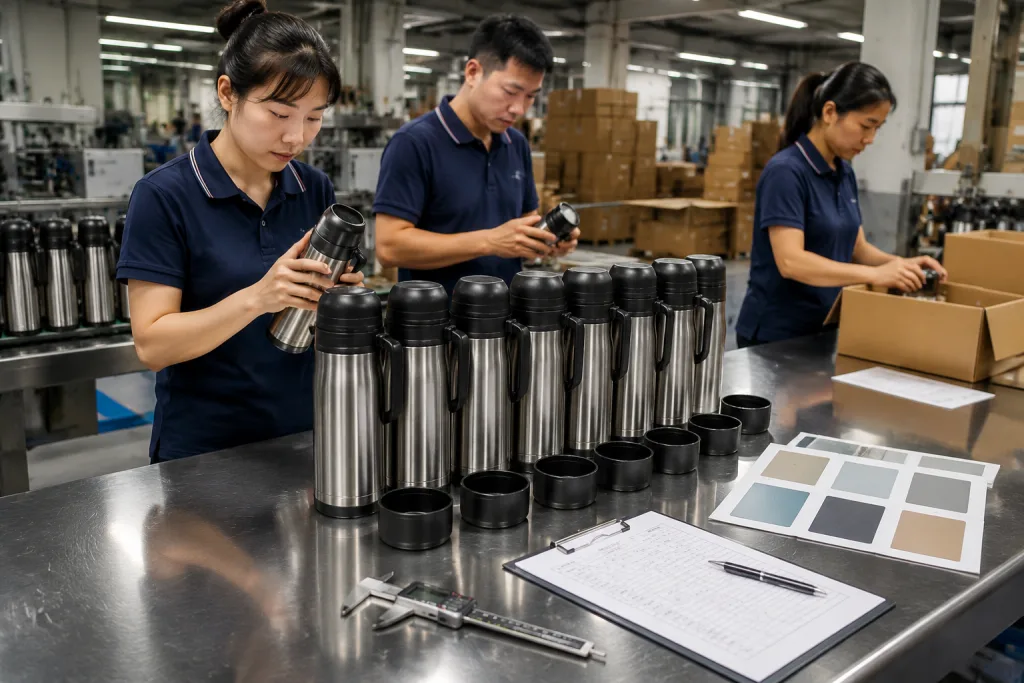
- A practical MOQ for custom thermos orders is usually 1,000-3,000 units per color, depending on logo and lid tooling
- 304 stainless steel should be confirmed with material declaration, incoming coil checks, and food-contact testing
- Laser engraving is durable, but silk screen or heat transfer may fit promotional thermos budgets better
- AQL 2.5/4.0 inspection and 24-hour leak testing samples should be agreed before mass production
You are not buying a catalog bottle. You are buying a flask that has to take a 12 kg master carton drop, shelf handling, trail use, logo checks under a 3M tape test, and the one Amazon customer who drops it on concrete. A 304 stainless steel vacuum flask custom project looks easy until QC pulls the sample and finds 0.42 mm body steel instead of the 0.50 mm written on the spec sheet, or a silicone ring sitting 0.3 mm loose in the lid groove.
From our line in Zhejiang, China, we see the same mistake about 6 times a month: buyers push for the lowest unit price first, then the cap seeps at the thread, the powder coat chips near the base, or the export carton collapses after a rough ISTA-style handling check. Wrong question. For an outdoor retailer or promotional brand, the math starts with leakage rate, coating adhesion, carton strength, and whether the purchase order says “matte black” while the artwork file says “satin black.” We’ve seen that typo go sideways.
What Are You Actually Customizing?
When buyers say 304 stainless steel vacuum flask custom, we usually have to stop the call and split it into 3 jobs. Cosmetic work means logo placement, Pantone color, powder-coat or spray finish, sleeve artwork, gift box layout, barcode, FNSKU, and carton marks; our prepress guy still checks whether the PO says “mat black” or “matte black” before the film is made. Component work covers the lid shape, handle, strap, tea filter, rubber base, straw cap, or push-button cap, and QC pulled the sample last month because a silicone gasket measured 0.4 mm loose in the lid groove. Structural work is the serious one: capacity, mold, mouth diameter, body profile, vacuum performance, and packaging drop resistance.
For most outdoor retailers and promotional brands, the best starting point is a proven factory thermos body with custom surface treatment and packaging. Full new mold development sounds attractive. The math often does not work. It adds 25-45 days, USD 1,500-8,000 in tooling depending on complexity, and more sampling risk; we have seen buyers lose 12 days just adjusting a 2 mm shoulder curve that nobody noticed on the 3D drawing. If you need a 500 ml, 750 ml, or 1,000 ml flask, existing molds usually cover 80% of commercial demand.
A proper customized thermos specification should state capacity tolerance, steel grade, inner and outer wall thickness, finish, lid material, gasket material, logo method, packing method, carton strength, and inspection standard. Do not send only a logo file and target price. Too loose. Our line needs details such as 0.5 mm inner wall, 0.4 mm outer wall, LFGB silicone, laser logo at 35 mm width, 5-layer export carton, and AQL 2.5 before the merchandiser can quote cleanly.
For bulk thermos programs, we usually recommend locking one master specification sheet before quoting. A bottle described as “750 ml matte black vacuum flask with logo” can vary by USD 0.60-1.40 per unit depending on steel gauge, cap design, coating type, and box. That difference is not small when you order 10,000 units for a distributor thermos campaign. We run the costing line by line, because the buyer may flag a USD 0.08 cap upgrade while missing a USD 0.32 color box change.
304 Steel Is Not a Slogan
304 stainless steel is not a marketing line on a spec sheet; we check it because the cup touches hot water every day. In our Hangzhou line, the usual build is 304 stainless steel for the inner wall, then 304 or 201 stainless steel for the outer wall, depending on the target FOB price. Premium outdoor buyers usually ask for 304 inner and 304 outer, and we mark it on the BOM before tooling. Promo buyers often choose 304 inner and 201 outer to cut cost; last month one German buyer flagged this because the PO said “full 304” while the artwork brief said “budget series.”
Ask the thermos supplier to confirm the steel grade in writing and tie it to real test papers. Practical files are a material declaration, LFGB or FDA food-contact report, REACH statement for coating if selling into Europe, plus a BPA-free declaration for plastic lids. If the flask is for children, ASTM or CPSIA-related checks may apply. QC should match the report name to the lid, body, and silicone ring; we have seen reports rejected because the factory code on page 2 did not match the supplier name on the invoice.
Wall thickness matters. We run many manufacturer thermos bodies at about 0.4 mm inner wall and 0.5 mm outer wall before forming, but capacity and shape change the number. Thinner steel can look fine on a desk sample, then dent after a 12 kg carton compression test or a drop on the shoulder radius. The wrong question is “can you make it cheaper?” Ask what thickness the quote uses, measured with a micrometer before forming and again after the drawing step. A good suppliers thermos quote should show this detail.
Vacuum insulation comes from weld control, evacuation time, copper plating or reflective layer choice, and stopper design. For a 500-750 ml flask, a fair target is hot water above 60°C after 6 hours at room temperature, tested from a 95°C fill and closed within 60 seconds. Wide-mouth flasks usually lose heat faster than narrow-mouth flasks because the opening area is larger. That is physics, not poor manufacturing. We have seen this go sideways when a buyer compared a 90 mm food jar with a 38 mm travel bottle and expected the same 12-hour claim.
Ask for test conditions, not just “keeps hot 12 hours.” Starting water temperature, room temperature, fill level, and test duration change the result; our lab sheet records all four before QC pulls the sample.
MOQ, Price, and Lead Time Reality
I’ll keep the tag structure intact and rewrite only the prose, with tighter buyer-facing language and concrete factory details. Then I’ll return the HTML only.For a standard custom thermos on an existing mold, our Zhejiang line usually works at 1,000 pieces per color for laser logo or one-color silk screen. If you want powder coating, color matching, or special packaging, 3,000 pieces is the cleaner number. New lid tooling or a new bottle mold is a different job; 5,000-10,000 pieces is where the math starts to work.
For a 500 ml 304 stainless steel vacuum flask custom order, we usually see USD 3.20-5.80 FOB Ningbo or Shanghai for standard commercial build, depending on lid type, finish, packaging, and qty. A heavier outdoor flask with handle lid, powder coating, and retail box often lands at USD 5.50-8.50. QC pulled a unit with a 0.8 mm print shift last week, so final artwork and spec sheet matter more than any rough quote.
Lead time has three parts. Pre-production sample takes 7-12 days after artwork confirmation. Mass production runs 25-35 days for 3,000-20,000 units. Sea freight to Europe or North America is usually 28-45 days port to port, plus local handling. If the campaign is urgent, air freight can save the date, but the freight bill can outrun the bottle cost fast.
Our thermos capacity is about 600,000 units per month across stainless bottles, travel tumblers, and vacuum flasks, but capacity does not mean open slots. Before peak season, the line books up early. We’ve seen this go sideways when a buyer waits for box copy sign-off and misses the boat by 12 days. If your event date is fixed, send the PO after sample approval.
- Prototype sample: 3-7 days if blank stock exists
- Custom logo sample: 7-12 days
- Mass production: 25-35 days after deposit and approval
- Usual deposit: 30%, balance before shipment or against copy documents
Which Logo Method Survives Use?
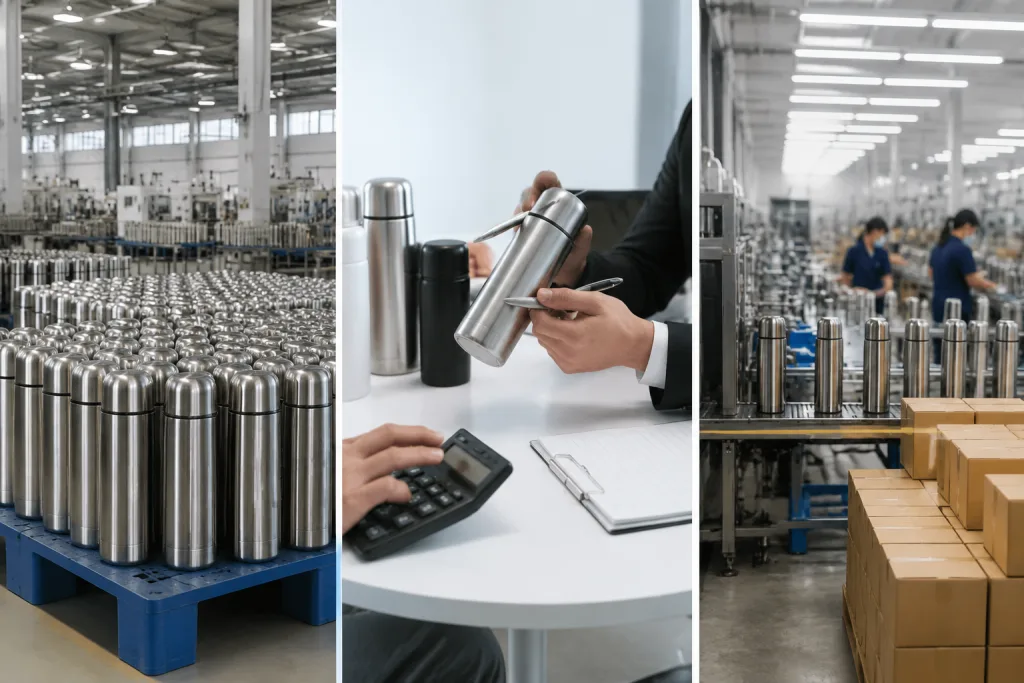
I’ll keep the HTML structure intact and rewrite the prose to sound like a factory-side sales engineer, with concrete shop-floor detail and fewer AI-like fillers.Logo choice is where a lot of thermos custom jobs go sideways. The artwork that looks clean in a PDF can fail once it hits a curved, powder-coated, vacuum-insulated bottle. We run this check on the line with 1 sample in hand, because branding, wear resistance, budget, and lead time do not always point to the same method.
Laser engraving is the safest pick for outdoor retailers. It cuts through or marks the coating, so it does not peel off later. It works on powder-coated, spray-painted, and bare stainless finishes. The price is often around USD 0.10-0.35 per unit, depending on logo size and line speed. The catch is color: laser usually gives tone-on-tone, silver, or a dark mark, not full-color artwork.
Silk screen printing fits simple promotional thermos orders. It is cheap, usually USD 0.05-0.18 per color per position, but the result depends on pretreatment and ink. We had one buyer flag a PO typo on the Pantone code, and QC pulled the sample before production because the shade would have missed the brand book. For trade show giveaways, screen print is fine. For hiking retail, laser or heat transfer usually holds up better.
Heat transfer and UV printing give you more color and gradients. They work for thermos promotional runs where the artwork does the selling. The question is scratch resistance, and this is the wrong place to guess. Ask for a 3M tape test, a cross-hatch adhesion check where applicable, and a rub test. If a supplier will not show those results, we have seen that order go bad before it leaves packing.
Embossed or debossed logos need mold or component tooling. They look premium, but they slow down development. For most first orders, we tell buyers to start with laser engraving or one-color print, watch sell-through, then spend on tooling for the second run. That math works.
Checklist Before You Approve Samples
A sample is not a photo for your internal buyer deck. It is the last low-cost stop before trouble gets expensive. Once 12,000 units are powder coated, laser marked, and packed, changing a lid gasket from 52 mm to 53 mm or moving a logo up by 8 mm means rework, delay, and a factory manager asking who approved the file.
Use a written checklist and send it back with approval comments. For a thermos customizable order, the golden sample should match mass production in body, lid, coating, logo, instruction sheet, barcode, inner box, and carton. If the sample uses a temporary cap or blank box, write that on the approval sheet and ask for a final pre-production sample before mass production. We run this with a red pen on the sample tag because “same as sample” has gone sideways more than once.
- Capacity: Check actual fill volume to the designed level, not overflow volume. Use a measuring cylinder, not a kitchen scale guess.
- Leakage: Fill with water, invert for 30 minutes, shake 20 times, then inspect cap and thread. QC pulled the sample last month after 6 drops formed near the silicone ring.
- Thermal test: Record starting water temperature, room temperature, and 6-hour result. Write the thermometer reading, for example 95°C start, 23°C room, 68°C after 6 hours.
- Coating: Inspect color against Pantone or approved physical chip under neutral light. The line should use a light box, not warehouse daylight at 5 p.m.
- Logo: Confirm size in mm, location from bottom or centerline, and orientation. A 45 mm logo placed 12 mm off-center is still a rejected logo.
- Odor: Smell silicone gasket and lid after hot water contact. We usually soak for 10 minutes before checking, since cold silicone can hide a smell.
- Packaging: Confirm FNSKU, UPC, suffocation warning, carton marks, and carton drop resistance. One PO typo on a UPC can block 300 cartons at the warehouse.
For Amazon or marketplace programs, packaging details matter as much as the bottle. FNSKU labels must scan on a Zebra scanner, carton weight should stay practical for warehouse handling, and each unit may need a polybag, insert card, or warning label. A thermos distributors program going through retail DCs may need GS1 carton labels, pallet height limits, and compliance with retailer routing guides. The buyer usually flags this late; that is the wrong time to discuss a 5-side carton mark.
Approval should be boring and specific. “Looks good” is not enough. Write “Approved: matte black Pantone 19-0303 TCX close match, logo 45 mm wide laser engraved, lid version L2, retail box file BF-750-042.” That sentence can prevent a USD 20,000 misunderstanding. Short words save money.
Quality Control That Catches Real Defects
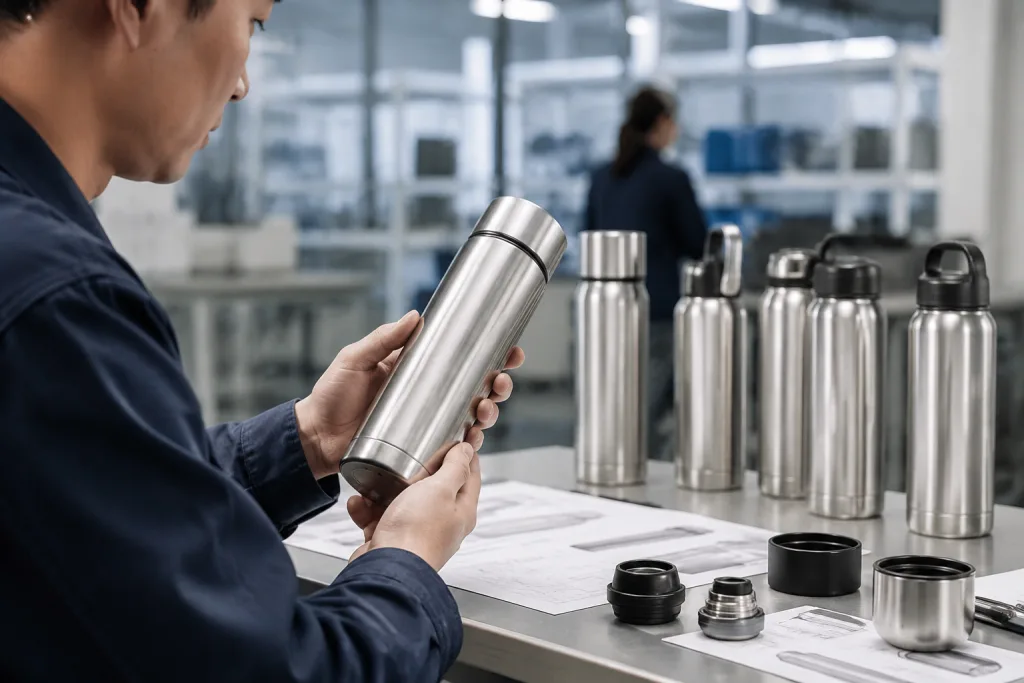
Drinkware defects usually land in five buckets: leakage, weak vacuum, surface defects, printing defects, and packing damage. We run checks at incoming 304 stainless coil, laser welding, polishing, vacuum pumping, coating, assembly, and carton packing. Final inspection still matters, but relying on it alone is the wrong question to ask. Last month QC pulled 32 samples at the packing table and found 3 lids with silicone rings not fully seated.
For bulk thermos orders, AQL inspection is the common language. About 8 out of 10 overseas buyers we work with use AQL 2.5 for major defects and AQL 4.0 for minor defects, with critical defects set at 0. Critical defects include sharp metal burrs, unsafe contamination, serious leakage, and wrong material. Major defects include failed vacuum performance, visible dents over the agreed limit, logo shift beyond tolerance, cap malfunction, and wrong packaging. Minor defects include small cosmetic marks inside the approved sample standard. On one PO, the buyer typed “matte black lid” while the artwork file showed silver; the line stopped until sales, QC, and the buyer confirmed the lid color.
Leak testing should not mean “we looked at it.” At minimum, random units should be filled to the shoulder, inverted for 10 minutes, shaken 20 times, and checked on dry tissue paper. Vacuum performance can be checked by temperature retention testing or by scanning the outer wall after hot water filling. Fast hot spots are a bad sign. If the outside wall reaches 45°C within a few minutes after 95°C water is poured in, QC should pull the sample and check the vacuum station record.
For coating, powder coating usually beats basic spray paint on chip resistance, but the math does not work if the curing oven is unstable. Ask for coating thickness targets if durability matters; powder-coated bottles often sit around 60-90 microns. Too thin can chip. Too thick can tighten the thread fit or leave orange peel texture. We check this with a coating thickness gauge and a thread go/no-go fixture, because a pretty bottle that fights the lid will still get rejected.
We recommend third-party inspection for first orders above 5,000 units or any order tied to a hard launch date. It costs a few hundred dollars, much less than receiving a container of thermos customized products with mismatched lids. We have seen this go sideways: 12 cartons opened, 4 different lid shades found, and the buyer flagged it before shipment. If you already have a trusted China QC partner, bring them in before production starts, not after the cartons are sealed with 48 mm tape.
Questions To Ask Your Supplier
Good questions shorten sourcing. Bad questions get friendly replies and soft quotations. When you contact a thermos supplier in Zhejiang or another China cluster, send a full RFQ and ask for proof: material spec, lid photo, carton size, test report, and sample lead time. We reject about 3 RFQs each week because the buyer asks for “best price” but gives no capacity, coating, or packaging. The line cannot quote air.
Start with the product: “Is the inner wall 304 stainless steel? What is the outer wall material? What are the wall thicknesses before forming? Which lid is included in the quotation? What gasket material is used?” Ask for numbers, not adjectives. For a 500 ml flask, we run inner shell material at around 0.4 mm before stretching; if a supplier refuses to state thickness, the math doesn't work. Then move to customization: “What is your MOQ per color? What logo methods fit this coating? Can you provide a pre-production sample with final packaging?” Last month QC pulled the sample because the PO said matte black, but the artwork file showed Pantone 426C gloss.
For compliance, ask whether the factory has BSCI, ISO 9001, or other audit documents if your retail customer requires them. A solid factory does not always carry every certificate, and a certified factory can still ship weak goods. Documents help screen supplier thermos risk. For Europe, REACH and LFGB questions are normal. For North America, FDA food-contact expectations, Prop 65 screening, and retailer-specific requirements matter on retail orders. We have seen a buyer flag a silicone gasket smell during AQL 2.5 inspection even though the steel body passed.
For commercial terms, ask whether the quote is FOB Ningbo, FOB Shanghai, EXW, or DDP. Freight causes most price arguments. A low EXW price from a thermos factory is often not cheaper after inland trucking, export handling, and documents; Hangzhou to Ningbo port can add 1 truck, 2 warehouse moves, and a customs file before the carton reaches the vessel. If you are comparing thermos suppliers, compare the same Incoterm, carton quantity, packaging, and inspection requirement. Same basis first.
Ask who owns the artwork files, molds, and exclusive design rights. If you pay for a custom lid mold, the agreement should say whether it is exclusive, the term length, and the annual order volume needed to keep it. We once had a buyer push for exclusive rights on a lid mold after ordering only 1,000 pcs; we've seen this go sideways. Good manufacturers thermos partners will discuss ownership before tooling starts, because a vague mold agreement turns into a fight when the second customer asks for the same cap.
Send Your Thermos Specification Before You Quote
Share capacity, logo file, target quantity, market, and packaging needs. We will return a practical FOB quote and sampling plan.
Frequently asked questions
What is the normal MOQ for a custom 304 stainless steel vacuum flask?
For an existing mold, the normal MOQ is 1,000 pieces per color for laser engraving or simple one-color printing. If you need powder coating in a custom Pantone color, retail box printing, or multiple logo positions, 3,000 pieces is a safer planning number. New mold work usually starts from 5,000-10,000 pieces because tooling, trial production, and QC setup need volume to make sense. For a first outdoor retail test, we usually suggest using an existing 500 ml or 750 ml manufacturer thermos body and spending the budget on better coating, packaging, and inspection instead of custom tooling.
Is 304 stainless steel enough for outdoor retail quality?
Yes, 304 stainless steel is a solid standard for most outdoor drinkware if the construction and testing are controlled. The inner wall should be 304 because it contacts the beverage. The outer wall can be 304 for premium positioning or 201 for lower-cost promotional use, but you should know which one you are buying. Ask for food-contact reports, a material declaration, and clear wall thickness. A flask with 304 steel but weak welding, thin outer wall, or poor cap gasket will still disappoint users. Material grade matters, but it does not replace process control.
Which logo method should we choose for a promotional thermos?
For a promotional thermos where budget matters, one-color silk screen printing is often the best value at roughly USD 0.05-0.18 per color per position. For outdoor retail or long-term corporate gifts, laser engraving is more durable and normally costs around USD 0.10-0.35 per unit depending on logo size. If your artwork needs full color, heat transfer or UV printing can work, but require scratch and tape testing before approval. Do not choose only by appearance on a sample photo. Ask your thermos vendor for adhesion testing and a physical sample using the final coating.
How long does a custom thermos order take from China?
For standard thermos bulk production from China, plan 7-12 days for a logo sample after artwork approval, then 25-35 days for mass production after deposit and sample sign-off. Sea freight to Europe or North America often adds 28-45 days port to port, plus customs clearance and inland delivery. If you need retail packaging, barcode labels, or FNSKU application, add several days for artwork confirmation and packing checks. A realistic calendar from RFQ to warehouse delivery is often 8-12 weeks unless you use air freight or already have approved samples.
What quality standard should we put on the purchase order?
Put the inspection standard directly on the PO. A common setup is AQL 2.5 for major defects, AQL 4.0 for minor defects, and 0 tolerance for critical defects. Define critical defects as leakage, sharp burrs, unsafe contamination, wrong material, or failed essential function. Also state logo tolerance, color reference, carton drop expectation, and thermal test method. For example, require a 6-hour hot water retention test with recorded starting temperature and room temperature. This gives the thermos manufacturers and any third-party inspector a measurable standard instead of a subjective argument.