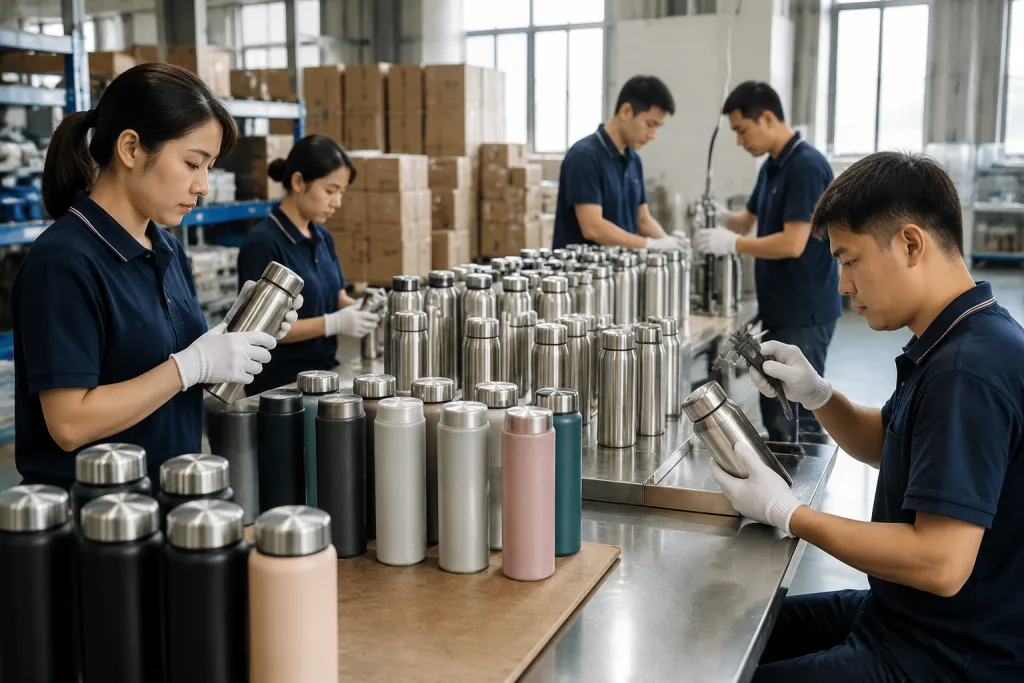
Key Takeaways
- For wholesale 304 bottles, specify 18/8 inner steel, 0.4-0.5 mm wall thickness, and copper-coated vacuum where needed
- A realistic MOQ for custom thermos colors is 1,000-3,000 units per SKU, depending on finish and lid tooling
- Leak tests should include inversion, 45° tilt, and 30-minute pressure or hot-water checks, not only a quick visual test
- Use AQL 2.5 for major defects and AQL 4.0 for minor defects on distributor thermos orders
A 304 stainless steel vacuum bottle wholesale order looks simple on a quotation sheet: 500 ml, Pantone color, flip lid, laser logo, 24 pcs carton, FOB Ningbo. Then the calls start after delivery. Lids seep in backpacks, powder coating chips on the retail shelf, logos land 2 mm off center, or a customer posts orange spots beside the weld line and calls it rust. QC pulled one sample last month with a lid gasket 0.4 mm thinner than the approved sample. That tiny gap was enough.
These problems are not “bad luck.” They usually come from loose specs, skipped incoming 304 stainless checks with an XRF gun, and AQL 2.5 written on the PO without clear defect limits. From our thermos factory in Zhejiang, China, we see the same 6 mistakes from outdoor retailers and promo brands running their first bulk thermos program. The fix is not adding paperwork for fun. Write the purchase spec like you already know where the line can fail, because we have seen this go sideways when the buyer only approves a nice photo sample.
Start With Steel That Matches Claims
The first failure mode is selling a “304 bottle” that is only partly 304. Last month we checked 12 low-price quotations for 500 ml bottles; 7 used 304 stainless steel for the inner wall, then 201 or 202 for the outer shell. Legal if declared. Not the same as a full 304 stainless steel vacuum bottle wholesale program. For outdoor retail, hydration brands, and premium promotional thermos campaigns, decide before quoting whether you need 304 inside only or 304 inside and outside. The buyer flagged this exact point after QC pulled the sample and found the outer shell grade missing from the PI.
The practical spec is simple: inner liner SUS304, food contact grade 18/8, thickness 0.4-0.5 mm for most 500 ml to 1,000 ml bottles. Outer shell can be SUS304 or SUS201, usually 0.45-0.6 mm, based on shape, dent resistance, and price target. If your catalog says “304 stainless steel,” ask your thermos supplier to state exactly which parts are 304 on the proforma invoice and inspection checklist. We run this as a line item, not a chat message, because one PO typo, “304 body” instead of “304 inner,” has already cost a buyer 18 days in rework.
Material failure usually shows up as rust complaints, metallic smell, or weak impact resistance. Real 304 stainless steel can still show tea stains, chloride marks, or contamination spots if polishing dust and iron particles are not removed. Passivation, washing, and clean assembly matter here. On the factory floor, our QC team uses an XRF gun on incoming coils and random finished bodies, especially for new suppliers thermos programs. We’ve seen this go sideways when a subcontracted shell shop mixed 201 blanks into a 304 rack after polishing.
For EU and North American buyers, request LFGB or FDA food-contact test reports where appropriate, plus REACH declarations for coating and silicone parts. Do not accept a generic certificate from “some bottle.” The test item should match your material, coating, and gasket. A manufacturer thermos quote that is USD 0.18 cheaper but cannot prove material composition is not cheaper once returns start. The math doesn't work: 2 cartons of rust claims can wipe out the saving on 3,000 pcs, before we even count air freight for replacements.
Vacuum Loss Is Usually Built In
The second failure mode is poor heat retention. Buyers often approve one golden sample, then expect the thermos bulk shipment to behave the same. That is risky. Vacuum performance comes from the laser weld, evacuation pressure, copper coating, lid seal, and aging rack time; skip 8 hours on the line and the bottle can look clean but lose heat like a single-wall cup. We have seen this go sideways when QC pulled the sample after carton packing and the shell was warm to the touch.
A typical 500 ml 304 vacuum bottle should hold water above 60°C after 6 hours when filled with 95°C water at room temperature around 20°C, but the result changes with mouth diameter and lid structure. A 38 mm narrow-mouth model usually beats a 58 mm sports lid because the heat leak at the cap is smaller. Copper coating improves retention, but it adds cost, so put it on the spec sheet instead of assuming the factory will run it for free. The buyer flagged this once after seeing “copper lined” in a catalog photo, while the PO only said “silver inner wall.”
The production risk is slow vacuum leakage. It does not always fail right after welding. That is why factories need aging before final packing, not after the container is booked. At BottleForge Industrial in Hangzhou, Zhejiang, our standard schedule for manufacturer thermos orders includes vacuum testing after evacuation and a second heat-retention sampling check before carton sealing. Our monthly stainless bottle capacity is about 450,000 units, but we still block at least 25-35 days for normal custom thermos production after artwork approval; cut that to 18 days and the math does not work, because vacuum validation gets pushed into the danger zone.
Your purchase order should define heat-retention criteria, sample size, test method, and rejection rule. Do not write “keeps hot 12 hours” without a temperature curve. Write it like this: fill to rated volume with 95°C water, close lid for 6 hours at 20°C ambient, acceptable result ≥60°C for 500 ml narrow-mouth bottle. For premium outdoor models, test 12 hours too, but set the pass line around the bottle geometry, not the sales copy. One PO we received had “6 house test” instead of “6 hours test”; our merchandiser caught it before PI confirmation.
Vacuum claims fail when marketing language replaces test conditions. Put temperature, time, fill volume, and ambient temperature into the spec.
Lids Leak Before Bodies Fail
The third failure mode is leakage, and 8 times out of 10 it starts in the lid system, not the stainless body. A good bottle body with a weak gasket is still a bad supplier thermos. We saw this on a 3,000 pcs outdoor order last May: QC pulled the sample, filled it to 20 mm below the rim, and the lid wept at the thread after 90 seconds. For outdoor retailers, one leaking bottle can soak a backpack, kill a laptop, and lose the next reorder. For promotional thermos orders, the complaint lands on the logo owner, not on the factory that molded the cap.
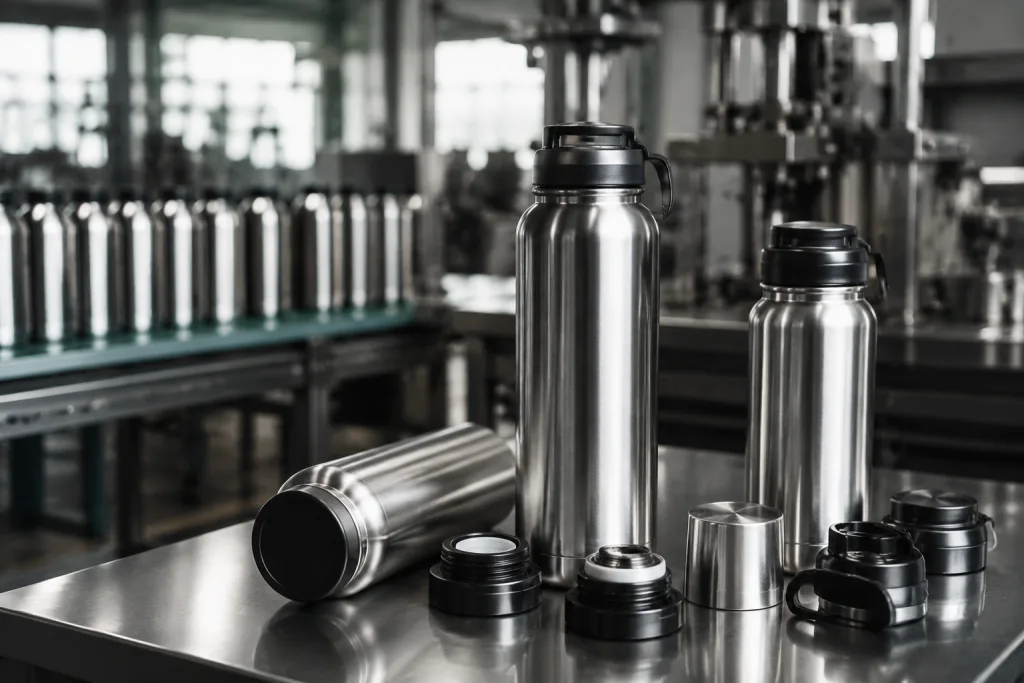
Leakage starts with tolerance stack-up. Thread depth, cap flatness, silicone gasket hardness, gasket compression, straw hole design, and hinge fit all affect the seal, but they do not fail in the same way. For screw lids, silicone hardness around 50-60 Shore A is common, depending on the sealing surface and the cap torque we run on the line. For flip lids and straw lids, the risk goes up because moving parts, vent holes, spouts, and springs add more places for water to escape. A thermos customizable with three lid options may look nice in a catalog; the wrong question is asking whether the bottle passed, when each lid needs its own test report.
We recommend three checks for bulk thermos production. First, run an inversion leak test after filling with room-temperature water; our QC bench uses a simple 10-minute upside-down hold on white tissue. Second, run a 45° tilt test because real users throw bottles into side pockets, car seats, and gym bags, not test jigs. Third, run a hot-water test because pressure changes expose weak gaskets that pass cold water. Be honest. For some travel tumbler lids, label them splash-resistant rather than leakproof, because we have seen this go sideways when a buyer’s Amazon page promised “100% leakproof” on a sliding sip lid.
For the inspection plan, use AQL 2.5 for major defects such as leakage, cracked caps, blocked drinking holes, and missing gaskets. If you are buying a distributor thermos range for multiple accounts, keep spare lids and gaskets available, and mark the carton label clearly by lid type; one PO typo between “straw lid” and “spout lid” can cost 12 days vs 18 days in replacement handling. A 1% spare parts pack is cheap insurance. On custom thermos wholesale orders, we usually recommend ordering extra lids equal to 1-2% of shipment quantity, especially for complex straw or handle lids where small springs and silicone plugs take the most abuse.
Coating Problems Show Up Late
I’ll rewrite the section in-place, keep the HTML tags and structure intact, and make the prose sound like a factory sales engineer wrote it.The fourth failure mode shows up on the surface: chips, peeling, color drift, fingerprints trapped under the coat, weak adhesion, or gloss that lands uneven. A bottle can pass a quick pre-shipment look and still come back from retail with scuffs from a car cup holder, campsite grit, dish rack knocks, or a cold-weather drop on concrete. I’ve seen buyers flag a “close enough” red that was 1 shade off the campaign board. That is the wrong question to ask.
Powder coating gets picked because it gives a tough matte hand feel and solid color range. Spray painting runs cheaper and looks smoother, but it gives up impact resistance. Electroplating and gradient finishes read premium, though the line gets less forgiving and MOQ usually climbs. Do not approve color from a screen image. We run better with a physical Pantone chip or a signed production chip, and for matte powder coat a Delta E under 2.0-3.0 is a practical target, depending on pigment and light. One PO typo on “matt black” versus “matte black” has burned a week before.
Adhesion needs a real test, not a sales promise. Common checks are cross-hatch tape test, boiling water exposure for selected finishes, rubbing test, and a 1.0 m drop onto a hard surface for functional review. A powder-coated 750 ml bottle with a 0.5 mm outer wall dents differently than a 0.4 mm promo thermos, and QC pulled the sample on that difference before shipment. If the buyer cares about ruggedness, lock wall thickness and coating test method in the same line item.
China factories vary a lot here. Some thermos makers send coating to a small workshop with poor dust control; others run a controlled line with pre-treatment, cure temperature records, and batch traceability. Zhejiang has a strong stainless drinkware chain, but you still need to ask who owns the finish. For orders above 3,000 units per color, we want a pre-production sample from the same coating line that will run mass production, not a hand-finished showroom piece. The math does not work any other way.
Logo Rejection Is Preventable
I’ll rewrite the section in-place, keep the HTML intact, and tighten the prose so it reads like factory-side sales guidance.The fifth failure mode is decoration that misses the brand standard. We have passed leak and vacuum tests, then watched a 1.2 mm logo shift kill the order because it sat off-center or got scratched in transit. Promotional buyers flag this fast. The bottle is the ad surface, so a logo defect is not a small issue.
Decoration has to match the bottle shape and finish. Laser engraving runs clean on powder-coated stainless because it cuts through the coating and shows the metal underneath; we run this on the line for one-color marks all the time. Silkscreen printing suits solid brand colors, but curved bodies and rough powder coat can blur the edge. Heat transfer and UV print handle complex artwork, and both need abrasion testing before you sign off.
Before mass production, lock three items: artwork file, position tolerance, and color tolerance. We usually write logo centerline ±1.5 mm, vertical position ±2.0 mm from the bottom reference, and Pantone C matched under D65 light. The buyer once sent a PO with “logo 5mm lower” typed into the notes, and that typo cost us a full reproof. For thermos custom orders, ask for a signed digital proof and a decorated physical sample.
Carton handling matters too. A good logo can get scuffed by weak inner packing, and we have seen that go sideways on export cartons with loose inserts. Paper sleeves, polybags, egg-crate dividers, and molded pulp inserts all change cost. A simple white box adds USD 0.12-0.25 per unit depending on size and paper grade, while full-color retail packaging adds USD 0.35-0.80. If you sell to outdoor retailers, check scuff resistance and barcode placement as hard as the print on the bottle.
Specs Must Control The Factory
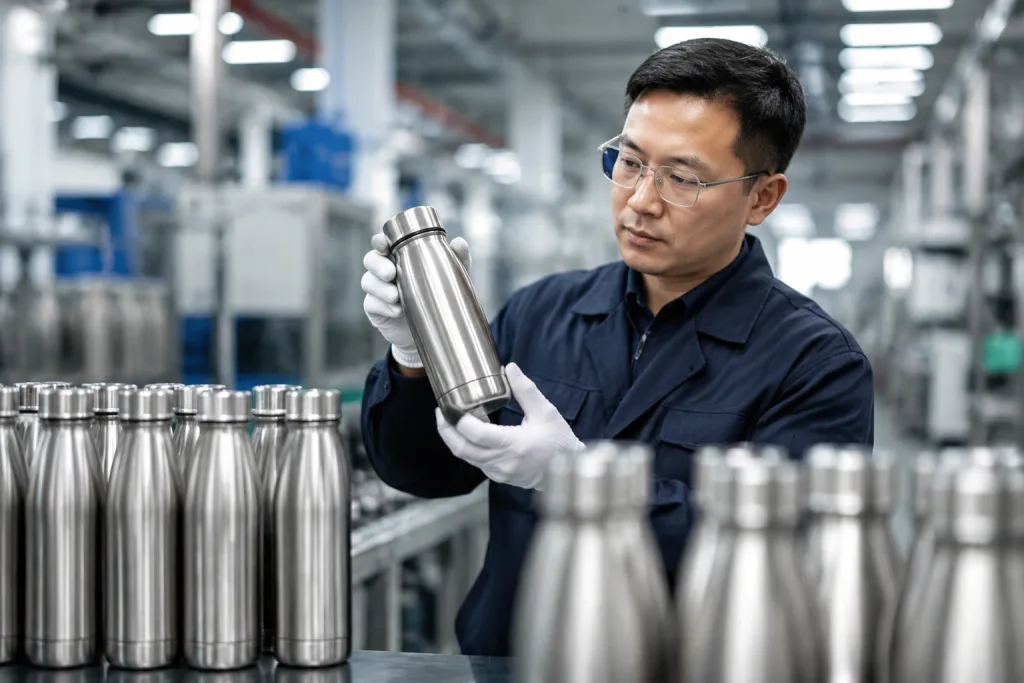
The sixth failure mode is thinking a quotation controls production. It does not. A quote gives price, carton count, and a rough build. The production spec is what tells the thermos manufacturer what passes, what fails, and who pays when the buyer flagged a 0.5 mm logo shift on the pre-shipment sample. We run into this often: two quotes both say “500 ml 304 stainless,” but one uses a 0.38 mm inner wall and the other uses 0.42 mm. The math changes fast. If you buy from 3 thermos suppliers across 2 seasons, a tight spec is the only way to compare pricing without guessing.
Your spec sheet should include model drawing, capacity tolerance, steel grade, wall thickness, lid material, gasket material, coating process, color target, decoration method, logo placement, packaging, barcode or FNSKU requirements, carton drop standard, and AQL table. Spell it out. For color, give Pantone code plus acceptable ΔE if your channel cares; QC pulled one sample last month where “sage green” on the PO became gray-green under the light box. For North America, buyers often request ASTM-related packaging or material checks depending on product and channel. For the EU, REACH, LFGB, and packaging waste requirements may apply. If the bottle is for children, treat it as a separate compliance project, not a smaller adult bottle with a cute print.
Commercial terms change the risk, not just the invoice total. FOB Ningbo or Shanghai is common for Zhejiang production. EXW looks cheaper on line 1, but you then own China-side pickup, export handling, and small errors like the forwarder receiving 52 cartons while the packing list says 50. A practical MOQ for a customized thermos is 1,000 units for laser logo on available colors, 3,000 units for custom powder color, and 5,000 units or more for special lids or new mold work. Sample lead time is usually 7-12 days for laser logo and 12-18 days for custom color or complex decoration. Mass production normally runs 25-35 days after deposit and approved sample.
For payment, many China suppliers use 30% deposit and 70% before shipment. If you are new to a thermos vendor, do not skip third-party inspection. We’ve seen this go sideways over small items: silicone gasket hardness off by 5 Shore A, barcode missing one digit, lid torque feeling loose after the hot-water test. Good factories still make mistakes. Inspection forces the order to be judged against your written standard. Ask for production photos, inline updates, and a final random inspection using AQL 2.5/4.0 before balance payment.
Price Gaps Often Hide Risk
The last failure mode is taking the lowest quote and never asking what got stripped out. Two 750 ml 304 stainless steel vacuum bottle wholesale offers can sit USD 0.60-1.20 per unit apart for clean reasons. One quote may cover a full 304 body, copper-coated vacuum, 70-80 μm powder coating, silicone strap, individual kraft box, and 2% spare lids. The cheaper quote may switch to 201 outer steel, cut the wall by 0.08 mm, use basic paint, skip heat-retention aging, and pack in bulk cartons. We saw QC pull a sample last month where the magnet test caught 201 outer steel after the buyer said, “Same shape, cheaper is fine.” It was not fine.
Ask for a costed breakdown, but do not demand the factory show every margin line. That usually goes nowhere. You need the cost drivers: steel grade and body weight first, then coating type, lid mold complexity, decoration process, packaging spec, testing scope, and freight terms. On our line, a push-button lid with 6 small parts takes slower assembly than a screw cap, and the labor gap shows up before anyone talks profit. A supplier thermos price under your target can work for a 30-day supermarket gift campaign. For a warranty-backed outdoor retail line, the math does not work if heat-retention aging and drop checks are removed.
Compare landed cost, not FOB only. A bottle with a bulky handle lid may reduce carton quantity by 15-25%, raising freight per unit. A heavier wall improves hand feel and dent resistance, but it adds shipping weight fast; one 24 pcs master carton can jump from 11.8 kg to 13.6 kg after a wall-thickness change. For Amazon-style or retail distribution, carton size, 5-layer master carton strength, barcode accuracy, and FNSKU placement prevent warehouse delays. We once had a PO typo listing a 52 mm barcode position instead of 25 mm, and the buyer flagged it before inbound booking. Distributors thermos programs need repeatable reorders, so lock the model, lid version, and carton dimensions before mass production.
The better buying question is not “What is your best price?” Ask this instead: “What failure rate am I accepting at this price?” A strong manufacturers thermos partner should answer with material specs, an AQL 2.5 inspection plan, lead time, and the trade-offs they built into the quote. If the answer is only “quality good,” keep digging. We have seen this go sideways: nice sample, thin production coating, then 3% paint chips after a 60 cm drop test.
Send Your Thermos Spec Before You Quote
Share capacity, lid style, finish, logo, MOQ, and target market. We will flag production risks before you place a bulk order.
Frequently asked questions
What MOQ should I expect for a custom 304 stainless steel vacuum bottle wholesale order?
For a logo-only custom thermos using an existing bottle and stock color, a realistic MOQ is 500-1,000 units per design. For custom powder coating, plan on 3,000 units per color because the coating line needs setup, cleaning, and color control. For a new lid, new mold, or exclusive body shape, MOQ usually starts at 5,000-10,000 units, plus tooling charges. If a thermos supplier offers 100 units with full custom color at a very low price, it is often a trading sample batch, not controlled factory production.
Is 304 stainless steel enough for outdoor retail bottles?
Yes, 304 stainless steel is the standard choice for most outdoor and promotional vacuum bottles because it balances corrosion resistance, food safety, workability, and cost. For marine environments or heavy salt exposure, 316 stainless can be considered, but it is more expensive and rarely necessary for normal drinkware. The bigger issue is not only the grade, but whether the inner liner is true 304, whether the welds are clean, and whether iron contamination is removed after polishing. Ask for XRF checks and food-contact reports.
How do I compare thermos factory prices fairly?
Compare the same specification line by line: capacity, actual body weight, inner and outer steel grade, wall thickness, lid type, coating process, logo method, packaging, test standard, and FOB port. A USD 3.20 bottle and a USD 4.05 bottle may not be equivalent if one has copper-coated vacuum, retail box, thicker powder coating, and stricter AQL inspection. Also check carton quantity and dimensions because freight can shift landed cost by USD 0.20-0.70 per unit on bulky models.
What lead time is normal for customized thermos production in China?
For existing molds with laser engraving, samples usually take 7-12 days and mass production takes 25-35 days after deposit and approval. Custom powder color or complex printing usually adds 5-10 days. New lid or body tooling can add 30-60 days before production starts. Around Chinese New Year, add at least 3-4 weeks of planning buffer. Zhejiang and other China drinkware clusters can produce quickly, but vacuum aging, coating curing, and final inspection still need time.
What inspection standard should I use for bulk thermos shipments?
Use a written AQL plan before production. A common setup is AQL 0 for critical defects, AQL 2.5 for major defects, and AQL 4.0 for minor defects. Critical defects include unsafe materials, sharp edges, or contamination. Major defects include leakage, failed heat retention, broken lids, severe dents, wrong logo, and wrong color. Minor defects include small cosmetic marks within agreed limits. The inspection should include random carton selection, visual checks, leak tests, capacity checks, barcode scans, and packaging review.