Key Takeaways
- Use 304 stainless steel for inner walls, with 0.4-0.5 mm typical wall thickness for retail-grade bottles
- A realistic MOQ for customized thermos production is 1,000-3,000 pcs per color
- Vacuum insulation should be checked at 6 hours and 12 hours, not only with a brochure claim
- Normal lead time is 35-45 days after artwork approval for bulk thermos orders
A vacuum bottle spec sheet looks simple until 3,000 pcs land in your warehouse with heat retention below spec, paint rubbing off at the shoulder, or a flip lid that starts leaking after 14 days in a school bag. We’ve seen this go sideways. If you buy for an outdoor retailer or promotional brand, you are not just picking a nice shape; you are fixing 304 stainless grade, inner and outer wall thickness in mm, powder coating, cap mold choice, 5-ply carton strength, test reports, and the complaint rate your sales team will have to answer for.
As a 304 stainless steel vacuum bottle supplier in Zhejiang, China, we see the same mistake on about 7 RFQs out of 10: the buyer asks for “a 500 ml custom thermos” before setting the insulation target, leak test standard, or drop test height. Wrong first question. A good spec sheet should tell the thermos manufacturer what to build, what QC must test, and what the line cannot swap when production is tight; last month QC pulled a 500 ml sample with a 0.38 mm outer wall where the PO called for 0.42 mm, and that 0.04 mm gap mattered.
Steel grade is not decoration
The first line on your spec sheet should name the steel, not hide it: inner wall 304 stainless steel, outer wall 201 or 304 stainless steel. For drink-contact surfaces, we run 304 as the baseline because it handles coffee, tea, electrolyte drinks, and light acid better than 201; QC has rejected 201 inner-wall samples after a 24-hour tea soak left visible staining around the weld line. If the bottle is sold as outdoor or retail premium, use 304 inside and outside. For a promotional thermos order chasing a USD 0.18-0.25 saving, 304 inside and 201 outside can work, but lock it before quotation.
Do not accept wording like “food grade stainless steel” without the grade. That is the wrong question to ask. Food grade is a claim; 304 is the material spec our incoming inspector checks with an XRF gun before the coil goes to forming. For North America and Europe, supplier thermos documents should support LFGB or FDA food-contact expectations where applicable, plus REACH for coatings and plastic parts if selling into the EU. We have seen this go sideways when a PO said “SS food grade” and the buyer flagged it at shipment inspection.
Typical wall thickness for a 500-750 ml manufacturer thermos is 0.4-0.5 mm per stainless layer. Dropping to 0.35 mm can cut the FOB by 3-6 cents, but the math does not work if cartons arrive with side dents after a 1.2 m drop test. The bottle feels wrong, too. Outdoor retailers notice weight, balance, and finish at the shelf. Promotional brands should look at failure rate first: a dented customized thermos with your client’s logo is not a small defect; it is a complaint with photos attached.
At our Hangzhou, Zhejiang facility, we build around 420,000 stainless bottles per month across thermos bulk, sports bottle, and travel tumbler lines. We ship that volume through 6 assembly lines, with QC pulling pre-production samples before mass polishing starts. Scale helps pricing. It does not replace a written spec. China has plenty of suppliers thermos options; the reliable factories freeze material grade in the proforma invoice and the pre-production sample report, down to “304 inner / 201 outer” if that is what the buyer approved.
Capacity changes the real cost
Capacity is not a carton-print detail. A 500 ml bottle and a 1,000 ml bottle often run on different body molds, carton sizes, lid torque settings, and CBM math. We check this on the line with a 0.1 g scale and a water-fill jig. If you ask 3 thermos suppliers for “a similar bottle” without locking the capacity tolerance, you are not comparing the same SKU.
For retail, we usually see 350 ml for commuters and 500 ml for daily outdoor use; 750 ml and 1,000 ml go into hiking, camping, or worksite channels. Promo buyers mostly stay with 500 ml and 750 ml because the gift value still matches the freight bill. A 500 ml powder-coated custom thermos may pack 24 pcs per export carton. A 1,000 ml version may pack 12 pcs. Simple math. One buyer pushed back on a USD 0.08 FOB gap last May, then ignored that the larger carton added 18% more CBM per piece.
Ask your thermos factory to state capacity tolerance, for example 500 ml ±5%. Ask if the test is brim-full or to the practical fill line; we write this on the spec sheet before sample approval. This is the wrong question to leave until packaging artwork. If your online listing says 20 oz and QC pulled the sample at 18.5 oz normal fill, returns will follow.
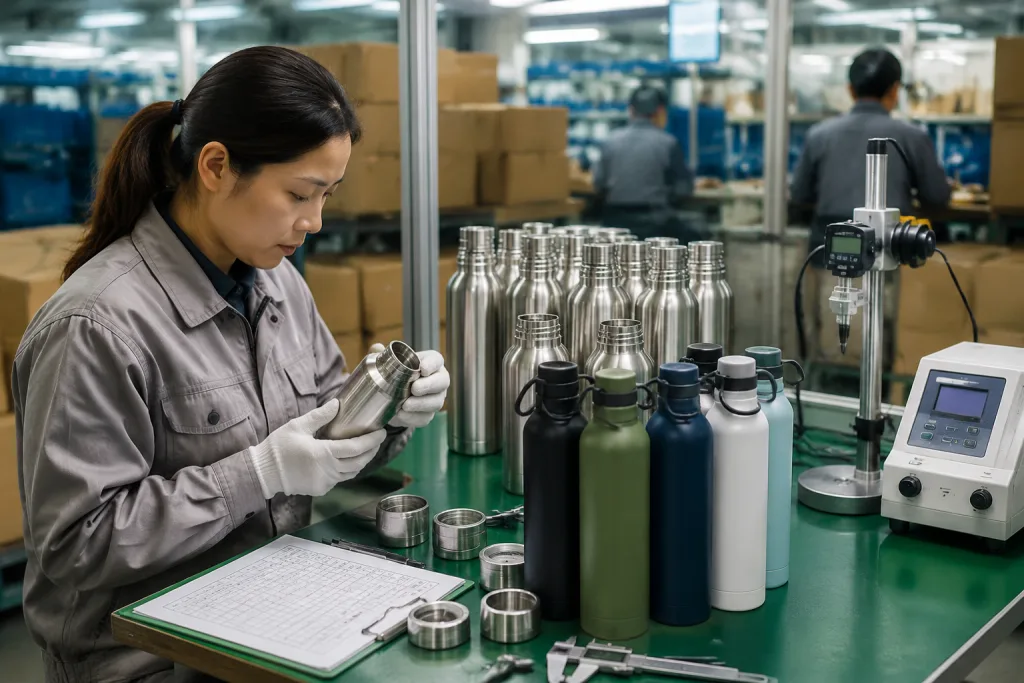
Weight belongs on the quote sheet too. A solid 500 ml vacuum bottle may weigh 280-340 g depending on steel thickness, cap design, and coating. If a bottle is 40 g lighter, ask where the grams came out: body wall, lid plug, or base plate. We use a digital caliper to check wall feel around the shoulder, because we have seen this go sideways. Outdoor customers accept a few extra grams if the bottle survives a trail drop. They do not accept a base that caves in after one weekend.
Vacuum performance needs test numbers
Insulation claims are where spec sheets turn into sales talk if nobody writes down the test method. “Keeps hot for 12 hours” is the wrong question to ask. We record 5 items on the QC sheet: starting water temperature, room temperature, fill volume, test duration, and final temperature. For a stainless steel vacuum bottle, we run a common bench test at 95°C starting water, 20°C room temperature, lid closed, full fill, with readings at 6 hours and 12 hours using a calibrated probe thermometer inserted 35 mm below the water line.
A well-built 500 ml bottle should hold hot water above 65°C after 6 hours and above 45°C after 12 hours under controlled conditions. Bigger bottles often score better; a 750 ml body has less heat loss per ml than a slim 350 ml body. Cold retention needs its own test. Don’t mix it with ice photos. We’ve seen this go sideways when a buyer accepted “24 hours cold” based on a cup packed with 180 g of ice, then QC pulled the sample and found the vacuum was weak after a plain 12-hour water test.
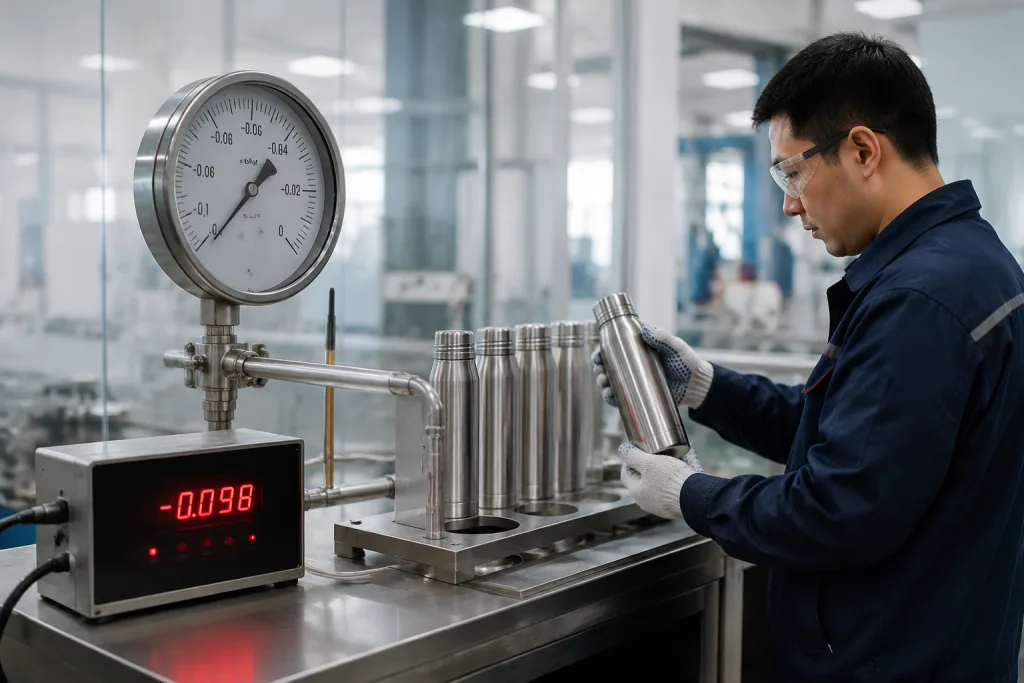
For bulk thermos orders, ask for 2 checks: vacuum leak detection on the line and finished-goods temperature testing by sampling. Vacuum failure comes from poor welding, oil or dust before sealing, or dents from rough handling between polishing and packing. You will not see it from the outside. A glossy powder coat can hide a bad bottle until your customer fills it with coffee; last winter we rejected 37 pcs after the helium leak station flagged pinholes near the bottom weld.
For an AQL inspection, most buyers we work with use AQL 2.5 for major defects and 4.0 for minor defects. Treat insulation failure as a major defect because the bottle no longer does its job. If you are placing a distributor thermos order for seasonal outdoor retail, do not rely only on the supplier’s internal QC photos. Put the insulation test method into the purchase order, including 95°C water, 20°C room temperature, 500 ml fill, and 12-hour final reading. Clear rules prevent arguments after shipment; one PO we received even typed “12 house test,” and the buyer flagged it before deposit because the math didn’t work.
Lids decide complaint rate
The cap is the line buyers underestimate on the spec sheet. They spend 40 minutes approving Pantone color and logo size, then sign off a lid without checking one-handed opening, gasket fit, thread engagement, or dishwasher exposure. On a thermos custom program, the lid drives 6 of 10 after-sales complaints we see: leaks in a backpack, coffee odor, broken flip buttons, and no matching spare parts. QC pulled a 500 ml sample last month and found a 0.4 mm gap at the silicone seat. That gap leaked after one shake test.
Specify the lid material in writing. PP and Tritan are common; some buyers choose stainless steel outer shells, silicone gaskets, or nylon parts when the fill temperature is higher. If you sell in Europe, request REACH compliance for plastic and coating materials. For kids or family outdoor channels, confirm BPA-free material declarations and, when relevant, ASTM or CPSIA expectations for the market. We run incoming checks with a Shore A durometer on silicone rings, because a gasket at 45 Shore A seals differently from one at 60 Shore A. The buyer flagged this once after the PO only said “black lid.” Too loose.
Thread design matters. A screw cap with 2.5-3 full thread turns is safer than a shallow decorative cap with a nice render. Flip lids open faster, but the hinge needs cycle testing; we use a simple fixture on the line and run 3,000 open-close cycles before we trust a new mold. For promotional thermos projects, cheap flip lids look fine in the sample room and fail after two weeks in daily use. This is the wrong place to save USD 0.08. If your end user is an outdoor retailer, ask for at least 3 leak tests: upright, inverted, and horizontal after shaking for 30 seconds.
Gasket design should be removable if users need to clean it. A hidden silicone ring traps coffee residue, then customer service gets the smell complaint. If the bottle is a thermos promotional gift, the recipient will not study care instructions, so the design must forgive lazy washing. We’ve seen this go sideways on a 20,000 pcs order when the gasket tool left a 0.2 mm flash line and QC found brown residue after a coffee soak test. If you need spare lids, agree on the ratio before shipment. A practical figure is 1-2% spare lids for distributor thermos inventory, packed separately and labeled by SKU.
Surface finish affects sell-through
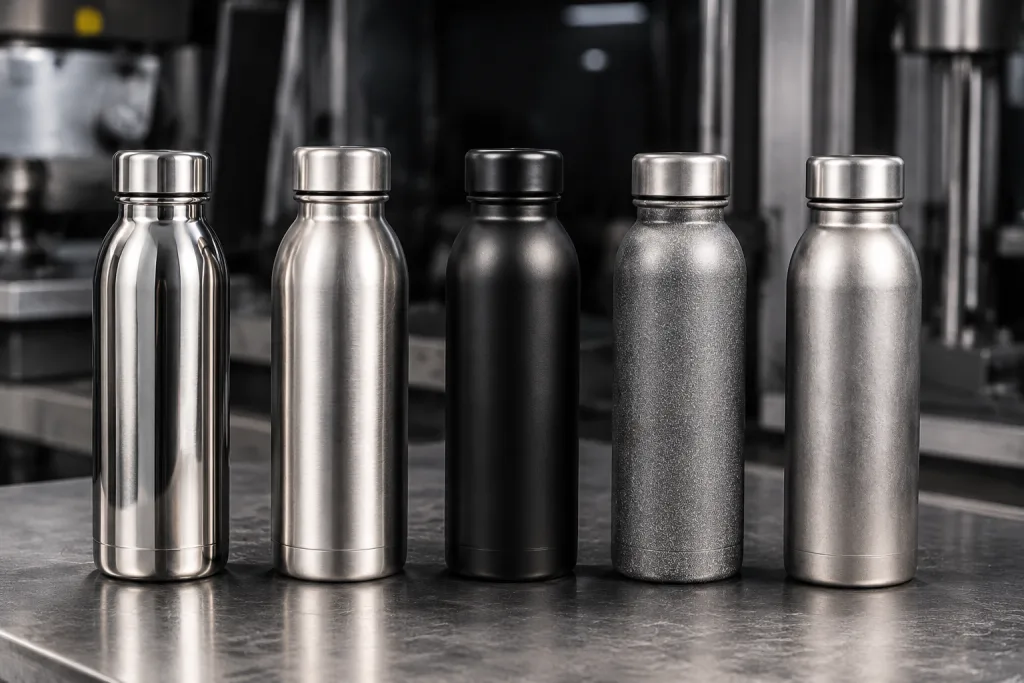
Finish is not decoration. It decides hand grip, scratch marks, logo edges, and whether a bottle still looks saleable after 60 days on a store shelf. We run powder coating, spray painting, stainless polishing, matte raw steel, rubberized coating, and gradient paint on the line, but powder coating is the safer default for outdoor retail. It gives better grip and better abrasion resistance than basic spray paint; QC pulled a black spray-paint sample last month with silver showing on the shoulder after carton rub.
For a customized thermos, write down the coating type, color code, gloss level, and color tolerance on the PO. Pantone matching on metal is never exact, and this is the wrong place to approve from a laptop screen. Use a physical pre-production sample, checked under a D65 light box, then sign the bottle body and lid together. If you need 4 colors, MOQ applies per color. Our standard MOQ in Zhejiang is 1,000 pcs per color for existing molds and 3,000 pcs per color when a new coating or lid combination needs line setup; we have seen buyers forget “per color” on the PO and then argue when the math changes.
Logo method should match where the bottle will be used. Silk screen works for simple one- or two-color logos and keeps cost down. Laser engraving lasts longer and looks cleaner on powder-coated or stainless surfaces, especially when the artwork has thin 0.3 mm lines. Heat transfer can carry complex artwork, but we test it harder for abrasion. Full-wrap printing is possible, yet reject risk rises because alignment and dust control are harder; one dust speck under the film can kill a whole side panel.
Ask your thermos vendor for a cross-hatch adhesion test or at least a tape test on coated samples. For retail, we also recommend a simple abrasion check: 500 cycles with a dry cloth or specified test pad on the logo area. Not fancy. It catches weak ink before mass production. For a promotional brand, one failed logo can affect thousands of impressions, and we have seen this go sideways when a buyer chose the cheapest print, then the logo scratched before the trade show ended.
Packaging is part of protection
Packaging belongs in the technical spec, not in the artwork folder three days before shipment. Stainless vacuum bottles take daily use well, but transit damage shows up fast at the shoulder, base, or cap edge; QC pulled 12 dented samples last winter after a loose divider let bottles kiss inside the carton. A normal export pack uses an individual polybag or tissue wrap, white box or kraft box, egg-crate divider, and 5-layer corrugated master carton. For heavier 750 ml and 1,000 ml thermos bulk orders, carton strength matters more than saving USD 0.06 on the box. We’ve seen this go sideways.
If you sell through outdoor retail stores, the unit box has to stand straight on the shelf and scan cleanly at checkout. For e-commerce, think like the parcel hub. Amazon-style fulfillment often needs FNSKU labeling, carton labels, and packaging that survives mixed handling with shoes, books, and 8 kg cartons on top. A 60 cm carton drop test on 1 corner, 3 edges, and 6 faces is a reasonable starting point for vacuum bottle packaging, though the final test should match your sales channel. On our line, we run the first packed carton through a drop-test board before mass packing, not after 2,000 cartons are sealed.
For FOB Ningbo or FOB Shanghai shipments from Zhejiang, packaging volume hits the freight bill directly. A 500 ml bottle packed 24 pcs per carton may produce a carton around 48 × 32 × 28 cm, depending on bottle shape and box style. Switching from plain white box to color gift box can increase volume by 5-12%. The box looks better, yes, but the math doesn't work if nobody adds the extra CBM into landed cost. Last month a buyer approved a gift box at 92 mm width, then flagged freight after the container plan lost 186 cartons.
Put barcode type, country-of-origin marking, recycling marks, warning text, and carton labels into the packaging spec. Do it early. For Europe, check language requirements by destination market. For the US and Canada, confirm importer details and any state-specific labeling needs. Good thermos manufacturers in China can print what you approve; they should not write compliance wording for you. We once caught a PO typo that said “Made in Chian” during prepress, and that 5-minute check saved a full carton-label reprint.
Ordering terms should be explicit
The last spec lines look commercial, but they still hit product quality. Tie MOQ, sample time, tooling cost, payment term, inspection timing, and lead time to the bottle spec on the PI. For an existing thermos mold we run in Hangzhou, plain samples normally take 7-10 days; logo samples take 10-14 days because the line needs artwork output, film check, and one adhesion test with 3M tape. Mass production is usually 35-45 days after deposit and artwork approval. Before Q4, waiting until September can add 10-15 days. We see this go sideways when the PO says “same as sample” but the sample lid was black PP and the bulk order needs a custom Pantone cap.
FOB pricing for a 500 ml 304 inner-wall vacuum bottle commonly ranges from about USD 3.20-5.80, depending on outer steel grade, lid type, coating thickness, logo method, and color box structure. A 750 ml version may range from USD 4.20-7.20. These are not fixed promises for every design, but they are close enough to catch a quote that is too cheap to survive production. The math doesn't work if a supplier quotes USD 2.60 FOB for 500 ml, adds powder coating, laser logo, individual color box, and still claims 304 stainless inside; QC usually finds the shortcut in the lid gasket, the wall thickness, or the carton paper.
For payment, about 8 out of 10 thermos factories use 30% deposit and 70% balance before shipment. If you require third-party inspection, book it when 100% of goods are produced and at least 80% packed. That gives the inspector enough finished cartons to pull by AQL 2.5 while leaving 2-3 days for rework if QC pulled the sample and found scratched coating or loose lid fit. Do not inspect too early. A half-packed order only tells you how the first part of the line behaved.
Ask whether the quotation is valid for 15, 30, or 45 days. Stainless steel, packaging paper, and exchange rates move; one RMB swing can erase the margin on a container. A supplier thermos quote without validity becomes an argument later. Confirm Incoterms too. FOB, EXW, and DDP are not interchangeable. If you are a new importer, FOB Ningbo or FOB Shanghai is usually cleaner than EXW because the factory handles China-side export procedures, including the customs declaration and commercial invoice. For repeat distributor thermos programs, judge the supplier by how clearly they write these terms before they ask for a deposit; we once had a buyer flag a PO typo where “FOB Ningbo” became “EXW Ningbo,” and that one word changed who paid the trucking, port fee, and export docs.
Send your thermos spec sheet for factory review
We will check material, MOQ, coating, packaging, and realistic FOB pricing before you commit to tooling or bulk production.
Frequently asked questions
What MOQ should I expect from a 304 stainless steel vacuum bottle supplier?
For existing molds, a practical MOQ is usually 1,000 pcs per color for a custom thermos with one logo. If you need a special coating, custom lid color, retail gift box, or a fully customized thermos body, expect 3,000-5,000 pcs. Small trial runs below 500 pcs are possible only when using stock bottles and simple laser engraving, but the unit price will be higher. For outdoor retailers, 1,000 pcs is normally enough to test one size and two colors. For promotional brands, it depends on event quantity and logo method. Always confirm whether MOQ is per SKU, per color, or per total order.
How do I know if the bottle is really 304 stainless steel?
Start by writing “inner wall SUS304” into the quotation, invoice, and pre-production sample approval. Then request a material declaration from the thermos manufacturer and, for higher-value orders, arrange third-party testing by XRF or chemical analysis. A magnet test is not reliable enough because some stainless steel can show weak magnetic response after forming. If the bottle contacts drinks, the inner wall matters most. For EU retail, also ask for LFGB food-contact testing when appropriate. A serious thermos supplier should be willing to document the grade before mass production, not only claim “food grade” in a catalog.
What is a reasonable FOB price for a bulk thermos order?
For a 500 ml bottle with 304 inner wall, powder coating, simple logo, and standard box, FOB China pricing often lands around USD 3.20-5.80. A 750 ml bottle often ranges from USD 4.20-7.20. The spread comes from outer steel grade, lid complexity, coating quality, carton specification, and order quantity. If one thermos vendor quotes 25% below everyone else, check wall thickness, lid material, insulation test, and packaging before celebrating. Low FOB price can become high landed cost if you receive dents, weak coating, or poor heat retention.
Which logo method is best for promotional thermos projects?
Laser engraving is the safest choice when you want durability and a premium look, especially on powder-coated bottles. Silk screen is cheaper and works well for simple one- or two-color logos on larger quantities, typically 1,000 pcs and above. Heat transfer is useful for complex artwork or gradients, but it needs abrasion testing before approval. For a promotional thermos used at trade shows or corporate gifting, I would not choose the cheapest print by default. Ask for a logo sample, run a tape test, and rub the print area at least 200-500 cycles before approving mass production.
How long does custom thermos production take from China?
For an existing mold, expect 7-10 days for a plain sample and 10-14 days for a logo sample. After sample and artwork approval, mass production usually takes 35-45 days. Add about 3-7 days for inspection, booking, and China-side export handling before the vessel or truck leaves. Peak season from August to November can add 10-15 days, especially for powder coating and gift box printing. If you need goods for a fixed outdoor season or promotional event, place the PO at least 75-90 days before your required warehouse date.