Key Takeaways
- Specify 304 stainless steel at 0.45-0.55 mm outer wall and 0.35-0.45 mm inner wall for most 500-750 ml bottles
- Use AQL 2.5 for major defects and AQL 4.0 for minor defects on retail and promotional thermos orders
- Plan 35-45 days production after artwork approval for customized thermos bottles with powder coating
- Ask for vacuum retention testing at 95°C water fill with 6-hour and 24-hour temperature records
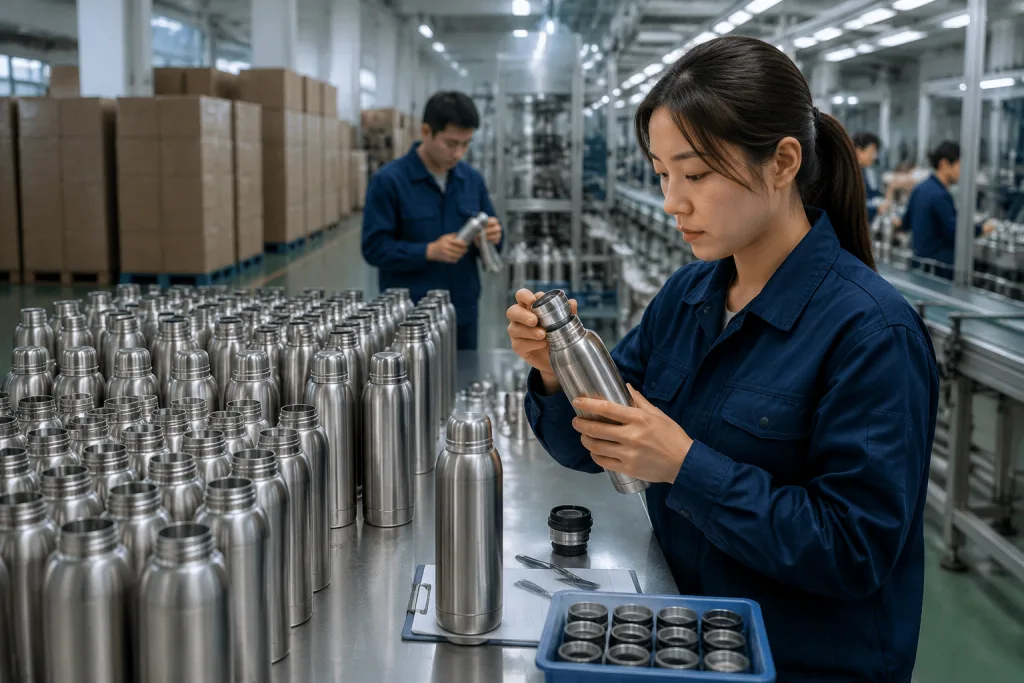
A custom thermos order usually fails in boring places: a lid gasket 0.3 mm too thin, a vacuum weld with shallow penetration, powder coat flakes after a 1.2 m carton drop test, or an AI logo file that looked clean on screen but bled on curved steel during pad printing. We have seen QC pull 32 samples from a 5,000 pcs run because the lid torque felt loose on the torque meter. If you are buying bulk thermos bottles for outdoor retail or a promotional thermos campaign, those small faults turn into chargebacks, late launches, and ugly customer reviews.
As a 304 stainless steel vacuum bottle manufacturer in Zhejiang, China, we see the same mistakes from first-time buyers and distributors who have run 20 thermos programs. “Find a good thermos supplier” is the wrong question to ask. The math doesn't work if the PO says 500 ml, the artwork says 17 oz, and the carton mark has the old SKU typo from last season. You need a spec sheet that blocks common production failure modes before the thermos factory starts cutting steel.
Steel grade claims that do not hold
The first failure mode is simple: the bottle is sold as 304 stainless steel, but the production record is thin. For a custom thermos program, “food grade stainless” is too loose; we have seen buyers try to claim against that wording and lose the argument. Put SUS304 / 18-8 stainless steel for all liquid-contact parts in the purchase order, including the inner liner and neck ring, then name the tea strainer or exposed steel straw if those parts are supplied. QC should be able to pull one liner from the line and match it to a coil tag, not just a carton sticker. The outer shell can also be 304, although some low-price models use 201 outside. That is acceptable only if it is declared and kept away from liquid contact.
For outdoor retailers, I prefer 304 inner and 304 outer on a manufacturer thermos priced above about USD 3.20 FOB Ningbo for a 500 ml powder-coated model. The math works better after dents, rubbed bases, and salt-spray complaints start showing up; one buyer flagged rust dots around the bottom seam after 21 days in a coastal store display. 304 outside gives better corrosion resistance around dents and scratched bases. If you are sourcing a distributor thermos for giveaways, 304 inner plus 201 outer may meet budget, but your packaging must not overclaim “full 304 stainless.” Don’t print that.
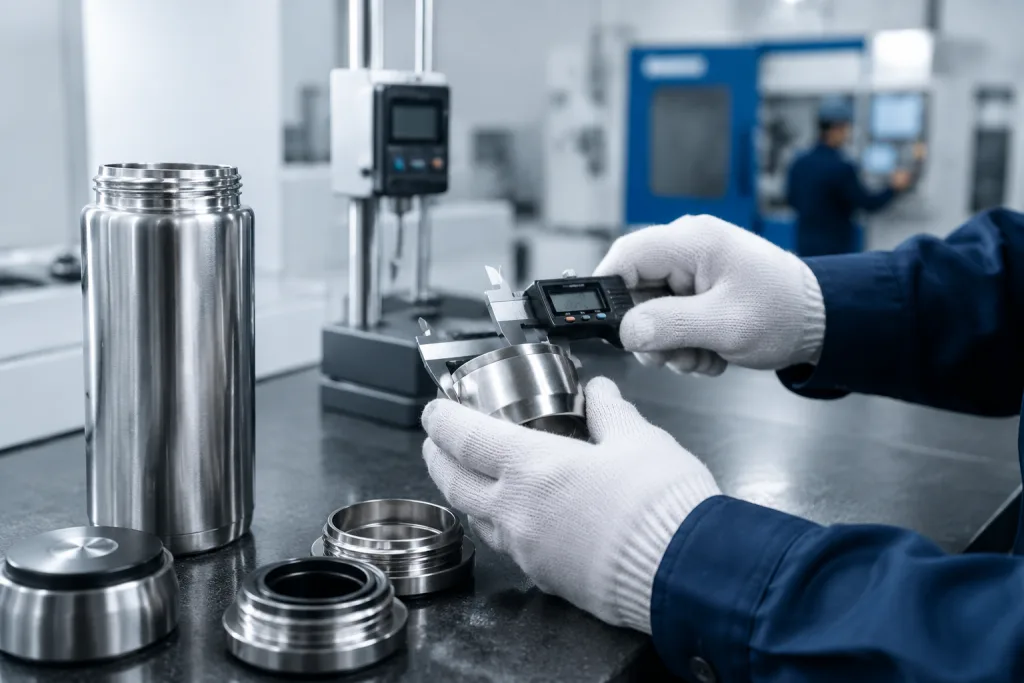
Ask the thermos manufacturer for incoming material inspection: a supplier mill certificate with heat number, PMI spot check by XRF on the coil edge, and thickness records taken with a micrometer before deep drawing. Common wall thickness for a 500-750 ml vacuum bottle is 0.45-0.55 mm outer and 0.35-0.45 mm inner. Below that, you save a few cents but increase denting during sea freight and shelf handling; we have opened a container where QC pulled 14 dented pieces from the first 200 because the outer wall was near the low end. In China, serious thermos manufacturers keep coil lot numbers linked to production dates. If they cannot show that traceability, your “304” claim is running on trust, not evidence.
Vacuum failure after the first shipment
The costliest failure is a bottle that looks clean on the shelf, then drops to lukewarm in the buyer’s kitchen. A vacuum bottle lives or dies by deep drawing, the circumferential weld, evacuation, tail sealing, and for some SKUs, copper plating. One 0.2 mm pinhole at the weld seam is enough. We have seen QC pull a mirror-finish sample from the line that passed appearance, then lost 18°C more than the approved sample after 6 hours. Visual inspection will not catch that.
For a thermos custom order, ask for a hot-water retention test from mass production, not only from pre-production samples. We run a practical check with 95°C water, room temperature at 20°C ± 2°C, then record the bottle temperature after 6 hours and 24 hours with a probe thermometer. A good 500 ml 304 bottle with a proper screw lid should hold above 65°C after 6 hours and around 40-50°C after 24 hours, depending on neck diameter and lid structure. Wide-mouth food jars lose heat faster. Narrow-mouth bottles perform better. The wrong question is “Did the sample keep coffee hot?” The better question is “Did the 3,000-piece lot hold the same curve?”
At BottleForge Industrial in Hangzhou, Zhejiang, our stainless thermos line runs up to 480,000 units per month, but we still test vacuum performance by lot because speed does not protect you from micro leaks. For bulk thermos orders, set a sampling plan such as AQL 2.5 major defects, plus 100% vacuum screening if the unit retail price is high or if the product is going into outdoor retail. On one PO, the buyer wrote “vacuum test: sample only” by mistake, and the math did not work once their retail team asked for batch records. That extra test cost is usually less than USD 0.03-0.06 per unit. Replacing a container of thermos customized bottles costs far more.
Do not approve a vacuum bottle because the sample kept coffee hot once. Approve the production control method.
Lids leak because tolerances drift
Consumer complaints almost never say “bad metallurgy.” They say “it leaked in my backpack.” Lid failure is usually a tolerance stack issue: the injection molded PP cap shrinks 0.15 mm more than expected, the silicone gasket comes in Shore A 45 instead of 55, or the bottle mouth is slightly out of round after necking. QC pulled one 500 ml sample last March where the body passed vacuum testing, but the cap leaked because the assembly torque on the line was 0.3 N·m too low. A customizable thermos with a new lid carries more risk than a standard factory thermos body matched with a cap we already run.
For a screw lid, specify food-contact PP or Tritan where relevant, LFGB or FDA-grade silicone, and gasket hardness around Shore A 50-60 for common bottle seals. Too soft, it mushrooms under the cap. Too hard, it cannot cover slight ovality at the mouth. Ask for a leak test written into the PO: fill to 95% with water, invert for 30 minutes, then shake horizontally for 30 seconds. We also check the thread with a go/no-go gauge after molding, because a nice-looking cap can still sit 0.2 mm high. For sports lids, add a pressure test if carbonated beverage use is claimed. If you do not want the bottle used for carbonation, print that warning clearly on the instruction sheet and carton, not just in a buried manual line.
Outdoor retailers should care about glove usability. Small detail. Big returns. A lid can pass leak testing and still fail in Alaska if the pull tab is too shallow for cold hands. Promotional brands often push for lower cap cost and a wider logo panel, but the thermos vendor still needs cycle testing on flip caps. For moving parts, I want at least 3,000 open-close cycles on the hinge design before launch, with the test sample marked by cavity number. If the thermos supplier says “we have sold 200,000 pieces” but cannot give the cap return rate, the math does not work. Real suppliers thermos teams talk about 0.6% gasket complaints or 1.2% hinge cracks, not slogans.
Coating looks good, then chips
Powder coating, spray painting, and UV printing are the parts buyers notice first on a custom thermos. They are also where we see about 7 out of 10 appearance complaints on factory thermos orders. The stainless steel has to be degreased and pre-treated before coating; on our line, QC checks the pre-treatment bath record and wipes the shell with a white lint-free cloth before hanging it on the rack. If drawing oil or polishing compound stays near the bottom radius, the finish can pass a showroom check, then chip around the bottom ring after 12 cartons ride in a truck for two days.
For a retail-grade customized thermos, put coating thickness and adhesion checks on the PO, not just “good paint.” Powder coating is often 60-90 microns. Too thin gives weak coverage; too thick can cause orange peel and thread interference near the neck, especially when the cap clearance is only 0.3-0.5 mm. Ask for a cross-hatch adhesion test, alcohol rub test for printing, and a 3M tape pull on logo areas. QC pulled one sample last month where the logo survived the first tape pull but failed after the alcohol rub, which tells you the artwork looked fine but the curing was short. For outdoor bottles, I recommend a 1.0 m drop test on a filled sample onto plywood or a rubberized test surface, not concrete unless you are designing a rugged premium product. Concrete will dent stainless; use it as a benchmark, not as your normal retail pass/fail.
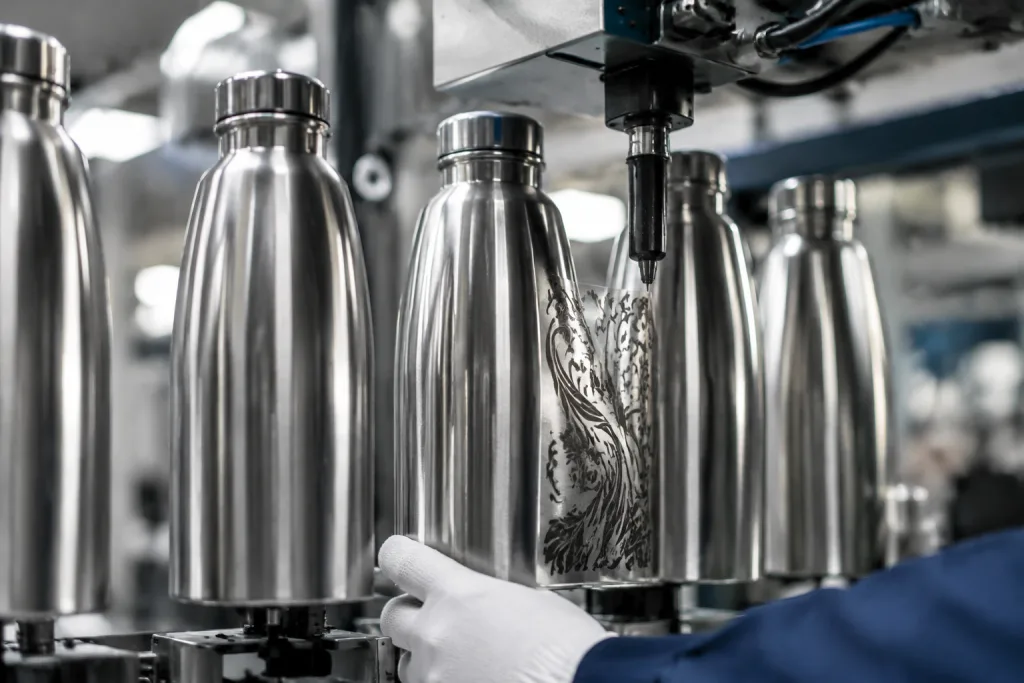
Laser engraving lasts, but it shows the underlying steel tone, so it is the wrong choice for some bright promotional thermos artwork. Silk screen works for 1-2 color logos and usually has a lower setup cost, but registration on curved bottles must be checked with a film ruler, not guessed from a PDF. Full-wrap heat transfer or water transfer gives more design area, with higher scrap risk; we have seen a 3% scrap rate turn into 9% when the wrap crosses a tapered shoulder. If you are buying thermos bulk for a tight event date, do not change color, logo position, or lid color after the golden sample. We’ve seen this go sideways: one buyer flagged a “minor” Pantone change after approval, and the shipment moved from 12 days to 18 days because the line had to re-run panels.
Artwork that fails on curved steel
Promotional brands send clean AI or PDF vector files and still get a weak thermos promotional run. Geometry is usually the culprit. A 70 mm wide logo on a flat proof does not sit the same on a 72 mm diameter bottle body. Fine lines under 0.25 mm often close up on the silk screen mesh. Small reversed text disappears fast on textured powder coating; QC pulled one black 500 ml sample last month because the 1.8 mm tagline turned into a gray block. Metallic inks also drift after oven curing, so a Pantone 877C callout on paper can look flatter on curved steel.
For a custom thermos order, lock the decoration method, logo size in millimeters, position from base or top shoulder, color standard, and acceptable tolerance. Better yet, send a marked bottle diagram. A normal logo placement tolerance is ±1.5 mm to ±2.0 mm on mass production. If you want tighter than that, say it before quotation; the line needs better fixtures, slower loading, and more inspection time. The math doesn't work if the buyer asks for ±0.5 mm after we already priced standard screen printing. For double-sided logos, confirm seam orientation too. Some bottles have an almost invisible weld line or polishing direction, and that 3 mm visual shift is enough for a retail buyer to flag the sample.
For Amazon or retail distribution, packaging artwork can fail before the bottle even leaves Hangzhou. Barcodes need quiet zones. FNSKU labels must scan through matte or glossy label stock. Outer cartons need shipping marks your warehouse team can read from 2 meters away. A thermos distributor in North America may ask for UPC on color box, FNSKU on unit label, and carton labels on two sides; miss one digit or put “sliver” instead of “silver” on the PO, and the carton layout gets held. That is not a small design detail. It belongs in the manufacturing brief. A good thermos factory in Zhejiang should confirm artwork proofs, pre-production samples, and carton layout before asking for the deposit balance.
Compliance gaps that delay customs
I’ll rewrite the section in-place, keep the HTML exactly as-is, and tighten the sales-engineer tone with concrete factory detail in each paragraph.A stainless bottle is simple until the compliance file is thin. For Europe, we run LFGB food-contact testing, REACH screening for coatings and plastics, and sometimes packaging waste declarations from the importer side. For the United States, buyers usually ask for FDA food-contact compliance, CPSIA if the bottle is sold to children, and a Prop 65 check for California. If the lid has a straw or toy-like clip, ASTM F963 comes up fast. QC pulled one sample with a 316L insert and the paperwork still missed the silicone ring. That is the wrong question to ask: one report does not cover every build.
Do not treat one test report as a blanket pass. A report for a bare stainless bottle does not cover a painted bottle with a silicone boot and printed logo. A black powder coat report does not cover a metallic finish from a different coater. We keep the BOM locked by SKU, down to the 0.8 mm gasket and the ink used on the carton. One buyer flagged a PO typo on the cap code, and the compliance file no longer matched the line. Save USD 0.01 on a gasket, and the math stops working.
Factory audits sit in a different box. BSCI, ISO 9001, Sedex, or a customer audit do not prove the bottle will pass every check, but they do show how the line handles traceability, process control, and labor records. For larger distributor programs, we ask for the latest audit status before sample development. Our MOQ in China is 1,000 units per color for standard 500 ml and 750 ml stainless thermos models, with 35-45 days lead time after deposit and artwork approval. Compliance testing adds 7-12 working days on top, and we have seen that go sideways when a buyer books production first and testing second. Air freight fills the gap. Every time.
Cartons fail before the product does
I’ll rewrite the prose in-place, keep the HTML tags intact, and make it read like a factory-side sales engineer wrote it.We see thermos shipments fail on the carton, not the bottle. A 750 ml stainless vacuum bottle in a color box has enough weight to crush a weak export carton on ocean freight, especially when pallets get double stacked or the boxes sit in a damp warehouse for 18 days. If you buy thermos bulk, packaging is part of the spec.
State the carton board, inner protection, and drop test standard. For drinkware, we usually run 5-ply corrugated board, around 44 ECT or the local burst equivalent, depending on carton size. If the retail color box needs to stay clean, add a polybag or tissue wrap; QC pulled the sample and the scuff marks showed up fast. On matte powder coating, bottles need proper separation. Vibration leaves shiny rub marks even when the coating itself passes adhesion.
For FOB Ningbo or Shanghai shipments out of Zhejiang, ask for carton size and gross weight before production closes. That number drives container loading, sample courier quotes, and how your warehouse books receiving. A 40HQ can take tens of thousands of bottles, but a bulky gift box can burn 15-25% of the cube. If the buyer flagged mailer boxes for Amazon FBA, say it on day one. This is the wrong question to ask late. We can build packaging for retail shelves, promo giveaways, outdoor distributors, or warehouse cartons, but only if the carton spec is on the PO and not left in a chat thread.
Send your thermos spec before you buy blind
Share capacity, finish, logo method, target price, and compliance market. We will return a practical FOB quote and QC plan.
Frequently asked questions
What MOQ should I expect from a 304 stainless steel vacuum bottle manufacturer?
For existing molds, a realistic MOQ is 1,000 units per color for 500 ml or 750 ml bottles with one logo. Some China factories accept 500 units, but unit price and setup cost rise quickly. New colors, custom lids, silicone boots, or full-wrap printing usually push MOQ to 2,000-3,000 units because coating and accessory suppliers also have minimum runs. For private mold development, budget 8,000-20,000 units over the first order cycle, depending on complexity.
How much does a custom 304 stainless thermos cost FOB China?
For a standard 500 ml 304 stainless vacuum bottle, expect roughly USD 2.80-4.20 FOB Ningbo or Shanghai with powder coating and a one-color logo at 1,000-3,000 units. A premium 750 ml bottle with carry handle, silicone boot, copper plating, or retail gift box can land around USD 4.50-7.50 FOB. Prices move with steel cost, exchange rate, decoration method, and packaging. Always compare by full specification, not only capacity.
How do I check if the bottle is really 304 stainless steel?
Ask for a material certificate from the stainless steel coil supplier, then require factory incoming inspection records. For higher-value orders, use XRF or PMI testing on random production pieces, especially inner liners and strainers. A simple magnet test is not reliable because cold-worked 304 can become slightly magnetic after deep drawing. Your purchase order should state SUS304 or 18-8 for all liquid-contact parts and require traceability by production lot.
What lead time is safe for a promotional thermos campaign?
For a standard promotional thermos with existing mold, one-color logo, and normal color box, plan 35-45 days production after deposit and artwork approval. Add 7-12 working days for compliance testing if needed, 3-7 days for golden sample approval, and ocean freight time separately. If your event date is fixed, approve color, logo position, carton marks, and shipping method before production. Last-minute artwork changes are the most common cause of missed campaign dates.
Should outdoor retailers choose powder coating or laser engraving?
For outdoor retail, powder coating plus laser engraving is a strong combination: good grip, durable branding, and no ink rub-off. Powder coat thickness around 60-90 microns is common. Silk screen printing is cheaper for colorful promotional logos, but it needs adhesion and alcohol rub testing. If your bottle will be clipped to packs or used on trails, avoid glossy paint that scratches easily. Test filled drop samples and abrasion before confirming a large thermos custom order.