Key Takeaways
- A serious RFQ should specify 304 inner steel, capacity, finish, logo method, carton packing, and target FOB price
- For most custom thermos projects, allow 7-10 days for pre-production samples and 30-45 days for bulk production
- AQL 2.5/4.0 inspection should cover vacuum retention, leakage, coating adhesion, logo accuracy, and carton drop testing
- PO line items should separate unit price, tooling, logo setup, spare lids, insert cards, FNSKU labels, and FOB China charges
Buying a 304 stainless steel vacuum bottle bulk order looks simple until five RFQs come back for five different bottles. We see it weekly: one thermos supplier quotes 201 outer steel, one leaves the laser logo out of the price, and one uses a 0.38 mm body that QC can dent by hand after retail carton testing.
If you sell outdoor gear or promotional thermos programs, the wrong question is “who is cheapest?” The better question is who can turn your sketch, target price, and ship date into a clean PO without surprises. BottleForge Industrial manufactures in Zhejiang, China; we run about 450,000 stainless bottles per month, and our usual MOQ is 1,000 units per color for standard molds. Last month a buyer flagged one PO because the Pantone code had a single typo. That small error would have put the whole line in the wrong powder coat.
Start with a usable RFQ
A vague RFQ gives you a vague quotation. If you write “500 ml stainless vacuum bottle, logo printed, best price,” 8 factories will quote 8 different bottles. One will run 0.35 mm outer wall thickness, another 0.45 mm. One will price a leakproof screw lid with silicone ring, another will use a cheaper push-button cap that QC can fail in the upside-down leak test. For 304 stainless steel vacuum bottle bulk buying, the RFQ is where you protect your margin. Ask only for “best price” and the math doesn't work.
Your RFQ should state capacity, bottle shape, mouth diameter in mm, inner and outer steel grade, finish, lid type, packaging, testing expectations, and destination port. For a retail outdoor bottle, we normally suggest 304 inner stainless steel, 304 or 201 outer stainless depending on budget, 0.4-0.5 mm body wall, copper-coated vacuum insulation for higher thermal performance, and a food-contact compliant PP or Tritan lid. On our line, QC checks mouth diameter with a digital caliper before lid matching, because a 0.3 mm miss can turn into a leak complaint after shipping.
For promotional thermos campaigns, the RFQ also needs the logo position, artwork size, and decoration method: silkscreen, laser engraving, heat-transfer print, UV print, or powder-coated color plus logo. Be specific. Last month a buyer sent a PO with “logo on front,” but the artwork showed a 42 mm mark wrapping across the curve; the buyer flagged it only after the pre-production sample. A supplier thermos quote without decoration details is not final pricing.
RFQ line items to include:
- Product: 500 ml 304 stainless steel vacuum bottle, standard mold or custom mold, with target height and diameter if shelf fit matters
- Steel: 304 inner, 304 outer or 201 outer, FDA/LFGB food-contact grade, with material certificate requested before mass production
- Finish: powder coating, spray paint, brushed steel, or mirror polish, plus Pantone code for color control
- Logo: 1-color silkscreen, laser engraving, or full-wrap print, with artwork size in mm and print position marked
- Packing: white box, color box, kraft box, or PDQ retail tray, with carton drop-test requirement if needed
- Quantity: 1,000 / 3,000 / 5,000 units with price breaks, plus sample quantity and target ship date
- Trade term: FOB Ningbo or FOB Shanghai, both common for Zhejiang factories, with destination port named for freight checking
This step is not paperwork for the sake of paperwork. We have seen this go sideways: the cheapest thermos vendor wins the first email, then adds USD 0.18 for box printing, USD 0.12 for logo setup, and USD 0.25 for a better lid after you have already planned the launch price. By then the buyer asks us to “match it,” but the BOM says no.
Check steel grade and structure
“304 stainless” needs a line-by-line check on the spec sheet. For a stainless vacuum bottle, the inner liner touches coffee, tea, or lemon water, so we use 304 stainless steel as the baseline for Europe and North America. The outer shell can be 304 too, but 7 out of 10 cost-driven factory thermos models we quote use 201 outside to hold the price. That can work for promotional orders and distributor programs if the powder coating passes our 3M tape pull and the buyer signs off on the structure. It is not OK to sell it as full 304 inside and outside. We have seen this go sideways when QC pulled the sample and the outer shell failed an XRF check at 0.7% nickel.
Ask your thermos supplier for a material declaration and, for larger orders, a stainless steel test report from the coil supplier or an SGS/Intertek-style composition test. 304 stainless usually contains about 18% chromium and 8% nickel. That nickel is one reason 304 costs more than 201, and the math does not disappear because a sales quote looks neat. If one price is 8-12% lower than every other quote, check the steel before celebrating. On our line, we run XRF spot checks on the inner liner before polishing, because once the bottle is welded and coated, arguing over steel grade costs 12 days vs 2 hours.
Vacuum structure matters as much as steel grade. A decent customized thermos should have double-wall vacuum insulation, clean mouth welding with no sharp lip, and a base seal that survives the vacuum furnace. For outdoor retail, we normally test with 95°C water and check temperature after 6, 12, and 24 hours. A 500 ml bottle should typically keep water above 55-60°C after 12 hours under room-temperature conditions, depending on mouth size and lid design. The wrong question is “how long does it keep hot”; ask for the test method, room temperature, fill volume, and whether QC used the final screw lid or a lab cap.
PO specification example: “Item BF-TH500, 500 ml vacuum bottle, 304 stainless steel inner liner, 304 stainless steel outer shell, double-wall vacuum, copper coating, powder-coated exterior, leakproof screw lid, BPA-free PP contact parts, REACH and LFGB compliant.”
That sentence cuts a lot of negotiation later. It gives your QC inspector something measurable, not just a nice product photo. We once had a PO typo that said “304 inner, 201 outer” while the artwork file claimed “full 304”; the buyer flagged it during pre-production, luckily before we cut the carton marks. A thermos manufacturer’s quote only means something when the product structure is written clearly enough that production, sales, and inspection teams are talking about the same bottle.
Price the customization honestly
Custom thermos pricing has two buckets: the base bottle and the branding package. Outdoor retailers usually push us on powder-coat scratch resistance, drop marks on the lid, and whether the color box survives a 10 kg carton stack test. Promotional buyers push on logo position, campaign ship date, and unit price. Ask for a split quote, not one blended number. Blended pricing hides problems; we have seen a buyer flag a USD 0.22 “free” barcode label after QC pulled the pre-shipment sample.
For a standard 500 ml customizable thermos in bulk, realistic FOB China pricing may sit around USD 3.20-5.80 depending on steel grade, wall thickness, coating, lid complexity, and packaging. A simple one-color silkscreen logo may add USD 0.05-0.12 per unit. Laser engraving is often USD 0.10-0.25 per unit. Full-wrap heat transfer can add USD 0.35-0.80, and custom color box printing may add USD 0.18-0.45 depending on paper grade and quantity. We run quotes with a 500 ml sample on the bench, caliper-check the body diameter in mm, then match the logo area before giving the decoration cost. No guessing.
If you need a new shape, the math changes fast. A new plastic lid mold can cost USD 1,500-4,000. A new stainless body mold may cost USD 3,000-8,000 or more depending on complexity. For most first orders, using an existing thermos factory mold is the safer call. You can still make it look proprietary with powder color, laser logo, lid color, strap color, gift box, hangtag, and insert card. We had one PO typo last year: “new mold” written where the buyer meant “new color”; that single line almost added 18 days to a 12-day sample schedule.
Decoration choices by use case:
- Outdoor retail: powder coating plus laser engraving; QC checks cross-hatch adhesion before packing, because it resists abrasion better than basic paint
- Corporate gifts: silkscreen logo on a standard matte finish for lower MOQ and fast lead time; the line can usually hold logo tolerance within 1 mm
- Event campaigns: UV print or heat transfer if the design has gradients or multiple colors; ask for a wet-proof sample if the bottle goes into ice buckets
- Premium sets: custom box, tissue wrap, insert card, and spare lid gasket; buyers often forget the gasket until the carton spec is already approved
On the PO, list each item: bottle unit price, logo charge, color box, master carton mark, barcode label, FNSKU label if needed, spare parts, and sample refund terms. This is how you avoid a USD 0.40 surprise on a 5,000-unit order. We ship based on the PO, not the chat history, so put the 60 x 40 mm barcode label and carton mark position in writing before deposit.
Approve samples before chasing price
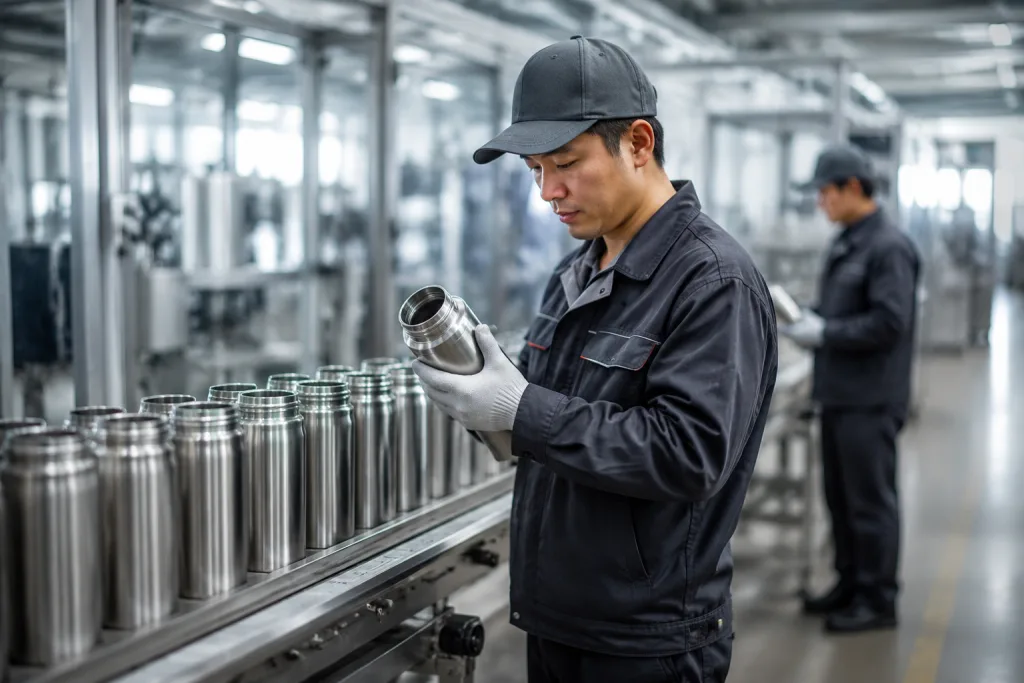
Samples are not souvenirs. They are cheap insurance. Before a 304 stainless steel vacuum bottle bulk PO moves to the line, approve at least one blank sample and one decorated pre-production sample. For a standard manufacturer thermos, blank samples can usually ship in 3-5 days if stock exists; our warehouse rack check is done against mold code, capacity, and lid type before we quote freight. A logo sample normally needs 7-10 days after artwork confirmation, and this is where we often see buyers lose 2 days because the AI file says Pantone 186C but the PO says red.
Do not approve only by photo unless the order is low risk, and honestly, for retail this is the wrong question to ask. Hold the bottle. Check the cap thread with 3 full turns, fill it with 95°C water, shake it upside down for 30 seconds, and leave it overnight on white paper. Check if the powder coating feels even. Look at the seam line, base welding, mouth polish, and inside cleanliness; QC pulled one 500 ml sample last month because polishing compound was still visible under a flashlight at the mouth. For outdoor retail, throw one sample into a backpack with keys for a simple abrasion check. It is not a laboratory test, but weak paint shows up fast.
Your sample approval should be written, not casual. Confirm Pantone color, logo size in millimeters, logo location measured from the base or mouth, box dieline, barcode placement, and warning text. If you are a thermos distributor selling into several accounts, make the sample approval file detailed enough that your sales team can answer questions without asking the China factory again; we run approvals better when the file name includes SKU, capacity, color, and revision date. One buyer flagged a carton mark after production because “black lid” was typed as “back lid” on the PO. That small typo cost 6 hours of checking.
Sample approval PO line items:
- 2 blank samples of selected mold, with mold code and lid style listed, freight collect or prepaid
- 2 logo samples with approved decoration method and logo size in millimeters
- 1 printed color box mockup or digital proof, with barcode position checked at 100% scale
- Vacuum performance test record from factory QC, including test time and water temperature
- Final approval photos from front, back, lid, base, and packaging, plus one close-up of the mouth polish
BottleForge Industrial in Hangzhou, Zhejiang normally keeps common 350 ml, 500 ml, 750 ml, and 1,000 ml vacuum bottle molds available, and we check the sample shelf before promising timing. For custom color and logo samples, expect small sample charges of USD 50-150 depending on process; laser marking sits at the low end, while powder coating plus silk print takes more setup. Good suppliers thermos programs treat this as normal development cost, not a nuisance. The math doesn’t work if you save USD 80 on samples and then reject 3,000 bottles at final inspection.
Turn approval into a clean PO
The PO is where 7 out of 10 bulk thermos headaches either get blocked or get written into the job. A clean PO should read like the sheet our merchandiser hands to the line, not just a price confirmation. Put the item number, approved sample reference with date, quantity by color, unit price, logo method, packing spec, AQL 2.5 inspection rule, payment term, shipment term, and delivery date in one place. We once had a buyer type “mat black” on the PO; QC pulled the pre-production sample against matte black, and that one missing “te” cost 2 days of email checking.
For 304 stainless steel vacuum bottle bulk production, we usually run 30-45 days after deposit and sample approval. Before Q4, powder coating and printed retail boxes push jobs to 50-60 days, especially when the coating line is booked with 3 shift runs. If your promotion has a fixed event date, allow at least 10-14 days for inspection, export documents, port cut-off changes, and vessel schedule slips. China export logistics is steady, but this is the wrong place to gamble.
Example PO structure:
- Item 1: 3,000 pcs 500 ml customized thermos, matte black, laser logo, FOB Ningbo, USD 4.35/pc
- Item 2: 2,000 pcs 500 ml customized thermos, forest green, laser logo, FOB Ningbo, USD 4.35/pc
- Item 3: Printed color box, included, 350 gsm white card, approved dieline V3
- Item 4: FNSKU label on each box, USD 0.04/pc if applicable
- Item 5: Spare silicone gasket, 2% free spare parts packed separately
- Inspection: AQL 2.5 major, 4.0 minor, 100% leak test by factory
- Payment: 30% deposit, 70% balance after passed inspection before shipment
Write the tolerances before we cut cartons. Capacity tolerance of ±5%, color checked against the signed sample under a D65 light box, logo position tolerance of ±2 mm, and carton weight under 15 kg are practical for a 500 ml bottle order. If you need BSCI factory audit, ISO 9001 documentation, REACH declaration, ASTM-related labeling for the US, or California Proposition 65 warning language, put those lines on the PO. A thermos suppliers contract without compliance wording looks tidy, but the math doesn't work when the buyer flags it during final inspection.
Inspect production before shipment
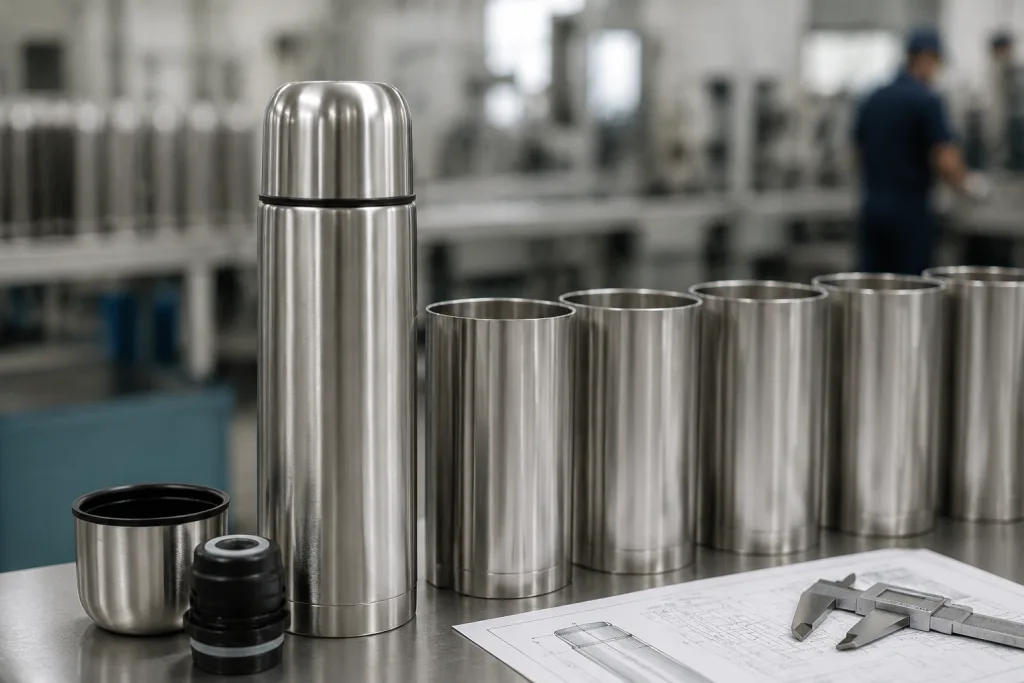
Good factories inspect on the line, not only at the end, but you still need a written final inspection plan. For thermos bulk orders, the common trouble spots are leakage, weak vacuum retention, coating scratches, logo color drift, dirty inner liner, loose lids, crushed boxes, and carton quantity mistakes. We see these on real POs. Last month QC pulled 32 pcs from a 3,000 pcs matte black run and found 5 lids with gasket tilt over 1.5 mm, which would have become distributor customer-service work fast.
Use AQL inspection for cosmetic and functional defects, then add bottle-specific tests. A common standard is AQL 2.5 for major defects and AQL 4.0 for minor defects. Critical defects, such as sharp metal burrs, severe leakage, or unsafe contamination, should be zero tolerance. For vacuum bottles, we run hot-water retention sampling, lid leakage, coating adhesion by cross-cut tape test, barcode scan, carton drop test, and actual capacity measurement with a 1,000 ml graduated cylinder. The buyer often asks, “Can we skip the drop test to save time?” Wrong question. One split export carton can ruin 24 retail boxes before the goods reach the warehouse.
The factory should conduct 100% leak testing before packing. On our line, each bottle goes through an upside-down water test before the worker fits the polybag and retail box. For vacuum retention, 8 to 32 samples per batch is more realistic because a full 24-hour test on every bottle blocks packing space and the math does not work. Ask for the factory QC record showing test batch, water temperature, start time, end time, and result. For a promotional thermos order of 1,000 units, sample testing is usually enough. For a retail order of 20,000 units, use third-party inspection or your own China QC partner.
Pre-shipment checklist:
- Carton count matches PO quantity and color ratio; we also check the outer carton stencil against the booking sheet
- Logo size, color, and position match approved sample; measure position in mm, not by eye
- Inner liner is clean, no rust spots, no oil smell after QC wipes it with a white cotton swab
- Lid passes upside-down leak test for at least 30 minutes with the gasket seated flat
- Coating has no exposed metal, bubbles, or heavy orange peel under normal inspection light
- Retail box barcode or FNSKU scans correctly; one wrong digit on an Amazon PO can stop receiving
- Export carton marks match booking and customer requirement, including item code and gross weight
A reliable thermos vendor will not object to inspection. They may argue about timing or sampling method, especially if the vessel is already booked, but basic AQL checks should not be a fight. If a supplier blocks inspection before shipment, we have seen this go sideways: mixed colors, short cartons, and rushed rework at 9 p.m. before loading.
Plan freight and repeat orders
I’ll rewrite the section in place, keeping the HTML tags and tightening the sales-engineer tone with concrete freight and repeat-order details. Then I’ll return only the updated HTML.After inspection passes, the last step is moving the goods without burning margin. Stainless vacuum bottles ship bulky, so freight cost decides the deal fast. A 500 ml bottle in a color box often packs 24 pieces per master carton, with carton size around 55 x 38 x 28 cm and gross weight around 10-13 kg, depending on the model. We run the numbers first: sea freight works for orders above 1,000-2,000 units, while air freight only makes sense for urgent promo top-ups or sample runs.
FOB Ningbo is common for Zhejiang makers because the port is close and the handoff is smooth. FOB Shanghai works too, but inland trucking from Hangzhou can add a few hundred RMB per container, and the buyer usually flags that. For North America, a lot of buyers use FOB China and book their own forwarder. For Amazon or 3PL delivery, send the carton label file, pallet spec, FNSKU, suffocation warning for polybags if used, and the delivery appointment rule in the PO. One typo on the PO can hold the line up for a day.
Repeat orders should never start from zero. Keep the golden sample, approved artwork, Pantone sheet, box dieline, inspection report, and complaint log. If you sold 5,000 units and saw 18 lid complaints, do not just reorder. We’ve seen that go sideways. Ask the thermos factory to change gasket hardness, lid thread tolerance, or packing method before the next PO. QC pulled the sample and found a 0.3 mm thread gap once; that kind of miss shows up as leakage later. This is how a one-off thermos job turns into a stable program.
For outdoor retailers and promo brands, the right sourcing result is not the lowest unit price. It is a bottle that matches the product-page claim, lands before launch, passes inspection, and keeps returns down. That takes a disciplined RFQ, honest samples, clear PO line items, and inspection before balance payment. The math does not work any other way. Skip one step, and the cost shows up in freight delays, rework, or chargebacks.
Send your thermos RFQ for factory review
Share capacity, quantity, logo method, packaging, and target delivery date. We will return a clear FOB Zhejiang quotation with sample timing.
Frequently asked questions
What MOQ should I expect for 304 stainless steel vacuum bottle bulk orders?
For standard molds, a practical MOQ is usually 1,000 units per color, although some thermos suppliers may accept 500 units with higher unit pricing. For powder-coated custom colors, 1,000-3,000 units is more realistic because coating lines need setup time and color cleaning. New body molds or private lid tooling normally require 5,000-10,000 units to make the tooling cost sensible. If your order has four colors at 250 units each, ask whether the factory can use stock colors instead of custom Pantone coating.
Is 304 stainless steel required for both inner and outer walls?
The inner wall should be 304 stainless steel because it contacts water, coffee, tea, or sports drinks. The outer wall can be 304 or 201 depending on your positioning. Full 304 construction is better for premium outdoor retail and supports stronger product claims, but it may add 5-10% to the FOB price. A 304 inner plus 201 outer structure is common for promotional thermos bulk programs. The key is to state it honestly on the PO and avoid marketing the bottle as full 304 if only the liner is 304.
How long does custom thermos production take after sample approval?
For standard stainless vacuum bottle molds, bulk production usually takes 30-45 days after deposit and final sample approval. Add 7-10 days for logo samples before that. If you need custom powder coating, printed color boxes, or a new lid mold, plan closer to 45-60 days. Q3 is often busy because brands prepare Q4 gift and retail programs, so book capacity early. For urgent promotional campaigns, air freight can save transit time, but it may add USD 1.50-4.00 per bottle depending on weight and destination.
Which logo method is best for a customized thermos?
For outdoor use, laser engraving on powder coating is usually the most durable and costs around USD 0.10-0.25 per unit. One-color silkscreen is cheaper, often USD 0.05-0.12 per unit, and works well for corporate gifts if the logo area is simple. UV print and heat transfer are better for multi-color artwork, gradients, or full-wrap designs, but they cost more and should be abrasion tested. Always approve a decorated sample, not just a digital mockup, because curved stainless bottles can distort artwork.
What inspection standard should I use for thermos bulk shipments?
Use AQL 2.5 for major defects and AQL 4.0 for minor defects, with zero tolerance for critical safety issues such as sharp burrs, contamination, or severe leakage. Add thermos-specific tests: 100% factory leak test, random vacuum retention test, coating adhesion test, capacity check, barcode scan, and carton drop test. For a 5,000-unit order, third-party pre-shipment inspection is usually worth the cost. Make inspection a PO requirement and link final balance payment to a passed report.