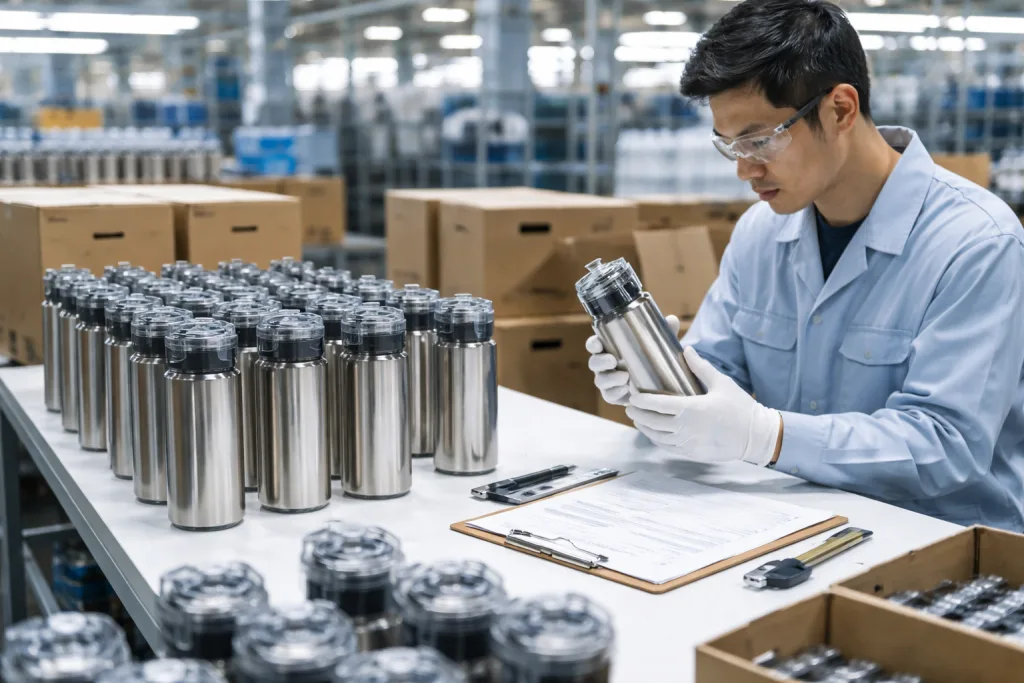
Key Takeaways
- Set MOQ, capacity, wall thickness, lid resin, and AQL level before asking for FOB pricing
- A typical factory MOQ for custom 304 stainless steel Tritan bottles is 1,000-3,000 units per SKU
- Sampling usually takes 7-12 days, while bulk production often needs 30-45 days after deposit and artwork approval
- Your PO should separate bottle cost, logo cost, packaging cost, spare parts, testing, and freight terms
Buying a 304 stainless steel Tritan water bottle wholesale program looks easy until 7 RFQ replies hit your inbox. One factory quotes a Tritan lid, another swaps in PP. One uses 0.5 mm steel, another uses 0.4 mm, and the buyer only notices when QC puts a micrometer on the rim sample. Freight, logo method, carton drop tests, and AQL limits sit in separate emails, so your landed cost is still a guess.
If you manage bulk drinkware for retail, promo, outdoor, or hospitality channels, you need a process that turns a nice-looking bottle into a controlled purchase order. Lowest FOB is the wrong question to ask. On our Zhejiang, China production floor, we run better projects when the PO locks steel grade, wall thickness, lid material, logo position in mm, carton spec, and inspection level before the line opens.
Start with the bottle brief
Your first step is not asking, “What is your best price?” That is the wrong question to ask. Start with a bottle brief a factory engineer can quote without guessing. For a 304 stainless steel tritan water bottle wholesale project, spell out each part: inner and outer body material, lid material, straw or spout design, gasket grade, capacity, color finish, and packaging. On our quoting desk, a missing gasket spec can add 1 day because QC has to pull a sample and check the silicone ring against the last LFGB file.
Use exact terms. Write: “304 stainless steel inner, 0.5 mm nominal wall, single-wall or double-wall vacuum, Tritan copolyester lid or insert, silicone food-contact gasket, 750 ml capacity, powder-coated body, one-color logo.” That is quotable. “Best wholesale drink bottle, premium quality” is not. We run wall thickness checks with a digital caliper, and 0.4 mm versus 0.5 mm changes the steel weight, the dent resistance, and the price.
At RFQ stage, your PO draft should already contain provisional line items. Include: item code, capacity, body material, lid material, finish, logo method, unit pack, master carton, target quantity, required certificates, Incoterm, and delivery window. If you are also sourcing a bulk canteen, wholesale canteen, or canteen bulk program in the same tender, list it as a separate SKU. The tooling, lid design, and carton dimensions may be different. We once received a PO with “Tritan” typed as “Titan,” and the buyer flagged the revised quote only after we priced a metal cap insert instead of a copolyester one.
In Zhejiang, we see about 7 out of 20 delayed projects start with buyers combining sports bottles, beer tumbler bulk, and alcohol flask bulk requests into one loose RFQ. It looks faster. The math doesn't work. A 750 ml sports bottle, a 16 oz beer tumbler, and an alcohol flask need different molds, leak tests, polishing steps, and master carton sizes, so the line cannot treat them as one family. Keep each product family separate, then compare apples to apples.
RFQ details that change price
FOB price moves fast when one technical detail changes. A 600 ml bottle in 0.4 mm stainless steel is a different costing sheet from a 750 ml bottle in 0.5 mm steel; the body blank alone changes weight by about 28-35 g on the scale we use beside the cutting line. A screw lid with PP plastic is not priced like a Tritan cap with a locking button, spring pin, and silicone seal. A plain carton is not the same job as a color box with barcode sticker and FNSKU label.
For drinkware wholesale quoting, send an RFQ table, not a long paragraph. Cleaner for both sides. Ask for pricing at 1,000, 3,000, 5,000, and 10,000 units. In our China factory, common custom MOQ is 1,000 units for existing molds and 3,000 units when a custom color, special lid, or private packaging is required. Current lead time is typically 30-45 days after deposit and final artwork, with monthly output around 450,000 stainless steel drinkware units across bottles, tumblers, canteens, and growlers. Last month QC pulled a 750 ml sample because the Pantone code on the PO said 7499C, while the artwork file showed 7490C; that one typo delayed approval by 2 days.
Your RFQ should break out these costs: base bottle and lid set, logo method with print size in mm, custom color with Pantone code, color box material, inner carton, master carton, spare lids, testing, sample courier, sea freight estimate, and document charge if any. This matters for wholesale growler, growler bulk, beer growler wholesale bulk, and beer tumbler wholesale bulk orders because cartons are heavier and shipping cost per unit can move 8-18% depending on packing density. We run carton drop tests at 76 cm for export packing, and a 64 cm master carton stuffed too tight will fail corners before the bottle fails. The math doesn't work if the quote hides packing.
Do not accept “all included” pricing unless the inclusion list is written. We have seen this go sideways when a buyer added REACH testing, Amazon labels, or retail tray packaging after price confirmation. The buyer flagged it, the merchandiser checked the PI, and nobody had listed the tray. Put every item in the RFQ from day one.
Check materials before sampling
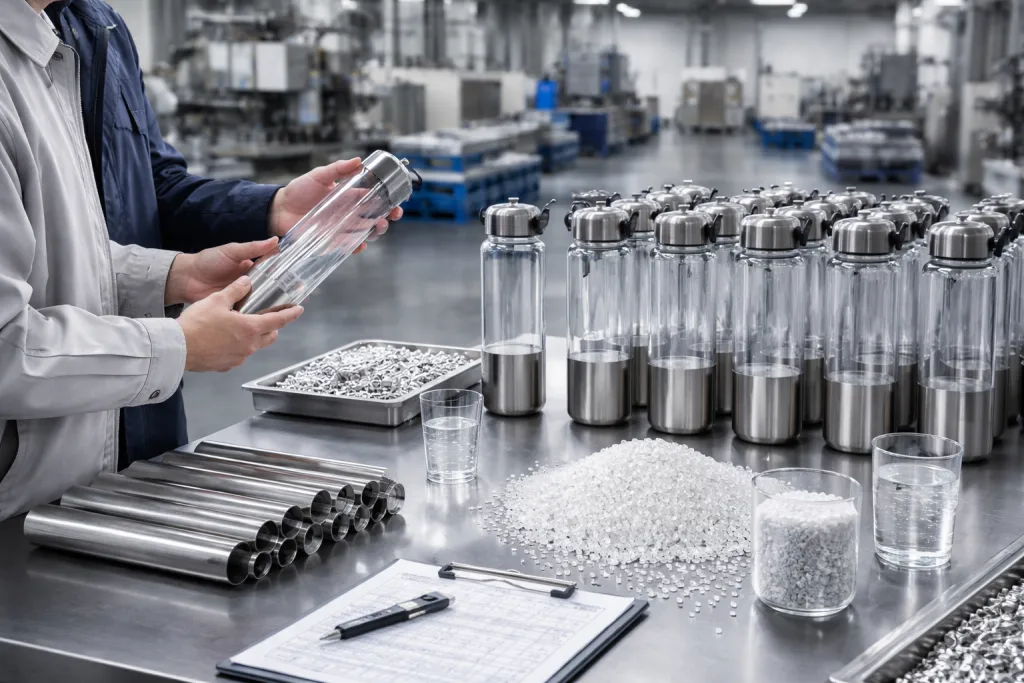
Material claims are easy to print on a quotation sheet and harder to prove once the line starts. For 304 stainless steel Tritan bottle sourcing, ask for material declarations before you approve samples. The stainless steel should be food-grade 304, often shown as 06Cr19Ni10 or SUS304 on the mill document; our incoming QC checks the coil tag and records wall thickness with a 0.01 mm caliper. Tritan should be named by resin grade from the material supplier, not written as “clear plastic” on a PI. Silicone parts should be food-contact grade, with odor checked after hot-water soaking at 60°C for 2 hours.
Ask for test reports dated within the last 12 months if your market requires them. For Europe, buyers usually request LFGB or EU food contact migration, REACH SVHC screening, plus packaging heavy metal limits with the carton ink and color box included. For North America, FDA food contact expectations apply, and children’s items may also need ASTM and CPSIA-related checks. If you are buying kids bottles, do not reuse adult bottle documents without checking paint, coating, and small-part risk; QC pulled one lid sample last year because the silicone straw plug came off under a 15 N pull test.
At this step, your PO line items should spell out document requirements: material test reports by part, coating test report by color, factory audit document such as BSCI if needed, and pre-shipment inspection standard with AQL 2.5 or your own limit. For drinkware bulk orders with 3 product types or more, separate reports by material set. A stainless bottle with Tritan lid is not the same file as an alcohol flask wholesale item, and it is not the same as a beer growler in bulk order with a swing-top assembly. We’ve seen this go sideways when a buyer’s PO had “Trian lid” typed wrong, the merchandiser copied it, and the lab refused to match the report to the sample.
Practical opinion: if the supplier refuses to name material grades before sample payment, stop there. Price pressure is normal in China sourcing. Hiding material information is not. The math does not work if you save USD 0.08 per bottle and lose 18 days on retesting after the buyer flagged the resin name.
Approve samples like production
Sampling is where we stop mass-production surprises before the line starts. A sample request should not say “send your best model.” Treat it like a small PO. Write the quantity, color, logo method, capacity marking, lid function, inner packing, master carton mark, and test items. For most custom wholesale drinkware projects, prototype or pre-production samples take 7-12 days after artwork confirmation; if the logo file arrives as a 72 dpi JPG, add 1 day for artwork cleanup before we even cut the screen. If new tooling is required, add 15-25 days depending on mold complexity.
Your sample PO should show: 2-3 plain samples for structure check with caliper readings on thread OD, 2 logo samples for brand approval under D65 light box, 1 packed sample for carton and barcode review, and 1 retained golden sample signed by both sides. Include acceptable tolerances. For example: capacity ±5%, weight ±5%, logo position ±1.5 mm, color matched to Pantone within commercial tolerance, no visible dents at 50 cm inspection distance. We once had a buyer flag a 0.8 mm logo drift after bulk packing, and the math did not work for rework.
Test the sample like a customer will abuse it. Fill with hot water if it is rated for hot liquids. Shake it upside down for 60 seconds. Open and close the lid 200 times. Check for metallic smell, coating scratches, gasket fit, and lid threading with the same lid fixture we run on the line. For beer tumbler in bulk or beer growler wholesale programs, check carbonation guidance carefully; most standard stainless bottles are not pressure vessels. This is the wrong place to guess.
Do not let the factory start bulk production from photos only. The signed golden sample should sit in the QC room in Zhejiang, usually in a clear bag with the PO number and version date written on the label, and be referenced during incoming material inspection, inline inspection, and final inspection. QC pulled the sample, not a phone photo, when the buyer flagged a shade difference on a 3,000 pcs reorder.
Build a clean bulk PO
The bulk PO is where sourcing discipline protects margin. A weak PO says “10,000 stainless bottles with logo.” That is how claims start. A workable PO states what we run, pack, inspect, and ship, down to the logo position in mm and the export carton mark. For a 304 stainless steel tritan water bottle wholesale order, put the commercial terms and technical attachments in the same document set, so our merchandiser, the line leader, and QC read one version.
Core PO line items should include SKU number, product description, capacity, dimensions, net weight, stainless grade, lid material, coating, logo method, logo size, Pantone color, packing specification, carton marks, barcode requirements, quantity, unit price, total amount, payment terms, Incoterm, loading port, delivery date, and penalty or remedy language for late or failed inspection if your company uses it. Add the drawing file name too, such as “WB-750-Rev-C.pdf,” because one buyer once sent Rev B on the PO and Rev C by email, then flagged a 3 mm logo offset during AQL 2.5 inspection.
Then add accessory and service lines. Spare lids at 1-2% are common for outdoor and distributor programs, and we usually pack them in a separate inner box with a spare-parts label. Spare straws or gaskets should not be mixed loose in the master carton. Testing can be listed as one line, with the lab, standard, and sample quantity named. Third-party inspection can be paid by buyer or charged back after failure; write it clearly. We have seen this go sideways when a PO said “inspection by buyer” but did not say who pays the re-inspection fee. If you are ordering alcohol flask in bulk, beer growler bulk, bulk growler, or wholesale growler SKUs together with bottles, each needs separate carton data because volumetric weight changes the freight plan.
For payment, many China export orders still use 30% deposit and 70% balance before shipment after inspection approval. First orders should stay conservative on both sides. For repeat buyers with stable credit, terms can be discussed after 2 or 3 clean shipments, not after one sample approval. The math does not work if the factory buys 304 stainless steel coil, Tritan lids, color boxes, and cartons before any deposit lands.
Control quality before shipment
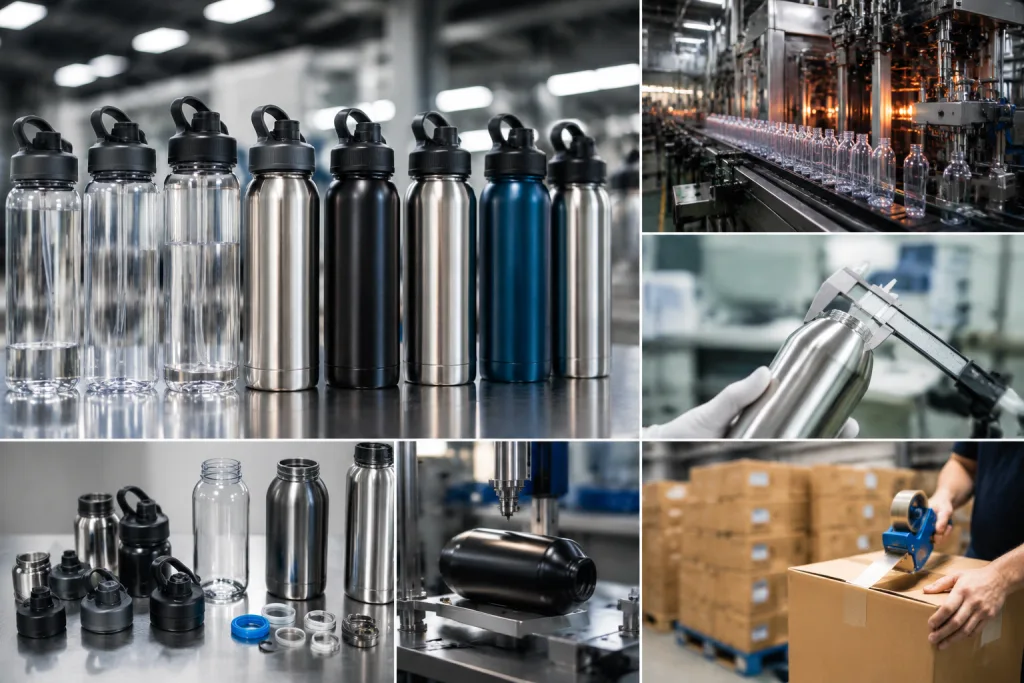
Plan inspection before production starts, not one week before the vessel closes. We write ANSI/ASQ Z1.4 sampling and AQL levels into the PO for wholesale drinkware and canteen wholesale orders; if the PO says “ALQ 2.5,” our merchandiser sends it back before deposit. A workable setup is Critical 0, Major 2.5, Minor 4.0, though some retail chains ask for Major 1.5 on painted bottles. Critical defects mean unsafe sharp edges, wrong material, leakage that stops normal use, contamination, or failed regulatory marking. Major defects include wrong color, weak logo adhesion after 3M tape test, lid malfunction, dented body, or a coating scratch over 10 mm.
Ask for three checkpoints. Incoming material inspection confirms steel, resin, silicone, and coating powder; QC uses a handheld XRF gun on 304 stainless batches and checks silicone gaskets against the approved sample. Inline inspection at 20-30% production catches logo drift, crooked lids, and assembly gaps before the line finishes 12,000 pcs the wrong way. Final random inspection checks quantity, workmanship, function, packing, carton marks, and drop test results. We run a carton drop test with ISTA-style handling logic, with the exact height set by carton weight and the buyer standard.
For drinkware bulk shipments to North America, FNSKU or carton label accuracy can hurt you as much as a leaking bottle. One wrong label means warehouse rework, chargebacks, and a buyer asking why 480 cartons scan as the wrong SKU. We have seen this go sideways. For Europe, check pallet height, carton recycling marks, and importer information before packing starts; QC pulled one sample carton last season where the importer VAT line was missing from the side mark.
Our opinion is simple: do not waive inspection to save USD 250-450 on a first order. The math doesn't work. One rejected container of bulk drinkware costs far more than an inspection report, especially after demurrage, repacking labor, and 18 days of email fighting with the buyer.
Ship with landed cost visibility
FOB Ningbo or Shanghai is normal for Zhejiang drinkware exports, but FOB is not landed cost. Do the sheet before you release the 30% deposit. Add ocean freight, destination charges, duty, customs brokerage, inland trucking, palletization, warehouse receiving, and compliance testing not already paid. A bottle quoted at USD 3.20 FOB can land at USD 4.10-4.80 depending on carton volume, destination, duty rate, and order size. We had one US buyer approve artwork at 2:00 p.m., then flag the USD 680 destination handling line 12 days later. Too late. The math had already moved.
Ask the factory for master carton dimensions, gross weight, units per carton, and total CBM before finalizing packaging. Make them pull the tape measure, not guess from last year’s 750ml bottle file. If you buy beer tumbler wholesale, beer tumbler wholesale bulk, alcohol flask wholesale bulk, or a bulk canteen range in the same shipment, carton mix changes container loading fast. One carton at 54×38×32 cm looks harmless until 1,200 cartons hit the loading plan. A 20GP may hold roughly 18-22 CBM after practical loading space, while a 40HQ is often planned around 58-65 CBM depending on carton strength and pallet use.
Your shipping PO or booking instruction should list Incoterm, port, consignee, notify party, HS code suggestion, carton marks, pallet requirement, document set, and deadline for commercial invoice, packing list, bill of lading, certificate of origin, and test reports. If you sell through marketplace warehouses, include FNSKU placement and carton label position. Be exact. Last month QC pulled the sample carton because the PO said “front right,” while the buyer’s warehouse guide wanted the FNSKU 50 mm from the short-side edge. That kind of small mismatch can burn 1 working day on relabeling.
The best sourcing result is not the lowest first quote. That is the wrong question to ask. You want a repeatable wholesale drinkware supply chain where your next PO runs with fewer emails, cleaner QC, and delivery dates your sales team can trust. We’ve seen this go sideways when a buyer saved USD 0.06 per bottle, then lost 9 days because carton marks, pallet height, and booking cut-off were not locked before production started.
Send your bottle RFQ for engineering review
Share capacity, quantity, logo, packaging, and target market. We will return a structured quote with MOQ, lead time, and QC notes.
Frequently asked questions
What is the normal MOQ for a custom 304 stainless steel Tritan bottle?
For existing molds, a realistic MOQ is usually 1,000 units per SKU for laser logo or single-color printing. If you need a custom powder-coating color, retail color box, or special lid combination, plan around 3,000 units. New mold development can push the practical MOQ to 5,000-10,000 units because tooling cost and setup waste must be covered. For mixed wholesale drinkware programs, you can sometimes combine colors under one model, but do not assume 500 units per color will be accepted without a surcharge.
How do I compare FOB prices from different China suppliers fairly?
Put every quote into one comparison sheet. Match capacity, wall thickness, steel grade, lid resin, coating type, logo method, packaging, testing, and Incoterm. A USD 0.25 cheaper bottle may use thinner 0.4 mm steel, a PP lid instead of Tritan, or bulk packing instead of color box. Ask for prices at 1,000, 3,000, 5,000, and 10,000 units. Also compare carton CBM because freight can change landed cost by 8-18%. FOB price alone is not enough for procurement approval.
Can I order canteens, growlers, tumblers, and flasks in the same PO?
Yes, but treat each as a separate SKU with its own specification, carton data, and inspection checklist. A wholesale canteen, beer growler wholesale item, beer tumbler bulk SKU, and alcohol flask wholesale product have different leakage risks, lid structures, and packing needs. You can consolidate them into one shipment to save freight, but do not merge them into one vague PO line. List unit price, quantity, packaging, spare parts, and test requirements for each item separately.
What testing should I request for Europe or North America?
For Europe, request food-contact migration testing relevant to stainless steel, Tritan, silicone, and coating, plus REACH SVHC screening where required by your importer. For North America, ask for FDA food-contact suitability and additional ASTM or CPSIA checks if the item is intended for children. Coating adhesion, odor, leakage, and dishwasher claims should be verified separately if you print those claims on packaging. Testing cost varies, but many programs budget USD 300-1,200 depending on materials and market scope.
How long does the full sourcing process take from RFQ to shipment?
A smooth repeat order can move from PO to shipment in 30-45 days after deposit. A first custom project usually needs longer: 3-5 days for RFQ clarification, 7-12 days for samples, 3-7 days for approvals, then 30-45 days for bulk production. Add ocean freight time separately, often 25-40 days to Europe or North America depending on port and season. If new tooling is involved, add 15-25 days before sample approval.