Key Takeaways
- A practical MOQ for custom 304 stainless bottles with Tritan lids is usually 1,000-3,000 pcs per color
- Ask for 304 inner and outer steel, or specify 304 inner with 201 outer if price pressure is real
- Pre-production samples should be checked for vacuum performance, logo accuracy, odor, leakage, and carton fit
- AQL 2.5/4.0 inspection and a 30-45 day bulk lead time are normal for Zhejiang export production
If you are looking for a 304 stainless steel Tritan water bottle manufacturer, you do not need a trend report. You need a tight RFQ: steel grade, Tritan part size, logo process, sample sign-off, carton spec, and AQL 2.5 before anyone talks about price. Last week we saw a PO typo change 0.5 mm wall thickness to 0.05 mm. That one digit would have wrecked the run.
At BottleForge Industrial in Hangzhou, Zhejiang, we see this about 6 times a month: buyers ask for custom drinkware, suppliers quote in 24 hours, then the file has no steel certificate, no Tritan resin note, no Pantone code, no 1.2 m carton drop requirement, and no inspection level. The buyer flagged it only after QC pulled the sample from the line. China can build good bottles, but the math does not work if the factory is guessing what you approved.
Start with the RFQ file
A proper RFQ is not a product name plus a target price. For a 304 stainless steel tritan water bottle manufacturer, it should look like a small technical file with enough detail for the engineer to price the same bottle twice. “Tritan water bottle” is too loose: it might mean a full Tritan body, a Tritan lid, a clear Tritan straw, or a Tritan infuser inside a stainless body. We have seen this go sideways when QC pulled the sample and found the buyer expected a Tritan flip lid, while the quote covered a PP lid with a Tritan straw.
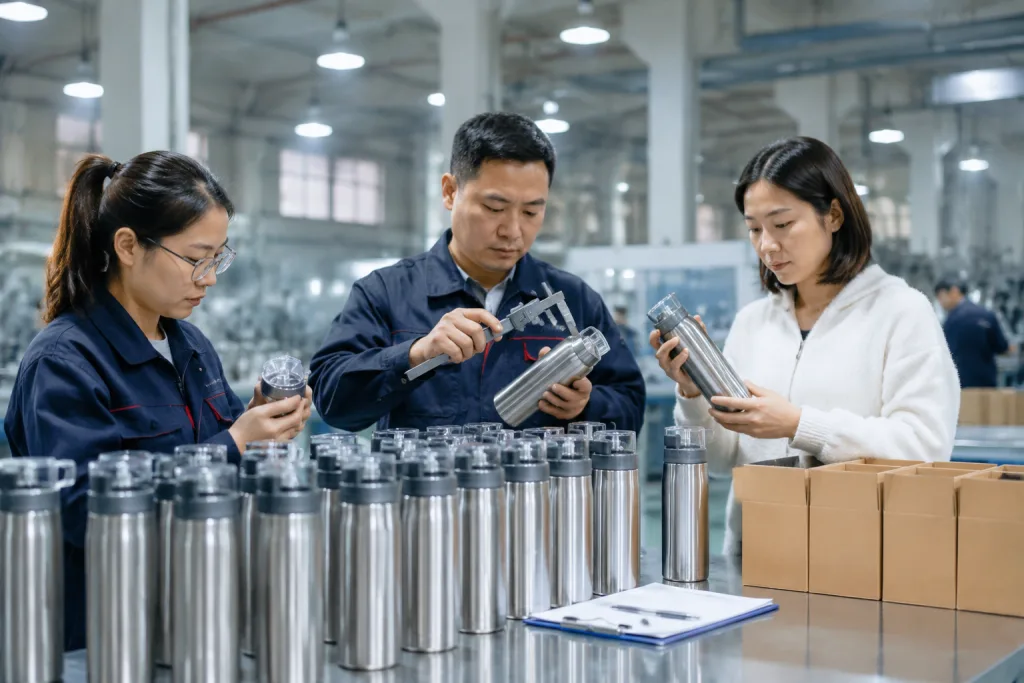
For a stainless vacuum bottle with Tritan lid, put these line items in the RFQ: capacity in ml and oz, body diameter, height limit, mouth diameter, inner steel grade, outer steel grade, wall thickness, lid material, gasket material, coating type, logo method, packaging, compliance market, and delivery term. A normal 500 ml double-wall bottle might use 0.40 mm inner 304 stainless steel and 0.50 mm outer stainless steel, with a BPA-free Tritan flip lid and food-grade silicone gasket. On the line, our caliper check on drawn shells is usually recorded to 0.01 mm, because a 0.10 mm steel change can move both cost and dent resistance.
State your commercial frame clearly. Is this for distributor drinkware, retail, corporate gifts, school canteen promotional programs, or a subscription box? A canteen distributor usually pushes us on repeat Pantone matching and shelf cartons; a brand owner may spend 18 days on lid tooling approval instead of 12 days on a standard mold color sample. For promo orders, the buyer often accepts our existing mold if the logo is sharp, the delivery date is locked, and the carton mark does not carry a PO typo.
RFQ PO-style line items to include:
- Item: 500 ml custom canteen, double-wall 304 stainless, Tritan flip lid
- Quantity: 3,000 pcs, split into 2 colors, 1,500 pcs per color
- Logo: 1-color silkscreen, 60 mm x 35 mm, one side
- Finish: powder coating, Pantone reference required
- Packaging: kraft box, 24 pcs export carton, carton under 15 kg
- Compliance: LFGB or FDA food contact, REACH coating report if selling in Europe
- Trade term: FOB Ningbo or Shanghai, quote in USD
Our Hangzhou, Zhejiang production network can run around 600,000 stainless drinkware units per month across standard and customized drinkware projects, but the cleanest orders start with a disciplined RFQ. The math does not work if 4 factories quote 4 constructions. We ship faster when the file already shows the lid resin, gasket spec, carton weight limit, and FOB port before sampling starts.
Separate material facts from sales claims
“304 stainless steel” gets printed on cartons too loosely. For B2B buying, ask exactly where the 304 sits. The inner liner matters most because it touches water, coffee, juice, or electrolyte drinks. On 17 price-driven projects we ran last year, the quote was 304 inner steel with 201 outer steel. That is acceptable if the spec sheet says it clearly. If your product page says 304 stainless steel bottle, a stricter retailer may read that as both inner and outer walls being 304. We have seen QC pull a finished sample with “SUS304” laser-marked on the base, then the XRF gun showed 201 on the shell. That goes sideways fast.
Tritan is not a generic name for clear plastic. It is a copolyester commonly used for BPA-free lids, straws, caps, and infusers. It gives better clarity and drop resistance than cheaper plastics, but the mold and gasket still decide whether the lid passes. Good resin will not save a bad lid. We once had a buyer flag 6 leaking flip caps out of a 50 pcs pre-shipment check because the silicone ring groove was 0.20 mm too shallow. For a canteen customizable program, ask your canteen manufacturer to list each plastic part: Tritan for the clear body, PP for the cap base, silicone for the gasket, PE or ABS where used. Do not accept “food grade plastic” as the only description.
Wall thickness affects durability, hand feel, and how the bottle behaves on the line. A 0.35 mm inner wall can pass basic use, but a 0.40-0.45 mm inner wall usually feels steadier and resists deformation during welding and forming. Outer wall thickness around 0.45-0.55 mm is common for mid-market bottles. Thicker steel raises cost and weight, so this is the wrong question to ask if the buyer only says “make it stronger.” The math does not work for every order: adding 0.10 mm can push a 500 ml bottle up by roughly 18-25 g, and that shows up in carton weight. Our forming line checks this with a digital micrometer before necking, not after polishing.
For coatings, powder coating is common for retail and distributor canteen programs because it gives a dry hand feel and a wide color range. Spray paint can cost less, but it chips faster if baking temperature, film thickness, or pretreatment is loose. Laser engraving lasts, but it only looks right when the exposed base material gives enough contrast. Silkscreen is cost-effective for a simple canteen customized logo, often adding about USD 0.08-0.18 per position depending on size and color count. On the factory floor, we usually check powder coating at 60-80 μm with a coating thickness gauge; below that, the buyer often complains after the first drop test.
Ask for material declarations before sampling, not after mass production. A serious China canteen factory should provide 304 stainless steel test reports, food-contact migration reports, and resin declarations for Tritan components. For Europe, REACH and LFGB requests should be discussed early. For the U.S., FDA food contact expectations and sometimes ASTM-related packaging or child-use requirements apply depending on the product and channel. We ship samples faster when the PO names the standard clearly; one buyer wrote “LFGB lid only” on the PO, then rejected the full bottle set 12 days later because the steel report was missing. Fix the paperwork first.
Price the bottle like a buyer
I’ll rewrite the section in place, keep the HTML structure unchanged, and tighten the pricing language so it sounds like a factory-side sales engineer.A useful quotation is not just a unit price. For custom drinkware, you need a landed-cost view, even if you buy FOB. The FOB Ningbo number can look clean on paper, but the real bill picks up mold fees, logo setup, sample courier, inspection, inner box, master carton, freight, duty, warehousing, and distributor margin. We had one buyer flag a USD 3.20 FOB bottle; by the time it reached their shelf, the math had moved a long way.
For reference, a standard 500-750 ml double-wall 304 stainless bottle with Tritan lid usually sits around USD 3.00-5.80 FOB China, depending on steel construction, finish, cap complexity, packaging, and order quantity. A custom growler or customized growler in 1.2 L to 1.9 L size runs higher, often USD 6.50-12.00 FOB if the lid, handle, or insulation spec is heavier. If a canteen vendor quotes far below the market, ask what changed: steel grade, thickness, coating, carton, inspection, or margin. On the line, we have seen a 0.4 mm wall spec and a cheaper carton hide most of that gap.
MOQ is another place where buyers need to stay practical. For a standard mold with custom logo, 500 pcs can work for a simple laser or screen print, but the unit price will climb and color choices stay tight. For powder-coated custom colors, 1,000 pcs per color is a normal floor. For a new lid mold, expect 5,000-10,000 pcs or a separate tooling charge, often USD 1,500-8,000 depending on complexity. We once checked a PO where the buyer typed one color code wrong, and the sample run had to be redone.
Quotation line items to request:
- Unit price at 1,000 / 3,000 / 5,000 pcs
- MOQ per color and MOQ per logo version
- Sample charge and refund rule
- Logo setup fee, mold fee, and Pantone matching fee
- Export carton dimensions, gross weight, and CBM
- FOB port, payment terms, and quote validity
- Estimated lead time after deposit and sample approval
If you are a canteen distributor comparing several canteen suppliers, put all quotes into one spreadsheet and normalize the specs. Compare 304 inner only against 304 inner only, powder coating against powder coating, and retail box against retail box. Otherwise the cheapest canteen vendors will look good until your QC report explains why. QC pulled one sample last month and found a 6 mm carton gap; that kind of miss changes freight and damage rates fast.

Approve samples without rushing
The sample stage is where 6 out of 10 B2B buyers we meet approve trouble too early. Do not sign off just because the logo looks clean under office lighting. A pre-production sample is the contract you can hold in your hand. If bulk goods differ from that signed bottle, your claim is stronger. If you approved a loose sample with no weight, capacity, color chip, or lid-fit note, the math does not work. We have seen this go sideways when QC pulled the sample and found the PP straw 2 mm shorter than the drawing.
For a customized canteen with Tritan lid, order at least 2-3 samples per color and logo version. Keep one sealed as the golden sample. Send one to your sales or retail team. Use one for physical testing. Check capacity with a measuring cylinder and water, not by trusting the catalog. A “750 ml” bottle may hold 720 ml to the brim and 680 ml in normal drinking use. Decide whether you sell nominal capacity or usable capacity before the PO is typed. Small detail, big argument.
Leak testing should be simple and strict. Fill with room-temperature water, close the lid, invert for 30 minutes, then shake for 30 seconds. Repeat after hot water exposure if the bottle is marketed for hot drinks. For vacuum performance, fill with water at around 95°C, close the lid, and record temperature drop at 6 hours and 12 hours. A good 500 ml stainless vacuum bottle may retain above 60°C after 6 hours, but performance changes with shape, lid structure, and 22°C versus 28°C room temperature. On our line, QC logs this with a probe thermometer and writes the lid torque note on the sample card.
Logo approval also needs numbers. Specify logo size in mm, position from the bottom or seam, maximum tilt tolerance, and acceptable color difference. For Pantone-matched powder coating, a visual standard is not enough. Ask for a color chip or approved physical sample. Slight batch variation is normal, but retailer programs should define a Delta E target if the brand book is strict. We once had a buyer flag a logo that was only 1.5 mm off center; they were right, because the approved artwork said 42 mm from the base seam.
Sample approval PO line items:
- Sample type: pre-production sample, not random stock sample from the showroom shelf
- Quantity: 3 pcs per color, with 1 pc sealed in a PE bag as the golden sample
- Approval scope: body, lid, logo, coating, packaging, insert sheet, and barcode label if retail packed
- Testing: leakage, odor, capacity, vacuum, adhesion cross-cut if coated, checked by 3M tape after the cut grid
- Golden sample: one signed sample retained by supplier and one by buyer, both dated and matched to the PO number
A reliable canteen manufacturer in Zhejiang should push you to approve these details. If the factory only asks for deposit and skips sample discipline, slow down. We run faster after approval, not before it; a wrong sample can add 12 days of rework, while a proper sign-off usually takes 3 days and saves the shipment date.
Write a PO factories can follow
A PO should never be one line saying “customizable drinkware as sample.” We have seen that go sideways by day 6 on the line, when the spray-paint room asks which Pantone chip to follow and packing is still waiting for barcode files. A usable PO turns the approved sample into factory controls: product description, exact material, order quantity, tolerance, packaging, inspection standard, shipment window, and document requirements. QC pulled one 750 ml sample last month where the PO missed lid color, and the buyer flagged it only after 312 cartons were packed.
Write the steel clearly. For example: “Inner wall: SUS304 stainless steel, outer wall: SUS304 stainless steel, both food-contact safe; no substitution without written approval.” If you accept 201 outer steel, put that on the PO. No guessing. The math does not work when a buyer prices 304 stainless but the factory quotes 201 outer body to hit target cost; we have had that argument over a USD 0.28 gap per bottle, and nobody enjoys reopening costing after deposit.
For packing, list the inner box size, barcode, FNSKU or retail label if needed, polybag rule, silica gel requirement, carton mark, and pallet requirement. Give measurements where you can, such as “white inner box 82 x 82 x 245 mm, 1 pc per polybag, 24 pcs per master carton.” Amazon and marketplace orders need carton labels that scan cleanly; our packing table uses a Zebra scanner, and a 1 mm barcode stretch from bad artwork can fail. Distributor growler orders may need mixed SKUs on pallets, but unclear mixed-carton rules slow the line and raise picking mistakes.
Payment terms in China commonly run 30% deposit and 70% balance before shipment for new buyers. For repeat buyers shipping 20,000 pcs per quarter, we can discuss other terms, but open account on a first order is the wrong question to ask. Bulk lead time is usually 30-45 days after deposit and sample approval for standard molds. Add 10-20 days if you need new tooling, complex packaging, or third-party testing before shipment; a new Tritan straw lid mold alone can take 18 days before the first T1 sample reaches our assembly bench.
Bulk PO line items to include:
- SKU code and product name: 750 ml 304 stainless custom canteen with Tritan straw lid, matched to approved sample photo file and lid drawing
- Quantity: 5,000 pcs, color A 2,500 pcs, color B 2,500 pcs, with Pantone codes listed beside each color
- Over/under tolerance: 0% without written approval, or define 3% if acceptable after final carton count
- Inspection: final random inspection under ANSI/ASQ Z1.4, AQL 2.5 major / 4.0 minor, with leak test and coating adhesion check noted
- Documents: commercial invoice, packing list, bill of lading, test reports, certificate of origin if required, using the same consignee name as the PO
- Shipment: FOB Ningbo, no partial shipment unless approved, with requested ETD week and forwarder contact
The PO is not office paperwork. It is the work instruction the merchandiser, welding team, paint line, packing table, and final QC can follow without calling the buyer at 10 p.m. We ship cleaner orders when the PO has no mystery in it.
Control bulk before it ships
Do not wait until cartons land in your warehouse to find a loose gasket or a logo printed 6 mm too high. Final random inspection is cheap compared with rework in Germany, Canada, or the US. For most customized drinkware orders, AQL 2.5 for major defects and 4.0 for minor defects is a practical starting point. Critical defects, such as sharp edges, contamination, severe leakage, or unsafe materials, should be zero tolerance. We have seen one buyer reject 3,000 pcs because the silicone ring was seated upside down. Fair call.
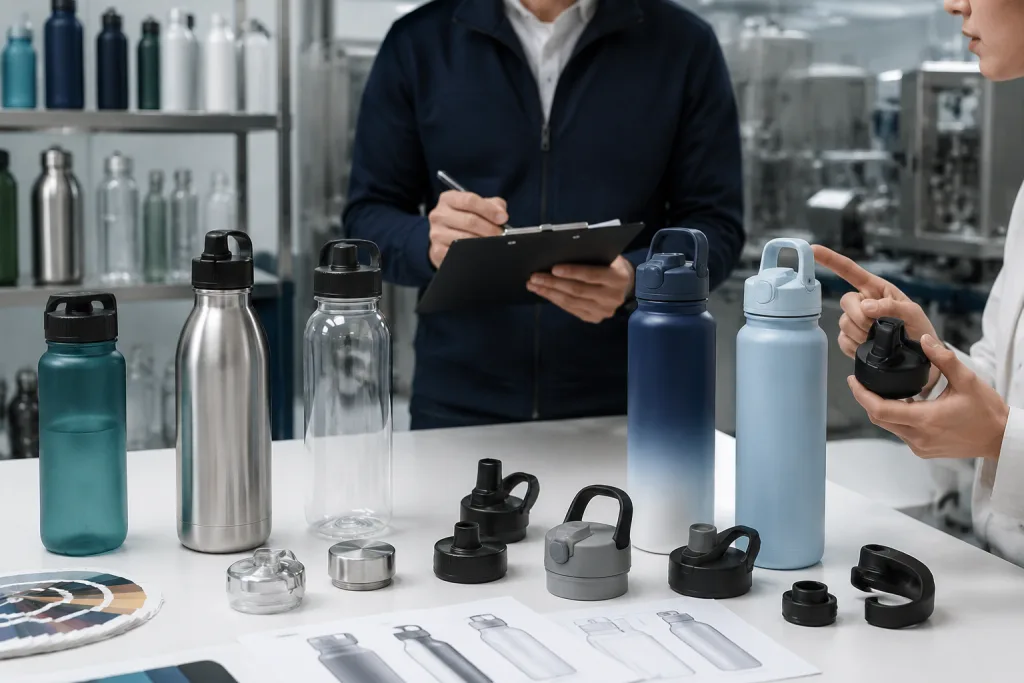
Inspection should check appearance, dimensions, function, packaging, barcode readability, carton strength, and quantity, but do not treat this as a tick-box exercise. For a stainless bottle with Tritan components, the inspector should open lids, check gasket placement with a probe, smell the inside, test random units for leakage, and verify logo adhesion or engraving depth. Use a caliper for mouth diameter and lid fit. A simple carton drop test also matters if you ship retail boxes through parcel networks; we run 1 corner, 3 edges, and 6 faces when the buyer asks for courier-level packing.
During production, ask for photos at three points: raw material and components, first finished units, and packed cartons. This does not replace inspection, but it catches obvious problems before the line keeps moving. A canteen supplier that refuses basic production photos is giving you a signal. In our Zhejiang operation, we normally share first-article photos before full coating or logo printing proceeds, because correcting 50 units is manageable; correcting 5,000 units is not. QC pulled the sample last month and found the PMS color looked right under office light but failed under the D65 light box.
If you use your own third-party inspector, send the approved sample and PO to the inspection company. Do not let them inspect only against a catalog page. Wrong question. The inspector needs the golden sample, carton artwork, barcode file, and defect classification. Define what counts as major: leakage, wrong material, wrong color, wrong logo, dent over a certain size, coating peel, missing gasket, unreadable barcode, or carton shortage. We once saw a PO typo list “matte black lid” while the approved sample had a stainless cap, so the buyer flagged it before shipment, not after Amazon photos went live.
For sea shipment, check CBM and carton strength. A 24 pcs carton for 750 ml bottles may weigh 12-16 kg depending on packaging. If cartons exceed practical handling weight, warehouse staff will hate the product and damage rates go up. The math doesn't work if you save USD 0.03 per unit on thin paper and then lose 2% to crushed corners. For China to North America or Europe, 28-35 days on the water is normal on many lanes, so we ship export cartons with sensible board strength and edge-crush performance, not the soft carton that folds when the container floor gets damp.
Plan the reorder before launch
A good sourcing project does not end when the first container leaves Ningbo. If your custom canteen sells well, the second order should run faster and with fewer arguments. That means keeping the production file complete: approved material spec, Pantone color chip, logo AI file, packaging dieline, AQL 2.5 inspection report, and the first 30 days of market complaint data. We keep one sealed golden sample in the sample room; QC pulled one last month where the buyer’s PO said “matte black” but the approved chip was Pantone 426C, and that small mismatch stopped the line for half a day.
For canteen distributors, reorder planning is where margin is protected. Wait until inventory is nearly gone, and the math doesn't work: you either pay air freight or lose shelf space to another bottle. Work backward from your sales velocity. If your monthly sell-through is 2,000 pcs and the factory lead time is 35 days, with ocean transit and clearance adding 30-40 days, place the reorder roughly 75-90 days before you run out. Around Chinese New Year, add more time, because 2-4 effective production weeks disappear fast in Zhejiang and across China. We have seen a 5,000 pcs reorder move from 12 days of buffer to 18 days late just because the buyer approved the carton mark after workers had already left for holiday.
Use market feedback carefully. If customers complain that the lid is hard to open, a new mold is usually the wrong question to ask first. Check gasket hardness, button tolerance, and assembly pressure; our line measures lid fit with a 0.02 mm feeler gauge before the carton is sealed. If the coating chips, review surface preparation, curing temperature, and adhesion test results. If the bottle dents too easily, discuss wall thickness or carton protection. Good canteen manufacturers fix these problems through process control before asking you to pay for expensive tooling.
For brand owners building a family of customizable growler, sports bottle, and travel tumbler SKUs, keep components consistent where you can. Shared lids and gaskets cut MOQ pressure, while shared cartons and color systems make after-sales work less painful. Simple wins. On one 304 stainless bottle program, we ran the same silicone gasket across 3 SKUs and avoided a separate 10,000 pcs gasket MOQ for the travel tumbler. A canteen promotional order may be a one-time campaign, but distributor drinkware should be built for repeat orders.
Your reorder PO should reference the previous order number and approved sample, then list any changes in a separate change table. Do not bury changes in an email thread. We have seen this go sideways: the buyer flagged “same as last order” on the PO, but one email attachment had a revised logo height of 42 mm instead of 38 mm. If color, logo, packaging, or steel grade changes, update the PO and ask for a revised sample when the change affects appearance or function. That is how a canteen manufacturer becomes a stable supply base, not a new problem every season.
Send us your bottle RFQ for review
We will check the spec, MOQ, logo method, packaging, and realistic FOB range before you commit to sampling.
Frequently asked questions
What does a 304 stainless steel Tritan water bottle actually mean?
In most B2B sourcing, it means the bottle body is stainless steel and one or more lid parts are Tritan. You should still define the construction. Write whether the inner wall is SUS304, whether the outer wall is also SUS304 or 201, and which parts are Tritan, PP, silicone, or stainless. A practical spec might be: 750 ml double-wall vacuum bottle, 0.40 mm SUS304 inner, 0.50 mm SUS304 outer, BPA-free Tritan flip lid, silicone gasket. Without that detail, different canteen suppliers may quote different products under the same name.
What MOQ should I expect for a custom canteen order?
For a standard bottle mold with a custom logo, MOQ can be as low as 500 pcs, but pricing is usually better at 1,000-3,000 pcs. For powder-coated custom colors, expect 1,000 pcs per color as a practical minimum. If you need a new Tritan lid mold or special cap structure, the MOQ can rise to 5,000-10,000 pcs, or you may pay tooling separately. For distributor canteen programs, we usually recommend starting with 2 colors and 1,500 pcs per color rather than spreading 3,000 pcs across too many SKUs.
How long does sampling and bulk production take in China?
For an existing mold, a logo sample normally takes 7-12 days after artwork approval. A powder-coated pre-production sample can take 10-18 days because color matching and curing add time. Bulk production is usually 30-45 days after deposit and sample approval. New tooling can add 15-30 days depending on the lid or body complexity. Around Chinese New Year, add at least 2-4 weeks of buffer. Zhejiang factories can move quickly, but only when artwork, PO, deposit, and packaging files are complete.
Which logo method is best for customized drinkware?
It depends on the finish and sales channel. Laser engraving is durable and good for stainless or coated bottles where a subtle mark is acceptable. One-color silkscreen is cost-effective for promotional orders, usually adding about USD 0.08-0.18 per position. Heat transfer or full-wrap printing works for richer graphics but needs stricter artwork control and adhesion testing. For a retail custom canteen, ask for a logo sample and run tape adhesion, rub, and dishwasher-related checks if you plan to make cleaning claims.
What inspection standard should I use before shipment?
Use ANSI/ASQ Z1.4 or ISO 2859-1 sampling with AQL 2.5 for major defects and 4.0 for minor defects as a normal B2B baseline. Critical defects should be zero tolerance. Major defects include leakage, wrong material, wrong logo, missing gasket, severe dents, coating peel, and unreadable barcode. Minor defects include small cosmetic marks within your approved limit. Send the inspector the PO, approved sample, artwork, carton marks, and packaging file. Inspecting against a vague catalog image is not enough for customized canteen production.