
Key Takeaways
- For mixed Tritan and 304 stainless projects, put resin grade, steel grade, capacity tolerance, decoration method, and carton spec directly on the PO
- A realistic first order MOQ is usually 3,000 units per SKU for custom color and 1,000 units for stocked components
- Expect 7-10 days for pre-production samples and 30-45 days for bulk after sample approval and deposit
- Use AQL 2.5 for major defects and AQL 4.0 for minor defects unless your retailer requires a stricter plan
A mixed-material bottle looks simple on a spec sheet. At 20,000 pcs, it gets messy fast. The body might be Tritan, the cap 304 stainless steel, the seal silicone, and the logo split between laser marking, screen print, shrink sleeve, or color box printing. If the RFQ leaves one item loose, QC pulled the sample too late and you pay later through re-sampling, carton rework, or a failed AQL 2.5 inspection.
As a Zhejiang canteen manufacturer exporting from China, we see this in about 7 out of 10 new custom bottle RFQs: the buyer asks for a “custom bottle” but the PO still misses resin grade, cap thickness in mm, logo position, or inner carton count. This is the wrong question to ask. A good 304 stainless steel tritan bottle supplier should lock materials, testing, MOQ, lead time, packaging, and AQL before the deposit, not after the line has opened the mold trial.
Start with a technical RFQ
Your RFQ is not just a price request. It is the first QC document. When you contact a 304 stainless steel tritan bottle supplier, send a spec table, not one loose product photo from Amazon. On the line, a 0.6 mm cap insert and a 0.4 mm cap insert look similar in a phone picture, but the cost is not the same. If the drawing is open, a supplier can quote with a thin cap, no-name plastic, or a weak 5-layer carton and still say “same style.”
For custom drinkware, the RFQ should state the working capacity in ml, bottle height and diameter in mm, target unit weight in g, Tritan resin requirement, stainless steel grade, lid structure with gasket material, leakproof test method, Pantone color, logo process, packaging format, test standards, and delivery term. If you are a canteen distributor selling into retail chains, add barcode format, country-of-origin marking, warning label wording, and carton drop-test requirements at the RFQ stage. We had one buyer flag a missing “Made in China” mark after mass packing; reworking 3,000 boxes with sticker labels is slow and the math doesn't work.
PO line items to prepare at RFQ stage:
- Product name: 650 ml Tritan bottle with 304 stainless steel cap insert
- Material: Eastman Tritan or equivalent copolyester, BPA-free; SUS304 stainless steel for food-contact metal parts
- Color: Pantone 548 C body, black lid, MOQ 3,000 units per color
- Decoration: 1-color screen print, 60 mm x 45 mm logo position
- Packaging: individual kraft box, 24 units per export carton
- Terms: FOB Ningbo, China, 30% deposit, 70% before shipment after inspection
Do not ask every canteen supplier for a “best price” before these details are fixed. Wrong question. You will get five prices for five different bottles, then spend 2 days chasing photos and cap weights. In our Hangzhou, Zhejiang factory network, a 650 ml canteen customized with one logo and box printing may quote at USD 2.10-3.40 FOB depending on lid complexity, wall thickness, and packaging. QC pulled one sample last month where the PO said “black lid” but the approved sample had a grey silicone ring; that small typo changed the order check sheet. The RFQ decides which end of that range you are comparing.
Check materials before design work
Tritan and 304 stainless steel solve different jobs on the same bottle. Tritan gives a clear body that survives the 1.2 m drop test better than basic AS or PS plastic; we still check the resin bag label before the line opens. 304 stainless steel belongs on food-contact parts where buyers expect a cleaner hand feel, better heat resistance, and a metal surface that will not embarrass them after 6 months on shelf. “Tritan” and “304” are not logo copy. Treating them that way is the wrong question to ask.
Ask your canteen factory for material declarations and, when needed, third-party test reports before artwork starts. For Europe, 7 out of 10 buyers we deal with ask for LFGB or EU food-contact compliance, plus REACH declarations for restricted substances. For North America, common requests include FDA food-contact compliance and sometimes California Proposition 65 review. Kids’ bottles may also need ASTM-related checks depending on age grading and retail channel; last April, QC pulled a sample because the PO said “kids 3+” but the carton mark was typed as “6+.”
If the bottle has a stainless inner straw, tea infuser, cap plate, or base ring, write down whether it must be SUS304 and whether non-food-contact trim can use 201 stainless steel. We have seen this go sideways when a buyer flagged a magnetic base ring during incoming inspection and assumed the whole bottle was downgraded. Mixing grades without approval creates claims fast. A practical canteen vendor separates these parts in the BOM, with part names, grade, and thickness, instead of hiding everything under one material line.
PO line items to use before sample tooling or component purchase:
- Plastic body: Tritan copolyester, transparent, BPA-free, virgin resin only, with resin bag photo checked before injection
- Stainless parts: SUS304 for all food-contact components, thickness 0.4-0.6 mm depending on part, confirmed by caliper check
- Sealing ring: food-grade silicone, odor-free, replaceable where design allows, with 2 spare rings per sample set if requested
- Compliance: supplier to provide material declaration and available food-contact test reports before mass production, not after the 30% deposit
This step is where 6 of 20 canteen manufacturers become quiet. Ask them to mark every plastic and steel part on the exploded drawing. If they cannot explain which parts are 304 stainless steel and which parts are plastic, they are not ready for a distributor drinkware program.
Convert samples into approval assets
Sampling is not for checking whether the bottle looks good on a buyer’s desk. It sets the control sample for the line. For a standard bottle with an existing mold, a Zhejiang factory can provide blank samples in 3-5 days and logo samples in 7-10 days after artwork confirmation. New mold development adds 25-40 days, with tooling costs from roughly USD 1,500 to USD 8,000 depending on cavity count, lid structure, and whether we need a new Tritan injection mold. QC will usually check the first sample with a digital caliper at the mouth thread and a torque tester on the lid. Small parts fail here.
Approve the bottle body first: mouth diameter, lid fit, silicone ring, straw length, coating feel, and leak test result. Then approve the visual file: Pantone color, print position, logo size, and whether laser engraving or silk screen matches your sales mockup. Packaging needs its own sign-off. Do not approve a bottle sample while leaving the carton or gift box “to be confirmed later.” That is how we have seen orders go sideways. Carton size affects freight cost, pallet loading, Amazon FBA receiving, and distributor warehouse handling. For distributor canteen orders, a 2 cm change in box height can reduce container loading by hundreds of units; we once had a buyer flag a 58 cm carton because their warehouse rack allowed 56 cm max.
PO line items to add at sample stage:
- Sample type: 3 pre-production samples with final logo, approved Pantone color, final lid, silicone ring fitted, and printed retail box
- Artwork file: AI or PDF vector file, Pantone color called out, logo tolerance ±1.5 mm
- Sample approval rule: bulk production must match signed sample within approved tolerance
- Sample cost: USD 80-150 for logo samples using existing mold, refundable against bulk PO above 3,000 units if agreed
- Courier: buyer account or prepaid DHL/FedEx, declared as commercial sample
For customizable drinkware, keep one approved sample in your office and ask the supplier to keep one sealed master sample at the canteen manufacturer site. We put ours in a PE bag with a sample label, PO number, color code, and approval date, then QC signs across the seal. Photos help, but a signed sample settles disputes faster than a 16-email thread. If you are buying a customizable canteen for multiple sales regions, approve labels and warnings for each region before the first production run; the buyer once sent us a PO with “California Prop 56” instead of “California Prop 65,” and QC pulled the sample before cartons were printed.
Price the whole landed program
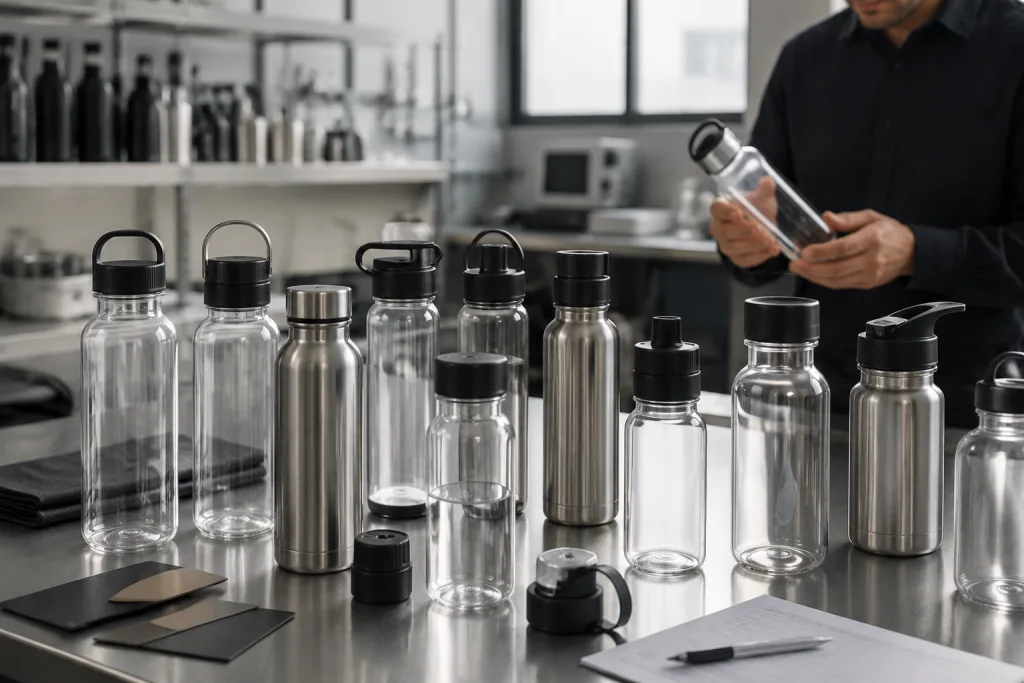
A low unit price gets expensive fast when the quote leaves out parts the buyer assumed were included. Ask each canteen supplier for a costed option table, not one loose FOB number. We run this check on a shared spec sheet because caps and cartons get mixed up too easily on the line. The same bottle may be USD 2.25 FOB with a plain cap and polybag, USD 2.70 with a stainless trim cap and kraft box, and USD 3.05 with two-color print, hangtag, spare gasket, and retail carton. None of those prices is wrong. They are different programs.
For a canteen promotional campaign, budget usually goes to logo size and delivery date; one buyer last quarter cut the gift box to save USD 0.18 and keep the vessel on a 22-day production slot. For a retail customized canteen, shelf packaging, barcode scan rate, and repeat color matching matter more; QC pulled 12 cartons once because the EAN label was 3 mm too low for the customer’s warehouse scanner. For a distributor growler or customized growler line, wall thickness, cap torque, and leak-test results beat a USD 0.10 saving. Chasing the cheapest assembly is the wrong question to ask. A good canteen vendor prices the options clearly and lets you see where the money goes.
PO line items that prevent price creep:
- Unit price: USD X.XX per unit, FOB Ningbo, including bottle, lid, silicone ring, 1-color logo, retail box, and master carton
- MOQ: 3,000 units per SKU/color; 5,000 units if custom body color resin is required
- Over/under shipment: ±3% accepted only with buyer approval for invoicing
- Spare parts: 1% extra silicone rings included, packed separately if required
- Carton marks: buyer item number, PO number, quantity, gross weight, net weight, made in China
Ask your forwarder for a landed-cost estimate using actual carton dimensions from the factory packing trial, not a guessed CBM. We measure with a steel tape after the master carton is taped shut, because a 2 mm bulge on each side changes pallet loading. A bottle with a large handle lid can look strong in photos but ship badly. On a 40HQ container, that wasted space can cost more than the stainless steel cap upgrade; we have seen the math go sideways on 8,000 units.
Lock production and inspection rules
Once the deposit lands, the job leaves the sales desk and goes to production control. A reliable 304 stainless steel tritan bottle supplier should send a dated schedule covering component purchase, logo printing, assembly, internal QC, final inspection, and shipment handover. At BottleForge Industrial, we run about 500,000 units per month across our drinkware lines, but booked capacity and open capacity are not the same thing. Big difference. In April and May, summer retail orders can take 60-70% of the line slots; before Q4 gifting, the same thing happens with corporate bottle sets and supermarket programs. Last season, QC pulled a 750ml sample where the silicone ring was 0.4mm undersize, and that one small gasket issue held the batch for 2 days.
For normal custom drinkware using existing molds, plan 30-45 days for bulk production after deposit and final sample approval. If you require BSCI-audited production, special packaging, or retailer-specific testing, add time and write it into the PO. Do not book a vessel from the first optimistic ship date. That is the wrong date to use. Book from the factory’s confirmed ready-for-inspection date plus a buffer of 3-5 days, because cartons still need sealing, pallet labels, and warehouse release after inspection. We have seen a buyer push for 30 days while also adding a color box with a new EAN barcode; the math did not work, and the forwarder had to roll the booking.
PO line items to lock before deposit:
- Production lead time: 35 days after deposit and written sample approval
- Inspection: final random inspection under ANSI/ASQ Z1.4, General Inspection Level II
- AQL: critical defects 0, major defects 2.5, minor defects 4.0
- Functional tests: 100% leak test during assembly; random cap torque and drop checks during final QC
- Defect definitions: leaking, cracked body, wrong material, wrong logo, odor, sharp edge, barcode unreadable
For a canteen promotional order, skipping third-party inspection to save USD 250-350 looks tempting. We have seen this go sideways. If the order is 10,000 units tied to a school opening date or a stadium giveaway, one leaking cap batch costs far more than the inspection fee. At minimum, require factory photos, inline checks, and a final inspection report with carton count, sample size, defect photos, and leak-test notes. Professional canteen distributors usually build this cost into the program instead of treating it as optional insurance; on our side, the line supervisor signs the leak-test sheet before packed cartons move to the finished-goods area.

Plan freight, cartons, and compliance
Shipment problems usually start with small decisions made 10 days too late. If you sell through wholesale, the cartons must take forklift bumps, pallet re-stacking, and warehouse clamp pressure. If you ship to Amazon FBA or a retailer DC, labels and carton sizes must match their rules before we run carton printing. A good canteen supplier in China should ask about the sales channel at order confirmation; asking after 6,000 pcs are packed is how we get rework on the line.
For export cartons, use at least 5-ply corrugated board for heavier drinkware and confirm edge crush strength if your buyer requires it. A typical 650 ml Tritan and stainless canteen may pack 24 units per carton, with gross weight around 8-11 kg depending on box and lid; our QC team usually checks this with a 0.1 kg floor scale before sealing the golden sample carton. For larger custom growler or customizable growler products, 12 units per carton is often safer. The math doesn’t work if you save RMB 0.40 on a carton and then get dented retail boxes after parcel delivery. For courier or parcel networks, we run carton drop testing to ISTA-style expectations, including corner and edge drops.
PO line items to complete before packing:
- Shipping mark: item number, PO number, carton number, quantity, N.W., G.W., dimensions, country of origin; one buyer once sent “Made in Chian” on the PO, and QC pulled the sample before mass printing
- Retail barcode: EAN/UPC/FNSKU as supplied by buyer, scan test required before mass printing with a handheld scanner on 3 printed labels
- Carton structure: 5-ply export carton, no mixed SKU cartons unless approved in writing, especially when color sleeves look similar on the packing table
- Palletization: if required, pallet height, carton orientation, stretch wrap, and label position specified; 1.6 m pallet height vs 1.8 m can change container loading
- Documents: commercial invoice, packing list, bill of lading, certificate of origin if requested; HS code and PO number must match the buyer’s booking sheet
FOB Ningbo is common for Zhejiang factories because Ningbo port works well for Europe and North America lanes. EXW may look cheaper on paper, but it pushes local trucking, export clearance, and coordination risk onto you. We’ve seen this go sideways when a forwarder booked pickup 2 days after the cut-off and then blamed the factory. If you are new to distributor drinkware imports, FOB is usually cleaner.
Treat reorders as engineering data
The first order proves the product. The second order proves whether your canteen manufacturer can run it again without surprises. We keep the signed sample in the sample room with the sample code sticker, plus the production batch sheet, SGS or in-house test reports, carton dimensions, AQL 2.5 inspection notes, customer complaints, and sell-through notes. A reorder should not start from zero. It should tighten the spec sheet, down to the 0.2 mm gasket groove if QC pulled the sample for leakage.
If customers report cap squeaking, gasket loss, odor, or logo abrasion, send numbers to your canteen vendors. “Some complaints” gets ignored on the line. “18 complaints from 4,800 units, mostly silicone ring falling out after dishwasher use” gives engineering a target. The fix may be a tighter gasket groove, different silicone hardness such as 50-60 Shore A, or a revised care instruction printed on the insert card. Last year a buyer flagged 27 logo rub-off cases after gym use; the math did not work for another USD 0.05 price fight, so we changed the curing time and ran a cross-hatch tape test before packing. For canteen customizable programs, small technical changes protect margin better than squeezing the factory again.
PO line items to maintain for reorders:
- Reorder reference: match approved sample code and previous PO number, not just the item name on the buyer’s spreadsheet
- Engineering change: no material, mold, gasket, coating, logo, or packaging change without written approval from both sides
- Complaint reserve: agreed replacement ratio or spare parts policy, commonly 0.5-1.0% depending on channel and return cost
- Batch traceability: production date code or carton-level batch record for claims handling when 3 cartons come back from one retailer
- Forecast: rolling 90-day estimate to reserve capacity and stabilize component pricing before lids or Tritan bodies move up
This is where a simple canteen vendor becomes a long-term supply partner. Zhejiang and wider China supply chains are strong because lids, silicone rings, cartons, and coating shops are often within a 2-hour truck run, but that advantage is wasted if your supplier changes parts without records. We have seen this go sideways after a PO typo changed “matte black” to “black,” and the line packed glossy bodies before QC stopped it. Whether you buy a canteen customized for a university, a distributor growler for outdoor retail, or a full customized drinkware range, repeatability is the difference between a product and a business.
Send your bottle RFQ for a practical factory review
Share capacity, material, logo, packaging, MOQ, and target market. We will return a workable quote and sampling plan.
Frequently asked questions
What MOQ should I expect from a 304 stainless steel Tritan bottle supplier?
For existing molds, expect 1,000 units if you accept stocked colors and simple logo decoration. For custom body color, custom lid color, or retail packaging, 3,000 units per SKU is more realistic. If the bottle uses a special stainless cap, custom mold, or matched accessories, many canteen manufacturers will ask for 5,000 units because component suppliers also have MOQs. For first orders, we usually recommend one color and one capacity to keep inspection, carton control, and cash flow simple.
How do I confirm the bottle really uses 304 stainless steel and Tritan?
Ask for a BOM that separates every component: body, lid shell, stainless insert, gasket, straw, infuser, and decorative ring. The supplier should state Tritan copolyester for the body and SUS304 for food-contact stainless parts. For higher-value orders, request material declarations and third-party food-contact test reports such as LFGB, EU food-contact, FDA-related testing, or REACH documentation. You can also add random material verification during inspection. Put these requirements on the PO, not only in email messages.
How long does sampling and bulk production usually take?
For an existing mold, blank samples usually take 3-5 days and logo samples take 7-10 days after artwork approval. Bulk production normally takes 30-45 days after deposit and signed sample approval. Add 7-14 days if you need special retail packaging, new color matching, or third-party lab testing. New mold projects are longer: 25-40 days for mold development is common before normal sampling begins. Always confirm the ready-for-inspection date before booking freight.
What defects should I define in the inspection standard?
Define leaking, cracked Tritan body, wrong stainless grade, wrong logo, strong odor, loose gasket, sharp edges, color mismatch, dirty surface, barcode failure, and damaged retail box. Use ANSI/ASQ Z1.4 with General Inspection Level II for most orders. AQL 0 for critical defects, 2.5 for major defects, and 4.0 for minor defects is a common starting point. For retailer programs, follow the buyer’s stricter standard. Include functional checks such as leak testing, cap torque, print adhesion, and carton drop review.
Is FOB Ningbo better than EXW for first-time importers?
Usually, yes. If your canteen factory is in Zhejiang, FOB Ningbo lets the supplier handle local delivery to port and China export clearance, while your forwarder controls ocean freight, destination charges, customs entry, and final delivery. EXW may show a lower factory price, but you then manage pickup, export documents, and local China charges through your forwarder. For first-time custom drinkware buyers, FOB reduces coordination risk and makes quotes from different canteen suppliers easier to compare.