Key Takeaways
- 304 inner and outer wall thermos flasks usually price from USD 4.20-8.80 FOB Ningbo at 3,000 pcs
- A 0.45 mm outer wall dents less than 0.35 mm, but adds weight and cost
- Powder coating needs 7-10 extra production days versus plain stainless steel
- For outdoor retail, test 6-hour and 12-hour insulation before approving mass production
If you are sourcing from a 304 stainless steel thermos flask supplier, finding a bottle is the easy part. China has 2,000+ factories and trading companies offering one. The hard part is locking the right spec before you approve tooling, artwork, and a 3,000-piece bulk thermos order your sales team has to carry for a full selling season. We have seen this go sideways: the buyer approved a 500 ml sample with a 54 mm mouth, then the PO said 58 mm, and QC pulled the sample only after the laser logo jig was already set.
Outdoor retailers ask us about heat retention, dent resistance, and shelf look because customers drop bottles on rock, not carpet. Promotional brands push on logo area, delivery date, and clean pricing; one buyer flagged a 0.18 USD color-box increase on a 10,000-piece run. We run both types on the line in Hangzhou, Zhejiang. A customized thermos that makes sense for a hiking shop is not automatically the right promotional thermos for a software conference, and chasing one “best bottle” is the wrong question to ask.
Spec table before sample approval
A buyer-supplier thermos discussion should start with a spec table, not a catalog screenshot. Photos will not show the return risks we see during QC: 304 stainless steel grade on the liner, outside wall thickness in mm, heat retention test time, silicone ring hardness, powder coat adhesion, carton burst strength, and the inspection standard. Last month QC pulled a sample that looked fine in the photo, but the outside wall measured 0.33 mm on the micrometer against a 0.40 mm PO. If a thermos vendor cannot write these points clearly, this is the wrong question to ask: you are not comparing factories, you are comparing guesses.
For a 304 stainless steel thermos flask supplier, our baseline is food-contact 304 stainless steel on the inner wall. Some buyers choose 201 stainless steel outside to cut USD 0.18-0.35 per bottle, but for outdoor retailers we usually quote 304 inside with 304 or 201 outside based on shelf price. A 304/304 manufacturer thermos gives cleaner technical claims and better corrosion resistance, especially after customers leave it in wet backpacks or car cup holders for 12 days. We run the salt-spray check on the lid shell and body bottom because that is where the buyer usually flags rust first.
Here is the head-to-head spec view we use before sample approval:
- Retail outdoor flask: 750 ml, 304 inner, 304 outer, 0.45 mm outside wall checked by micrometer, powder coat, stainless cup lid, silicone base, packed in color box for shelf display.
- Promotional thermos: 500 ml, 304 inner, 201 outer, 0.35-0.40 mm outside wall, spray paint or powder coat, PP lid, packed in white box; the buyer usually pushes back on logo cost before anything else.
- Distributor thermos: 500 ml and 1,000 ml shared shape, 304 inner, 201 or 304 outer, laser logo, neutral carton, barcode label; we ship this style often because one lid mold covers two SKUs.
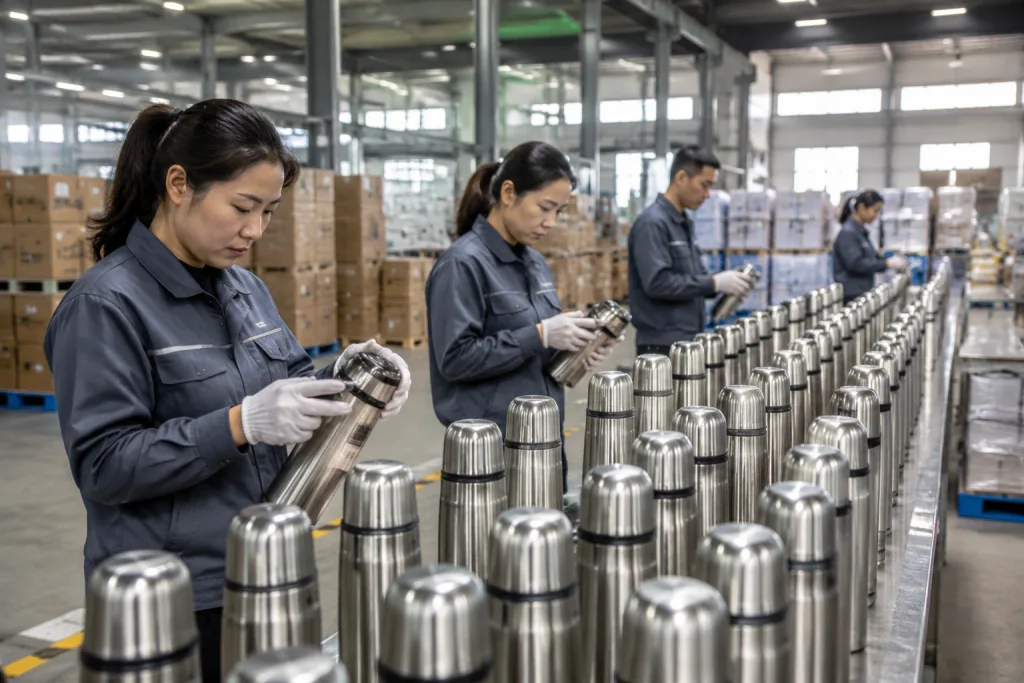
Our Zhejiang production line normally handles about 420,000 stainless vacuum bottles per month across thermos bulk and tumbler orders. For new custom thermos projects, the realistic MOQ is 3,000 pcs per color for powder coating and 1,000-2,000 pcs for plain stainless with laser logo, depending on bottle shape and lid inventory. The math does not work below those quantities once the line changes powder color, cleans the spray booth, and resets the laser jig. We have seen this go sideways when a PO typo listed “mat black” instead of “matte black,” so we now lock the color code and sample seal before mass production.
Retail flask versus promotional flask
Outdoor retail and promotional gifting can look the same on a PO line, right down to the typo we saw last month, “thermos flsak.” The risk is not the same. A retail customer may use the flask daily for 18 months, then judge the brand on scratch marks from a backpack side pocket, lid threading after 300 opens, and whether coffee stays hot through a 6 a.m. cold trail check. A promotional recipient may only use it 20 times, but the buyer will judge logo position within 1 mm, ship date, and landed cost. This changes the thermos custom specification.
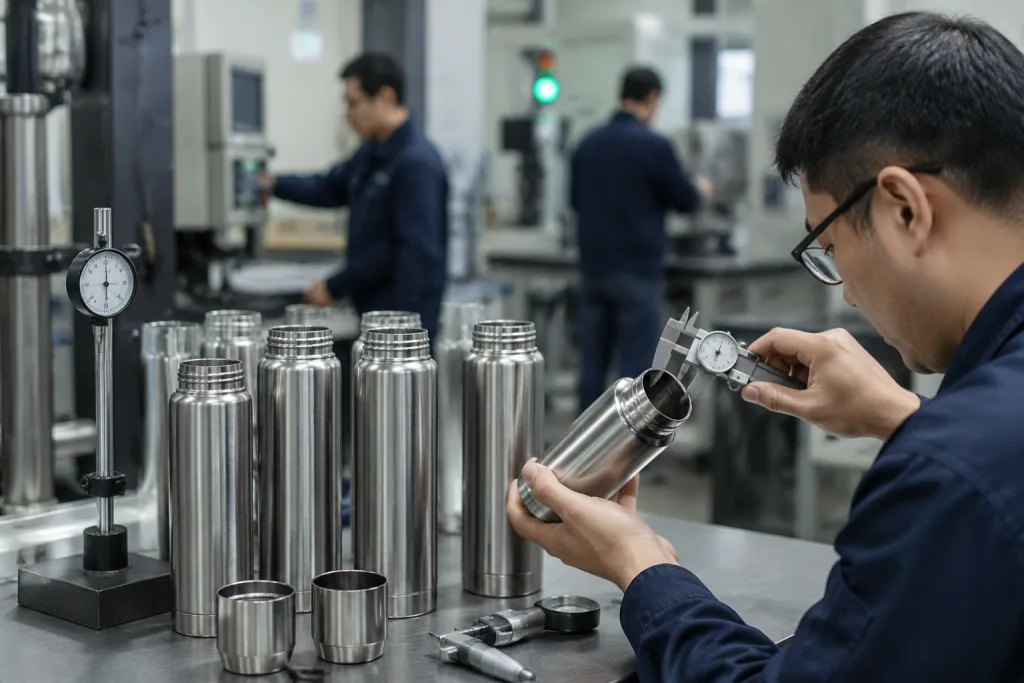
For outdoor retailers, we prefer a heavier body. A 750 ml customized thermos with 0.45 mm outer wall, copper-coated vacuum layer, and powder coating usually weighs 430-520 g depending on lid type. We check that with a Mitutoyo caliper and a bench scale before the sample leaves Hangzhou. It costs more, but it feels honest in the hand. A thin 0.32 mm body may pass a quick sample review, then dent during carton compression or store handling. Saving USD 0.25 here is the wrong place to be clever.
For promotional brands, the best customizable thermos is often simpler. A 500 ml body with a straight logo panel, leakproof screw lid, and one stable coating color will beat a design loaded with five accessories. We have seen this go sideways when the buyer wanted a tea strainer, carry strap, gift spoon, spare gasket, and color box, then asked us to hold the same unit price. The math does not work. If your campaign is 10,000 pcs for a bank, university, outdoor club, or employee gift pack, the customized thermos must survive packing, sea freight, and fast handout at 8 distribution tables. It does not need a premium retail cup lid if the budget is tight.
Do not ask a thermos manufacturer for “best quality” without a target use case. Ask for the best quality at 500 ml, 12-hour heat target, powder coat, 3,000 pcs, FOB Ningbo, with REACH-compliant paint.
That sentence gives the thermos team enough detail to quote without guessing. QC pulled one sample this week where the quote looked 6% cheaper because copper coating was removed, outer steel changed to 201, and the carton was cut from 5-layer to 3-layer. On paper, all three suppliers looked close. On the line, they were not the same flask.
304 steel claims need proof
“304 stainless steel” gets overused in drinkware sourcing. Ask your thermos supplier for material declarations, food-contact reports, plus a part-by-part steel statement. The bottle body may be 201, the inner wall 304, the tea filter 304, while the lid insert is often PP or silicone. If your product page says 304 everywhere, your PO should say the same; last month QC pulled a sample where the PO said “304 lid” but the approved drawing showed PP liner.
For Europe, buyers usually ask for LFGB or EU food-contact testing, REACH on coating and plastic parts, plus BSCI or Sedex factory audit files when a retailer is involved. For North America, FDA food-contact expectations apply, and promotional distributors often flag Prop 65 for California shipments. For children’s or family outdoor sets, some buyers ask about CPSIA or ASTM-related packaging safety, even when the core item is a thermos flask. We keep these reports in the order folder by SKU, because one buyer once rejected a shipment over a missing silicone gasket page, not the flask body.
A practical material comparison looks like this, based on what we check with the handheld XRF gun at incoming inspection:
- 304 inner wall: the minimum we recommend for coffee, tea, electrolyte drinks, and normal retail claims.
- 316 inner wall: better corrosion resistance, but usually adds USD 0.35-0.80 per unit and is not necessary for most promotional thermos orders.
- 201 outer wall: acceptable for cost-sensitive thermos promotional projects if coating quality is controlled.
- 304 outer wall: stronger claim for outdoor retail, export catalogues, and premium distributor thermos programs.
As a China factory thermos exporter, we run incoming material checks and can support third-party lab testing before shipment. Build testing into the timeline from day 1. A lab test can take 5-10 working days, and the math does not work if the vessel is closing on Friday. If you wait until the container is booked, we have no room to recoat 3,000 pcs or replace a wrong steel batch the line already assembled.
Insulation numbers that matter
Thermos suppliers like to print big insulation claims on a catalog page. The number means nothing until the test setup is written down. We run a 1,000 ml flask and a 350 ml flask on the same bench, and they do not behave the same. A narrow mouth usually holds heat better than a wide mouth by 6-10°C at the 12-hour check. A stainless cup lid loses less heat than a flip lid with 3 plastic joints and a silicone button. Last month a buyer flagged a quote that said “24 hours hot,” but the PO had no water volume, start temperature, or room temperature. That is the wrong question to ask.
For a standard 500 ml vacuum flask, a useful factory target is hot water starting at 95°C, tested in a 20°C room with a calibrated probe thermometer. Simple test. For decent double-wall vacuum construction, we expect 60-70°C after 6 hours. After 12 hours, 42-55°C is realistic, depending on mouth size and lid structure. For a 1,000 ml outdoor flask, 12-hour retention is stronger because the larger liquid volume loses heat more slowly; on our line, the same lid design often shows 48°C on 500 ml and 58°C on 1,000 ml after 12 hours. QC writes those readings on the inspection sheet, not in a sales slogan.
Cold retention sells well, but the math gets messy when ice is involved. If an outdoor retailer wants a product page we can defend, we test with water at 4°C and record temperature at 6, 12, and 24 hours using the same fill line each time. If your promotional brand only needs a broad claim, do not chase extreme wording. “Keeps drinks hot or cold for hours” is safer than a 24-hour claim nobody tested. We have seen this go sideways: one buyer used 30% ice in the lab, another used 70% ice in-store, then both asked why the numbers did not match.
Vacuum failure creates the loudest customer complaints because the end user spots it on day one. We use 100% vacuum insulation screening on production, then random AQL inspection before packing. The line pulls samples after the heat-retention tunnel, and QC checks for warm outer walls, leaking lids, and cup threads that feel rough past 0.3 mm burr height. For export orders from Zhejiang, our usual final inspection level is AQL 2.5 for major defects and 4.0 for minor defects, unless the buyer requests a stricter plan. If you ship to chain retailers, put the AQL standard in the purchase order before production starts; changing it after 8,000 pcs are packed does not work.
Logo and coating trade-offs
The best thermos customizable option comes down to the logo file and where the flask will sell. Laser engraving is clean and durable on 304 stainless or powder-coated bodies; we run it with a fiber laser, usually 0.08 mm line tolerance on straight text. It normally costs USD 0.08-0.18 per position at volume and does not add much lead time. The catch is color. Laser gives a metal or undercoat look, so if the buyer wants a full-color brand mark for a gift-box window, this is the wrong process to quote.
Silkscreen printing fits simple one- or two-color logos. It is common for promotional thermos orders because the unit cost is low, usually USD 0.05-0.12 per color per position. Curved bodies and textured powder coat make registration harder; QC pulled one 500 ml sample last month because the second color drifted 0.7 mm near the seam. Tiny text is worse. If your logo has small legal copy under 1.5 mm stroke width, do not expect miracles.
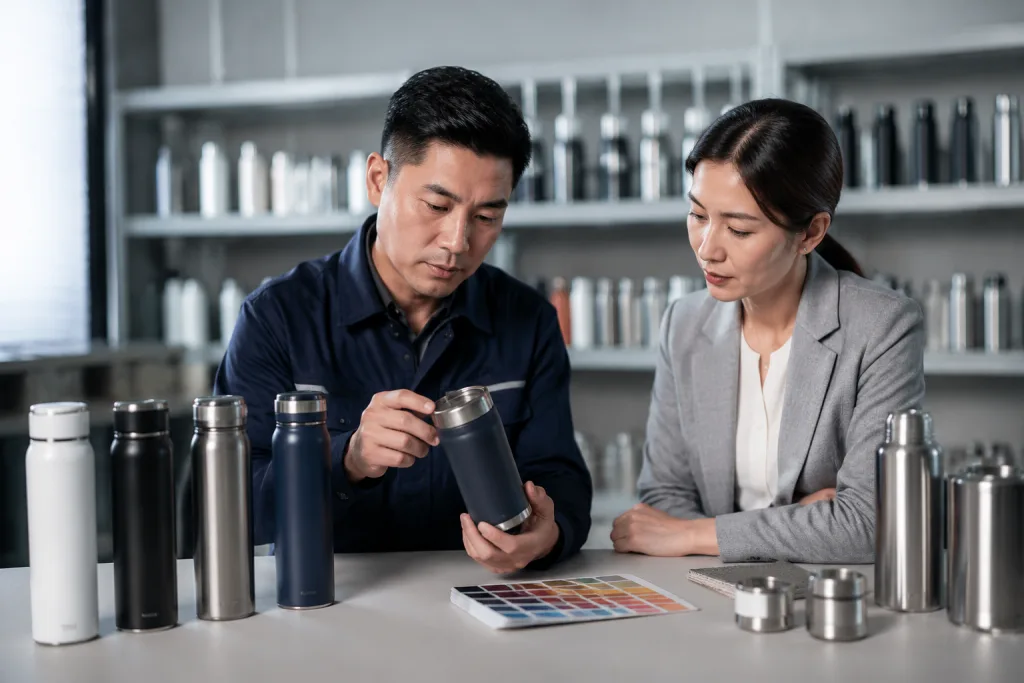
Heat transfer and UV printing handle richer artwork for thermos customized retail designs, seasonal graphics, and outdoor club merchandise with map-style or mascot artwork. The trade-off is cost and durability. A wrap design may add USD 0.35-0.90 depending on coverage, and abrasion testing becomes the part buyers forget until the sample scratches. We have seen this go sideways on matte black coating. For retail shelves, we recommend a 3M tape adhesion test, cross-cut test, and 50-cycle rub test on the approved sample; the line keeps the rubbed sample beside the Pantone card until bulk packing starts.
Coating choice changes lead time more than most POs admit. Plain stainless with laser logo can ship in about 25-30 days after deposit and artwork approval if components are in stock; our warehouse usually checks lids, gaskets, and 304 stainless bodies by carton count before we confirm. Powder-coated custom thermos orders normally need 35-45 days. Multi-color gradients, soft-touch coating, or rubberized paint can push production to 50 days because rejection rate is higher. China can produce fast, but paint curing, AQL 2.5 inspection, and export packing still take real time.
Pricing by use-case fit
Price comparison is where buyers lose the plot. We had 17 RFQs last month where the buyer compared a USD 4.20 thermos bulk quote with a USD 6.80 quote as if they were the same bottle. They were not. This is the wrong question to ask. Before you push a supplier thermos team for a lower number, decide what you will cut: 304 outer wall, copper coating, gift box, silicone base, 5-layer carton, or AQL 2.5 inspection. QC pulled one sample on the line last week where the “same spec” had a 0.42 mm outer wall instead of 0.50 mm. That is where the price went.
For reference, FOB Ningbo pricing from a Zhejiang thermos factory usually lands in these bands at 3,000 pcs per color. A 500 ml flask with 304 inner, 201 outer, and silkscreen logo may run USD 4.20-5.20. A 500 ml 304/304 powder-coated retail flask with laser logo may run USD 5.40-6.60. A 750 ml outdoor flask with cup lid, 304/304 body, copper coating, and color box may run USD 6.80-8.80. These are not promises; they are working ranges before final drawings, LFGB or FDA testing, and packaging are locked. On our costing sheet, a color box typo on a PO once delayed artwork approval by 3 days, which hurt more than the USD 0.06 box difference.
For distributors thermos programs, shared tooling is usually the cleanest move. We run one body shape across 500 ml and 750 ml where the design allows it, with common cap threads and one carton structure. Less confusion. Fewer spare parts. A thermos distributor can stock neutral inventory and apply laser logos by customer, or place scheduled orders with factory logo decoration. The math does not work if every small customer wants a new lid mold for a 1,000 pcs trial order; one cap mold can eat USD 1,200-2,500 before the first carton ships.
If you sell through Amazon or retailer distribution centers, include labeling cost early. FNSKU labels, carton barcodes, suffocation warnings for polybags, and master carton marks look cheap one by one, then go sideways when added after packing. We ship export cartons with 58 x 39 x 25 cm marks checked against the packing list, and the buyer flagged it once because the PO said “matte balck” instead of “matte black.” A supplier that understands export packing can save you more than USD 0.03 on bottle cost.
Buying process without surprises
A clean sourcing process should feel boring. Good. Start with one written spec sheet: capacity in ml, 304 stainless steel or other grade, target body weight in grams, lid drawing, coating finish, logo method with artwork size, inner box and master carton details, compliance market, inspection standard, and delivery term. We ask buyers to put this into one PDF or Excel sheet, then send the same file to 2-3 thermos manufacturers. If one factory gets a lifestyle photo, another gets a PO note with “same as last year,” and the third gets a 500 ml bottle photo with no diameter, the quotes are not comparable. We see this every month. The line cannot build a price from guesswork.
For new projects, we run a simple timing chart: 3-5 days for existing sample dispatch, 7-12 days for logo sample if the body is in stock, 10-18 days for new color or special decoration sample, and 35-45 days for mass production after deposit and sample approval. New mold work can add 25-40 days depending on lid complexity. Standard payment is usually 30% deposit and 70% before shipment, with FOB Ningbo or FOB Shanghai common from Zhejiang. On one recent lid project, QC pulled the sample because the silicone ring groove was 0.4 mm shallow, and that alone cost us 3 days before we could send the DHL box.
Outdoor retailers should order pre-production samples in final packaging. Drop the carton from 80 cm, check the lid seal after dishwasher exposure if you claim dishwasher safe, and test the coating with wet hands, not just dry hands in an office. Promotional brands should check logo size on the actual bottle, not only on a PDF proof. A 60 mm logo can look strong on screen and too large on a curved 500 ml flask. We had one buyer flag this after receiving 12 samples, because the logo crossed the curve and looked tilted under store lighting.
The right 304 stainless steel thermos flask supplier will push back when a spec is risky. If you want a low MOQ, six coating colors, retail packaging, and 20-day delivery, someone may say yes, but the math does not work. Production will not become smoother because the quote sounds friendly. A practical manufacturer thermos partner in China should tell you where cost and lead time fight quality before your launch date is fixed. We have seen this go sideways when a PO typo changed “matte black” to “gloss black,” and the buyer only caught it after the first 300 pcs came off the coating line.
Send your thermos spec sheet for review
We will check steel grade, logo method, MOQ, packing, compliance needs, and realistic lead time before you commit to sampling.
Frequently asked questions
What MOQ should I expect for a custom stainless thermos?
For most custom thermos projects, expect 3,000 pcs per color for powder coating and 1,000-2,000 pcs for plain stainless with laser engraving if the bottle body is already in stock. A full thermos custom shape with new mold normally needs 5,000-10,000 pcs because tooling, trial runs, and component purchasing must be justified. For promotional thermos orders with tight deadlines, using an existing 500 ml or 750 ml body is usually the safer choice. If you need four colors at 750 pcs each, ask whether the factory can combine coating runs, but expect a higher unit price.
Is 304 stainless steel enough for outdoor retail flasks?
Yes, 304 stainless steel is the practical standard for most outdoor retail thermos flasks. We recommend 304 for the inner wall as a minimum, especially for coffee, tea, and flavored drinks. For premium retail, 304 inner and 304 outer is a stronger claim and improves corrosion resistance. 316 stainless steel is available, but it usually adds USD 0.35-0.80 per unit and is more relevant for harsh saltwater or specialist positioning. For normal hiking, camping, and daily commute use, a well-made 304 vacuum flask with a good lid seal matters more than upgrading the steel grade.
How long does a customized thermos order take from China?
For an existing thermos factory model, plan 35-45 days for mass production after deposit, artwork approval, and sample approval. Existing samples can usually ship in 3-5 days, while a logo sample takes 7-12 days if the body is available. Powder coating, gradient finishes, or special retail packaging can add 7-15 days. New mold projects are longer; add 25-40 days for tooling and trial sampling. From Zhejiang, ocean freight to Europe or North America commonly adds 25-40 days port to port, so do not treat production lead time as the full delivery timeline.
Which logo method is best for promotional thermos orders?
For a promotional thermos, laser engraving is the safest when you want durability and a clean corporate look. It usually costs USD 0.08-0.18 per position and works well on powder coat or stainless steel. Silkscreen is cheaper for simple one-color logos, often USD 0.05-0.12 per color, but it needs a smooth print area and sensible artwork size. UV printing or heat transfer is better for full-color campaigns, but cost and abrasion risk increase. For 5,000 pcs or more, approve a physical logo sample before mass production, not only a digital proof.
What should I inspect before paying the balance?
Set inspection rules before production starts. For most thermos bulk orders, use AQL 2.5 for major defects and 4.0 for minor defects, with checks for vacuum performance, leakage, coating scratches, logo position, carton drop resistance, barcode labels, and packing quantity. Pull samples from finished cartons, not only from the production line. Test several units with 95°C water for 6 hours and check lid leakage by inversion. If you sell through retail or distributor thermos channels, confirm color box printing, master carton marks, and pallet requirements before paying the 70% balance.