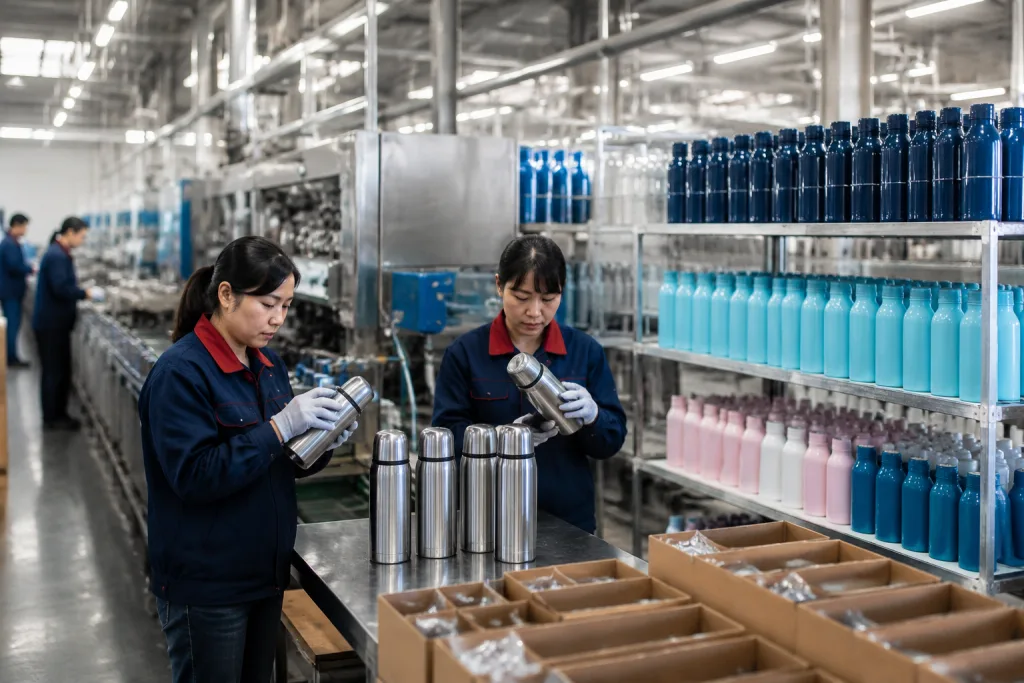
Key Takeaways
- Specify SUS304 inner wall, 201 or 304 outer wall, and 0.45-0.60 mm wall thickness before asking for price
- A realistic private label MOQ is usually 1,000-3,000 pcs per color for factory thermos production
- Expect 7-12 days for samples and 30-45 days for bulk thermos production after artwork approval
- Use AQL 2.5/4.0 inspection, vacuum heat testing, and 1.2 m carton drop testing for export orders
If you sell to hikers, campsites, ski shops, corporate gift buyers, or outdoor subscription boxes, a thermos is not just another bottle. It has to hold coffee at 60°C after 12 hours, take a 1.2 m backpack drop, pass food-contact checks, and keep your logo clean after 500 dishwasher cycles if dishwasher safety is printed on the box. QC pulled a sample last month where the laser logo looked fine, but the powder coat chipped at the bottom ring after the line ran the first 300 pcs.
For a 304 stainless steel thermos flask private label project, the costly mistakes usually happen before sampling. The buyer asks for a custom thermos, the supplier quotes a neat FOB price, and nobody locks steel grade, vacuum performance, cap structure, coating, carton drop test, or AQL level. We see this every week from Zhejiang, China. The wrong question is “what is your best price?” Ask what we run on the line, how many hours the vacuum test takes, whether the cap mold is private, and what happens if the PO says matte black but the artwork file says PMS 426C.
Start With The Steel Spec
Buyer question: Do I need to write 304 stainless steel on the PO, or is “stainless” enough?
No. “Stainless” is too loose. For a 304 stainless steel thermos flask private label order, put the material spec into the RFQ and purchase order: SUS304 or 18/8 stainless steel for the inner liner, food-contact silicone for seals, and BPA-free plastic for any lid parts touching liquid. We have seen this go sideways when a PO said “SS bottle” and the buyer flagged SUS201 on the outer shell during pre-shipment inspection. The outer shell can be SUS304 or SUS201 depending on your price target, but match it to the shelf you sell into. Outdoor retailers in Europe and North America often push for 304 outer walls because the product story supports a premium price.
The usual build is double-wall vacuum insulated stainless steel. For a 500 ml to 750 ml customized thermos, we normally quote inner wall thickness around 0.45 mm and outer wall around 0.50-0.60 mm, checked with a digital micrometer after deep drawing. Thin it down and you might save USD 0.08-0.18 per unit. The math often does not work. Dent complaints rise, cartons get crushed at the corner, and QC pulls more samples from the line. Go thicker and you pay in steel cost plus freight weight.
- Checklist: confirm 304 inner liner by material declaration or third-party test, not by a sales sheet photo.
- Checklist: define capacity tolerance, usually ±5% for drinkware, and state whether it is brimful or usable volume.
- Checklist: confirm whether the outer body is 304 or 201 stainless steel, especially if the MOQ is split across 2 colors.
- Checklist: ask if the supplier thermos line uses copper plating inside the vacuum layer for higher heat retention, then request the heat test curve.
A solid thermos manufacturer in China will answer these questions without drama. A weak thermos vendor may hide behind “food grade,” which is the wrong answer. QC pulled one 750 ml sample for us last year where the silicone ring passed odor check, but the liner spec on the packing list still said 201. That phrase is not a specification.
What Performance Should You Demand
Buyer question: What heat-retention target should I put on the spec sheet: a USD 3.80 promo flask or a USD 9.20 outdoor retail thermos?
Heat retention is not a slogan. It comes from body volume, mouth opening in mm, cap stack-up, vacuum draw, and copper plating inside the vacuum wall. On our line, a narrow-mouth 750 ml flask with a 38 mm opening usually beats a soup thermos with a 62 mm mouth, even when both use 304 stainless. We had one buyer ask for “keeps hot all day” on the color box; QC pulled the sample at 12 hours and it was 54°C. The math doesn't work.
For a 500 ml to 750 ml 304 stainless steel thermos flask private label order, we run this benchmark: fill with 95°C water, close the lid within 30 seconds, test at 20°C ambient temperature, and require water temperature above 60°C after 12 hours. Better models can hold above 68°C after 12 hours, but the stopper seal and lid thread tolerance start to decide the result. We measure the thread with a go/no-go gauge, because a 0.3 mm cap mismatch can turn a good vacuum body into a weak sample. For cold retention, 8°C or below after 12 hours with iced water is a normal claim; write the ice weight, water volume, room temperature, and start time on the test sheet.
For promotional brands, you can accept a lower-performing thermos promotional model if the job is price-driven. Do not print “24 hours hot” unless your own test supports it. We’ve seen this go sideways: a PO had “24H HOT” typed into the artwork note, while the approved sample only passed 12 hours above 60°C. Retail returns cost more than a USD 0.20 saving.
- Checklist: request a temperature curve at 2, 6, 12, and 24 hours, with room temperature shown on the report.
- Checklist: test 5 sample units from the pilot run, not only 1 golden sample from the sales desk.
- Checklist: check leakage after the bottle is filled, inverted, and shaken for 60 seconds; QC should record any cap sweating or gasket slip.
- Checklist: confirm lid torque, stopper fit, and gasket replacement availability before carton artwork is locked.
At BottleForge in Hangzhou, Zhejiang, our stainless thermos workshop can produce about 220,000 units/month depending on cap complexity and coating schedule. That number matters. A factory thermos partner with only 2 vacuum furnaces may quote 18 days, then stretch to 32 days when Q3 outdoor orders hit. We ship better when the buyer locks the lid BOM, Pantone coating, and carton mark before the first pre-production sample.
Private Label Options That Matter
Buyer question: Which private-label choices move the unit price and push the ship date?
A customizable thermos can stay simple, or it can get expensive fast. For 8 out of 10 outdoor retail and promo orders we run, the best first buy is a stock mold with your logo, body color, packaging artwork, and EAN/UPC barcode. Custom mold work is fine if the annual forecast is above 20,000-30,000 pcs per year. Below that, the math doesn't work; spend the money on coating, carton strength, and cleaner retail packaging instead. Last month QC pulled a stock 750 ml body from the line, checked the mouth at 53.2 mm with a digital caliper, and the buyer still sold it as a private-label flask with no body tooling charge.
Logo methods change both cost and sampling time. Laser engraving is durable and clean on powder coating or bare stainless steel; it usually adds USD 0.08-0.25 per unit depending on logo size. Silk screen handles color, but we have seen it go sideways when the ink and coating are not matched; the buyer flagged scratches after a 3M tape test on black powder coat. UV printing works for multi-color logos and gradients, often from USD 0.18-0.45 per unit. For a premium thermos custom project, embossing or debossing on silicone sleeves can look sharp, but it means a sleeve mold, a signed 2D drawing, and usually 18 days for approval instead of 12 days.
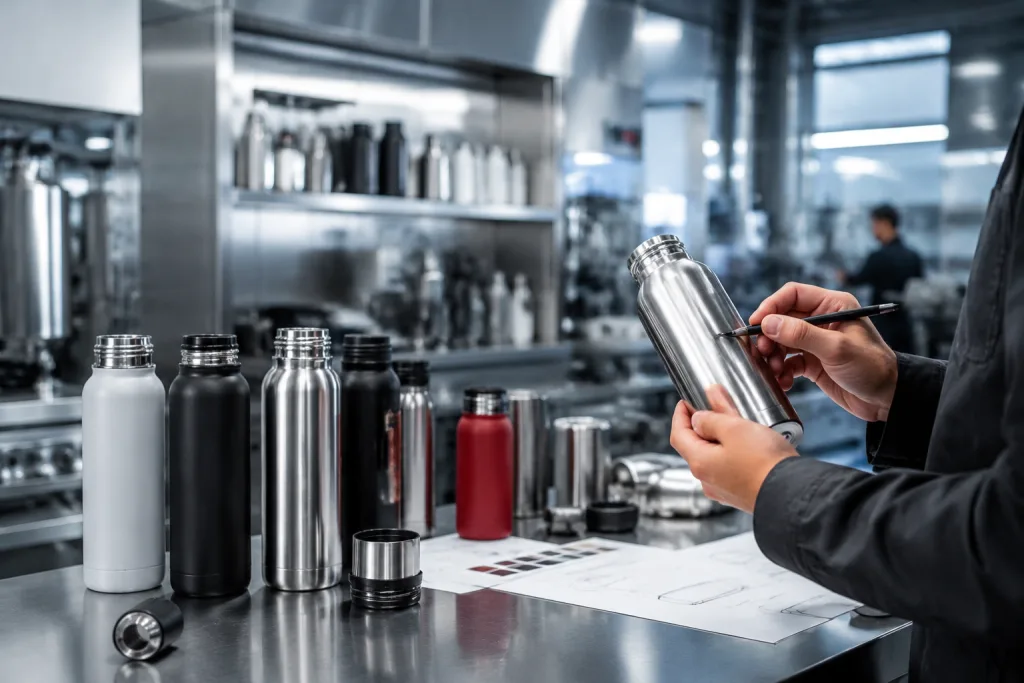
Color is the quiet troublemaker. Powder coating is popular because it grips well outdoors and hides fingerprints, but ask for coating thickness, adhesion testing, and color tolerance before bulk. We usually check 60-80 μm powder thickness with a coating gauge, then run cross-cut adhesion before packing. For Pantone-matched powder coating, expect MOQ pressure because powder suppliers do not like 200 kg leftovers in odd colors. A realistic MOQ is often 1,000 pcs per color for a stock body and 3,000 pcs per color for tighter private label control.
- Checklist: send AI or PDF vector logo files; a 72 dpi JPG from a website will blur on a 35 mm logo.
- Checklist: define logo size in millimeters and placement from bottle base or rim, such as 28 mm wide and 95 mm up from the base.
- Checklist: approve a physical color chip before bulk thermos coating; screen color is the wrong reference for powder.
- Checklist: request one full packaging sample with insert, manual, barcode, and carton mark; we once caught a PO typo where “matte navy” became “matte naby.”
For distributors thermos programs, keep 2-3 evergreen colors and one seasonal color. Too many colors create dead stock and slower reorders. We ship faster when the line repeats black, white, and army green, because the spray booth does not need a full cleanout between every 600 pcs batch.
MOQ, Price, And Lead Time
Buyer question: What should I expect when I ask for thermos bulk pricing?
For a 304 stainless steel thermos flask private label order using our existing molds, the workable MOQ is 1,000-3,000 pcs per SKU. We run 500 pcs sometimes, but the unit price is usually 15-30% higher because the coating booth, logo jig, packaging plates, and carton line still need the same setup time. Small runs look cheap on paper. The math doesn't work. For a new outdoor line, 1,000 pcs is the safer first order; for national retail supply, plan 3,000-10,000 pcs per style so the line can hold color and carton packing steady.
FOB China pricing for a 500 ml to 750 ml stainless vacuum flask often lands around USD 3.20-6.80, depending on steel spec and lid structure, plus the finish and retail packing. A low quote can be real, but check the exclusions line by line: inner 304 grade, copper coating, retail box, FNSKU label, drop test carton, spare gasket, and inspection support. Last month QC pulled a 750 ml sample with a 0.42 mm inner wall after the PO said 0.50 mm. A supplier thermos quote without a cost sheet is not apples to apples.
Lead time is not just “production days.” Samples normally take 7-12 days after artwork confirmation, including laser logo alignment on the rotary fixture and one leak test. Bulk production usually takes 30-45 days after deposit, sample approval, and final packaging files. Add 5-10 days if you need custom color powder, molded gift box inserts, or retailer compliance labels. We have seen this go sideways when a buyer sent “Pantone 186C” in the email but the PO had “168C.”
Do not push a thermos factory for impossible delivery unless you can accept a simpler finish or split shipment. Rushing powder coating and vacuum testing is how defects reach your warehouse; the vacuum tester does not care about your launch date.
- Checklist: ask for EXW and FOB Ningbo or Shanghai pricing, with the port charge split shown in RMB.
- Checklist: confirm carton quantity, gross weight, and CBM before freight booking; one 24 pcs master carton can change the pallet plan fast.
- Checklist: agree payment terms, usually 30% deposit and 70% before shipment for first orders, before the factory opens the material order.
Compliance Is Not Paperwork
Buyer question: What certificates do I need for Europe and North America?
For Europe, stainless steel food-contact items need LFGB or EU food-contact compliance, and we check REACH risk on powder coating, screen-printing ink, silicone rings, and PP lids. For the United States, buyers ask for FDA food-contact compliance; 6 out of 10 retail programs we handled last year also asked for California Proposition 65 screening. If the flask is for children, bring up ASTM and CPSIA before we cut the mold. QC once pulled a kids’ straw-lid sample because the silicone plug measured 5.8 mm and the buyer flagged small-part risk. An adult 304 stainless thermos is not automatically safe for a kids’ range.
Factory audits matter before price looks “approved.” A distributor thermos program for larger retailers may need BSCI, Sedex, ISO 9001, or a customer-specific social audit with payroll and dormitory records checked. Not every thermos manufacturers supplier has these ready. If your channel requires BSCI, say it before sampling; we need to confirm the audit scope, factory name on the report, and expiry date. We have seen this go sideways: the buyer approved the 750 ml sample, then the order stopped because the audit report listed an old workshop address from 2022.
Ask for recent test reports on similar material and coating, but do not treat them as a free pass. A report for a black 500 ml bottle from last year is not the same as a report for your white powder-coated 750 ml bottle with printed logo. The math doesn’t work if you plan a retail launch and skip project-specific testing to save USD 300-900. In our lab room, we mark coating panels by Pantone code and bake setting; one white powder coat passed adhesion on the cross-cut tester, while the same logo ink failed after the 3M tape pull.
- Checklist: match test reports to 304 stainless steel, powder coating or spray paint, silicone gasket, straw, PP lid, and any plastic push button.
- Checklist: confirm packaging needs recycling marks, country of origin, importer address, barcode size, and warning text before the carton artwork goes to plate-making.
- Checklist: request a Declaration of Conformity where applicable, with the same item number as your PO; one typo in “TH-750W” versus “TH-750M” can delay customs files.
- Checklist: verify that the thermos manufacturer can support pre-shipment inspection documents, including AQL 2.5 results, carton drop-test photos, and packing list weight checks.
China has strong stainless drinkware manufacturing, but compliance discipline changes from factory to factory. In Zhejiang, export-focused plants near Yongkang, Jinhua, and Hangzhou usually keep EU and US buyer files in order; small domestic-only workshops often stop at a material certificate and a nice sample. We ship both OEM and private label programs, and this is the wrong question to ask at the end of sampling. Ask on day 1, when the line can still adjust coating, logo ink, gasket material, and carton copy without losing 12 days.
Inspection Before Shipment
Buyer question: How do I avoid receiving leaking or scratched thermos flasks?
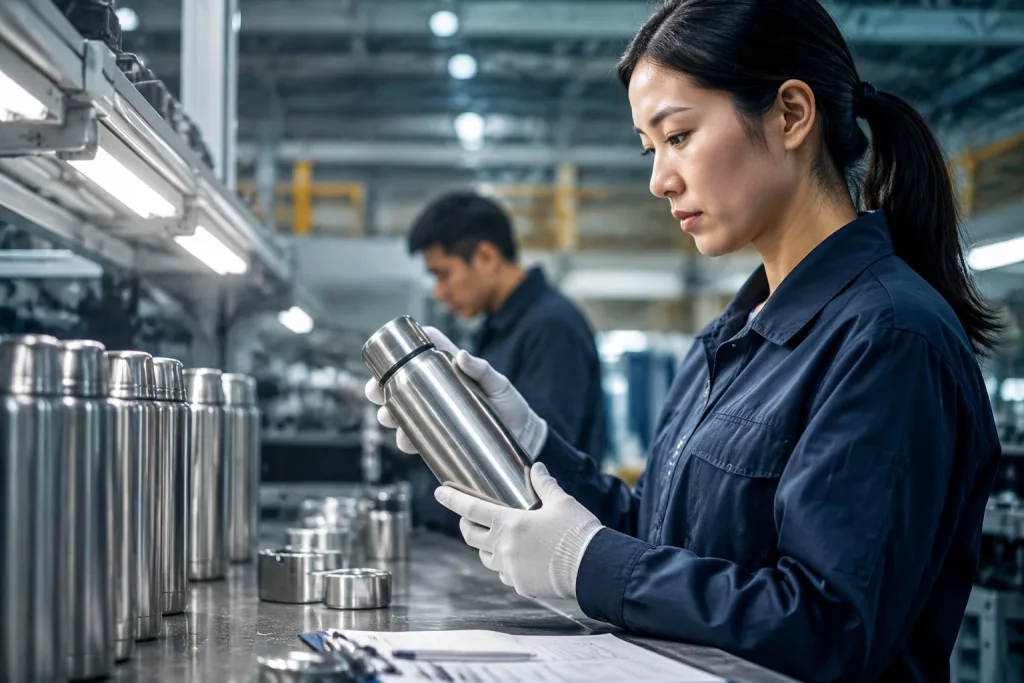
Put the inspection plan in writing before mass production starts. Visual check is the wrong question to ask by itself. For private label 304 stainless thermos flasks, we run checks for leak rate, vacuum heat loss, coating adhesion, logo offset in mm, real capacity, lid thread fit, smell after hot-water rinsing, carton compression, barcode scan, and packing match against the PO. On our line, QC uses a 3M tape pull for coating and a digital caliper when the buyer sets logo tolerance at ±1.5 mm. For most export orders, use AQL 2.5 for major defects and AQL 4.0 for minor defects. Critical defects such as sharp edges, contamination, broken glass accessories, or severe leakage should be zero tolerance.
Sample size depends on lot quantity, but even a 1,000 pcs order needs enough cartons opened to catch repeat defects. We normally test 20-32 pcs for leakage on small orders, then increase the pull when the lot goes above 3,000 pcs. For vacuum heat testing, QC should pick bottles from the first, middle, and last pallets, not only the clean samples sitting near the packing table. We have seen this go sideways when the first 50 pcs passed, then the welding station drifted by 0.3 mm after lunch and later units lost heat faster.
Carton testing gets skipped until the buyer sends photos of dented bottles from the warehouse. Use a 1.2 m drop test for export cartons if your channel includes parcel handling or Amazon-style fulfillment. If you need FNSKU labels, retail barcodes, suffocation warnings on polybags, or mixed-color cartons, put each item on the inspection checklist with the exact artwork file name. Last month QC pulled a carton where the PO said “matte black,” but the carton mark had a typo as “mate black”; small error, big receiving delay.
- Checklist: approve the golden sample, then keep one in your office and one sealed at the factory with date and signature.
- Checklist: require photo records for logo placement, inner packing, carton marks, and pallet loading, with at least 6 clear shots per style.
- Checklist: inspect before paying the balance, not after the vessel leaves Ningbo or Shanghai.
- Checklist: state who pays rework cost, replacement cartons, and re-inspection fees if defects exceed AQL.
A solid thermos supplier will accept clear inspection terms. Vague wording helps nobody, except a weak factory trying to push borderline goods out the door before QC pulls the sample.
Questions To Ask The Factory
Buyer question: How do I compare thermos suppliers without choosing only the lowest price?
Ask shop-floor questions. A solid manufacturers thermos team should answer with numbers, line photos, and process notes, not a 40-page catalog. You need a factory that can repeat the same finish on a reorder, update a color box without mixing old artwork, and tell you when a design will fail the drop test. Last month QC pulled a 500ml sample because the lid gasket sat 0.6mm too high. That kind of detail matters.
Start with capacity and process ownership. Does the factory run forming and welding in-house? What about vacuuming, polishing, powder coating, and final assembly? Outsourcing is not a deal breaker, but the math changes when vacuum sealing sits 80km away and a truck delay costs 2 days. Ask for monthly capacity, current lead time, sample room timing, and proof they have shipped outdoor retail or promotional orders before. If you are a thermos distributor, ask how they control repeat SKUs, spare lids, and replacement gaskets after shipment; we have seen buyers get 3 lid versions under the same item code, and that goes sideways fast.
Then ask commercial questions with shipping detail. Can they reserve 304 stainless steel coil for your reorder? Can they pack mixed cartons for distributors thermos shipments without crushing the color boxes? Can they apply FNSKU labels, inner carton labels, and pallet labels, then send label photos before loading? Can they ship FOB Ningbo, FOB Shanghai, or DDP if needed through your forwarder? A useful answer includes carton dimensions, gross weight, HS code guidance, and production dates such as 12 days for samples and 35 days for mass production, not “soon.” We check this against the packing table in Excel because one typo on a PO can turn 48 cartons into 84 cartons.
- Checklist: request 3 production photos from a current stainless thermos line, including welding, vacuum testing, and packing table.
- Checklist: ask for defect data from the last 3 similar orders, with AQL 2.5 findings if they have them.
- Checklist: confirm MOQ for spare lids, silicone rings, and retail boxes, including the carton qty for each spare part.
- Checklist: ask what they would change in your spec to reduce cost without hurting quality, such as coating thickness, box structure, or lid mold choice.
The best thermos manufacturers are not always the cheapest on the first quote. Lowest price is often the wrong question to ask. They reduce your landed cost by avoiding late shipments, rework, wrong cartons, and customer complaints; one relabeling job at the Ningbo warehouse can eat the savings from a USD 0.08 cheaper flask. New buyers miss that cost until the buyer flagged it in the first review.
Send Your Thermos Spec For A Practical Quote
Share capacity, logo, color, MOQ, target market, and compliance needs. We will return a clear FOB quote and sampling plan.
Frequently asked questions
What is the best MOQ for a first 304 stainless steel thermos flask private label order?
For an existing mold with your logo and standard packaging, 1,000 pcs per color is a practical first MOQ. It gives the factory enough volume for coating, laser engraving, assembly, and carton packing without forcing you into a heavy inventory position. If you need custom Pantone powder coating, printed retail boxes, or several lid colors, expect 2,000-3,000 pcs per SKU. Very small 300-500 pcs orders are possible with some thermos suppliers, but unit price can be 15-30% higher and packaging choices are limited. For outdoor retailers, we usually suggest testing 2 colors at 1,000 pcs each rather than 6 colors at 300 pcs.
How much should a private label stainless thermos cost FOB China?
A normal FOB China range for a 500 ml to 750 ml 304 stainless steel thermos flask is about USD 3.20-6.80 per unit. The lower end usually means a simpler lid, stock color, basic box, and no extra copper coating. The higher end may include 304 outer wall, better powder coating, laser logo, retail packaging, and stronger heat retention. Always compare quotes line by line: steel grade, coating, logo method, gasket material, carton size, and test requirements. A USD 0.40 cheaper factory thermos can become more expensive if it fails inspection or needs repacking before shipment.
Can I use the same thermos for retail and promotional gifting?
Yes, but define the positioning clearly. A retail custom thermos should prioritize coating durability, heat retention, packaging presentation, and barcode accuracy. A promotional thermos may prioritize logo visibility, campaign deadline, and price. The body can be the same 304 stainless steel flask, but the finish and packaging may differ. For example, outdoor retail might use powder coating, laser engraving, and a 350 gsm color box. A promotional brand might use silk screen printing and a kraft box to save USD 0.20-0.50 per unit. If both channels use the same SKU, avoid exaggerated claims that one channel cannot support.
What tests should I request before shipment?
At minimum, request leakage testing, vacuum heat retention testing, coating adhesion testing, capacity check, logo placement check, carton drop testing, and packaging verification. Use AQL 2.5 for major defects and AQL 4.0 for minor defects. For food-contact compliance, arrange LFGB or EU food-contact testing for Europe, and FDA-related material checks for the US. If your bottle has colored coating or printed artwork, include REACH or Prop 65 screening if your retailer requires it. For parcel-heavy channels, add a 1.2 m carton drop test. Inspection should happen before balance payment and before containers leave China.
How long does sampling and production take from Zhejiang?
For our Zhejiang production base, a logo sample normally takes 7-12 days after artwork approval. If you need a custom powder color or special packaging prototype, allow 12-18 days. Bulk production for a 1,000-5,000 pcs private label thermos order is usually 30-45 days after deposit, approved sample, and final packaging files. Peak season, typically June to September for many outdoor and holiday programs, can add 7-15 days. Sea freight to Europe or North America is separate, often 25-40 days port to port depending on route and congestion.