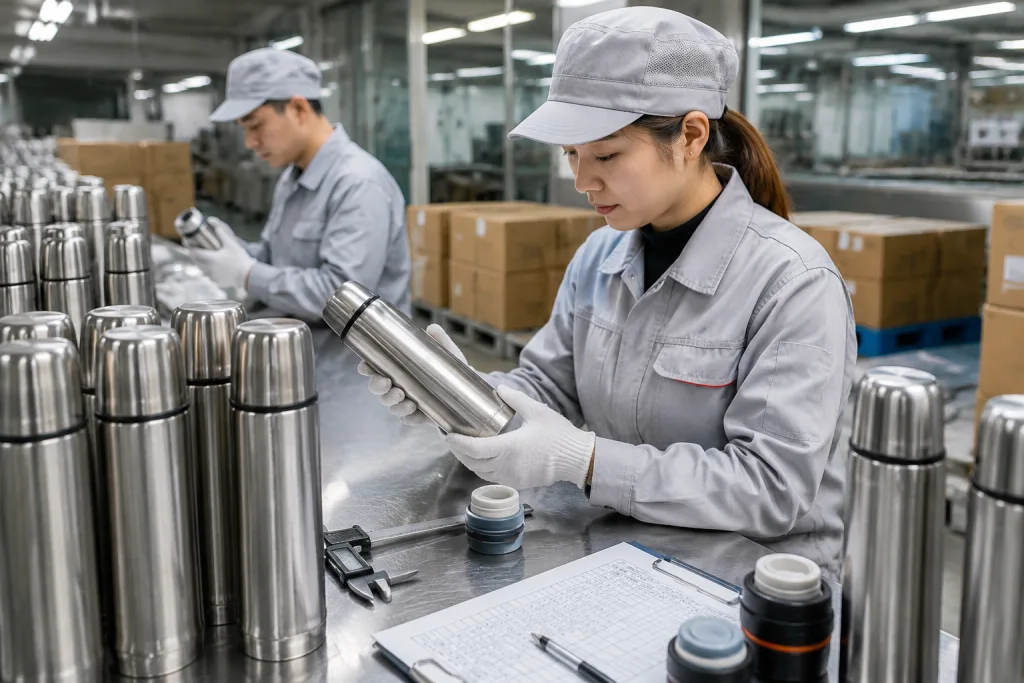
Key Takeaways
- A clear RFQ should specify 304 inner steel, capacity tolerance, lid type, coating, carton pack, MOQ, and target FOB price before sampling.
- For custom thermos orders, expect 7-12 days for standard-logo samples and 25-35 days for bulk production after deposit and artwork approval.
- Reliable thermos bulk inspection should use AQL 2.5 for major defects and AQL 4.0 for minor defects, with leak and vacuum retention tests included.
- A practical first PO for outdoor or promotional use is usually 1,000-3,000 units per color, not 100 units with five custom colors.
A stainless thermos looks simple until you buy 5,000 pieces and QC pulls 63 lids with seepage after a 30-minute inverted water test. The steel body is usually not where the loss starts. The loss starts when the PO says “matte black, good logo, gift box” and nobody locks the powder thickness, Pantone number, gasket material, or carton drop test.
If you need a 304 stainless steel thermos bottle manufacturer in China, this is the wrong question to ask: “Can you make this bottle?” Most factories will say yes. From our line in Hangzhou, Zhejiang, we’ve seen the better buyers send a 2-page spec sheet with capacity tolerance in ml, insulation target at 6 hours, logo artwork, packing method, and AQL 2.5 inspection points before sampling. Those orders run cleaner. Samples take 7 days instead of 12, and bulk thermos production has fewer last-minute fights over scratches, color drift, or a missing straw brush the buyer flagged only after cartons were sealed.
Start with the RFQ skeleton
Your RFQ decides whether you get a workable quotation or a polite guess. A 304 stainless steel thermos bottle manufacturer needs more than “send price for 750 ml bottle.” We see that line at least 8 times a month, and QC can already predict the problem: the supplier has to guess 0.4 mm or 0.5 mm steel, lid type, coating grade, carton size, and logo process. The first price may look cheap. The final PO will not match it.
Use a one-page RFQ with hard fields. For a 750 ml outdoor thermos, we would expect: 304 stainless steel inner wall, 304 or 201 outer wall, double-wall vacuum insulation, 0.45-0.55 mm body gauge checked by micrometer, screw lid with silicone seal, powder coating or spray paint, 24-hour cold retention target, 12-hour hot retention target, and retail box or bulk carton packing. If you need EU distribution, ask for LFGB or REACH-related material declarations. For North America, ask whether the paint and plastics can support applicable FDA food-contact expectations and California Proposition 65 screening if your channel requires it. The wrong question is “what is your best price?” Ask what construction the price is based on.
Put your commercial line items in the RFQ too. We once had a buyer typo “30,000” instead of “3,000” on a PO draft, and the line planned material 10 days too early before the merchandiser caught it:
- Item: 750 ml customized thermos bottle, 304 inner stainless steel, with body shape drawing or reference photo attached.
- Quantity: 3,000 units, 1 color, 1 logo, with overrun tolerance stated if your warehouse allows it.
- Incoterm: FOB Ningbo or Shanghai, China, so the freight forwarder does not quote from the wrong port.
- Target: USD 4.20-5.80 depending on lid and finish; below that, the math does not work for a stable coating.
- Packing: 1 pc white box, 24 pcs master carton, export carton below 15 kg, with carton drop test requirement if retail delivery is rough.
- Inspection: pre-shipment AQL with leak, coating, and logo checks; we run 100°C hot-water leak tests on pulled samples before sealing cartons.
This is not overkill. It is the minimum language that lets a thermos manufacturer quote the same product you are imagining, not the cheapest version the line can build. We have seen this go sideways when the buyer approved a price first and argued about logo position 18 days later.
Translate product use into specifications
Outdoor retailers and promotional brands may both ask for a stainless thermos, but the spec sheet should not look the same. A hiker drops a bottle onto rock at 1.2 m or leaves it on frozen ground; a conference giveaway sits beside a laptop and gets judged by the logo edge. Before we run a sample, pick the failure that will cost you money first: heat loss, leakage, dents, coating scratches, logo defects, or freight weight. This is the wrong question to ask: “What is your standard model?” Ask what the end user will do to it.
For a retail outdoor SKU, we usually quote 304 stainless steel for all liquid-contact surfaces, 0.50 mm body material where the budget allows, a thick powder coat, and a lid tested to at least 3 leak cycles after hot filling. QC pulled one 900 ml sample last month after a 95°C fill test and found seepage at the silicone ring, measured with a 0.05 mm feeler gauge. A cheap lid can save USD 0.20, then create 2% returns. On 10,000 units, the math does not work.
For a promotional thermos, the specification can be leaner. You may choose 304 inner and 201 outer stainless steel to control price, use laser engraving for a durable single-color mark, or switch to silkscreen when the campaign logo needs a 65 mm print area. If the product is handed out at an event, food-contact safety and leak control still stay on the checklist, but a premium carry handle or molded carton insert may be wasted cost. We have seen this go sideways when the buyer approved 201 outer steel, then later asked why the unit felt lighter than the retail sample.
Your PO line items should match the use case clearly. We check this before the line opens, because one typo on a PO, like “mat white” instead of “matte white,” can hold printing plates for 2 days while the buyer confirms artwork.
- Outdoor retail PO: 1,500 pcs black, 1,500 pcs forest green, powder coat with 6H pencil test target, laser logo, retail color box, barcode label.
- Promotional PO: 5,000 pcs matte white, 1-position silkscreen logo with approved Pantone code, individual white box, no barcode.
A good manufacturer thermos partner will push back on weak assumptions. If 4 suppliers simply say yes to every line, they are probably quoting the bottle shape, not reading the requirements.
Price the thermos before sampling
Sampling before price alignment burns days. We have seen a custom thermos sample pass vacuum testing, look clean under the light box, then die because the final FOB price was USD 1.00 over the buyer’s shelf-margin target. For distributor thermos programs, get a quote range first, then pay the sample charge. QC pulled one 500 ml sample last month with a perfect laser logo, but the buyer flagged the landed cost before they even checked the lid.
The main price drivers are capacity, steel grade, body gauge, lid complexity, coating, decoration, packing, and test reports. A 500 ml factory thermos with a simple screw lid may sit around USD 3.20-4.60 FOB at 3,000 units. A 750 ml customized thermos with handle lid, powder coat, laser logo, and retail box may run USD 4.80-7.20 FOB. A 1,000 ml outdoor bottle with cup lid, heavier wall, and color box can move higher. Steel cost and exchange rate move the quote, so treat these as working ranges, not promises. The wrong question is “how cheap can you make it”; the better question is whether the line can hold the target price with 304 stainless, the selected coating, and the carton spec your retailer needs.
MOQ matters. In Zhejiang, our standard MOQ for existing thermos bottle molds is normally 1,000 pcs per color, while new color coating is cleaner at 2,000 pcs per color because the spray line loses material during color change and oven setup. New mold development is a separate cost and often starts above USD 1,500-4,000 tooling depending on body and lid complexity. Our Hangzhou-linked production network can produce about 300,000 drinkware units per month across stainless thermos, travel tumbler, and sports bottle lines, but capacity still needs booking before peak Q3 shipments. We run into trouble when a PO arrives with “mat black” typed instead of “matte black” and no Pantone number.
Ask the thermos supplier to separate costs in the quotation:
- Unit price for bottle body and standard lid.
- Logo charge per unit or setup charge, with the laser area in mm if the artwork is large.
- Color box, insert, barcode, FNSKU, or carton label cost.
- Testing fee, if third-party reports are required.
- Sample fee and whether it is refundable after bulk PO.
This structure gives you parts to adjust instead of a blind price fight. We can change the lid, reduce box weight by 30-50 g, or switch decoration before sampling; after the sample is approved, every change costs time on the line.
Approve samples like an inspector
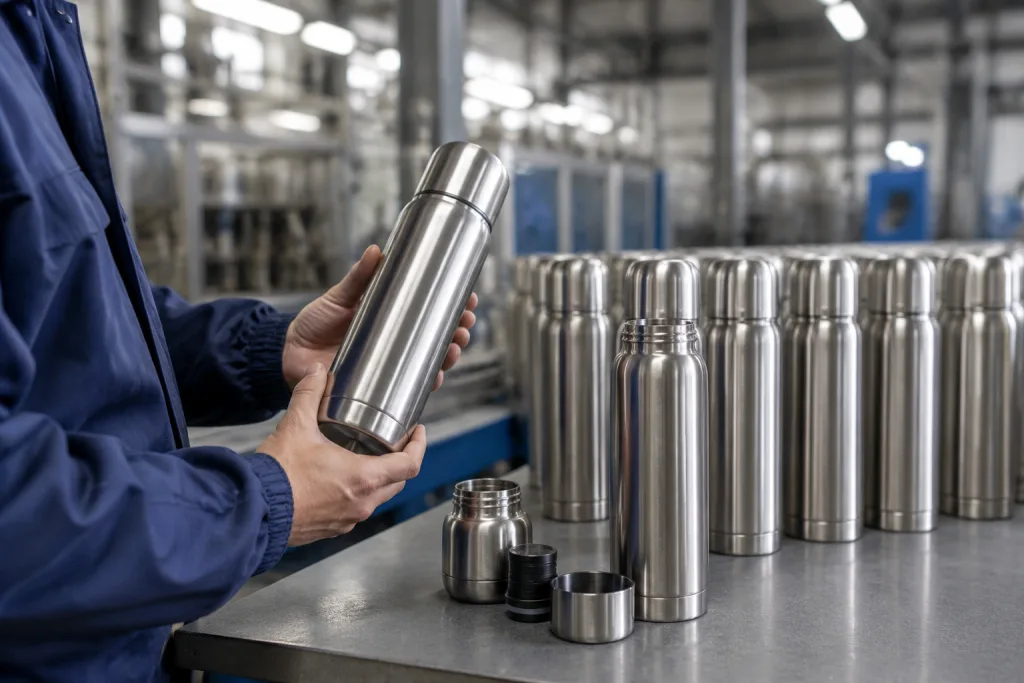
The sample stage is where buyers get too polite. We’ve seen this go sideways. Do not approve a customizable thermos because it is “close enough” unless you are ready to see the same scratch, color shift, or crooked logo on 5,000 units. A sample approval should be a written technical approval with photos, measurements, and sign-off notes, not a WeChat photo with a thumbs-up. QC pulled one 750 ml sample last month where the logo was 3 mm low; the buyer flagged it only after cartons were packed.
For standard mold samples with custom logo, 7-12 days is normal after artwork confirmation. Custom color coating may take 10-15 days because the coating line needs color matching and curing. If you request a new lid or modified mold, sample time can extend to 25-45 days. In China, the sample room and bulk line are not always identical, so ask which parts are production-grade and which are hand-made. We run some first samples on a small laser machine, while bulk moves to the line fixture; that 1 mm clamp difference can show up in logo position.
Check the sample in a simple but strict way. Fill it with boiling water, close the lid for 5 minutes, then invert and shake over white paper. Measure outside surface temperature after 30 minutes to spot obvious vacuum failure. Use calipers for logo size if placement matters. Rub silkscreen with a damp cloth, then pull it with 3M tape if your channel gets strict about print durability. Put the bottle in a backpack with keys for one day to judge coating scratches. Fast test. No excuses. On matte powder coating, we also check the shoulder area under a 600 mm inspection lamp because thin coating often hides there.
Your sample approval line items should read like this:
- Approved sample code: S-750ML-BK-LASER-01.
- Approved deviations: logo position tolerance plus/minus 2 mm.
- Not approved: lid color differs from Pantone Black C; revise before bulk.
- Bulk reference: supplier keeps one signed golden sample; buyer keeps one.
Golden samples stop arguments before they start. Without them, every defect becomes an opinion, and the math does not work when 60 cartons are waiting for rework at final inspection.
Write PO lines that protect you
A purchase order is not just quantity and price. For a custom thermos project, the PO is where email promises become production instructions the line can follow. If it says only “stainless thermos, 3,000 pcs,” the vendor has room to choose the lid, coating standard, carton strength, and even the silicone ring color. We have seen this go sideways over a 2 mm logo position difference after QC pulled the sample.
Write PO line items that cover product, compliance, decoration, packaging, and inspection terms. A practical PO for distributors thermos supply might include:
- Product: 750 ml double-wall vacuum bottle, 304 stainless steel inner wall, 201 outer wall, powder coated body, screw lid with food-grade silicone ring.
- Decoration: one-position laser engraving, 45 mm width, centered 70 mm below shoulder, artwork file BF-LOGO-AI-2026.
- Quantity: 3,000 pcs matte black, allowed quantity tolerance plus/minus 3% only with buyer approval.
- Price: USD 5.35 per pc FOB Ningbo, China.
- Packing: 1 pc kraft box, 24 pcs export carton, carton drop-resistant, gross weight below 16 kg.
- Labeling: carton marks, SKU label, optional FNSKU for marketplace programs.
- Payment: 30% deposit, 70% after passed inspection before shipment.
- Lead time: 30 days after deposit, golden sample, and packaging artwork approval.
State the failure rule. If inspection fails, supplier reworks defects at supplier cost, and the re-inspection fee is charged to supplier if a major failure is confirmed. This is normal B2B wording, not a threat. Serious thermos manufacturers expect it, and our QC team checks against the PO with a caliper, vacuum tester, rub tester, and carton scale before release.
If you need BSCI factory audit, ISO 9001 process control, or retailer-specific documents, put them on the PO before deposit. After deposit, the math does not work well: the export team may need 3 to 5 working days to pull audit files, test reports, and stamped declarations, while production is already cutting cartons or printing labels. One buyer once sent a PO with “FNSUK” instead of “FNSKU”; small typo, big delay.
Control bulk before shipment
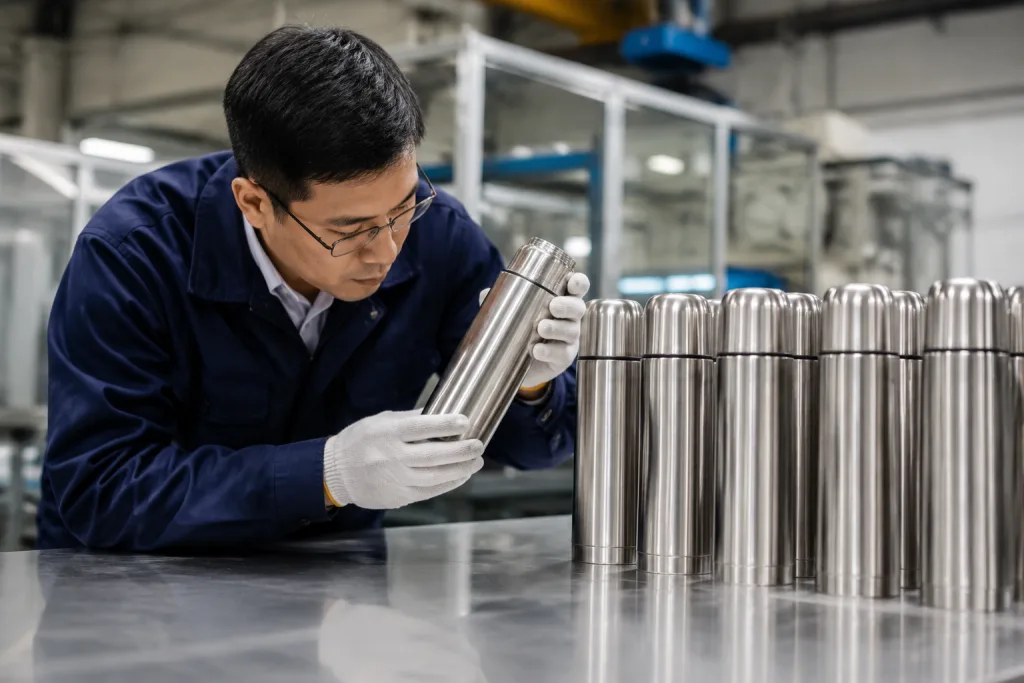
Bulk production should not disappear for 30 days. Ask for three checkpoints with dates on the PO: material arrival, pre-production sample, and inline production photos or video. On a manufacturer thermos order, we watch body forming, vacuum sealing, coating, logo application, and lid assembly because one bad setting on the hydraulic press or vacuum furnace can ruin 3,000 pcs before anyone sees it. QC should pull the sample, measure the mouth diameter with a caliper in mm, and send clear photos under normal line lighting. Silence is not progress.
For inspection, use AQL, not “check carefully.” A normal stainless thermos pre-shipment inspection can use General Inspection Level II, AQL 0 for critical defects, 2.5 for major defects, and 4.0 for minor defects. Critical defects include unsafe sharp edges, contamination, broken glass components if any, or severe leakage. Major defects include leaking lids, failed vacuum insulation, wrong logo, exposed metal under coating, large dents, or incorrect carton labels. Minor defects include small coating specks within agreed limits, light box scuffs, or slight color variation within approved tolerance. We had one buyer approve matte black, then flag a 1.5 mm silver scratch near the base during PSI; that belongs in the defect limit before the line starts.
Test at least these points during final inspection. Do not rely on a clean carton photo. The inspector should open cartons across the lot, scan the barcode with a handheld scanner, and record the actual water fill on a scale instead of guessing from the mold name.
- Capacity check against nominal volume, usually with plus/minus 5% tolerance.
- Leak test after hot water filling and inversion.
- Vacuum performance spot test, such as hot water temperature drop over 6 hours.
- Logo adhesion or engraving position check.
- Carton count, barcode scan, and shipping mark verification.
For thermos suppliers in Zhejiang and other China manufacturing regions, export packing is routine, but you still need to specify it. Ocean freight punishes weak cartons. If cartons exceed 18 kg or use soft single-wall board, your distributor thermos order may arrive with crushed retail boxes. We run 5-layer export cartons for heavier bottles, and the carton edge-crush test should be checked before packing starts. Ask for palletization if your warehouse charges for loose unloading; paying USD 0.60 more per carton can beat a 2-hour unloading claim later.
When inspection passes, release the balance payment, book vessel or air freight, and keep the approved inspection report with the commercial invoice and packing list. Match the PO number, carton quantity, and shipping marks line by line; we have seen one typo in the destination code hold a shipment for 2 days at the forwarder. That paper trail matters when a retailer asks why your thermos bulk shipment is safe to receive.
Send your thermos RFQ before sampling
Share capacity, quantity, logo method, target price, and destination. We will respond with practical specs, MOQ, FOB pricing, and sample timing.
Frequently asked questions
What is the normal MOQ for a custom stainless thermos order?
For an existing mold, a realistic MOQ is 1,000 pcs per color for most 304 stainless steel thermos bottle manufacturer programs. If you need a special powder coating color, 2,000 pcs per color is easier because coating lines lose efficiency on small batches. Laser logo orders can sometimes start lower than silkscreen because setup is simpler, but freight and inspection costs become inefficient below 500 pcs. For promotional thermos campaigns, 3,000-5,000 pcs usually gives better FOB pricing and cleaner production scheduling. New body molds or private lid tooling normally require a much larger commitment plus tooling fees.
Is 304 stainless steel required for both inner and outer walls?
For food-contact safety, the inner wall should be 304 stainless steel because it touches water, tea, coffee, or sports drinks. The outer wall can be 304 or 201 stainless steel depending on your price point and corrosion expectations. Outdoor retailers often choose 304 inner and 304 outer for a premium position, especially in wet or coastal markets. Promotional brands often use 304 inner and 201 outer to reduce cost by roughly USD 0.20-0.50 per unit. The important point is to state the steel grade on the PO and require material confirmation, not accept a generic “stainless steel” description.
How long does a custom thermos project take from RFQ to shipment?
For a standard mold customized thermos, plan 45-60 days from serious RFQ to FOB shipment. Quotation and specification alignment usually take 2-5 working days. Logo or color samples take about 7-15 days after artwork approval. Bulk production is commonly 25-35 days after deposit and golden sample approval. Final inspection and export booking add another 3-7 days. If you need third-party testing, new packaging structure, or retailer compliance review, add 10-20 days. Before Q4 or Chinese New Year, book earlier because China factory capacity fills fast.
Which logo method is best for outdoor and promotional thermos bottles?
Laser engraving is the safest choice for outdoor use because it does not peel and handles abrasion better than most printed logos. It works well on powder coating and stainless surfaces, but it is usually one-color by nature. Silkscreen is better when you need a large, colorful promotional thermos logo, though it needs adhesion testing and clear artwork tolerances. Heat transfer can create more complex graphics, but it adds cost and may be less rugged on curved bodies. For orders above 3,000 pcs, ask for one sample of each method before deciding.
What inspection standard should I use for thermos bulk orders?
Use AQL rather than a vague factory promise. A common setup is General Inspection Level II with AQL 0 for critical defects, 2.5 for major defects, and 4.0 for minor defects. For a 3,000 pcs order, the inspector will select a statistically defined sample size and check appearance, function, packing, and labeling. Add specific tests: leak test, capacity check, hot water retention spot test, lid fit, coating defects, logo position, barcode scan, and carton drop condition. If you sell through outdoor retail chains, keep the inspection report, material declaration, and packing photos for later claims handling.