Key Takeaways
- For 304 stainless steel thermal bottle custom projects, specify 0.45-0.60 mm inner wall thickness and 6-12 hour insulation targets
- Typical MOQ is 1,000 pcs per color for OEM colors and 500 pcs for stock color laser logo orders
- Reliable custom canteen sampling usually takes 7-10 days, with bulk lead time around 30-45 days after artwork approval
- Use AQL 2.5/4.0 inspection, leak testing, and material migration reports before releasing balance payment
A 304 stainless steel thermal bottle custom order looks simple until the quotes land in your inbox. One canteen supplier writes 0.45 mm steel, another writes 0.55 mm. One includes laser engraving, another adds a logo mold charge after the PI is signed. We still see vendors write “food grade” on a quotation but fail to send LFGB, REACH, or FDA migration reports when QC asks for the test file. That is a red flag.
If you buy custom drinkware for retail, promotion, hospitality, or distributor drinkware programs, price is the wrong question to ask first. The bigger risk is receiving 10,000 bottles that pass a photo check but fail vacuum insulation, leak testing, Pantone color matching, or a 1.2 m carton drop test. Last month, QC pulled the sample from the line and found the lid gasket sitting 0.3 mm proud, enough to leak after shaking. From our Hangzhou, Zhejiang factory network in China, we treat this as an engineering purchase first and a branding purchase second.
Start with the bottle specification
I’ll rewrite the prose in-place, keep the HTML structure untouched, and tighten the sales-engineer tone with concrete factory details.Before you ask any canteen factory for a price, write the bottle spec in numbers. “Good quality 304 stainless bottle” is not a purchasing spec. It gives you five readings and five quotes you cannot compare.
For a 304 stainless steel thermal bottle custom order, define capacity, structure, wall thickness, lid type, finish, packaging, and test requirements. Our normal base is SUS304 for the inner wall, SUS201 or SUS304 outside depending on price target, copper-coated vacuum layer for better insulation, and wall thickness around 0.45-0.60 mm. For premium retail, we run SUS304 outside too. For promo programs, SUS201 outer with 304 inner keeps the math in line.
Capacity drives tooling and freight. Common SKUs are 350 ml, 500 ml, 750 ml, 1,000 ml, and 1,900 ml for a custom growler. A 500 ml bottle may pack 24 pcs per export carton; a 1,000 ml canteen customized with handle lid may pack only 12 pcs. We’ve seen the buyer flag this after the first quote, because freight per unit shifts by 18-35%, and Europe plus North America feel it fast. The cartoning line shows it immediately.
Use a checklist like this when briefing canteen suppliers:
- Material: SUS304 inner, SUS304 or SUS201 outer, PP or Tritan lid components.
- Capacity tolerance: plus or minus 5% unless a measuring line is required.
- Insulation: hot water above 60°C after 6 hours for many retail models; higher targets need a tighter vacuum and copper coating.
- Leak test: 100% factory water test for screw lids and flip lids.
- Surface: powder coating, spray paint, electroplating, brushed steel, or sublimation coating.
- Carton: 5-ply export carton, drop test from 60-80 cm depending on carton weight.
A canteen factory in Zhejiang, China should quote against this spec without guessing. If the answer is “same as picture,” push back. That is the wrong question to ask. Pictures do not show steel grade, vacuum performance, or coating adhesion, and QC pulled a sample last week that failed the water test at 52°C after 6 hours.
Which customization actually matters?
I’ll rewrite this section in a more field-tested sales tone, keep the HTML structure intact, and make sure the wording stays specific and natural.Customization is where buyers burn budget fast. A new mold is rarely the right first move. For most custom canteen and customizable drinkware orders, start with an existing bottle body, then tune color, logo, lid, packaging, and accessory set. That keeps tooling cost down and lead time stable.
Logo choice should match the brand and the use case. Laser engraving gives a clean, durable mark and works well on stainless steel or powder coat when the logo needs to show through to metal. Silk screen printing suits one- or two-color artwork on smooth surfaces. Heat transfer and UV printing handle gradients and larger artwork, but QC still needs adhesion checks. We’ve seen buyers push for a full-color print on a promo run, then the line came back with scuff complaints after 2 weeks. For a canteen promotional campaign with a tight budget, one-color silk screen on a stock color keeps the math sane. For a retail customized canteen, laser logo plus retail box usually lands better.
Color needs a Pantone C code, not a screenshot. On our line, powder coating MOQ is usually 1,000 pcs per color, while stock colors with laser engraving may start from 500 pcs. A solid canteen vendor will send a pre-production sample before mass coating. One sample at 5 p.m. can save a whole batch. If the buyer flagged Delta E under 1.5, expect extra cost; Delta E under 2.0-3.0 is the more common industrial window.
Packaging is part of the spec, not an afterthought. A white box, color box, kraft box, belly band, hang tag, instruction sheet, barcode label, and FNSKU label all add labor and days. On Amazon or distributor growler orders, label position matters down to the mm. If your warehouse needs GS1 barcodes, carton marks, or pallet labels, put them in the purchase order before we run, not after packing starts.
My rule is simple: customize what the buyer touches first. Color, logo, lid feel, and the retail box beat a fancy bottle curve for most B2B programs.
Price questions buyers should ask
I’ll rewrite the section in place, keep the HTML structure intact, and tighten the sales wording so it reads like a factory-side buyer note.When a canteen manufacturer sends a low FOB price, do not celebrate yet. Ask what sits inside that number. A USD 0.18 gap per unit usually comes from 0.35 mm steel instead of 0.45 mm, no copper lining, a cheaper lid gasket, or no individual box. We’ve seen the buyer flag a quote on day one, then the landed cost jumps after packaging and carton work get added.
For reference, a 500 ml double-wall 304 inner thermal bottle from China usually sits around USD 2.40-4.20 FOB Ningbo or Shanghai, depending on finish, lid, carton, and order quantity. A larger custom growler or customizable growler in 1.2-1.9 L capacity may run USD 5.80-11.50 FOB. Those are working ranges, not promises; stainless steel prices, exchange rates, and box specs move every week. If one canteen supplier is 25% under the pack, the math does not work. We check the sample line with a caliper before we believe it.
Ask these questions before comparing canteen vendors:
- Is the quoted price based on SUS304 inner wall only, or SUS304 inner and outer?
- Does the price include powder coating, laser logo, individual box, and master carton?
- Is sample cost refundable after bulk order?
- Which port is quoted: FOB Ningbo, FOB Shanghai, EXW Zhejiang, or CIF destination?
- Are inspection costs, palletizing, FNSKU labeling, or carton drop testing included?
- What is the payment term: 30% deposit and 70% before shipment, or against inspection report?
For distributor canteen and distributor drinkware orders, price tiers should be clear. A factory may quote 1,000 pcs, 3,000 pcs, 5,000 pcs, and 10,000 pcs. Our Zhejiang production partners typically run 300,000-500,000 stainless bottles per month across standard and custom drinkware lines, so better pricing appears when the run stays on one coating color and one lid assembly. We’ve seen this go sideways when a PO typo changed the cap finish from matte black to gloss black, and QC pulled the sample back to the line.

Compliance cannot be assumed
“Food grade” is a phrase, not a certificate. If you import into the EU, UK, US, or Canada, ask for current test reports that match the exact 304 stainless steel, lid plastic, gasket, coating, and logo process on your PO. For stainless steel drinkware, the normal file includes LFGB for Germany and wider EU use, FDA food contact testing for the US, REACH for coating and restricted substances, and sometimes California Proposition 65 if you sell into that market. QC should match the report to the sample on the bench, not just file a PDF from last season.
For kids’ products, the checklist gets tighter. A kids bottle may need CPSIA, ASTM F963 for certain accessory risks, and lead/phthalate testing for paint and plastic parts. If your thermal bottle includes a straw, bite valve, silicone boot, or painted cartoon graphic, test those components too. We once had a buyer flag a panda graphic because the black ink was not listed on the original report. Fair point. Do not accept a general factory report from 3 years ago for a different lid.
Quality control should be written into the order. For most customized drinkware, AQL 2.5 for major defects and AQL 4.0 for minor defects is a practical inspection level. Critical defects, such as leakage, sharp edges, contamination, wrong material, or broken vacuum, should be zero tolerance. Pre-shipment inspection should include capacity check, logo position within a 1.5 mm tolerance, color, coating adhesion, lid torque, leak test, vacuum insulation test, barcode scan, carton mark, and carton drop test. QC pulled the sample before packing last month and found 7 lids with weak thread bite. The line stopped.
You can also ask the canteen factory for process controls: incoming material inspection, salt spray test for plated parts, 3M tape test for coating adhesion, dishwasher test if you claim dishwasher-safe use, and hot water retention test. We run 95°C water retention checks on sample bottles and log the temperature drop after 6 hours. If the canteen manufacturer cannot explain its inspection process, you are buying a finished picture, not a controlled product.
About 8 out of 10 first-time buyers ask for certificates after the goods are finished. That is backward. Compliance should be confirmed before deposit, because changing paint, gasket, or lid plastic after production starts can turn a 12-day job into an 18-day delay. The math does not work, and we have seen this go sideways over one wrong gasket material code typed on a PO.
Sampling and approval flow
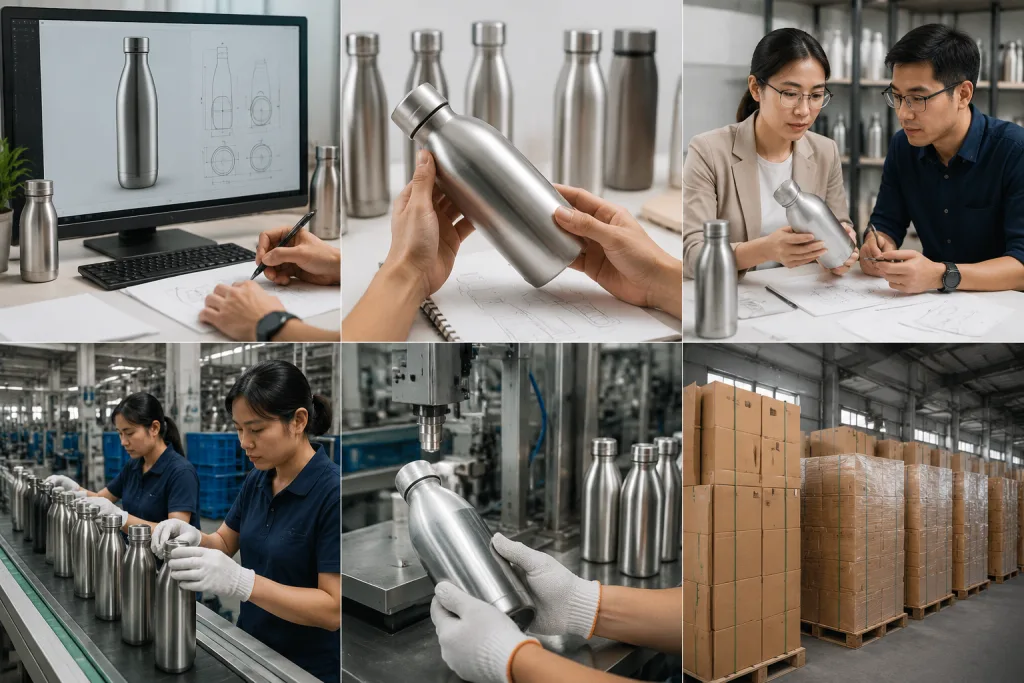
A sample is not just a logo check. It is where you catch cheap problems before the line cuts steel or mixes powder. For a 304 stainless steel thermal bottle custom order, split sampling into three stages if the schedule has room: existing sample, customized sample, and pre-production sample. We had one buyer flag a loose push-button lid at sample stage; fixing the silicone ring then cost less than USD 20, not a full rework later.
The existing sample confirms shape, hand feel, lid function, weight, and insulation. If stock exists, it can usually ship in 3-5 days from a canteen supplier. The customized sample adds your logo, color approximation, and packaging mockup. This usually takes 7-10 days for laser or silk screen, and 10-15 days for custom powder coating. The pre-production sample should use the same material, coating, logo method, lid, and box planned for bulk production. QC pulls it from the trial run, checks the 304 stainless body with a thickness gauge, and records the bottle weight in grams before approval.
Your approval notes should be specific. “Looks good” is not enough. Approve the Pantone code, logo size in millimeters, logo distance from base, lid color, box dieline, barcode readability, carton quantity, and warning text. On one PO, “logo 5cm from bottom” became 5 mm in the artwork file; the buyer flagged it only because the sample photo had a ruler beside the bottle. If you approve a digital render only, expect arguments later about logo size and position.
For a canteen customizable project with multiple SKUs, create a sample matrix. List 500 ml black laser logo, 750 ml white silk screen, 1,000 ml blue retail box, and each matching lid and carton mark. Each line should show status: sample made, buyer approved, artwork locked, bulk released. Simple table. No drama. This prevents the common problem where one size is approved but another size goes into production using the wrong logo scale; we have seen a 60 mm logo copied onto a smaller body, and the math does not work.
Our usual lead time from China is 30-45 days after deposit and final artwork approval for 1,000-10,000 pcs. Add 7-14 days if you need a new lid mold, custom box proofing, or third-party lab testing before shipment. Air samples from Zhejiang to the US or EU usually take 4-7 days by courier. We ship most samples by DHL or FedEx from Hangzhou, and the carton is normally under 3 kg unless you request a full retail packaging set.
Supplier selection checklist
A solid canteen distributor needs repeatable supply, not rescue work on every PO. Before you approve a canteen manufacturer, look past the studio photos and ask how the factory handles repeat runs, rejected goods, and engineering changes after the deposit is paid. We run into this on the line: a 0.3 mm mouth-thread change can make last season’s lid feel loose.
Start with business fit. Some canteen suppliers are built for 5,000 pcs promotional jobs with simple opp bags, but they struggle with retail color boxes and barcode placement. Some canteen vendors can make a custom growler, yet they cannot control FNSKU labels or mixed-SKU export cartons without two rounds of rework. Some factories want 20,000 pcs single-color runs and will push your 1,000 pcs boutique order behind a bigger chain-store job. That is not a moral issue. It is capacity. We have seen this go sideways when the buyer flagged carton marks only after QC pulled the sample.
Use this checklist before placing a first PO:
- Factory audit: BSCI, ISO 9001, or a recent audit report showing the welding area, vacuum station, coating line, and packing tables.
- Capacity: monthly stainless bottle output, coating line capacity by pcs/day, vacuum line count, and backup plan during peak season.
- MOQ: written MOQ by color, logo method, and packaging type, with clear rules for 500 pcs, 1,000 pcs, and 3,000 pcs orders.
- Engineering: 2D artwork proof, box dieline with barcode position, and material specification sheet for 304 stainless body, lid parts, and silicone ring.
- QC: incoming inspection for steel and plastic parts, in-process inspection after coating, final AQL inspection, and retained samples kept with PO number.
- Communication: reply within 24 hours on working days, English technical notes with measurements in mm, and no vague “no problem” answers when tolerance is the real issue.
- After-sales: written policy for shortages, breakage, logo defects, and functional leakage claims, including photo evidence rules and credit note timing.
If you are a canteen distributor or distributor growler buyer, ask for a reorder plan before chasing the lowest first quote. Will the same powder coating color be available six months later, or was it a one-time batch from a local paint supplier? Can the factory keep your logo file and carton marks under version control, such as V1.2 instead of “new final final.ai”? Can they support split shipments to two warehouses without mixing 12 pcs inner cartons and 24 pcs master cartons? This is where the math often breaks, even if the unit price looks cheaper by USD 0.08.
China remains the strongest sourcing base for stainless steel thermal drinkware because the supply chain is dense: steel forming is nearby, vacuum processing is close, coating is usually within the same industrial zone, and plastic injection, silicone parts, packaging, and export trucking can be arranged fast. Zhejiang works well for buyers shipping through Ningbo or Shanghai; from our Hangzhou side, a container can reach Ningbo port in roughly 4 to 5 hours when traffic behaves. The factory still needs clean paperwork and inspection discipline. One typo on a PO, like 304 stainless listed in the spec sheet but “201” left in an old carton file, can stop a shipment at the worst time.
Purchase order details that prevent disputes
Your purchase order should read like a control document, not a price confirmation. We’ve seen disputes start from 6 mm logo drift, 24 pcs carton quantity written nowhere, missing spare lids, coating that fails a 3M tape test, or an EAN-13 barcode our warehouse scanner cannot read. Small blanks get expensive.
For a 304 stainless steel thermal bottle custom PO, include model number, capacity, material grade, surface finish, Pantone color, logo method, logo artwork version, packaging file version, carton quantity, inspection standard, delivery term, shipment port, and payment condition. Attach approved artwork and sample photos. If you approved a physical sample, write the sample date and sample reference number; QC pulled the sample from our shelf last month because the PO had “black lid” while the signed sample used a smoke grey PP lid.
Spare parts are worth discussing before deposit. For flip lids and straw lids, order 1-2% spare lids or gaskets if the product will be sold through distributors. For hospitality or outdoor retail, spare parts cut complaints and keep the bottle in use after the first dropped lid. If you are selling a customized growler with a special cap, confirm whether replacement caps can be ordered later at 500 pcs or 1,000 pcs MOQ; we run those caps on a separate mold, so the math does not work for 80 pcs after shipment.
Define acceptable defect handling in writing. If pre-shipment inspection fails for leakage above AQL, the factory must rework and reinspect at its cost. If the color is outside the approved tolerance, judge it against the approved sample and Pantone target, not a phone photo under yellow warehouse lighting. We’ve seen this go sideways when the buyer flagged “too warm” after checking powder coating beside a 3000K lamp on the packing line.
Do not leave shipping until the last week. Confirm carton dimensions, gross weight, HS code, pallet requirement, and destination documents early. A bottle that saves USD 0.10 in production but adds USD 0.35 in freight because of poor carton design is not a saving. We ship tighter when the master carton is tested first; one 58 x 39 x 26 cm carton can load 18 days before vessel cut-off, while a redesigned carton at the last minute can push booking to 12 days and create avoidable pressure before the container door closes.
Send your thermal bottle specification for review
Share capacity, quantity, logo, target market, and packaging needs. We will return a practical China sourcing quote with risks clearly marked.
Frequently asked questions
What MOQ should I expect for a custom canteen order?
For most 304 stainless steel thermal bottle custom projects, expect 500 pcs for stock color with laser engraving and 1,000 pcs per color for custom powder coating. If you need a new lid color, retail box, silicone boot, or mixed accessories, the practical MOQ may move to 2,000-3,000 pcs. A fully new bottle mold is different; tooling often requires 5,000-10,000 pcs to make sense. Canteen promotional orders can sometimes start lower, but the unit price and setup cost will be higher.
Is SUS304 inner and SUS201 outer acceptable for Europe or North America?
Yes, if the food-contact inner wall is SUS304 and the product passes the required migration tests. Many mid-range customized drinkware programs use SUS304 inside and SUS201 outside to control cost. For premium retail, outdoor, or coastal markets, SUS304 inner and outer is safer because corrosion resistance is better. Ask the canteen supplier to state both grades on the proforma invoice and material sheet. Do not rely on the phrase “stainless steel” alone, because it does not define grade or food-contact suitability.
How long does a customized canteen sample take?
An existing blank sample usually ships in 3-5 days if the canteen factory has stock. A laser engraved or silk screen sample normally takes 7-10 days after artwork confirmation. Custom powder coating, electroplating, or complex retail packaging can take 10-15 days. Courier delivery from Zhejiang, China to the US or EU is typically 4-7 days. If you need third-party lab testing before approval, add 7-14 days depending on the lab schedule and the test items.
What logo method is best for distributor drinkware?
For distributor drinkware that needs durability and repeat orders, laser engraving is usually the safest option on stainless steel or powder-coated bottles. It has no ink adhesion risk and handles washing better. Silk screen is cheaper for simple one-color logos and works well for canteen promotional programs. UV printing is better for full-color artwork, but you should run a 3M tape test and rub test before bulk production. For retail packaging, keep the logo size, position, and color code locked in an approved proof.
How do I compare quotes from different canteen manufacturers?
Put every quote into the same format: capacity, SUS304 inner or full SUS304, wall thickness, finish, logo method, lid type, box type, carton quantity, MOQ, lead time, and FOB port. Then compare unit price plus setup, sample, inspection, pallet, and labeling charges. A USD 2.80 bottle without box, copper coating, or testing is not cheaper than a USD 3.15 bottle that includes those items. Ask each canteen manufacturer to confirm AQL standard, leak testing, and current compliance reports before you decide.