Key Takeaways
- A practical MOQ for custom 304 thermal bottles is usually 1,000-3,000 pcs per SKU
- 304 stainless steel is the default for inner walls, while 316 is used only when the market demands it
- Vacuum loss, lid leakage, and coating adhesion should be checked before mass packing
- FOB Ningbo or Shanghai lead time is commonly 30-45 days after artwork and deposit approval
Buying a 304 stainless steel thermal bottle bulk order is not hard because factories are hard to find. The hard part starts when 6 quotes all look within USD 0.20, then QC pulls the sample and finds different steel grade claims, weak vacuum hold, a lid leak at 180° inversion, laser logo mismatch, thin K=K carton packing, or no clear AQL 2.5 rule.
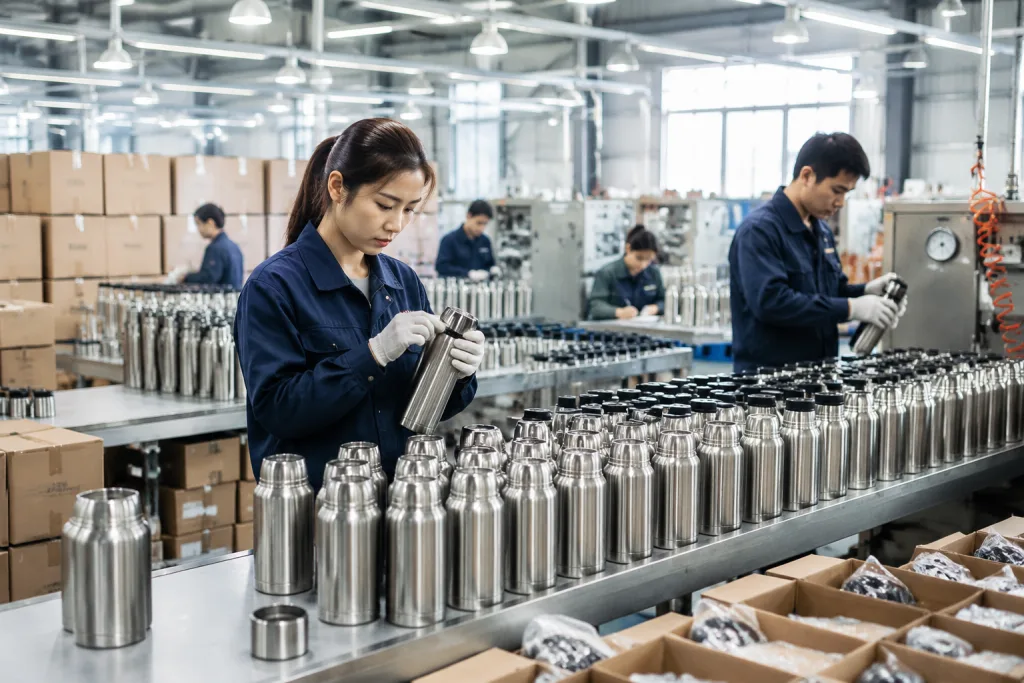
If you manage procurement for wholesale drinkware, canteen wholesale, or a private label outdoor line, asking for the lowest FOB price first is the wrong question to ask. Decide what product risk you can accept. In our Zhejiang factory, we run 304 stainless orders for Europe and North America, and we’ve seen 4 choices send projects sideways: material grade, capacity and body shape, branding process, and quality control level. One buyer once flagged a PO typo changing 500ml to 550ml after tooling confirmation. That small line cost 12 days, not 2.
Start With The Steel Decision
The first decision is simple: are you buying a real 304 stainless steel thermal bottle bulk program, or a cheaper bottle with loose wording on the PI? On serious purchase orders, we want to see SUS304 inner wall, not just stainless steel. We have seen buyers send a PO with “SS bottle” and then argue after QC pulled the sample and found 201 on the inside. Bad start. For most bulk drinkware orders, 304 is the practical standard because it gives stable corrosion resistance, food contact safety, workable pricing, and ready coil supply in China.
A typical double-wall thermal bottle runs 304 stainless steel on the inner wall and either 304 or 201 stainless steel on the outer wall. The outer wall does not touch the beverage, so some buyers accept 201 outside to cut roughly USD 0.20-0.45 per piece depending on size and finish. That can work for promotional wholesale drinkware if the powder coating passes cross-hatch tape testing and the target market is price-sensitive. For premium retail, gyms, outdoor chains, or the best wholesale drink bottle positioning, full 304 inside and outside gives cleaner product claims and fewer questions from buyers. We ship both. The math does not work, though, if a brand wants “premium 304” on the carton but asks us to hide 201 outside in the spec.
Ask for wall thickness before you approve price. For many 500-750 ml bottles, inner wall thickness around 0.4 mm and outer wall around 0.5 mm is common. Go too thin and you save a few cents, then lose it back through denting, unstable seam welding, and vacuum failure during hot water testing. On the line, a 0.05 mm difference shows up fast when the body goes through the expanding mold. If your supplier refuses to state steel grade, thickness tolerance, or food contact test history, the quote is not comparable. Zhejiang and wider China supply chains can make excellent thermal bottles, but only when the specification is tight enough to block material substitution.
Choose Capacity By Sales Channel
The second decision is capacity and body format. A 500 ml bottle sells cleanly into office, commuter, and school channels when the cup holder diameter stays around 70 mm. A 750 ml or 1,000 ml bottle fits outdoor and fitness retail. A 1.2 L to 1.9 L bulk growler or beer growler bulk order needs different tooling logic, different cartons, and a handle that survives a loaded drop test, not just a nice 3D drawing. On the line, we check handle rivet pull with a 20 kg hanging weight before approving mass production. Do not treat a bulk canteen, a travel bottle, and a growler bulk project as the same product with different volume.
Procurement teams ask for one universal bottle to cover wholesale canteen, beer tumbler wholesale, and corporate gifting. This is the wrong question to ask. A narrow-mouth 500 ml thermal bottle holds heat well and rides well in a commuter bag, but the buyer will hear complaints when users try to add ice cubes at the gym. A wide-mouth canteen bulk model cleans faster with a bottle brush, but lid sealing and cap torque matter more; QC pulled one sample last month at 9.5 kgf·cm because the cap felt loose after the leak test. A beer growler in bulk order needs attention to carbonation pressure, cap seal surface, and local alcohol packaging rules if it is sold as a refillable container.
For planning, check carton volume early. A 500 ml bottle may pack 24 pcs per master carton, while a 1.9 L wholesale growler may pack 6 or 8 pcs, and that swing changes ocean freight per unit plus warehouse cubic meters. We ship from Hangzhou, Zhejiang, so we quote unit price with carton measurement; the cheap bottle often stops looking cheap once the CBM hits the forwarder’s sheet. We have seen this go sideways when a PO typo changed “6 pcs/ctn” to “12 pcs/ctn” and the buyer’s 3PL storage estimate was off by 38%. If you are sourcing bulk drinkware for multiple channels, build a working matrix with capacity and mouth diameter, lid type and carton quantity, then target retail price and required tests.
Match Finish To Real Use
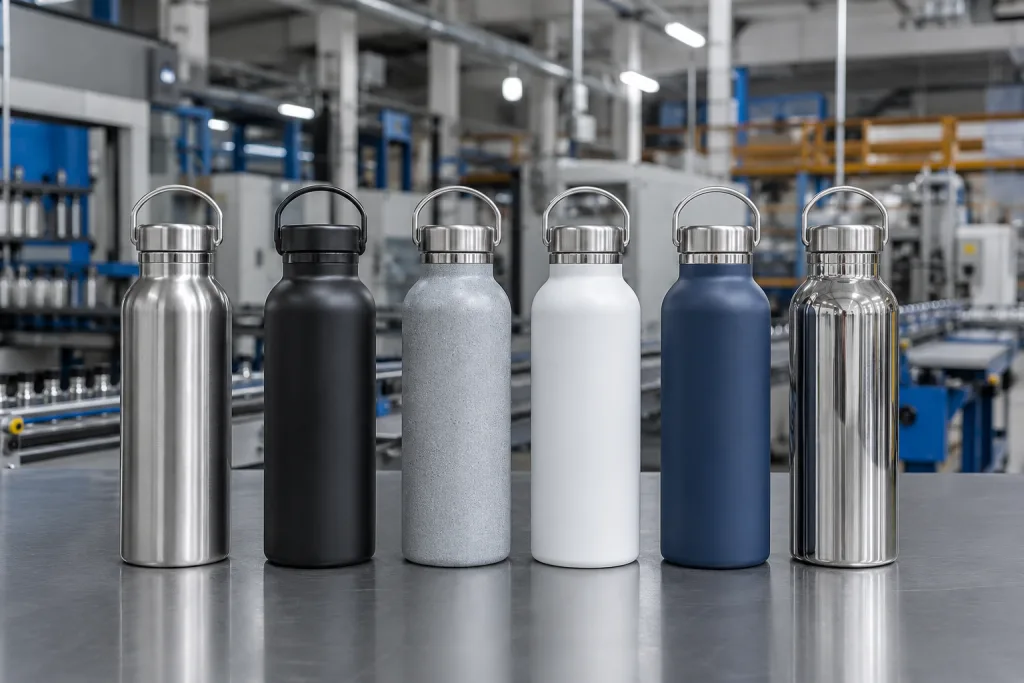
The third decision is surface finish and logo method. We run powder coating for most drinkware wholesale jobs because the 60-80μm coating gives a dry matte grip and holds retail colors well under normal handling. Spray painting saves money at quotation stage, but QC pulled samples last month with edge chips after a 1.2m drop test. Brushed stainless steel looks clean and stable, but fingerprints show fast and the shelf story is mostly silver. For beer tumbler bulk, beer tumbler in bulk, and beer tumbler wholesale bulk programs, powder coating with a laser logo is the safer bet than a large printed logo that gets scratched by ice scoops, bar rails, or event crates.
Logo method should follow the sales channel, not the buyer’s mood. Short answer: sell channel first. Laser engraving suits premium private label, outdoor retail, and corporate gifting because it cuts through the coating and does not peel. Silk screen printing works for a simple one-color or two-color logo on a straight wall; our print jig needs a flat contact area, or the edge goes fuzzy. Heat transfer handles complex artwork, but we test adhesion with 3M tape before we approve mass production. Full-wrap printing looks good in a mockup, but we have seen this go sideways on tapered bottles when weld marks or uneven coating thickness push rejects above AQL 2.5.
For custom logo orders, our usual MOQ is 1,000 pcs per color for existing molds and 3,000 pcs or more when custom color matching, special lids, or non-standard packaging are involved. Pantone color approval normally adds 3-5 days. Pre-production samples take about 7-10 days after artwork confirmation. A factory producing 450,000-600,000 stainless drinkware units per month can still miss your ship date if artwork, color chips, and barcode placement are approved out of order; we once held 6,000 pcs because the PO said matte black but the approved chip was Pantone 426C. The right checklist is finish, logo durability, inspection test, and approval timing. The math does not work if branding is treated as the last step.
Specify Lids Before Price
Lids cause more claims than the 304 stainless body. On a 304 stainless steel thermal bottle bulk order, the lid system drives leakage rate, drinking feel, spare-part cost, and 1-star reviews. A screw cap with a silicone gasket is still the safest choice; we run 0.8-1.2 mm gasket compression checks with a simple depth gauge on the line. A flip lid sells better for commuters, but the hinge pin, spring, lock button, and gasket all add failure points. Straw lids move well in sports and kids channels, but QC needs to check valve sealing, straw material, and printed cleaning instructions.
If you are buying bulk canteen or wholesale canteen products, do not treat the handle as decoration. Bad idea. A weak PP handle can crack in drop testing, especially on 1 L and larger bottles; we have seen a 1.2 L sample fail at the handle after a 1.0 m side drop. For growler wholesale or beer growler wholesale bulk, lid thread quality and seal compression matter more than a glossy logo. The buyer may push back on price here, but the math does not work if beer leaks in the carton. Alcohol flask bulk and alcohol flask wholesale orders need a different check: the cap must close smoothly, the mouth opening must match filling use, and the product claim must fit local alcohol accessory rules. Do not recycle the same QC checklist across every shape.
Ask your supplier to list the lid material clearly: PP, Tritan, stainless steel, silicone, or mixed construction. For Europe and North America, buyers often request LFGB, FDA, REACH, or relevant food contact documentation depending on market. A lid can pass a quick factory water test and still fail after 95°C hot water, 3 hours of truck vibration, or 30 days of consumer use. We recommend 100 percent obvious-leakage testing during production on high-risk lids, plus AQL inspection before shipment; QC pulled one flip-lid sample last month because the vent plug sat 0.6 mm proud and leaked only after shaking. It costs more than blind trust. It is cheaper than replacing a full drinkware bulk shipment.
Build Pricing From Cost Drivers
A China factory quote has to show the parts that move price, not just one clean FOB number. For a standard 500 ml 304 thermal bottle using an existing mold, simple powder coating, and a one-position logo, FOB China pricing often sits around USD 3.20-5.80 depending on inner/outer steel thickness, lid parts, order quantity, and packing. We run 0.4 mm and 0.5 mm body options on some lines, and that small thickness change shows up fast when the buyer orders 10,000 pcs. Larger 1 L canteens sit higher. Bulk growler and beer growler wholesale models can move from USD 7.00 to above USD 14.00 if the body, handle, and cap are built for bar use instead of light promo stock.
The main cost drivers are steel grade, body weight, vacuum yield, lid structure, coating type, logo process, retail box, and export carton strength. A gift box can add USD 0.25-0.80. A spare straw or brush can add USD 0.08-0.30. Small items matter. Individual polybag, tissue wrap, instruction sheet, FNSKU label, and inner carton packing each add hand work at the packing table; QC pulled one sample last month because the FNSKU label was 6 mm off-center on a matte black bottle. For alcohol flask in bulk or alcohol flask wholesale bulk, the smaller size does not make the math cheap, because polishing around the shoulder, laser welding, and cap fitting still take labor.
Do not ask five factories for “your best price” without a spec sheet. You will receive five different bottles, and we have seen this go sideways when a PO said “500ml bottle” but the artwork file named it “550ml.” A better request states capacity, 304 stainless steel, finish, lid drawing or photo, logo method, retail packing, testing requirement, target MOQ, Incoterm, and destination market. FOB Ningbo or FOB Shanghai are common from Zhejiang. EXW rarely helps overseas buyers unless your forwarder controls China-side consolidation and can check carton marks before loading. If your margin depends on USD 0.10, lock every component before deposit, not after the line starts.

Control Quality Before Shipment
The final decision is how much quality risk you want to pay to remove. For 304 stainless steel thermal bottle bulk orders, we check vacuum insulation, leakage, coating adhesion, odor, dents, sharp edges, logo position, carton drop strength, and barcode accuracy against the signed sample. AQL inspection is normal for export buyers. In our files, 8 out of 10 retail buyers use AQL 2.5 for major defects and 4.0 for minor defects, with critical defects set at zero tolerance. If the bottle is for children, hot liquid, or regulated retail, tighten the plan. The line will not guess for you. Last month QC pulled a sample with a 1.8 mm burr inside the mouth rim; that is the kind of small finding that becomes a claim after delivery.
Vacuum performance needs hot water testing over a fixed time, not a quick hand-feel check. For example, fill with 95°C water, close the lid, and measure after 6 hours or 12 hours according to your claim. If your retail page says 12 hours hot and 24 hours cold, the production lot must support that claim. Coating adhesion can be checked with a cross-cut tape test using a 1 mm cutter and 3M tape. Leakage can be tested by inversion and shaking for 30 seconds. Carton drop testing should use actual export packing, with the master carton, polybag, divider, and printed inner box in place. An empty showroom box tells you nothing. We have seen this go sideways when a buyer approved the bottle but skipped the 12 kg carton drop test.
Our practical approach in Zhejiang is simple: approve a golden sample, lock the BOM, run an inline inspection at 20-30 percent production for first-time orders, then perform final random inspection before balance payment. For repeat wholesale drinkware, canteen wholesale, beer tumbler wholesale, and growler wholesale orders, we can move faster, but we do not remove the checkpoint. The math doesn't work if you save one inspection fee and then sort 3,000 leaking lids in your warehouse. China factories can produce at scale and speed, but export reliability comes from written standards, signed samples, and inspection data. We ship cleaner orders when the buyer defines pass and fail before mass production, down to details like logo tolerance within 1.5 mm and the correct EAN barcode on the PO.
Send your bottle spec before requesting price
We will check steel grade, MOQ, decoration, packing, and FOB timing before you commit to a bulk thermal bottle order.
Frequently asked questions
What MOQ should I expect for 304 stainless steel thermal bottle bulk orders?
For existing molds, a realistic MOQ is usually 1,000 pcs per SKU and color if you accept standard lids and standard packaging. Custom Pantone powder coating often pushes the practical MOQ to 2,000-3,000 pcs because coating lines lose efficiency on small batches. New lid tooling or custom body molds can require 5,000-10,000 pcs to make the project economical. If you need 300 pcs, you may get stock wholesale drinkware with limited logo options, but not a fully controlled private label specification.
Is 304 stainless steel enough for Europe and North America?
Yes, 304 stainless steel is the normal choice for thermal drink bottles sold in Europe and North America. It is food contact safe when properly sourced and processed, and it resists corrosion from water, coffee, tea, and most everyday beverages. Some buyers ask for 316 stainless steel, but it usually adds cost without a clear benefit for normal drinkware. The more important checks are FDA or LFGB food contact documentation, REACH compliance for coatings if applicable, proper passivation, and no metallic odor after hot water testing.
How long does bulk production take after sample approval?
For a standard 304 thermal bottle using existing tooling, mass production usually takes 30-45 days after deposit, artwork approval, and golden sample confirmation. Add 7-10 days for pre-production samples and 3-5 days if Pantone color matching is needed. Peak season before summer retail launches or Q4 gifting can extend lead time by 10-15 days. If your order includes custom retail boxes, FNSKU labels, or mixed carton packing, approve those files early because packaging delays often hold shipment more than bottle production.
Can one supplier handle bottles, canteens, growlers, and flasks?
A capable stainless drinkware factory can often handle thermal bottles, bulk canteen orders, beer growler bulk projects, beer tumbler wholesale, and alcohol flask wholesale, but the production lines and QC points are not identical. Growlers need stronger handles and cap sealing. Flasks need careful polishing and cap fit. Straw bottles need more lid testing. Before combining SKUs, ask for capacity per month, past test reports, sample references, and whether each item is made in-house or subcontracted. Mixed sourcing without disclosure creates traceability problems.
What should I include in an RFQ for wholesale drinkware?
Your RFQ should include capacity, bottle dimensions if fixed, inner and outer steel grade, wall thickness target, lid type, coating, Pantone color, logo method, packaging, test requirements, destination market, MOQ, Incoterm, and target ship date. Attach artwork in AI or PDF format and state whether you need barcode, FNSKU, or retail warning labels. For a serious quote, also ask for carton size, gross weight, sample lead time, mass production lead time, and AQL inspection standard. That gives you comparable offers instead of random low prices.