Key Takeaways
- Start with 304 stainless steel body, 0.45-0.60 mm wall thickness, and 1,000 units per color MOQ
- Choose the lid first because leak rate, cleaning, straw function, and gym use depend on it
- Use laser engraving for long-life logos and powder coating for better grip than glossy paint
- Set AQL 2.5/4.0 inspection, REACH checks, and carton drop testing before paying the balance
A 304 stainless steel sports water bottle private label project looks simple until the lid weeps at 0.8 bar, the powder coating scratches in the carton rub test, or the logo starts ghosting after 300 dishwasher cycles. For a fitness brand or gym chain, the bottle is not just merchandise. It gets dropped into lockers, jammed into 74 mm car cup holders, carried through spin studios, and lined up on retail shelves with your logo taking the blame for every leak. We’ve seen this go sideways.
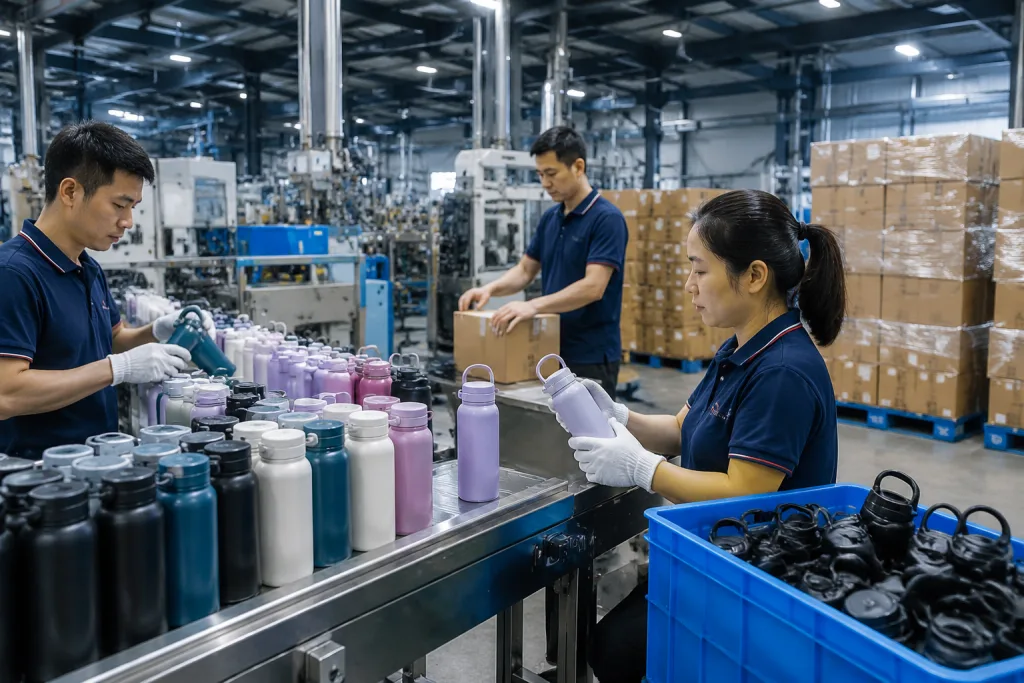
From our Zhejiang factory network, clean orders usually start with two fixed points: the bottle build and the buyer’s pass/fail standard. Then we lock the capacity, lid type, coating, and logo process against that standard before quoting. If you ask for prices first, the math doesn’t work; you get 6 suppliers guessing different wall thicknesses, paint grades, and carton specs. Our typical MOQ for stainless sports bottles is 1,000 units per color, with 25-35 day production after sample approval. On the line, QC pulled the sample with a digital caliper and found a 0.3 mm lid-seat mismatch—cheap to fix before tooling sign-off, expensive after mass production.
Start With The Use Case
Before you ask for a bulk sports water bottle quote, pin down where the bottle will be used. A gym retail shelf, a member welcome pack, a personal training upsell, and an e-commerce bundle all pull the spec in different directions. We see 7 or 8 new buyers a month send one competitor photo and ask for “same but cheaper.” Wrong starting point. On our sample table, QC pulled a 750 ml bottle last week that looked fine in photos but failed the shelf test because the lid height blocked a standard 290 mm gym locker cubby.
For gym chains, 600-750 ml is the safer capacity range. It fits most cardio machine holders, car cup holders, and backpack side pockets. For outdoor fitness brands or endurance training, 900-1,000 ml makes sense, but it adds carton volume and feels heavy when full. A 750 ml single-wall 304 stainless steel bottle may weigh 185-230 g depending on wall thickness. A vacuum insulated version can reach 320-420 g. Small detail, big bill: one buyer flagged that 1,000 ml packed 24 pcs/carton pushed the carton past 18 kg, so we changed to 12 pcs/carton to pass their warehouse handling rule.
If you sell a custom fitness water bottle through studios, grip matters. Sweat tells the truth. A powder coated surface gives better handling when hands are wet. A glossy spray finish looks bright on a product page but scratches faster against dumbbells, keys, and metal lockers. If your members carry the bottle during HIIT or functional training, ask for a recessed grip zone or a silicone boot. The boot adds about USD 0.25-0.45 FOB, but it cuts dent complaints. We run a simple 1 m drop check on the line; bottles with boots come back with fewer bottom-edge claims after courier delivery.
A bulk gym water bottle for giveaways can use a lighter 0.45 mm wall. A retail-grade customized sports water bottle should be closer to 0.50-0.60 mm, especially if you want a premium feel. Thicker material costs more, and the math doesn't work if the bottle is only for a one-day promotion. For retail or distributor sports water bottle programs, the extra steel reduces body deformation during transport and looks better after 3 months of use. We usually recommend a mid-spec platform that accepts several lids and colors, so distributors can reorder without rebuilding tooling each season; one PO typo changed “black lid” to “blank lid,” and a shared platform saved 12 days of rework versus an 18-day new lid run.
Choose Body Structure Carefully
The first technical choice is single-wall or double-wall vacuum insulation. Both can use food-grade 304 stainless steel, but they sell to different buyers. On our line, the single-wall body comes off the hydraulic expansion mold at about 0.45 mm wall thickness; the vacuum body needs inner cup, outer shell, bottom welding, vacuum pumping, then leak testing.
A single-wall custom sports water bottle is lighter, lower cost, and fits cold water use in gyms, school teams, or race giveaways where insulation is not the selling point. Typical FOB China pricing for a 750 ml single-wall 304 bottle with powder coating and one-color logo is around USD 2.20-3.40 at 3,000 units, depending on lid and packaging. It cannot be used with hot drinks because the wall conducts heat. Print the warning icon. QC pulled a sample last month that hit 63°C on the outside after hot-water filling, and the buyer flagged the burn risk during artwork approval.
A double-wall vacuum bottle costs more but feels like a better retail item in the hand. A 650-750 ml insulated bottle often lands around USD 4.20-6.80 FOB at 3,000 units, again depending on lid, coating, and carton packing. It works better for a private label retail item priced at USD 18-30. If your gym chain sells branded merchandise at reception, vacuum insulation is easier to justify than a basic bottle. The math doesn't work when a buyer asks for “premium retail” but chooses the cheapest single-wall mold to save USD 1.60.
Ask for 304 stainless steel on the inner wall as a minimum. Some factories quote 201 stainless steel to cut cost. It looks close in a showroom, but corrosion resistance is weaker, especially with electrolyte drinks, lemon water, or repeated washing. For a 304 stainless steel sports water bottle private label order, your purchase order should state SUS304 or 18/8 stainless steel for food-contact parts. If the outer shell is 201 on a double-wall bottle, that can pass for some budget projects, but approve it with open eyes. We have seen this go sideways when the PO said “stainless steel” and the buyer assumed all parts were 304; the magnet test on incoming sheet caught it before mass production.
For brands selling in Europe, ask whether coatings and plastic lid parts can support REACH and LFGB-related testing. For North America, request FDA food-contact material declarations and, when relevant, California Proposition 65 screening. A solid China supplier should not be surprised by these documents. We run these checks before the first carton is packed, because a 12-page test report is cheaper than holding 3,000 units in Hangzhou warehouse after the buyer’s compliance team rejects the lid gasket.
Lids Decide User Complaints
The lid is where most warranty issues start. We’ve seen buyers spend two weeks on Pantone chips and ten minutes on the closure. Wrong order. For a customizable sports water bottle, the lid controls leak claims, drinking speed, brush cleaning, and whether your team has spare parts when a gym member drops one on tile. Last month QC pulled 12 pre-production samples from the line; 3 passed color review, but 1 lid had a gasket sitting 0.4 mm proud.
Fitness and gym projects usually choose from four lid styles. A screw cap is simple and hard to break, but athletes hate twisting it open between sets. A flip straw lid works well on treadmills and cycling bikes if the silicone seal is tight and the straw pulls out for washing. A chug lid gives faster flow for strength training. A shaker lid with a mixing ball or internal grid works for protein drinks, but the 304 stainless interior needs clean polishing around the shoulder radius; powder collects there if the seam is rough. We run a finger wipe and flashlight check after polishing, because cloudy residue inside a black bottle gets missed too easily.
If you are sourcing a bulk shaker bottle or custom shaker bottle, be honest about cleaning. Protein residue is nasty. A narrow mouth looks sleek in a rendering, then users complain after the first shake. For a custom made shaker bottle, we recommend a mouth opening of at least 50 mm, preferably 55-60 mm, so users can pour powder without a funnel and scrub the inside with a normal bottle brush. A custom logo shaker bottle also needs a spare gasket plan. A USD 0.03 silicone ring can prevent a USD 8 customer service problem; the math does not work if your front desk has to replace the full bottle.
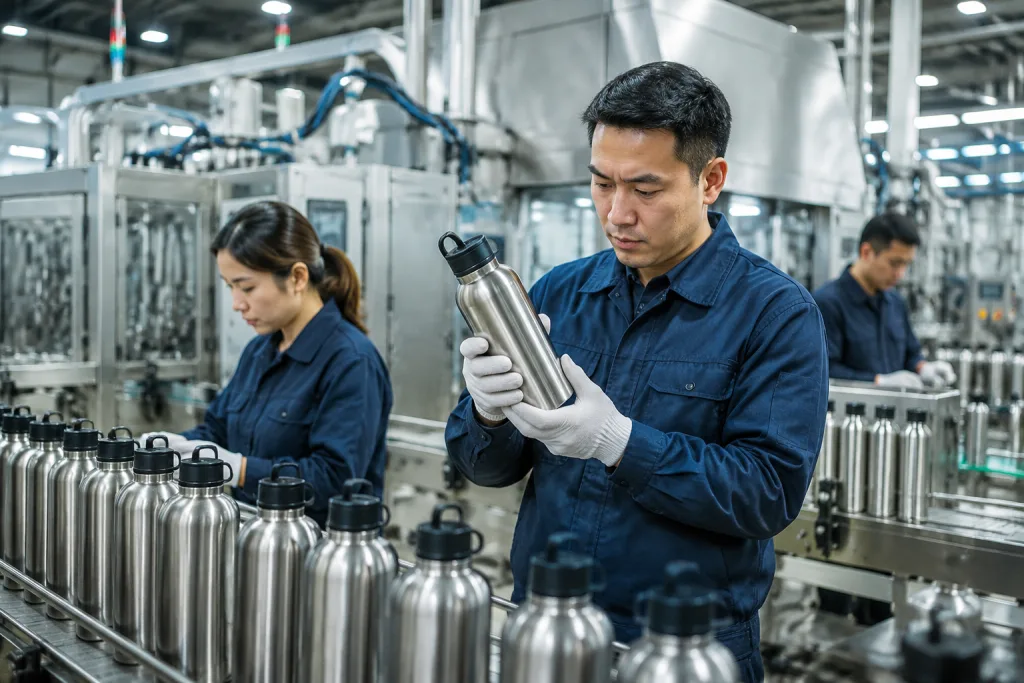
Leak testing belongs in your QC file, not in a chat message after production. For sports lids, we use an inverted leak test for 30 minutes, then a shake test for 30 seconds. For straw lids, test with the straw open and closed. Set the defect limit clearly: one leaking bottle in a showroom sample is a warning, not bad luck. We’ve seen this go sideways when a PO had “spare lids” typed as “spare lids color same as body,” and the buyer flagged it after cartons were sealed. If you are buying for multiple clubs, ask for 1-2% spare lids packed separately. Cheap insurance.
Decoration Is Not Just Logo
Private label buyers usually ask, “Can you put our logo on it?” Wrong first question. Ask, “Which decoration method still looks decent after 30 days in a gym bag?” A customized gym water bottle gets knocked against towel hooks, cable machines, and car keys. We’ve had QC pull a sample after a key-scratch test, 500g load, and the pretty logo looked tired before packing started.
Silkscreen printing is the budget choice for one or two colors. It runs well on smooth powder coating, and we use it often for a bulk fitness water bottle campaign. The cost can be as low as USD 0.05-0.12 per position after screen setup, but 6pt small text can lose sharpness on a curved 73mm bottle body. Heat transfer handles gradients and large artwork, but edge lifting shows up fast if the surface is not wiped clean before pressing. UV printing gives colorful logos and lower setup pressure, but abrasion resistance changes by ink and coating, so we run tape test and thumb-rub test before mass production.
Laser engraving is the tougher option for a premium custom gym water bottle. It removes the coating and exposes 304 stainless underneath. No peeling. Clean shelf look. The trade-off is color: the mark is metallic, not Pantone matched. For fitness brands that want quiet merchandise, laser usually earns the extra USD 0.10-0.25 per unit, and the buyer pushback we hear most is simple: “Can it be black?” No, not with standard engraving.
For a full private label program, decoration covers more than the bottle body. You might need a logo on the lid top, a branded silicone boot, swing tag, color box, barcode sticker, FNSKU label, or club-specific carton mark. A distributor gym water bottle order often needs neutral cartons plus 4-6 SKU labels for different regions. Confirm this before the PO. We’ve seen this go sideways when a buyer approved the bottle artwork on Monday, then sent the FNSKU file 9 days later with one digit typo. Packaging changes can add 7-10 days if the artwork is approved late.
Color tolerance matters too. Powder coating cannot always hit Pantone exactly. A practical tolerance is Delta E under 1.5-2.0 for strict brand colors, but that adds checking time and raises rejection risk when the line is running 3,000 bottles per color. If your brand color is critical, approve a physical color chip, not just a PDF. We match against the chip under a D65 light box, not against a laptop screen.
Build A Real Cost Picture
FOB unit price is the wrong question to ask first. A customizable gym water bottle priced USD 0.30 lower can cost more after 4% defects, oversized cartons, and replacement claims from one retailer. We have seen QC pull samples where the cheaper lid passed the first leak test, then failed after 6 hours upside down on the bench. Compare the spec sheet line by line.
A workable quotation should show capacity; material grade such as 304 stainless; wall thickness in mm; lid material; coating type; logo process; packing method; MOQ; sample time; mass production lead time; and incoterm. At BottleForge Industrial in Zhejiang, China, a normal development schedule is 5-7 days for an existing mold sample, 10-15 days if a new color and logo are needed, and 25-35 days for mass production after deposit and sample approval. Our monthly capacity for stainless sports bottle lines is about 450,000 units, depending on coating mix and lid complexity. On the line, a powder-coated bottle with laser logo moves faster than a two-position silk print because the fixture change adds minutes to every batch.
For MOQ, 1,000 units per color is realistic for most 304 stainless steel models we run. If you want four colors, treat that as 4,000 units unless the factory agrees to split coating batches. A small trial of 500 units works on stock colors in some cases, but logo setup, packaging, and inland handling cost per unit will be higher. The math gets ugly fast. For distributors sports water bottle programs, 3,000-5,000 units usually gives better buying power on carton design, spare lids, and third-party inspection, and we have had buyers flag a PO because “matte black” was typed once as “matt black” before coating started.
Do not forget freight math. A 750 ml single-wall bottle may pack 24 units per carton, with carton dimensions around 48 x 33 x 28 cm. A vacuum bottle with gift box may pack only 12-20 units per carton. That changes sea freight, warehouse handling, and last-mile parcel cost. If you sell online, ask for carton drop testing and confirm whether the color box survives e-commerce handling; our QC team usually checks corner crush after a 1.2 m drop on the packed carton. A beautiful box that crushes during delivery is not premium. It is waste.
Set Quality Gates Before Production
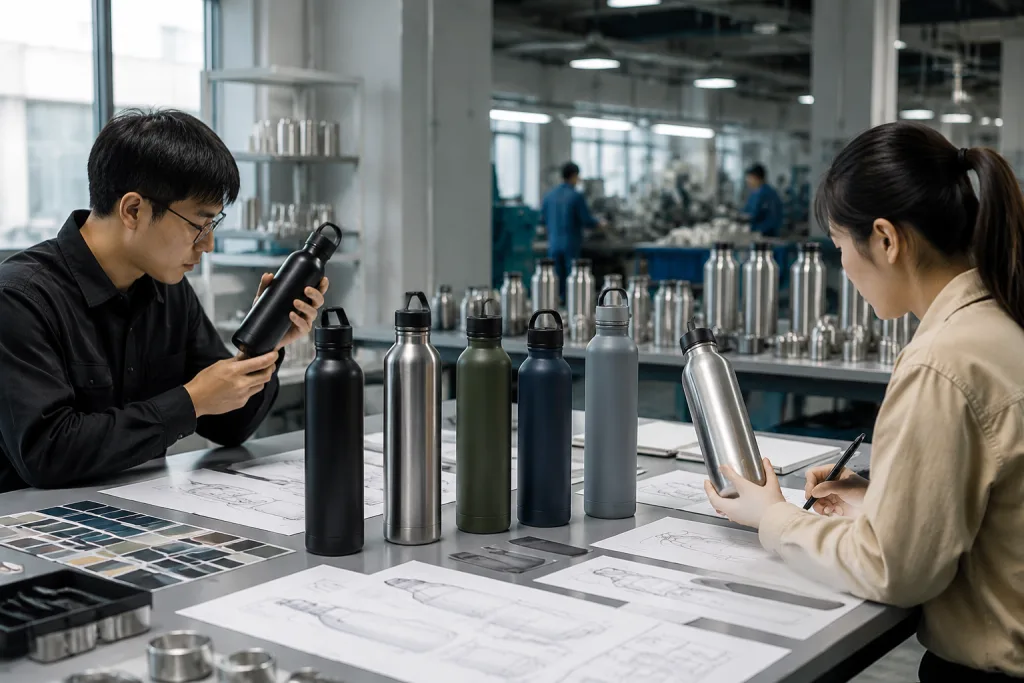
Set the quality gates before you pay the deposit. Not after the goods are packed. For a customized shaker bottle or sports bottle order, we run three control points: pre-production sample approval, mid-production check at about 20%, and final random inspection before balance payment. On our line, this starts with a signed spec sheet, a Pantone chip, and a caliper reading for the mouth diameter in mm.
The pre-production sample should match the signed specification: 304 stainless steel grade, capacity tolerance, coating color, logo size, lid function, packaging, barcode, and warning text. Keep one approved sample at your office and one sealed sample at the factory. Tape the seal and sign across it. During production, the mid-line check should cover coating adhesion, color consistency, weld polishing, vacuum performance if insulated, and lid assembly. QC pulled a sample last season where the powder coating passed color but failed the 3M tape test near the bottom edge. Catching that at 20% production hurts. Catching it after 30,000 units are packed is a mess.
For final inspection, AQL 2.5 for major defects and 4.0 for minor defects is common. Critical defects should stay at zero tolerance. Major defects include leaking, wrong logo, sharp burrs, serious dents, failed cap closure, and wrong material contact parts. Minor defects include small coating specks, light carton marks, and slight print misalignment within the approved tolerance. For a custom logo shaker bottle, test powder mixing parts for fit and shake noise, then check gasket fit with a leak test at full capacity. For straw lids, check suction function and cap locking force; we usually record this with a simple pull gauge, because “feels tight” is the wrong standard.
Material and compliance records should sit in the order file before mass production starts. Ask for stainless steel material reports, coating test reports, and food-contact declarations. If your fitness chain has ESG requirements, BSCI or Sedex audit status may matter. Around 7 out of 10 Zhejiang bottle factories we know can support social compliance audits, but ask early because valid audit reports are tied to a legal factory name and date. We have seen this go sideways when the PO used the trading company name, while the audit report showed the factory’s Chinese license name.
Your balance payment should be linked to inspection release. A practical term is 30% deposit, 70% after passed inspection and before shipment. If the supplier pushes back on any third-party inspection for a private label order, treat it as a serious signal. The math does not work if you save one inspection fee and then ship 18 cartons of leaking lids to a retail DC.
Plan Reorders And SKU Control
The first order proves the bottle. The reorder proves whether your spec control is real. We see fitness brands launch with 1 hero custom fitness water bottle, then ask for 4 colors, a club edition, staff bottles, or a summer bundle. If the original spec sits only in emails, it drifts fast: the lid shade shifts from Pantone 426C to a near-black, the logo moves 3 mm, the powder coating feels rougher, or the carton barcode changes from EAN-13 to UPC-A. QC pulled the sample last month and found the logo centered to the weld line instead of the front face. Small miss. Big argument.
Build a SKU sheet before we run mass production. Include the model number and capacity; stainless grade and wall thickness; lid code and gasket code; coating code and approved logo file name; packaging version, carton quantity, and inspection standard. Boring work, yes, but it protects margin. For distributor fitness water bottle and distributor shaker bottle orders, this matters even more because 2 retailers may use the same physical bottle while asking for different barcode labels, inner box art, and carton marks. We had one PO typo where “black lid” became “black body,” and the SKU sheet caught it before the line opened cartons.
If you are building a long-term customizable shaker bottle line, ask whether lids and gaskets will stay available for at least 18-24 months. Some low-cost lids vanish when the mold owner moves capacity to another client or changes the thread design by 0.5 mm. The math doesn't work if you save USD 0.08 on the first order and lose reorder compatibility later. Ask for artwork dielines, approved PP samples, and 8-10 production photos from the first batch, including the logo position ruler shot and gasket assembly. When your buyer changes jobs or your marketing team updates packaging, those records stop guesswork.
For gym chains in North America and Europe, we usually recommend 1 core bottle body and 2 lid options: a chug lid for training floors and a straw lid for lifestyle retail. It keeps inventory clean while still giving members a choice. If sell-through supports it after 90 days, add a larger 1,000 ml version or a stainless custom shaker bottle for protein programs. Do not launch 6 SKUs because the catalog page looks nice. We have seen this go sideways: 3 slow colors sat in the warehouse for 11 months, while the buyer kept pushing us to air-ship the black reorder in 12 days instead of the normal 18 days.
Send Your Bottle Brief For A Practical Quote
Share capacity, lid type, logo method, target MOQ, and market. We will return a China FOB quote with realistic lead time.
Frequently asked questions
What MOQ should I expect for a 304 stainless steel sports bottle private label order?
For most existing 304 stainless steel sports bottle molds, a realistic MOQ is 1,000 units per color. If you need four colors, plan for 4,000 units total. Stock coating colors may allow 500 units, but the unit price is usually higher because logo setup, packing labor, and inland handling are spread across fewer bottles. For custom powder coating, custom cartons, or a new lid color, 3,000 units is a more comfortable starting point. If you need a new mold, the MOQ can rise to 5,000-10,000 units, with tooling cost quoted separately.
Is 304 stainless steel necessary for a gym bottle?
For food-contact surfaces, yes, 304 stainless steel is the practical standard. Gym users put water, electrolyte drinks, amino drinks, lemon slices, and sometimes protein mixes into the bottle. 201 stainless steel is cheaper but has weaker corrosion resistance. It may be acceptable for non-food-contact outer shells on some double-wall bottles, but the inner wall should be SUS304 or 18/8 stainless steel. Your PO should state the grade clearly. For Europe, also ask for food-contact documentation and REACH-related coating checks. For North America, request FDA material declarations and relevant Prop 65 screening if required.
Which logo method is best for a custom gym water bottle?
For long-term gym use, laser engraving is the safest choice because it cannot peel. It works especially well on powder coated 304 stainless steel bottles and usually adds about USD 0.10-0.25 per unit, depending on logo size. Silkscreen printing is cheaper and good for simple one-color logos, often around USD 0.05-0.12 per position after setup, but it can scratch over time. UV printing or heat transfer is better for multicolor artwork, but you should request abrasion testing before approval. If your bottle will be sold as premium retail merchandise, choose durability over a slightly lower decoration cost.
Can I source a stainless steel custom shaker bottle for protein drinks?
Yes, but the design needs more care than a basic water bottle. A custom shaker bottle should have a wide mouth, ideally 55-60 mm, so users can add powder and clean residue. The interior polishing must be smooth, and the mixing ball or grid should be removable. The lid needs a reliable silicone gasket and a tight flip cap because protein shakes are thicker than water. For a bulk shaker bottle order, we also suggest 1-2% spare gaskets and lids. Test with actual powder, not only water, before approving mass production.
How long does sampling and production take from China?
For an existing stainless sports bottle model in Zhejiang, China, a blank sample can usually ship in 5-7 days. A logo and color sample normally takes 10-15 days after artwork confirmation. Mass production is typically 25-35 days after deposit and approved pre-production sample. Add 3-7 days for final inspection, export booking, and loading. Sea freight to Europe or North America commonly takes 25-45 days depending on port and season. If you need holiday delivery, lock the specification at least 90 days before your warehouse deadline.