Key Takeaways
- A standard 304 stainless steel sports bottle usually lands at USD 2.40-5.80 FOB China depending on capacity, lid, finish, and packing.
- MOQ is commonly 1,000 units for stock molds, 3,000-5,000 units for custom colors, and 10,000+ units for new lid tooling.
- A realistic custom logo production timeline is 35-55 days after artwork approval, plus 25-38 days ocean freight to Europe or North America.
- AQL inspection, LFGB/REACH material checks, and drop/leak testing should be agreed before deposit, not after cartons are packed.
Buying bottles for a fitness brand or gym chain is not hard because suppliers are scarce. The hard part is checking whether a USD 3.10 quote and 45-day lead time match the actual build: 304 stainless body thickness, lid gasket spec, logo method, carton count, and AQL 2.5 inspection. We see this go sideways when a PO says “matte black bottle” but leaves out the powder-coating code; QC pulled the sample at 0.42 mm wall thickness, while the buyer expected 0.50 mm. A China 304 stainless steel sports water bottle factory can make your custom sports water bottle program run cleanly, but the math needs MOQ, decoration limits, lid tooling, packing, and inspection terms locked before deposit.
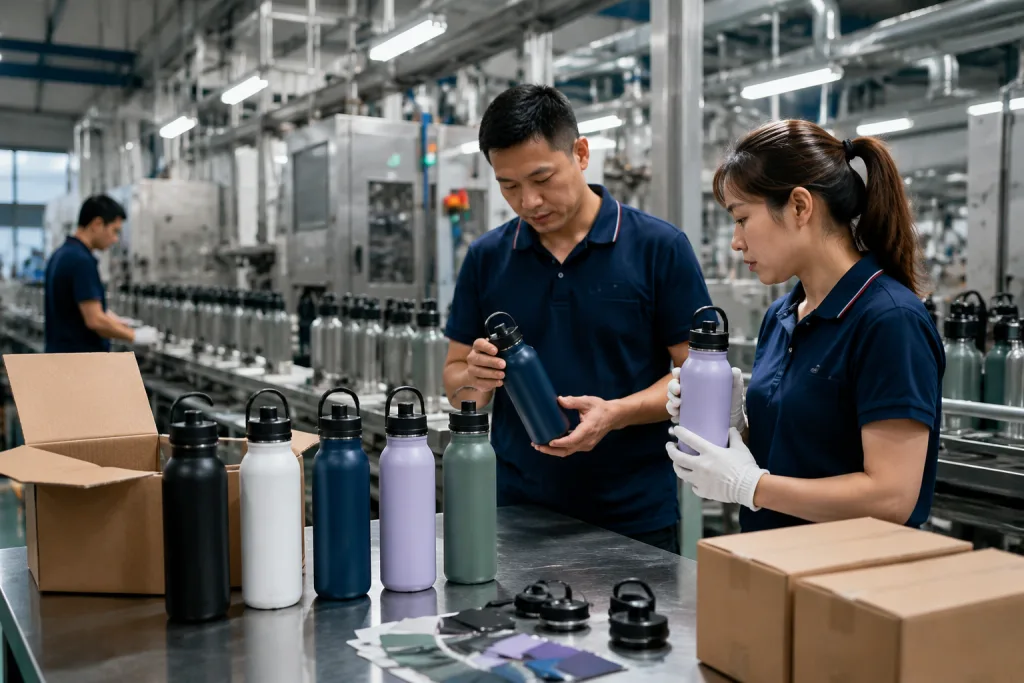
BottleForge Industrial is based in Hangzhou, Zhejiang, and we manufacture for overseas distributors, gyms, and private-label fitness brands. Our sports bottle line runs about 600,000 units/month across standard 304 stainless steel models, with MOQ from 1,000 units for existing molds. We run laser marking, silk screen, and powder coating on the line, then pack common 750 ml bottles in 24 pcs/carton unless the buyer asks for retail boxes. One buyer flagged a 12-day artwork approval delay last season; production was still 45 days, but shipment moved from week 7 to week 9. The numbers below are the practical ranges we quote from Zhejiang and other China production regions.
What you are really buying
A sports bottle looks simple on a gym retail shelf, but your PO is buying separate parts: steel grade, wall structure, lid design, finish, logo process, packing style, and test documents. When we quote from a 304 stainless steel sports water bottle factory, each line changes the price and the delivery date. Small choices move money. Last month QC pulled a 750 ml sample because the buyer’s PO said matte black, while the approved sample card said PMS Black 6C with a soft-touch coating.
For fitness and gym programs, we usually run food-contact 304 stainless steel on the inner wall, with 201 or 304 stainless steel on the outer wall depending on the target price. For single-wall bottles, 0.45-0.55 mm wall thickness is typical. For double-wall vacuum sports bottles, inner wall thickness usually sits around 0.40-0.50 mm and outer wall around 0.45-0.60 mm. Thicker steel feels better and dents less, but the math does not always work on a 3,000 pcs promo order because deep drawing gets slower and scrap rises on the line.
Separate a sports water bottle from a shaker before you ask for a price. A bulk sports water bottle normally uses a straw lid, chug lid, flip cap, or screw cap. A bulk shaker bottle or custom logo shaker bottle needs a mixing ball, agitator grid, or internal whisk structure, and the lid tolerance must be tighter because powder residue catches in threads. We check thread fit with a go/no-go gauge, and this is where cheap shaker lids fail first. If your gym sells protein powder, a customized shaker bottle is the right SKU. If members use bottles during treadmill or cycling sessions, choose a leak-resistant one-hand lid and ask for an inverted leak test, 30 minutes minimum.
The honest buying question is not “Can you make a custom gym water bottle?” Almost any factory says yes. That is the wrong question to ask. Ask which parts are existing molds, which parts need new tooling, and which parts can pass your market’s chemical and physical tests without rework. We have seen this go sideways when a buyer approved a nice-looking cap from a sample room, then the lid mold needed 18 days instead of the quoted 12 days because the silicone plug cavity was not ready.
FOB cost drivers to check first
For an existing-mold 304 stainless steel sports bottle, a realistic FOB China price usually runs USD 2.40 to 5.80 per unit. A simple 600 ml single-wall bottle with one-color silkscreen may sit near USD 2.40-3.10. A 900 ml double-wall vacuum bottle with powder coating, carry handle, straw lid, and retail color box can move above USD 5.00. If a quote comes in 20-30% below the market, do not celebrate yet. Check the steel grade, wall thickness, lid material, and packing; last month QC pulled the sample and found a 0.38 mm body wall where the PO said 0.45 mm.
Material is the first cost driver. 304 stainless steel costs more than 201, but it is the right choice for the inner food-contact surface. If your bottle is sold as a custom fitness water bottle for daily gym use, 304 inner steel is not a premium add-on; it is risk control. For Europe, buyers often ask for LFGB food-contact testing plus REACH screening for coating and plastic parts. For the U.S., we ship with FDA food-contact declarations when requested, and some channels ask for California Proposition 65 review. The wrong question is “can we make it cheaper?” The better question is whether the inner tank, checked by XRF gun on the line, matches the claim on your spec sheet.
The lid is usually the second biggest variable. A basic screw lid may add USD 0.25-0.45. A flip straw lid with silicone seal, PP body, handle, and air valve may add USD 0.70-1.20. A customizable shaker bottle lid with mixing insert and measurement markings costs more because the mold structure and leak test standard are stricter. We run 100% upside-down leak checks on these lids for 30 seconds, and this is where cheap silicone rings fail. One buyer flagged a 0.3 mm gap at the air valve after the first pilot run; the math did not work after rework and air freight.
Decoration is smaller, but it still changes the FOB. One-position laser engraving is often USD 0.15-0.35 per unit. One-color silkscreen is about USD 0.08-0.18, while multi-color artwork needs separate screens, registration checks, and more setup time. Powder coating can add USD 0.35-0.80 compared with plain brushed steel, depending on color, coating thickness, and scrap rate. On the coating line, we measure around 60-80 μm for most matte finishes, and bright colors can push scrap above 3% if the pre-treatment is rushed. For a custom sports water bottle going into gym retail, do not under-budget the finish. Members notice chipped coating faster than they notice a USD 0.20 saving.
MOQ tiers without sales fog
MOQ is not a factory trying to be difficult. It comes from coil purchasing, powder coating setup, logo fixture time, printed packing, and the production slot we reserve on the line. At BottleForge in Zhejiang, the practical MOQ for an existing stainless sports bottle mold starts at 1,000 units per model if you accept standard colors or stainless finish. We run that on shared 304 stainless body inventory, usually checked with a 0.02 mm caliper at incoming QC. That level suits a pilot launch, one gym region, or a distributor sports water bottle test order.
At 3,000 units, the math changes. Custom Pantone powder coating becomes realistic because the coating booth is not being washed out for a tiny batch, and carton planning gets cleaner when we can palletize by SKU instead of hand-sorting mixed leftovers. This is the tier most serious gym chains use for a custom gym water bottle or customized fitness water bottle launch. At 5,000 units, factories can usually split two or three colors, run steadier coating batches, and push accessory suppliers harder on lids, straws, and silicone rings. QC pulled the sample last month on a matte black batch because the film thickness was 72 μm on one side and 48 μm near the base. Small orders make that harder to catch before packing.
For a new lid, unusual capacity, special shoulder shape, or exclusive custom made shaker bottle design, expect 10,000-20,000 units as a commercial MOQ, plus tooling charges. Stainless bottle body tooling can range from USD 1,500 to 5,000 for simpler adjustments, while new plastic lid molds can run USD 3,000-12,000 depending on sliders, seals, straw parts, and complexity. A buyer once asked us to do a flip lid with a hidden carry loop at 2,000 units and “no mold cost”; the math does not work. If a supplier offers a completely new lid mold for free at 2,000 units, assume the cost is buried in the unit price or the mold will not be exclusive.
Distributors gym water bottle programs often need mixed cartons and multiple logos for different fitness clubs. That is possible, but each logo change adds setup cost and production control risk. A clean structure is 1,000 units per logo, 500 units per color minimum within that logo, and one master carton layout. We ship this way because the loading team scans one carton mark format, not five versions with one letter changed. We have seen this go sideways from a PO typo: “FitClub East” printed on 600 cartons meant for “FitClub West.” Keep the carton plan boring. It keeps pricing sane and stops cartons being misallocated during loading.
Lead time from artwork to shipment
A custom stainless sports bottle order is not a “30 days” job unless the logo, color, carton marks, and materials are already cleared. For existing molds, plan 35-55 days after deposit and final artwork approval. That is the safer number we use on the sales board in Hangzhou. If the launch is for January gym membership season or a summer fitness campaign, count backward from the retail delivery date, not from the day the line starts forming bodies.
The first 3-7 days usually go into checking the AI/PDF artwork, fixing logo thickness under 0.2 mm, confirming Pantone codes, and getting the proforma invoice signed. Small things slow orders down. Last month a buyer’s PO had “Matt Black” while the artwork said Pantone Black 6C, and QC pulled the sample before we opened the coating job. If you need a physical pre-production sample, add 7-12 days for sampling and another 3-5 days for courier transit to Europe or North America. For new powder colors, lab dips or spray samples add days because the coating shade changes after baking at around 180°C.
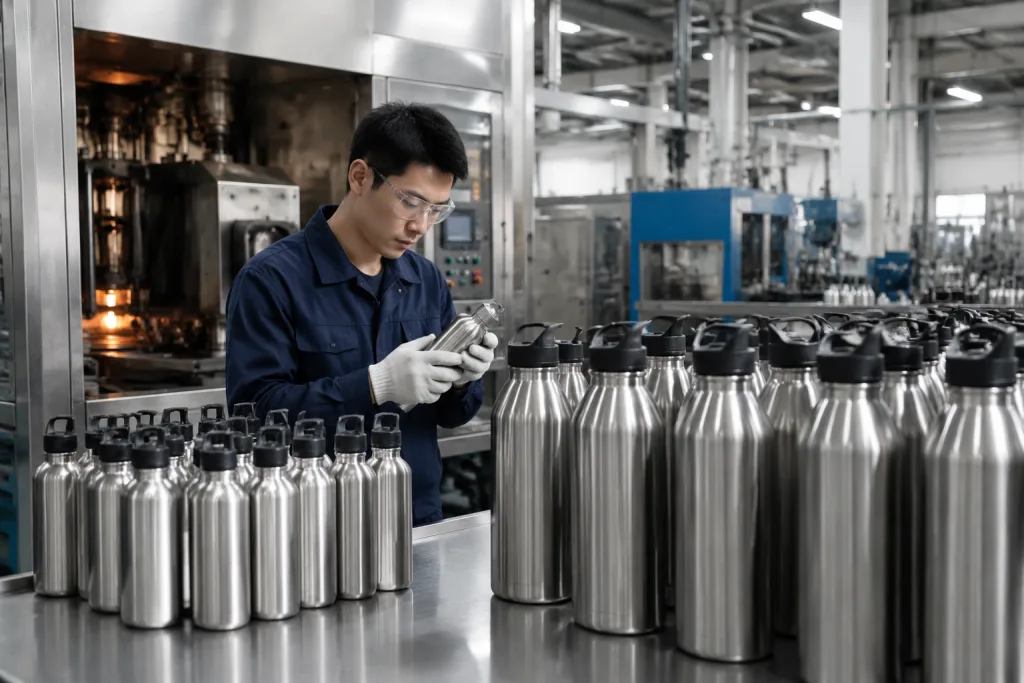
Bulk production for a standard custom sports water bottle normally takes 25-40 days. The bottle body goes through stainless forming, welding, polishing, vacuum testing if applicable, coating, logo printing, assembly, and packing, and those steps are not on one continuous line. We run body forming faster than coating on some weeks, so the math does not work if a buyer assumes every process moves at the same speed. Lid delivery can block the whole order too. For custom shaker bottle projects, add 5-10 days if the lid has multiple plastic parts and silicone seals, because incoming inspection checks fit, odor, color, and leakage before assembly.
Final inspection and export handling need their own slot on the calendar. AQL inspection is usually booked when 100% of goods are produced and at least 80% packed. The inspection itself takes 1 day, but booking, corrective action, and report review can add 2-4 days, especially if the inspector finds scratched coating near the bottom edge or loose polybags inside the export carton. We ship FOB Ningbo or Shanghai most often. Ocean freight is commonly 25-32 days to U.S. West Coast, 35-45 days to U.S. East Coast, and 30-40 days to major European ports. Air freight is faster, normally 5-9 days door to door, but for heavy stainless items it often costs more than the bottle. That surprises first-time buyers.
Logo, color, and retail packing costs
For a fitness brand, the bottle walks around the gym with your logo on it. For a gym chain, it also keeps the member touching the brand after sign-up. Match the decoration to the job. A bulk gym water bottle for a membership kit usually runs fine with one-color silkscreen; last month QC pulled 3 samples from the line and checked logo position with a 0.5 mm tolerance gauge. A premium retail customizable sports water bottle can carry laser engraving, gradient coating, or 360-degree wrap printing, but only if the retail price supports it. The math has to work.
Silkscreen suits simple logos, bold text, and one or two main colors. Setup is usually USD 30-60 per color, per position, and the unit cost stays low once we run 1,000 pcs or more. Laser engraving lasts longer because there is no ink to rub off, and it looks best on powder-coated or painted bottles where the beam cuts through to the 304 stainless body. Heat transfer and UV printing handle smaller artwork details, but we test them harder. Cup holder rub, gym bag abrasion, and dishwasher claims are where we have seen this go sideways; one buyer flagged a logo after 500 dry rub cycles because the bottom edge started to haze.
Color affects sales and scrap rate. Black, white, navy, and stainless are stable choices with low surprise. Neon orange, pearl pink, and metallic blue show shade drift faster, especially when the coating powder comes from two batches. If you are ordering a distributor fitness water bottle range with six colors, ask whether the MOQ applies per color and whether all colors will ship in the same production lot. Splitting colors across weeks can create shade inconsistency. We once had a PO typo that listed “matte balck,” and the buyer approved the sample photo anyway; production still stopped for 6 hours while sales confirmed whether they wanted matte black or a dark charcoal finish.
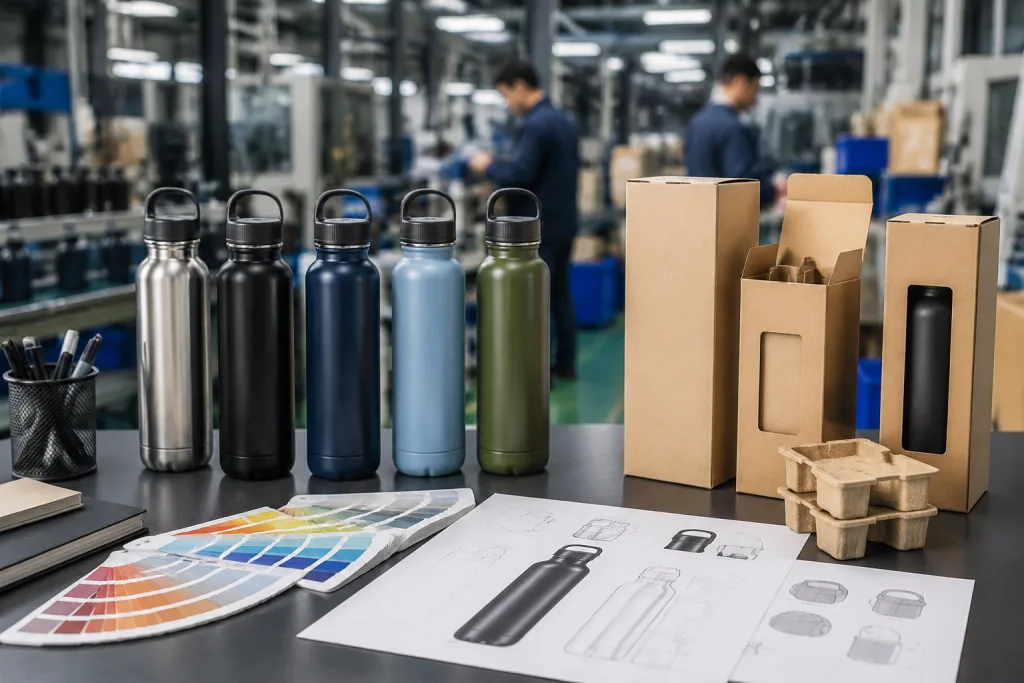
Packing gets underestimated. A plain polybag and white box may add USD 0.10-0.20. A printed retail box with barcode can add USD 0.25-0.55. Instruction sheets, spare straws, cleaning brushes, FNSKU labels, and master carton drop-test requirements all add cost. For e-commerce or club retail, we recommend a 5-ply export carton, 12-24 units per carton depending on bottle size, and carton gross weight under 15 kg where possible. Simple rule: do not save USD 0.03 on a weak carton and then lose 2% in transit claims. Warehouse staff appreciate cartons that do not break their backs.
Quality controls that prevent claims
Most bottle claims we see come from 4 places: leaks, coating scratches, dents, and logo position off by 3-5 mm. Polite emails do not stop claims. Specs do. Before deposit, write the measurable standards on the PO: steel grade, capacity tolerance, Pantone or coating color, logo size and position, packing method, AQL level, and required test reports. Last month the buyer flagged a PO typo where “matte black” became “mate black”; the line stopped for 2 hours while merchandisers checked the approved color chip.
For 304 stainless steel, ask for material declarations and, where needed, third-party testing. For EU buyers, LFGB and REACH are common requests. For U.S. buyers, FDA food-contact compliance and CPSIA only if the item is marketed to children. If you sell a customized gym water bottle to adults, paying for kids testing is the wrong question to ask unless your sales channel demands it. We run XRF screening on incoming steel coils, and QC pulled the sample when one supplier mixed 201 lids into a 304 stainless body order.
Leak testing should include inverted static testing and shake testing. For straw lids and shaker lids, we normally check assembled bottles with water for 30 minutes inverted, then do manual shake tests on sampled units. Simple test. It catches trouble. Vacuum bottles should also pass insulation checks, commonly hot water at 95°C with temperature measured after 6 or 12 hours depending on the claim. Do not print “keeps cold 24 hours” unless the construction can support that statement under repeatable testing; we have seen this go sideways when a thin-wall sample passed once in the lab but failed after the lid gasket was changed by 0.4 mm.
For inspection, 8 out of 10 export buyers we work with use AQL General Inspection Level II with critical defects 0, major 2.5, minor 4.0. Critical defects include sharp edges, contamination, serious leakage, and unsafe plastic odor. Major defects include logo misprint, obvious dents, coating peel, wrong color, or missing accessories. If your distributors shaker bottle order is going to multiple retail accounts, use a carton-by-carton barcode and label check. A perfect bottle in the wrong carton is still a claim; our QC team once found 36 cartons with the right bottle but the wrong Amazon FNSKU label during final inspection.
How to compare factory quotations
Send one spec sheet to every 304 stainless steel sports water bottle factory. Same file. Same photos. Same target price term. Do not ask one factory for a 750 ml double-wall powder-coated bottle with straw lid and another for “something similar.” Last month, a buyer sent us a PO with “750ML” in the item line but a 680 ml drawing attached, and QC pulled the sample before tooling because the body height was off by 14 mm. Quotes like that look comparable on a spreadsheet, but the parts are not the same.
Your RFQ should list capacity, single-wall or double-wall structure, 304 inner steel requirement, outer steel grade if important, lid type, logo method with size in mm, Pantone color, packing, target market, order quantity by color, and delivery term such as FOB Ningbo, FOB Shanghai, or DDP warehouse. If you need a bulk fitness water bottle for gyms in Germany, say so. If you need a custom logo shaker bottle for U.S. e-commerce with FNSKU labels, say so. We price a plain export carton differently from a 5-layer carton for Amazon, and the line needs to know if each bottle needs a barcode sticker, silica gel, and a PE bag before packing starts.
Watch quotations that leave out inland handling, export carton upgrades, logo setup, or testing. Small line items add up fast. Together they can move the project by USD 0.30-0.80 per unit. On 10,000 units, that is real money. Ask if the price holds for 15 days or 30 days, because stainless steel and exchange rates move; we have seen a quote go sideways after a 12-day delay when the buyer waited for artwork approval. The math doesn't work if one supplier includes LFGB testing and another hides it as a “later charge.”
A good China factory should push back. If you request a 1,000 ml slim bottle that fits every car cup holder, the answer should not be blind agreement. Our caliper check on common car holders is around 72-76 mm, and a stable 1,000 ml double-wall body usually wants more diameter unless the bottle gets too tall for gym bags. If you want a matte white coating for heavy gym use, the factory should warn you about visible scuffs; we run a simple tape test and rub test before approving mass production. The best sourcing result is not the lowest first quote. It is the quote that still holds up after production, inspection, shipping, and member use.
Send your bottle spec and target launch date
We will price the model, MOQ, logo method, packing, testing, and FOB lead time before you commit to sampling.
Frequently asked questions
What is the lowest practical MOQ for a custom sports water bottle?
For an existing 304 stainless steel bottle mold, 1,000 units is usually the lowest practical MOQ for one logo and standard color. If you need custom Pantone powder coating, plan for 3,000 units per model, often with 1,000 units per color minimum. For a new lid, special capacity, or custom made shaker bottle structure, 10,000 units or more is more realistic because plastic mold tooling, trial runs, and assembly checks need enough volume to justify setup.
How much should a 304 stainless steel gym bottle cost FOB China?
A normal FOB China range is USD 2.40-5.80 per unit. A 600 ml single-wall bulk gym water bottle with simple logo can be around USD 2.40-3.20. A 750-900 ml double-wall customized sports water bottle with powder coating, straw lid, and retail box is more often USD 4.20-5.80. Add testing, special packaging, spare straws, barcode labels, or FNSKU work separately if they are not listed in the quotation.
Can one order include both sports bottles and shaker bottles?
Yes, but treat them as separate SKUs. A customizable gym water bottle and a customizable shaker bottle use different lids, leak tests, accessories, and sometimes different carton sizes. If you order 2,000 sports bottles and 2,000 shaker bottles, do not expect the factory to price it like one 4,000-unit SKU. The production lines can share stainless forming and coating resources, but plastic lid assembly and quality checks are different, especially for shaker lids with mixing inserts.
Which logo method is best for gym chain merchandise?
For high-use gym merchandise, laser engraving on powder coating is the most durable choice, usually adding about USD 0.15-0.35 per unit. One-color silkscreen is cheaper at roughly USD 0.08-0.18 per unit and works for event giveaways or membership gifts. UV printing and heat transfer are better for multi-color artwork, but you should request abrasion testing. For a custom fitness water bottle sold at reception desks, durability matters more than saving a few cents.
What lead time should distributors plan before a fitness season launch?
For existing molds, plan 35-55 days for production after deposit and artwork approval, then add shipping time. Ocean freight is commonly 25-32 days to the U.S. West Coast, 35-45 days to the U.S. East Coast, and 30-40 days to Europe. If you need pre-production samples, add 10-17 days. For distributors fitness water bottle programs tied to January or summer campaigns, start sourcing at least 100-120 days before the required warehouse date.