Key Takeaways
- Typical MOQ is 1,000 pcs per color for stock shapes and 3,000-5,000 pcs for custom lids or molded parts
- 304 stainless steel inner walls should be verified by material report, not only product description
- Logo method affects both cost and durability; laser engraving usually adds USD 0.15-0.45 per pc
- Plan 25-35 days for production after sample approval, plus 30-40 days ocean transit to Europe or North America
If you buy bottles for a 42-site gym chain, a fitness retail line, an event program, or a distributor catalog, the hard part is not finding a clean product photo. The hard part is freezing a spec that takes daily drops, passes the dishwashing claim you print on the hangtag, keeps the logo readable after sweat-room use, and still lands at the cost your finance team approved. We’ve seen this go sideways when the buyer signs off from a render only; QC pulled the sample later and found a 0.8 mm lip dent after one carton drop test.
For 304 stainless steel sports water bottle bulk projects, treat the bottle as packaging, daily-use gear, and brand space. Our Hangzhou, Zhejiang team sees the same 4 mistakes every month: capacity written as “about 750 ml” instead of a measured fill line, logo AI files arriving 6 days after artwork cut-off, no leak test on the sport lid, and buyers comparing FOB prices without checking steel gauge or AQL terms. That last one is the wrong question to ask. A 0.4 mm body and a 0.5 mm body may look the same in a PDF, but the line knows the difference once the bottles hit the pressure tester.
What should you specify first?
Start with the use case, not the capacity. A bulk fitness water bottle for front-desk retail needs shelf appeal and clean logo placement; a distributor sports water bottle for wholesale cartons needs stable carton cube and fewer lid complaints; a custom gym water bottle in a new member welcome kit needs a price that survives 3,000 pcs per club rollout. If you ask only for “750 ml stainless sports bottle,” 8 factories in China will quote within 24 hours, but the comparison is messy. We see it on the line: one quote uses a 0.45 mm body, another uses 0.38 mm, and the buyer flags the dent rate only after QC pulls the sample.
Put these items into the first RFQ email:
- Capacity: 500 ml, 600 ml, 750 ml, 1,000 ml, or 32 oz. For gym chains, 750 ml and 1,000 ml are the most common; we run more molds in those two sizes, so sampling is usually 7 days vs 14 days for odd volumes.
- Construction: single-wall 304 stainless steel, double-wall vacuum, or hybrid body with plastic sleeve. State whether the bottle must survive a 1.2 m drop test, because the math does not work if you expect vacuum performance at single-wall pricing.
- Wall thickness: ask for 0.45-0.50 mm on many single-wall sports bottles, or 0.4 mm inner and 0.5 mm outer on vacuum styles. Our thickness gauge often finds “0.5 mm” samples landing at 0.42 mm after polishing.
- Lid type: screw cap, straw lid, flip lid, chug lid, or shaker insert. Better: send a photo of the drinking action, because “sports lid” caused 6 revised drawings on one PO last quarter.
- Finish: powder coating, spray paint, brushed steel, or electro-polished stainless. If you need Pantone matching, give the code and gloss level; QC checks color under a D65 light box, not under office lighting.
- Packing: bulk carton, white box, color box, or e-commerce drop-test packaging. A 24 pcs master carton is cheaper, but Amazon-style packs need 5-layer carton and corner protection.
For a custom sports water bottle, the lid decides half the complaint rate. Fitness users open the cap one-handed, drop it on rubber floors, then throw it in bags with protein powder tubs. Ask whether the lid uses PP, Tritan, silicone, or PE sealing rings, and request the gasket hardness if leakage matters; we usually check silicone rings with a Shore A durometer before assembly. For food-contact programs in Europe and North America, request LFGB or FDA-related material statements by market, plus REACH for coatings and inks.
Is 304 stainless steel enough?
304 stainless steel is a solid starting point for a customized sports water bottle, but the grade on the quote sheet is not enough. Ask which part is 304. On the line, we often see vacuum bottles with 304 inner liner and 201 outer shell; for single-wall bottles, we normally spec the full body in 304 because the user’s drink touches the wall directly. QC checks this with a handheld XRF gun before polishing, and we have rejected 0.45 mm body sheets when the nickel reading did not match the supplier’s label.
For a 304 stainless steel sports water bottle bulk order, ask your supplier for a material composition report or incoming material certificate. A proper 304 sheet normally contains around 18% chromium and 8% nickel. If the price is USD 0.18–0.35 per pc lower than the other 3 quotes, check the steel before you celebrate. We have seen POs say “304 inside” in line 6, then the buyer reads the product page as “all 304”; that wording goes sideways fast. 201 stainless steel can work for short-run promotional bottles, but it gives more trouble when users leave electrolyte drinks or lemon water inside for 12 hours after training.
Our opinion: if your bottle will be sold under a fitness brand name, do not save USD 0.20 per pc by downgrading the steel without telling your customer. The math does not work. It comes back as 1-star reviews, replacement claims, and distributor calls nobody wants on a Monday morning.
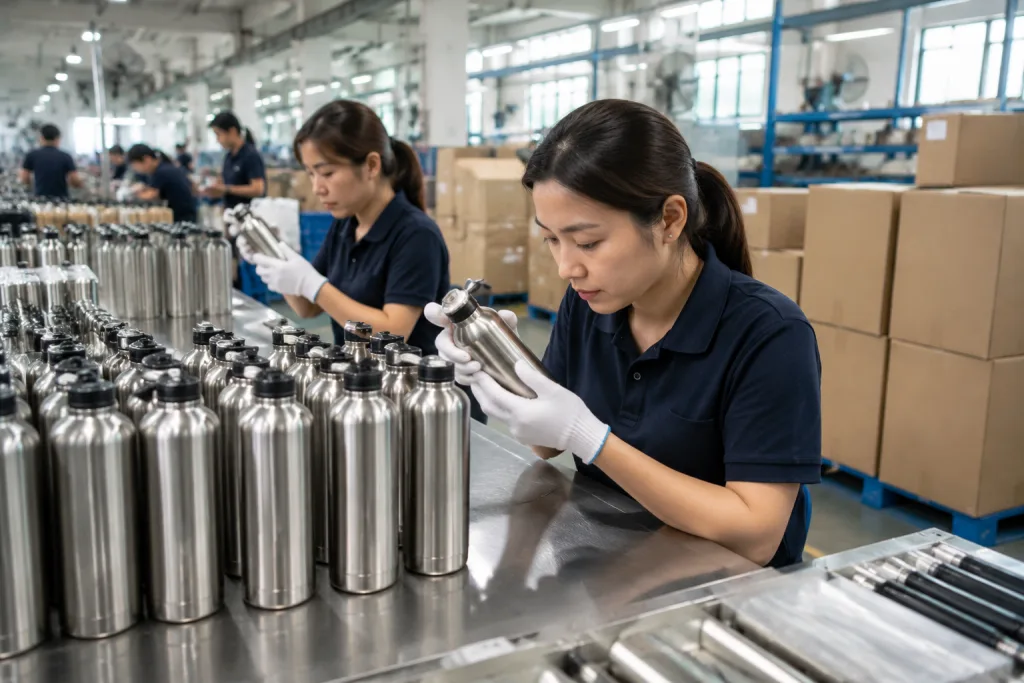
Confirm passivation and washing before the bulk order starts. Stainless bottles are welded, polished, cleaned, and dried; if the line is rushed, QC may pull samples with metallic odor, oil film under the lid thread, or rust-colored marks around the laser weld. In our Zhejiang production network, we normally run pre-shipment inspection under AQL 2.5 for major defects and AQL 4.0 for minor defects, with checks on odor, coating adhesion, leakage, capacity, and carton drop condition. One common finding is a 500 ml bottle measuring 486 ml to the brim after forming, so capacity needs a measuring cylinder check, not just a catalog photo.
How do logo choices affect cost?
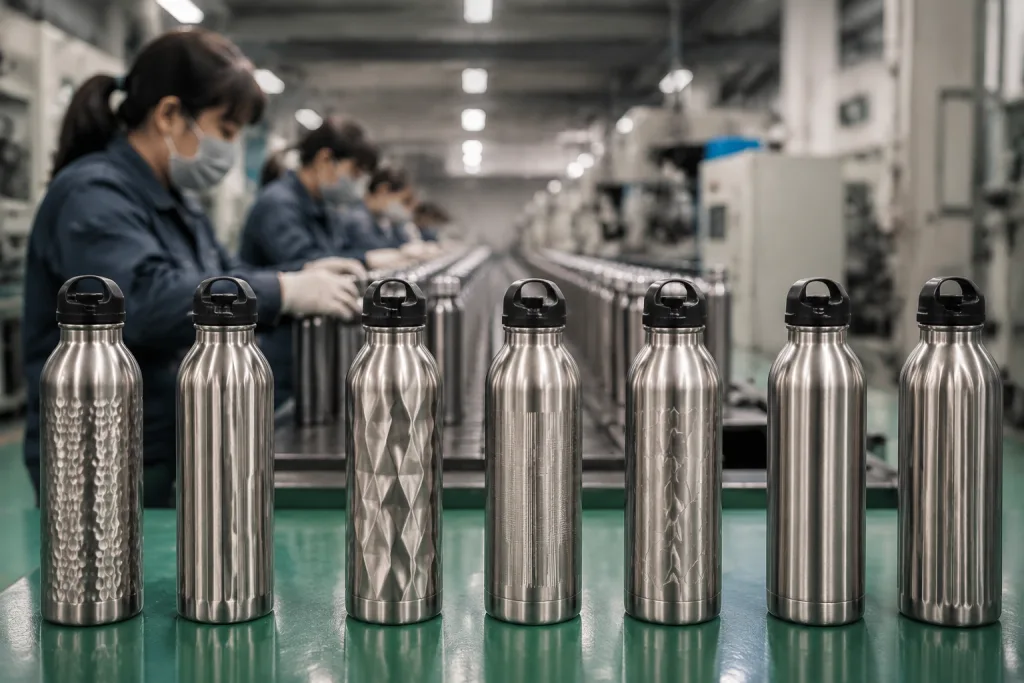
A custom logo shaker bottle or custom fitness water bottle only earns its keep if the mark survives daily abuse. We see gym bottles grabbed with wet hands, dropped into 72 mm car cup holders, washed 3-4 times a week, and scratched by zipper pulls in a backpack. Last month QC pulled the sample after 50 dishwasher cycles because a white silkscreen logo on matte black powder coat started feathering at the edge. Match the logo process to the finish and the retail price. No shortcuts here.
Here is the pricing range we quote most often on stainless sports bottles made in China, based on 1,000-5,000 pcs runs:
- Silkscreen printing: USD 0.08-0.25 per position for simple 1-color logos. Works on flat panels or a mild curve under 15 degrees; the line needs a print jig and a clean 0.2 mm edge on the artwork.
- Laser engraving: USD 0.15-0.45 per pc depending on logo size. Best choice for powder coating when the buyer wants wear resistance; we run a 20 W fiber laser and check the mark after tape pull.
- Heat transfer: USD 0.25-0.70 per pc for multi-color artwork or wrap designs. Needs adhesion testing on the actual coating, not a spare panel; we have seen wrap seams lift by 1.5 mm near the bottom radius.
- Embossed or molded logo: tooling often USD 300-1,500 depending on lid or silicone part. Makes sense for a custom made shaker bottle with repeat orders, usually 3,000 pcs MOQ or more, because the math does not work on a one-off promo order.
For a customizable gym water bottle, send vector artwork in AI, EPS, or PDF format before sampling. We need the Pantone code, logo size in mm, and placement from the bottle base, not just a JPG pasted into a PO. If artwork arrives after bottle samples are approved, we usually lose 5-7 days on logo positioning, Pantone matching, and print plate confirmation. For a gym chain with 30 locations, that delay can hit launch stock and staff training kits before anyone notices the retail display schedule slipping.
If you are a distributor shaker bottle buyer, offer two versions: a low-MOQ laser logo program on stock colors and a higher-MOQ customized shaker bottle program with exclusive powder colors. We ship stock-color laser orders faster because there is no coating line changeover and no new powder approval card. The buyer pushback we hear is, “Can you make every customer’s color exclusive at 500 pcs?” Wrong question. Put small customers on stock colors, then reserve custom powder, lid matching, and molded logo work for accounts that can carry the MOQ.
What MOQ and price are realistic?
For stock stainless sports bottle shapes, we usually quote MOQ at 1,000 pcs per color, with logo printing either built into the price or shown as a separate line on the PI. For a fully customizable sports water bottle with exclusive Pantone color, new lid tooling, custom shaker ball, or molded grip, the practical floor is 3,000-5,000 pcs per SKU because the coating line and injection mold setup both need volume. Small orders get tricky. If a supplier says yes to 300 pcs with full customization, ask if they are pulling old inventory and doing local rework; QC once pulled 47 scratched bodies from a 312 pc “custom” trial like that.
FOB Ningbo or FOB Shanghai pricing for a 304 stainless steel sports water bottle bulk order swings by steel gauge, cap structure, coating loss rate, and packing spec. For first-round budgeting, we run these numbers on a normal AQL 2.5 inspection plan and a 7-9 kg export carton:
- Single-wall 750 ml 304 bottle: about USD 2.10-3.20 per pc, depending on body thickness, PP cap style, and powder coating or spray paint finish.
- Double-wall vacuum 750 ml sports bottle: about USD 4.20-6.80 per pc, with price gaps coming from vacuum pass rate, lid complexity, and copper coating requests.
- Stainless bulk shaker bottle with mixing ball or insert: about USD 3.20-5.50 per pc, usually checked with a 24-hour leak test and ball-fit gauge on the line.
- Color box: add roughly USD 0.15-0.45 per pc, depending on 250-350 gsm paper, matte lamination, and whether the buyer needs barcode placement within 2 mm.
BottleForge Industrial is based in Hangzhou, Zhejiang, with partner production lines that support about 300,000 stainless drinkware units per month across sports bottles, tumblers, and thermos projects. Standard production lead time is 25-35 days after sample approval and deposit, assuming artwork is clean and the PO does not say “black lid” on one page and “white lid” on the next. We see that typo twice a month. Peak season before Q4 retail can move production to 40-50 days when special coating or component molding is involved.
Do not compare a bulk gym water bottle quote only by unit price. That is the wrong question to ask. Ask whether the quote includes inner polybag, spare silicone ring, export carton, barcode label, logo setup, testing, and inspection access; our packing table changes by USD 0.12-0.28 per pc when buyers switch from plain carton to retail-ready packing. A USD 0.18 cheaper quote can cost more once the missing items are added, and we have seen this go sideways after the buyer flagged missing spare rings during final inspection.
Which tests belong in the order?
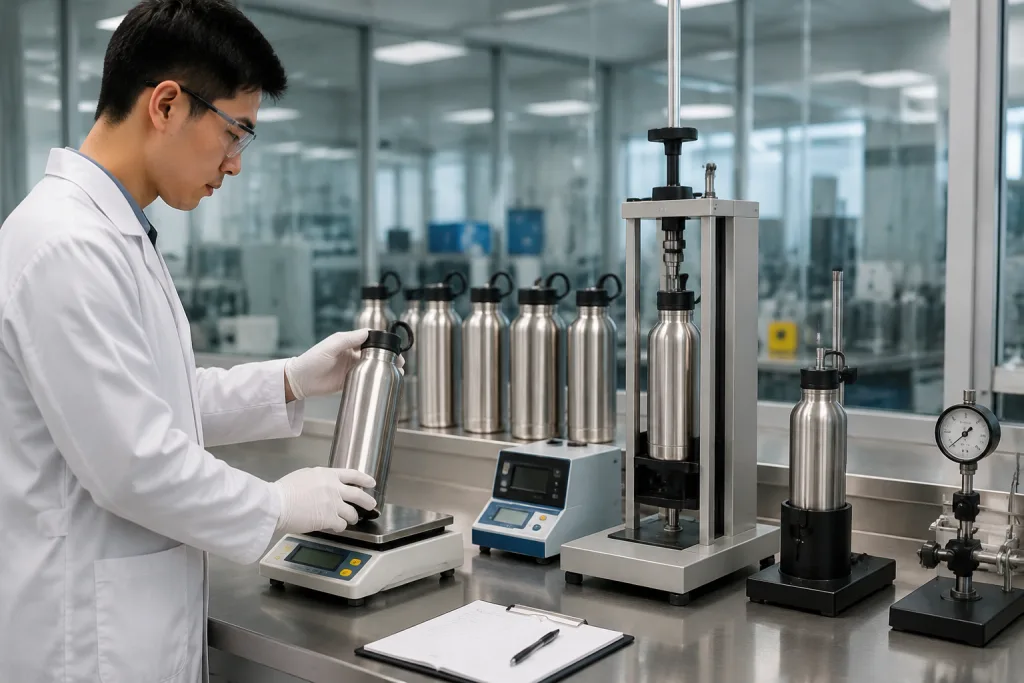
A custom shaker bottle or customized gym water bottle needs the same test plan we use for retail product, not the loose check people accept for a giveaway. On 304 stainless orders, the complaints we see most often are leakage, coating chips, lid cracks, odor, wrong capacity, and logo drift over 2 mm from the artwork line. The wrong question is “can you inspect before shipment?” Ask what we lock before the line starts. Last month QC pulled the sample after the PP meeting because the silicone gasket sat 0.6 mm proud and failed the upside-down bench test.
Pre-production checklist
- Confirm golden sample with signed label, date, version number, and one sealed counter sample kept in the QC room.
- Measure full capacity and recommended fill line capacity separately with a 1,000 ml graduated cylinder, then record both on the sample card.
- Check lid torque and thread fit on at least 10 samples; we run this before buying bulk lids because one loose mold can spoil 5,000 pcs.
- Approve Pantone color under D65 light, not from a phone photo; buyers have flagged “same black” when the powder coat was 1 shade warmer.
- Run 3M tape test on logo and coating adhesion, with the tape pulled at 180 degrees after the ink is fully cured.
- Confirm carton drop test requirement, usually ISTA-style internal drop from 76 cm for export cartons under 10 kg.
Pre-shipment checklist
- Leak test: fill with water, invert for 30 minutes, and shake for 30 seconds; the line should test assembled lids, not loose parts.
- Visual inspection under AQL, commonly 2.5 major and 4.0 minor, with coating scratches over 5 mm treated as a major defect.
- Capacity check using measuring cylinder or weight conversion, especially when the PO says 750 ml but the artwork shows 25 oz.
- Barcode or FNSKU scan test if selling through marketplace fulfillment; one unreadable label can block a full pallet at receiving.
- Carton mark check: SKU, quantity, gross weight, net weight, and country of origin, including spelling because we have seen “Stianless” printed on a PO.
For Europe, ask for LFGB food-contact testing and REACH compliance for coatings, inks, and plastic parts before the deposit is paid. For the United States, FDA food-contact expectations and California Proposition 65 review depend on the sales channel; Amazon, Costco, and a small gym chain will not review risk the same way. If the bottle is marketed for children, extra standards can enter the project. For most adult bulk sports water bottle programs, we ship smoother when food-contact safety, labeling, and retailer packaging rules are frozen at sample approval, not 3 days before container loading.
How should distributors plan variants?
Distributor fitness water bottle programs usually fail because the first range is too fat. We’ve seen buyers open with 5 capacities, 6 colors, 3 lids, and 4 logo methods; the catalog looks strong, then QC pulled 2 dusty color samples six months later because nobody reordered them. Start with SKUs that move every month: black and stainless in 750 ml and 1,000 ml, with chug lid or straw lid. Add shaker function only if your accounts already sell protein powder, PT packages, or gym retail goods. Otherwise the math doesn’t work.
For distributor gym water bottle orders, we run the line more cleanly with one shared bottle body and change the lid, logo, sleeve, or color box. Same 304 stainless body, same neck thread checked by go/no-go gauge, fewer surprises. That lets you quote a distributor fitness water bottle for corporate wellness, a customizable shaker bottle for supplement brands, and a custom gym water bottle for membership campaigns without rebuilding the supply chain each time. One buyer once asked for a new lid shape at 3,000 pcs; tooling alone killed the margin.
Carton planning matters more than buyers expect. A 750 ml stainless sports bottle usually packs 24 pcs per export carton, while a larger 1,000 ml vacuum bottle may pack 12 or 18 pcs depending on color box size and carton strength. If you ship to 8 gym locations, ask for master cartons with inner cartons of 6 pcs. It adds cost, often about USD 0.04–0.08 per bottle, but branch allocation is cleaner and the warehouse team stops cutting open full cartons with a knife.
If you sell to North American retailers, prepare UPC labels and carton labels before pre-production samples. If you sell online, confirm FNSKU placement and scannability before mass packing; we test with a handheld barcode scanner after shrink wrap because glare can fail a good label. For European wholesale, put importer address, recycling marks, and language requirements into the packaging artwork yourself. China factories can print these details, but we should not invent them for you. We’ve seen this go sideways from one PO typo in a postcode.
How to brief the factory cleanly
A clean RFQ beats hard bargaining. Send a Zhejiang or China supplier a proper brief, not five screenshots with “best price” typed under them. We have seen a 304 stainless quote move 6–9% after the buyer changed the lid, color split, and carton mark in three separate emails. The costing clerk still has to check the mold code and measure bottle height with a digital caliper before the line can price it.
Use this short format:
- Product: 304 stainless steel sports water bottle bulk order, 750 ml, single-wall or vacuum; include lid type and mouth diameter in mm if fixed.
- Market: EU, US, Canada, or mixed; tell us where the goods will be sold, not just where they ship.
- Quantity: 1,000 / 3,000 / 5,000 pcs, with color split; for example, 40% black, 30% white, 30% blue.
- Logo: laser, silkscreen, heat transfer, or undecided; attach AI, PDF, or SVG vector file, not a JPG pulled from a website.
- Packaging: bulk pack, white box, color box, or e-commerce box; state drop-test needs if Amazon or retailer delivery is involved.
- Compliance: LFGB, FDA, REACH, Prop 65, BSCI, or retailer audit request; send the exact buyer checklist if you have one.
- Trade term: FOB Ningbo, FOB Shanghai, CIF, DDP quote support, or forwarder pickup; include destination port or ZIP code for freight checking.
- Deadline: sample need date and warehouse arrival date; 12 days for a plain sample is different from 18 days with logo and color box.
For a customized fitness water bottle, ask for a quotation sheet that separates bottle cost, logo cost, packaging cost, testing cost, sample cost, tooling, and estimated carton dimensions. A real quote should show carton size, gross weight, and loading quantity, such as 53 x 40 x 46 cm and 12.5 kg for one common 750 ml pack. This is where the math either works or it does not. It also protects your margin when your customer changes from silkscreen to engraving, or from bulk pack to color box, after QC pulled the sample and everyone finally sees the finish under the light box.
The best factory conversation is simple: confirm the spec, sample it, test it, approve it, then produce it without redesigning halfway through. We have seen this go sideways when a buyer approved a black lid on the PI, then the PO said “dark grey” in one line item and nobody caught the typo until pre-production. If you need help choosing between a bulk shaker bottle, a bulk sports water bottle, and a custom sports water bottle for a gym retail program, bring your target landed cost and launch date first. “Which bottle is cheapest?” is the wrong question; ask which bottle can pass your use case, carton drop, and margin target.
Send your sports bottle RFQ for a practical quote
Share capacity, quantity, logo method, target market, and deadline. We will return a clear FOB quote with MOQ, lead time, and options.
Frequently asked questions
What is the normal MOQ for a custom 304 stainless sports bottle?
For existing molds and standard colors, 1,000 pcs per color is a realistic MOQ. If you need a custom powder coating color, many China factories will ask for 3,000 pcs because coating lines need setup time and powder loss allowance. For a custom made shaker bottle with molded lid, embossed logo, or exclusive mixing insert, plan for 3,000-5,000 pcs and tooling from roughly USD 300-1,500. If your project is only 500 pcs, use a stock body, stock lid, and laser logo to keep cost and lead time under control.
Can a stainless steel bottle work as a shaker bottle?
Yes, but the lid and mixing system need attention. A stainless bulk shaker bottle can use a stainless mixing ball, plastic grid insert, or integrated agitator. The cap must seal well because users shake protein powder hard for 10-20 seconds, often with milk or cold water. We usually recommend testing at least 20 sample units with powder, not only plain water. Also confirm the mouth opening; 55-60 mm is more practical for adding powder than a narrow sports mouth. For hot liquids, avoid shaker lids unless the venting design is specifically tested.
How long does sampling and production take?
A blank stock sample can usually ship in 3-5 days. A logo sample normally takes 7-10 days after artwork confirmation, and a new molded part can take 20-35 days for tooling and first samples. After you approve the golden sample and pay deposit, mass production is typically 25-35 days for standard stainless sports bottles. Add 5-10 days for complex heat transfer artwork, special coating, or retailer packaging. Ocean freight to Europe or North America often adds 30-40 days port to port, so plan backward from your launch date.
Which logo method is best for gym chain bottles?
For gym chain daily-use bottles, laser engraving on powder coating is usually the safest choice. It costs about USD 0.15-0.45 per pc, but it resists sweat, abrasion, and repeated washing better than basic printing. Silkscreen is cheaper, often USD 0.08-0.25 per position, and works for short campaigns or giveaways. Heat transfer is good for full-color designs but needs adhesion testing. If the bottle will be sold at reception or included in a premium membership kit, spend the extra amount on engraving or a tested high-adhesion print.
What inspections should I require before shipment?
Use a third-party or factory pre-shipment inspection based on AQL, commonly 2.5 for major defects and 4.0 for minor defects. The inspector should check leakage, coating scratches, logo position, color consistency, capacity, odor, lid fit, barcode scanning, packaging, and carton marks. For leakage, ask them to fill samples, invert for 30 minutes, then shake for 30 seconds. For coating, a simple cross-hatch and 3M tape test catches many weak finishes. If the order is above 5,000 pcs, also consider an inline inspection when 20-30% of production is finished.