Key Takeaways
- Specify 0.5 mm inner 304 stainless steel and 0.6 mm outer shell for a durable sport bottle
- Use AQL 2.5/4.0 inspection with leak, drop, coating, and carton tests written into the PO
- Private label MOQ normally starts at 1,000 pieces per color with 35-45 day production lead time
- Request LFGB, REACH, FDA, or ASTM documentation based on your selling market before deposit
A 304 stainless steel sport bottle private label project almost never dies because the bottle concept is wrong. It dies because the PO says “500 ml sports bottle, matte black, logo,” and the factory has to guess the wall thickness, lid test, Pantone, packing, and logo position. Bad guess, bad shipment. That is how buyers end up with leaking flip lids, 0.38 mm bodies when they expected 0.50 mm, color drift after powder coating, scratched cartons, or master cartons crushed after 32 days on the water.
If you buy custom drinkware from China for retail, corporate programs, or a canteen distributor channel, final inspection is already late. The right job is to define failure before the line starts: torque test standard, drop test height, AQL level, powder thickness, barcode placement, carton kg limit. At our Hangzhou, Zhejiang facility, we run 180,000 stainless bottles per month, and QC pulled 27 lid samples last week just because one buyer flagged a 1.5 mm gap at the spout. Small detail. Big claim risk.
Steel grade gets quietly downgraded
The biggest hidden failure in a 304 stainless steel sport bottle private label order is not a dramatic defect. It is material substitution. You asked for 304 stainless steel, but the supplier quotes low and runs 201 on the outer shell, swaps in a mixed-grade lid insert, or presses a thinner sheet than the signed sample. Looks fine on day one. On a 5,000 pc run, QC pulled the sample with an XRF gun and found the cup mouth was 304, while the bottom cover tested as 201. Six months later your customer is sending photos of rust spots near the thread, metallic smell, or discoloration after dishwasher use.
For food-contact bottles, name the steel grade by component. A workable spec reads like this: 304 stainless steel inner wall, 304 outer wall unless you approve 201 in writing, PP or Tritan lid parts, and silicone gaskets with no odor after a 100°C hot-water check. If you sell in Europe, ask for LFGB and REACH reports tied to the same material bill, not a recycled report from another SKU. For North America, FDA food-contact conformity and CPSIA or ASTM checks apply based on whether the bottle is sold for adults, kids, or school programs.
Do not write “stainless steel” only. That is the wrong question to ask the factory. A canteen factory in China may read it as “any stainless that passes appearance,” while your retail compliance team reads it as 304 stainless. Ask for incoming material records, PMI spot testing when the order value justifies it, and keep a sealed pre-production sample with label, date, and PO number; we have seen a PO typo change “304 inner/304 outer” into “304 inner/201 outer” before the line opened. For a premium custom canteen or distributor drinkware line, we run 0.5 mm inner wall and 0.6 mm outer wall. Going below 0.4 mm can cut FOB cost by USD 0.20-0.35, but the math doesn’t work when dents and vacuum failure start coming back.
Vacuum performance is underspecified
Buyers spend 3 emails on the logo size and 0 lines on heat retention. That is the wrong question to ask. A sport bottle still has to work as a bottle. Vacuum insulation fails when welding heat runs too hot, the evacuation port depth drifts by 0.3 mm, or the base plug is not sealed flat. We have seen this go sideways after logo approval: QC pulled the sample, the artwork was perfect, and the 500 ml bottle dropped from 95°C to 52°C in 6 hours.
Write a measurable thermal requirement. Use a test method buyers and the line can repeat: fill with 95°C water, cap closed, ambient temperature 20-25°C, temperature after 6 hours not below 65°C for a 500 ml bottle. For cold retention, specify 4°C water and a target after 12 or 24 hours. Use a calibrated probe thermometer, not a warehouse IR gun pointed at the bottle wall. If your bottle is single-wall, state it clearly and remove insulation claims from packaging. Customs and consumer protection agencies dislike vague performance claims, and the buyer will flag it faster than a typo on the PO.
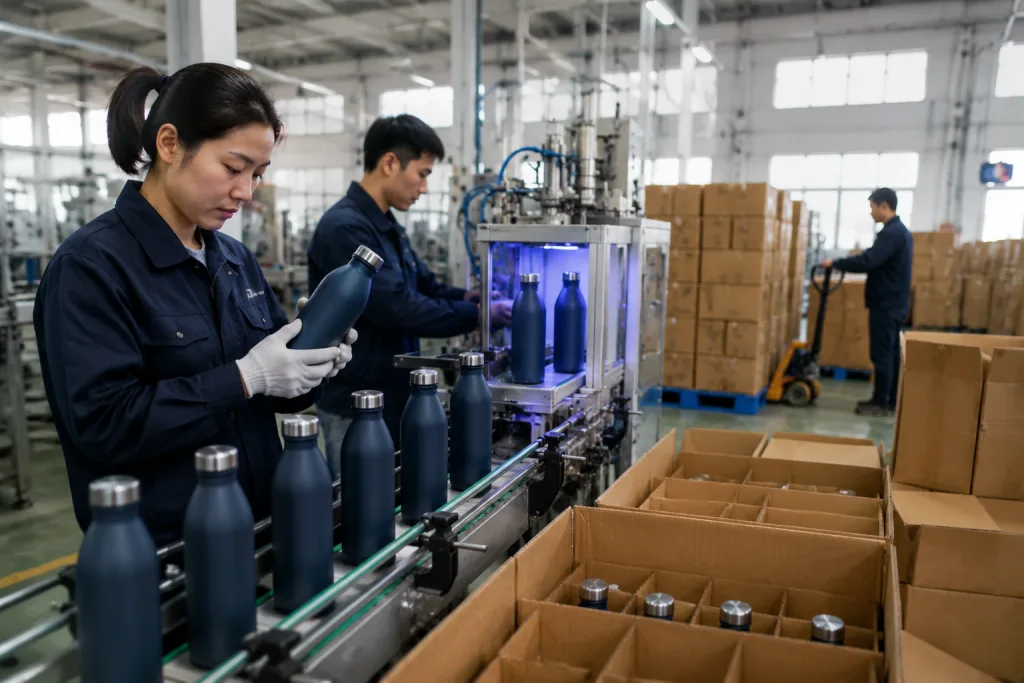
At BottleForge in Zhejiang, we test vacuum bottles by batch sampling before surface treatment and again before final packing. We run the hot-water check before powder coating because a failed vacuum shell is scrap, not a rework item. A realistic AQL plan is Critical 0, Major 2.5, Minor 4.0, with 100% leak testing on lids for private label sport bottle programs. If you are developing a canteen customizable range for outdoor retail, add a drop test from 1.0 m onto plywood or concrete, depending on your market positioning. Small dents after impact are acceptable for some outdoor channels; loss of function, cracked caps, and leaking threads are not.
Lids leak after the sample passes
About 7 out of 10 private label bottle complaints we see start at the lid, not the 304 stainless body. The sample has a fresh silicone ring, a hand-fitted straw or spout, and the assembly girl on the sample bench checks it twice. Then mass production runs a gasket at a different hardness, an M3 hinge screw gets over-tightened, or the cap thread drifts by 0.2 mm on the go/no-go gauge. The math doesn’t work: one “approved” custom drinkware line can still come back with a 3% leak complaint rate.
Spec the lid like an engineered part. Call out food-grade silicone for the gasket, with 50-60 Shore A as the normal range for sport caps, and have QC check it with a Shore A durometer instead of guessing by hand. Confirm the lid type with details: screw cap with single or double gasket, flip-top with hinge pin size, straw lid with bite valve, chug lid with sealing plug, or dual-drink system with separate air path. Each fails in a different way. Straw lids need suction testing and small-part review for kids’ bottles. Flip lids need cycle testing; 3,000 open-close cycles is a sensible baseline for retail programs. For a canteen promotional project under price pressure, a simpler cap can pass, but skipping the leak standard is where we’ve seen this go sideways.
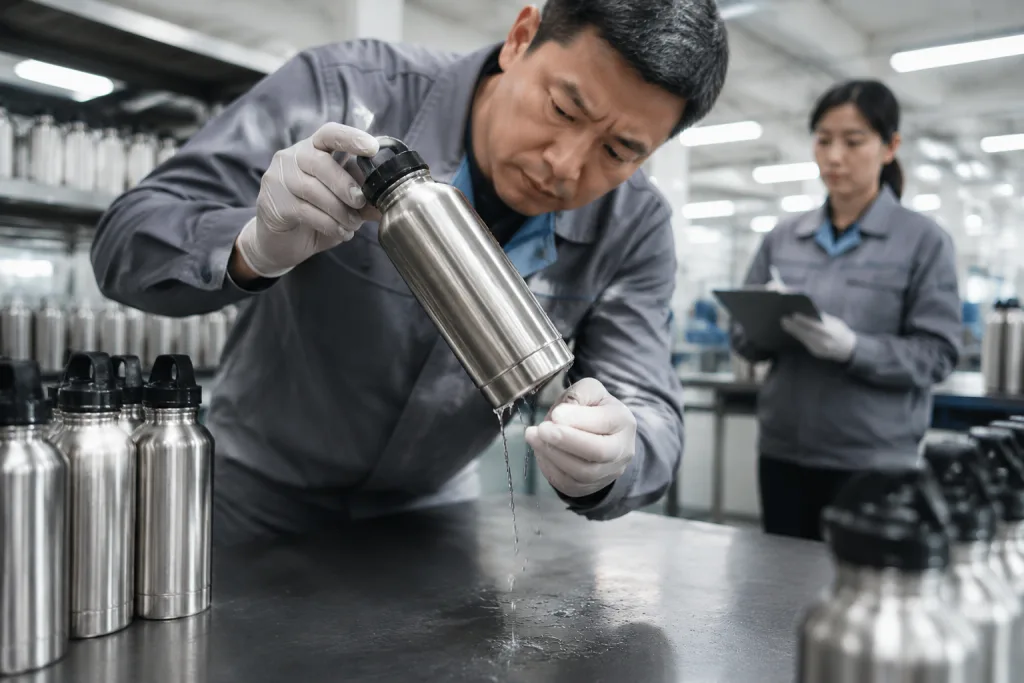
A proper leak test is not “turn it upside down once.” We run room-temperature water, fill to rated capacity on the line, close the lid at normal torque with a small torque driver, invert for 30 minutes, then shake horizontally for 30 seconds. QC pulled one 750 ml sample last month because two drops showed at the straw valve after the shake, even though the first inversion looked clean. For carbonated beverages, do not imply suitability unless the lid is designed and tested for pressure. This matters more for a custom growler or customizable growler than for a standard sports bottle, but the rule is the same: the use case must match the closure design.
Powder coating and logos disappoint
Surface finish is where 3 out of 10 canteen customized projects start losing money. Matte powder coating looks clean in the showroom, then the line gives you hairline scratches, dust points, orange peel, and color drift after the logo is already on the bottle. Expensive mistake. Last month QC pulled a 750 ml curved bottle from the rack and found the laser mark sitting 1.5 mm low because the jig clamp had play. A silkscreen logo can bleed if the ink system does not match the coating. Heat-transfer artwork can wrinkle around shoulders or grooves, especially on bottles with a tight radius under 18 mm.
Set visual standards before production. For powder coating, ask for coating thickness around 60-90 microns, cross-hatch adhesion test to ISO 2409 grade 0-1, and a simple rub test with 95% alcohol if your bottle will be handled daily. We run the thickness check with a coating gauge on the body and near the bottom edge, because thin coating at the foot ring is where chips show first. For color, provide Pantone reference but approve a physical color chip on the actual coating, not just a paper swatch. Black, white, navy, and beige are stable across batches. Fluorescent and metallic shades show more batch variation; the buyer may accept it on a sample table, but retail shelves make the difference obvious.
Logo method depends on your brand promise and budget, but “which logo is cheapest?” is the wrong question to ask. Laser engraving is durable and clean for stainless surfaces, with no ink migration risk. Silkscreen works for one or two colors, often adding USD 0.05-0.12 per position at scale, but we still check edge sharpness with a 10x loupe after curing. UV print handles multi-color artwork but needs adhesion testing. For a canteen supplier serving corporate buyers, we recommend one pre-production sample with final artwork, final coating, final lid, and final carton marking. Do not approve logo placement from a flat PDF only; we have seen a PO typo put a 45 mm logo on the back side instead of the front, and the math does not work once 3,000 bottles are printed.
Cartons fail before bottles sell
A bottle can pass AQL 2.5 inspection on the line and still land with dents because nobody fought for the carton spec. We see this too often. A 304 stainless sport bottle is stiff, but the powder coat is easy to scuff when the polybag is thin or the divider collapses. QC pulled one 750 ml sample last season after a 76 cm drop test; the bottle was fine, the color box corner split open. Sea freight from Ningbo to Hamburg or Los Angeles means 28-35 days of stacking pressure, damp air, forklift moves, and tired warehouse hands. If you sell through Amazon FBA or a retail DC, a crushed master carton turns into a chargeback. Not just an ugly box.
Lock the packing structure before artwork approval. For a normal 500-750 ml private label bottle, we run one bottle per white box or color box, 24 pieces per master carton, five-layer K=A or B=C corrugated carton, plus corner or edge protection for painted items. Keep gross weight under 15 kg when possible; the math doesn’t work when a carton hits 18 kg and gets dropped from waist height. Our packing table uses a 30 kg digital scale and a carton size jig, because a 10 mm carton change can affect pallet loading. For e-commerce, ask for ISTA 1A or 3A testing if you ship single units.
Carton marks should show item number, color, quantity, gross/net weight, carton size, country of origin, and the buyer’s barcode if required. Simple list. No guessing. If you buy for canteen distribution, confirm whether each unit needs EAN, UPC, FNSKU, suffocation warning, or polybag recycling marks; the buyer flagged one PO typo where “FNSKU” was written as “FNSK,” and the warehouse refused the label file. A vendor saying “we can add later” may be honest, but late label changes can delay booking by 3-5 days and add relabeling cost at the warehouse.

Compliance is checked too late
Compliance failure hurts because it usually shows up after the 30% deposit, after the line has packed 8,000 pcs, or when the carton is already sitting at Ningbo port. A canteen manufacturer may show an old test report for a similar bottle, but your exact item might use a new powder coating, a different PP lid, a colored silicone gasket, or a revised printed box. QC pulled one sample last year where the body passed, but the black gasket failed LFGB migration. Small change. Big bill. Those changes can affect LFGB, REACH, FDA, Prop 65, CPSIA, or national retailer protocols.
Ask for documents before you issue the purchase order. Match the report to material, color, factory name, and SKU; do not accept “same series” as proof unless the lab report actually lists the shared material code. If the test report is older than two years, your importer or retailer may reject it. For kids’ bottles, confirm small parts, lead, cadmium, phthalates, and relevant ASTM or EN standards. For promotional drinkware, some buyers skip testing because the product is “free.” Wrong question. The end user still drinks from it, and your logo is still printed on the bottle; we have seen a PO delayed 12 days because the buyer typed FDA only, while their retailer file required FDA plus Prop 65.
Social compliance also affects sourcing. European and North American buyers often request BSCI, Sedex, ISO 9001, or factory audit records, and a supplier with 3 export sales staff may not track expiry dates well. Not every canteen manufacturers list is prepared for this. In Zhejiang, China, established export factories usually know the routine, but you still need to verify audit scope, factory address, and expiry date against the business license. We run pre-shipment files with the test report, audit certificate, carton mark, and AQL 2.5 inspection record in one folder. Testing lead time is commonly 7-10 working days for standard food-contact reports; if migration fails and the coating or gasket needs reformulation, expect 18 working days instead of 7-10.
Price targets hide real tradeoffs
If two canteen suppliers quote the same 750 ml bottle with a USD 0.80 gap, one cost has been cut. Check it before you chase the lower price. We usually find the gap in 0.4 mm vs 0.5 mm body steel, powder coat thickness under 45 μm, cheaper PP lid resin, a 5-layer export carton changed to 3-layer, skipped AQL 2.5 inspection, tighter payment terms, or a factory trying to buy the order with no margin left. Last March, QC pulled the sample from a quote that looked fine on paper; the lid thread gauge failed after 18 open-close cycles. The buyer flagged it too late, after the PO was already signed. That is how a USD 0.80 saving turns into a claim.
For reference, a 500-750 ml 304 stainless steel sport bottle private label order from China often lands around USD 3.20-6.50 FOB Ningbo or Shanghai, based on vacuum structure, lid parts, powder coating, logo process, and packaging spec. A custom growler or larger capacity bottle can move higher because material weight and carton volume increase; a 1.2 L bottle can add 80-160 g of stainless steel before we even talk about the lid. At BottleForge, private label MOQ is usually 1,000 pieces per color, with 35-45 days production after deposit and artwork approval. Rush orders are possible, but the math does not work if the schedule cuts coating cure from 18 hours to 12 hours and leaves only one day for rework. We run the line with coating thickness meters, vacuum test tanks, and carton drop tests, not wishes.
Use a comparison sheet for every canteen vendor: steel grade and wall thickness in mm, capacity tolerance, lid material with resin code, coating test result, logo method, packing spec, compliance reports, AQL level, FOB port, sample cost, sample lead time, production lead time, and payment terms. One typo on a PO, such as “304 inside” instead of “304 stainless steel inner and outer,” can change what the factory buys. The sheet makes supplier selection less emotional. The cheapest quote can fit a canteen promotional campaign where the bottle is handed out once and the logo matters more than repeat use. It is usually the wrong question to ask for a long-term customized drinkware retail line; saving USD 0.15 on the first shipment means little if the second shipment comes back with scratched coating, loose lids, and 72 cartons held for inspection.
Send your bottle spec before you request pricing
We will review material, lid, coating, MOQ, packing, and compliance risks before quoting your private label sport bottle.
Frequently asked questions
What MOQ should I expect for a private label stainless sport bottle?
For a normal 304 stainless steel sport bottle private label order, expect 1,000 pieces per color as a practical MOQ. Some factories accept 500 pieces using stock colors and simple laser engraving, but unit cost rises and color control is weaker. If you need custom powder coating, custom lid color, retail box, and barcode labeling, 1,000-3,000 pieces is more realistic. New mold lids or unique bottle shapes may require 5,000-10,000 pieces because tooling and setup cost must be spread across enough units.
How long does production take after I approve the sample?
A standard lead time is 35-45 days after deposit, artwork approval, and confirmed pre-production sample. Stock bottle shapes with laser logo can sometimes ship in 20-25 days. Custom coating, retail packaging, and third-party testing add time. Add 7-10 working days for food-contact testing if you need fresh LFGB, REACH, or FDA documentation. During peak seasons before summer and Q4, China factories can stretch by another 7-14 days, so lock your canteen supplier schedule early.
Is 304 stainless steel required for both inner and outer walls?
The inner wall should be 304 stainless steel because it contacts beverages. The outer wall can be 304 or 201 depending on price and positioning, but you should not allow substitution without written approval. Premium retail and distributor drinkware programs usually specify 304 inner and 304 outer for simpler claims and better corrosion resistance. If you accept 201 outer wall to save cost, keep it away from aggressive salt-spray claims and confirm coating adhesion, especially for outdoor or coastal markets.
Which logo method is best for a customizable canteen program?
For long-term durability, laser engraving is the safest choice on stainless or powder-coated bottles because it does not rely on ink adhesion. Silkscreen is cost-effective for simple one-color logos and large canteen promotional orders. UV print is better for full-color artwork but needs adhesion and rub testing. For most B2B buyers, we suggest approving one final physical sample and then testing the logo with 95% alcohol rub, tape pull, and scratch review before mass production starts.
What inspections should I include in the purchase order?
Use AQL Critical 0, Major 2.5, Minor 4.0 as a baseline for export drinkware. Add clear tests: 100% lid leak test, vacuum temperature retention sampling, coating adhesion, logo position tolerance, capacity check, carton drop test, barcode scan, and visual defect limits. State who pays for reinspection if the order fails. For a 5,000-piece customized canteen order, a pre-shipment inspection usually costs less than one pallet of rejected goods in a North American or European warehouse.