Key Takeaways
- For a 304 stainless steel sport bottle order, expect MOQ around 3,000 units per shape and 10,000 units for better color and packaging pricing
- A practical lead time is 35-45 days after artwork, color sample, and deposit approval
- Use AQL 2.5 for major defects and AQL 4.0 for minor defects unless your retailer requires stricter inspection
- 304 stainless steel should be confirmed by material certificate and random XRF testing, not just written on a quotation
You do not buy a sport bottle. You buy decisions: 304 stainless steel thickness, capacity tolerance, lid thread fit, powder coating, logo process, carton burst strength, FDA or LFGB test scope, delivery date, and a supplier willing to tell you when QC pulled the sample and found a 0.4 mm rim scratch before shipment. If this is your first custom drinkware order from China, the quote may look clean; the risk usually hides in the 3 small cells nobody checks on the Excel sheet.
Let’s use one real sourcing case with a 304 stainless steel sport bottle manufacturer in Zhejiang: 10,000 units, two colors, one logo, FOB Ningbo, retail-ready packaging. We run orders like this often, and the buyer usually flags the same points: “Can you make the carton smaller?” or “Can you ship 12 days earlier?” Sometimes the math doesn’t work. A distributor, brand owner, or promotional buyer should lock the canteen custom specification before the deposit, not after the line has already opened the mold and printed the first 50 logo samples.
Start with the real order
Assume you are a European canteen distributor preparing a spring retail program. The real item is clear: 750 ml vacuum sport bottle, powder coated body, carry handle lid, leakproof seal, one-color logo, barcode sticker, and 24-piece export carton. The landed cost is tight. Fine. But the math does not work if the quote depends on thin steel, soft coating, or lids that leak after 14 days in a gym bag. We have seen QC pull a sample after a 1.2 m carton drop and find the lid thread already whitening.
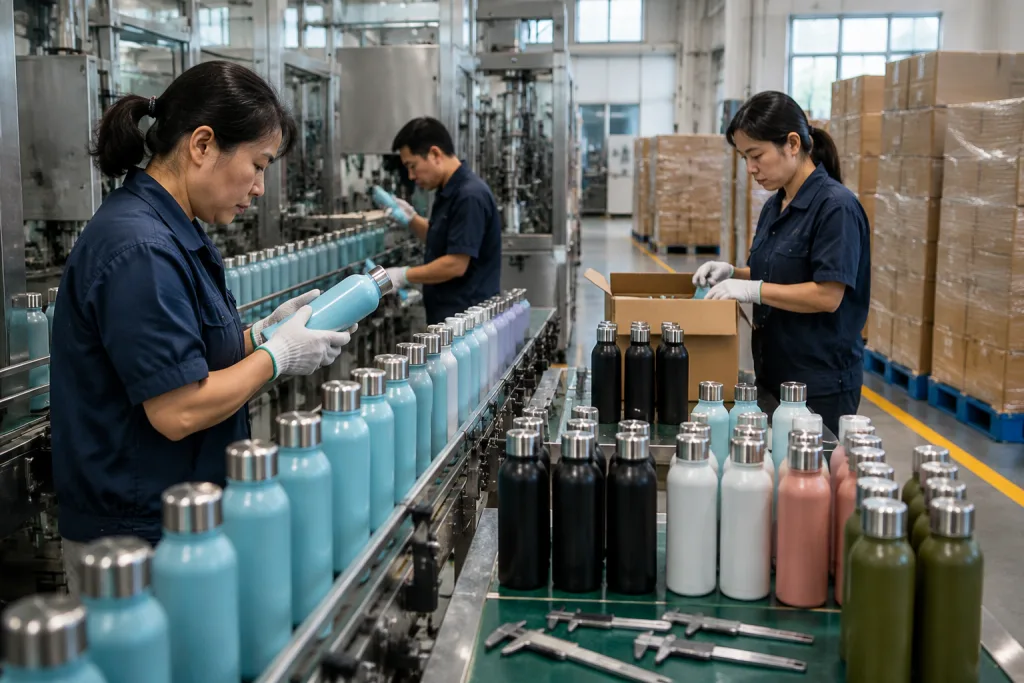
At our Hangzhou, Zhejiang sales desk, we first turn that request into a control sheet. One page. The sheet lists capacity, outer diameter, height, mouth size, body construction, inner and outer stainless grade, lid material, gasket material, finish, logo placement, individual packaging, carton drop requirement, and compliance market. We also add the barcode position in mm because one buyer once flagged a PO typo where EAN-13 was written as EAN-18. Without this sheet, a canteen supplier can quote a clean price on Monday, then add USD 0.18 for coating, USD 0.06 for color matching, and another carton charge before shipment.
For this order, a sensible specification is 304 stainless steel inner wall, 304 or 201 outer wall depending on price position, 0.45-0.50 mm inner wall thickness, 0.5 mm outer wall thickness, silicone gasket, PP lid, and copper-free vacuum insulation if you want a more sustainable pitch. If you sell customized drinkware into North America, decide up front whether FDA food-contact documentation and California Proposition 65 screening are required. For Europe, ask for LFGB or EU 1935/2004 food-contact test reports, plus REACH attention on coating and printing ink. On the line, we run a caliper check at the cut tube station; if the wall drops below spec by 0.03 mm, the bottle may still look good, but the dent complaint comes later.
The point is not to over-engineer the bottle. The point is to stop the canteen factory and the buyer from imagining two different products. This is the wrong question to ask: “Can you make it cheaper?” Ask which part is changing, in mm, grams, test level, or packing method.
Check steel before chasing price
The phrase “304 stainless steel” gets stretched too far in drinkware quotations. A serious 304 stainless steel sport bottle manufacturer should state which parts are 304, which parts are not, and how the material is checked. We see about 6 out of 10 budget sport bottle quotes use 304 for the inner liner and 201 for the outer shell to save cost. That can work for some distributor drinkware programs if the BOM says it clearly. It does not work when your retail label says “304 stainless steel bottle” and the buyer assumes both walls are 304. QC pulled one sample last month with a 304 inner wall, 201 outer wall, and a PO line that only said “SS bottle.” That is where trouble starts.
For a 10,000-unit custom canteen order, ask for two checks before mass production, then write them into the order file. Get the steel coil or tube material certificate from the upstream supplier, with heat number and grade shown. Ask for a pre-production sample cut or test result showing 304 chemistry, and allow random XRF testing during inspection. Simple. XRF is not perfect for every element, but it catches the common grade swap on the factory floor. We run the gun on the body, neck, and base area because mixed stock can slip in after tube cutting if the line is rushing.
Price gaps are real. Moving from 201 outer wall to 304 outer wall can add roughly USD 0.12-0.28 per 750 ml bottle, depending on steel market and bottle weight. Increasing wall thickness by 0.05 mm adds material cost, but it can reduce dents during carton drop and warehouse handling. A canteen vendor quoting USD 2.10 while others quote USD 2.55 is not automatically smarter; they may be using thinner steel, lower-grade outer material, or a lighter lid. We have seen this go sideways when the buyer flagged side-wall dents after a 1.2 m drop test, and the supplier’s answer was only “normal tolerance.” The math does not work if the return claim eats the saving.
Our view from Zhejiang is blunt: if your brand promise depends on durability, specify the wall thickness and stainless grade in the purchase order. “Good quality” is not a specification in China or anywhere else. Put “inner 304 stainless, outer 304 stainless, body wall 0.40 mm before forming” if that is what you need. We ship what is written, and the line follows the PO, not the sales chat.
Build the logo and finish plan
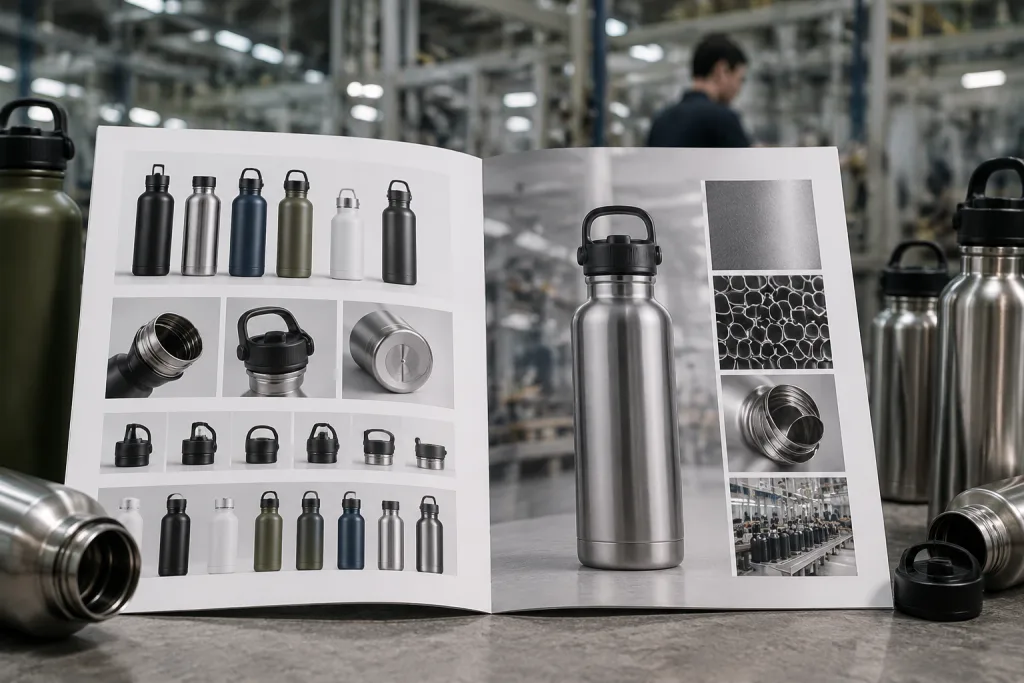
After the bottle structure is locked, decoration becomes the next place orders go wrong. Buyers approve a digital mockup and expect the line to hit it 1:1. It won’t. A mockup helps us check logo position and proportion, but it is not a color chip or a print tolerance sheet. Last month QC pulled a matte sample from the rack and the buyer flagged a 3 mm logo shift that never showed on the PDF.
For this order, choose two powder coating colors: matte black and forest green. Give Pantone references, but powder on 304 stainless steel will not read the same as ink on coated paper. Ask for color plaques or actual bottle samples before bulk production; we run both through the powder oven at around 180°C, then check them under a D65 light box. For repeat retail programs, keep one signed master sample at your office and one at the factory. We usually allow Delta E 2.0-3.0 on powder coating, but if your retailer is strict, write the Delta E target into the PO before production.
Pick the logo method by how the bottle will be sold. Silk screen printing suits simple one or two-color artwork and keeps the cost sensible for 3,000-10,000 units. Laser engraving looks cleaner and lasts well, but it exposes the metal under the coating, so the result can feel too industrial for some brands. Heat transfer handles gradient artwork and small text, but we want abrasion testing, usually 500 rubs with a 1 kg load, before we say yes. For canteen promotional orders, buyers often choose silk screen because the math works on cost and lead time. For outdoor retail lines, laser usually feels more permanent.
Placement matters more than people think. A logo too close to the bottom curve will stretch. A logo over a weld line can print unevenly, and we have seen this go sideways on tapered bodies. Ask your canteen suppliers for a printable area drawing with dimensions, not just a nice mockup. On a 750 ml bottle, a typical front logo might be 55-70 mm wide, centered 80-110 mm from the base, but the exact position depends on the bottle shape and the fixture we use on the line.
Make packaging survive the route
Packaging is where 10,000 customized canteens can lose money after the bottle already passed QC. We have seen this go sideways: QC pulled the sample, coating passed the 3M tape check, then the buyer flagged rubbed logos, crushed gift boxes, and EAN labels that would not scan at receiving. If you sell through retail, Amazon, or distributor channels, this is the wrong place to save USD 0.06 per unit. Packaging is part of the product.
For the 10,000-unit scenario, we run one bottle in a polybag or tissue wrap, then a white or kraft individual box using 350 gsm paperboard, or 400 gsm when the bottle is over 650 g. If the bottle has a powder coated finish, add a neck sleeve or body sleeve where the box wall touches the shoulder; abrasion usually shows first at that 8-12 mm contact point. Export cartons should usually be 5-ply corrugated, with carton weight kept under 15-18 kg for safer handling on the line and at the forwarder warehouse. 24 pieces per master carton works for most sport bottles, but larger growler-style products often need 12 pieces because the math does not work once gross weight passes 18 kg.
If you are an Amazon or marketplace buyer, send FNSKU rules before mass packing starts. Do not wait until final inspection to tell the canteen factory that every box needs a 50 mm x 30 mm label on the lower right panel; we have had a PO say “stick on side,” then the buyer rejected 312 cartons because the scanner angle was wrong. If you are a distributor growler or custom growler buyer shipping to multiple warehouses, mark carton sides with SKU, color, quantity, gross weight, net weight, and carton dimensions. Pallet rules need to be on the packing instruction too; European buyers may need EUR pallet planning, while North American buyers often cap pallet height at 1.6 m or 1.8 m.
A practical carton test is a 76 cm drop test on one corner, three edges, and six faces for small parcel conditions. For normal container freight, that test can be tougher than the route, but it shows weak dividers, thin box corners, and loose inner packing before 10,000 units leave China. Test one carton first. Fixing 1 carton in Hangzhou is cheap; reworking 417 cartons after arrival is not.
Set inspection points before deposit
Do not wait until finished goods to start QC. By then, the line has moved, cartons are sealed, and the math does not work if 6,000 bottles need rework. For a new customized drinkware order, we set three checkpoints in the PI: pre-production sample approval with signed photos, inline inspection at 20-30% completion, and final random inspection when at least 80% is packed. We had one buyer flag this after deposit because their PO said “matte black” but the artwork file said “black sand texture.” Better to catch that on day 3, not day 38.
The pre-production sample should use the intended steel, coating, logo, lid, gasket, and packaging. If the sample uses a substitute lid because the correct one is “not ready,” write it on the sample tag and do not count it as full approval. The inline inspection should check vacuum performance, coating adhesion by 3M tape, logo position within the agreed mm tolerance, lid fit, smell, visible dents, and packing method. Final inspection should use an AQL plan. A lot of B2B buyers use AQL 2.5 for major defects and 4.0 for minor defects; for critical defects such as leaking, sharp edges, contamination, or wrong material, acceptance should be zero. QC pulled one sample last quarter with a silicone gasket seated 1.5 mm high, and that small gap was enough to fail the leak test.
For sport bottles, basic tests include 100% leak testing at the production line, vacuum insulation sampling, cross-hatch adhesion test for coating, alcohol rub test for printing, lid torque or open-close cycling, and capacity check. A 750 ml bottle should not become 710 ml because the mold was convenient. That is the wrong question to ask in tooling review. We run capacity checks with a digital scale and water weight, then compare the fill line against the approved drawing. Tolerance should be agreed, often around ±5% for practical drinkware capacity unless your claim is exact.
At BottleForge Industrial, our current stainless drinkware capacity is about 450,000 units per month across standard shapes, with typical MOQ from 3,000 units per model for existing molds. New mold or special lid projects need separate review, especially if the lid uses a flip straw, carry loop, or custom silicone part. Normal lead time for a canteen customized order is 35-45 days after deposit and approvals, not after the first email. We ship faster when artwork, carton marks, and barcode files arrive clean; we have seen a single typo on a PO hold booking by 2 days.
Understand the quotation line by line
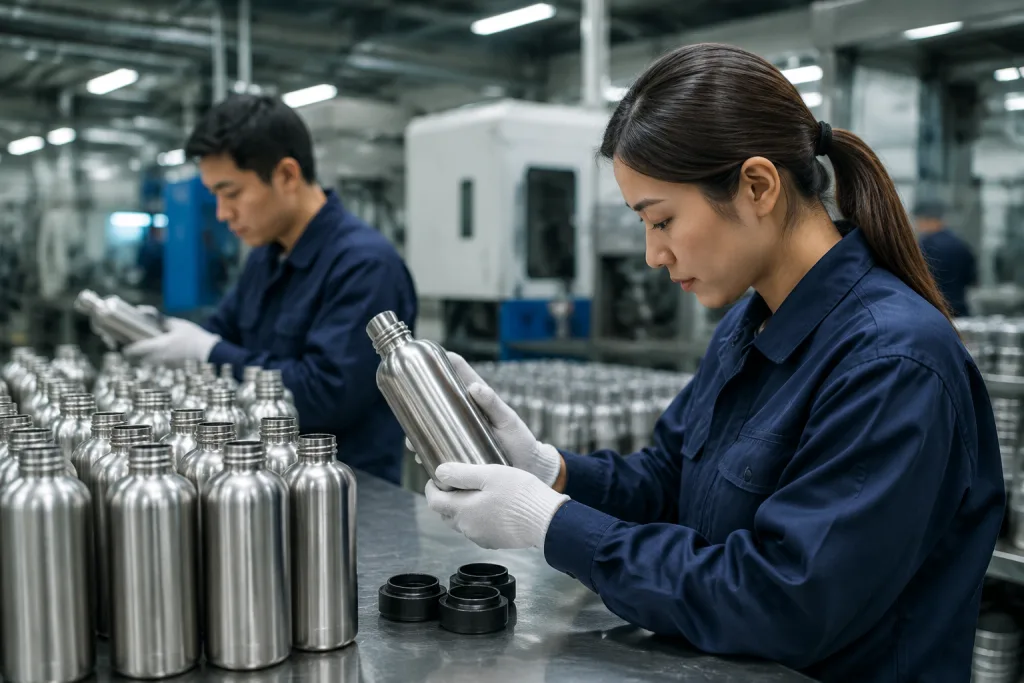
A workable quotation from a canteen manufacturer should let your buyer compare apples to apples. We want to see the model number, capacity, 304 stainless grade, finish, logo method, packaging, MOQ, unit price, sample cost, sample time, production lead time, payment terms, Incoterm, loading port, and quote validity. If the quote says only “750 ml stainless bottle, USD 2.35,” the math doesn't work. Last month QC pulled a 750 ml sample that was 286 mm tall, but the PO listed 275 mm; that 11 mm difference changed the carton size and freight estimate.
For this buyer scenario, a normal FOB Ningbo price range might be USD 2.40-3.20 per unit for a 750 ml vacuum sport bottle with powder coating and one-color logo, depending on steel weight, lid parts, packaging, and order volume. A single-wall sport canteen costs less. A wide-mouth insulated bottle with a premium carry lid and full 304 inner/outer construction sits higher, especially if the lid uses a silicone straw, hinge pin, and separate PP handle. Customized growler and customizable growler projects can move above this range because they use heavier steel, larger cartons, and leave fewer units per container; we’ve seen 1,200 ml growlers drop from 24 pcs to 12 pcs per master carton after the buyer added a gift box.
Payment terms for a first order from China are usually 30% deposit and 70% before shipment after inspection. After 3 or 4 clean shipments, some canteen distributors ask for better terms, and sometimes we accept if the credit history is solid. Tooling fees, if any, should be listed outside the unit price. Artwork setup fees need a separate line too, especially for multi-color printing or heat transfer film; one buyer once sent a PO with “2C logo” while the AI file had 4 Pantone colors, and the line stopped until sales corrected the approval sheet.
Ask whether the quoted price includes compliance documents already available or only factory internal tests. BSCI, ISO 9001, food-contact reports, REACH screening, and ASTM-related claims do not mean the same thing, and they do not cost the same. A canteen vendor should not promise every certificate casually. If your retailer requires a named lab report on your exact SKU, budget both time and money for that test; SGS or Intertek sampling can add around 7-10 working days before mass shipment, and the buyer flagged it too late on one order after cartons were already sealed with 3M tape.
Approve production without guessing
Before you release the deposit, build one final approval pack and get both sides to sign it. Include the signed quotation, proforma invoice, product specification sheet, artwork file, Pantone or coating reference, packaging dieline, barcode file, carton marks, inspection standard, and shipping instruction. We usually staple the printed spec to the counter sample and write the bottle height, mouth diameter, and carton gross weight in mm and kg on the first page. Boring work. Still cheaper than the argument we hear too often in custom drinkware: “I thought you meant the other lid.”
During production, ask for dated photos and 10–20 second videos at the points where mistakes show up: raw body forming, polishing, coating, logo printing, assembly, leak testing, and packing. Photos do not replace AQL 2.5 inspection, but they catch the obvious misses before 8,000 bottles are boxed. We run leak testing with water and air pressure on the line, and QC pulls samples after coating to check scratches under a 6500K light box. One buyer approved a black lid in the rendering, while the PO code picked a grey lid from the standard parts list. Assembly photos found it. Final inspection would have been too late.
If you are working with 3 or 4 canteen vendors, keep one comparison table that tracks more than unit price. Use columns for defect rate, reply time in hours, sample accuracy, document errors, packing damage, and actual ship date versus promised ship date. This is where the math often looks ugly. The cheapest canteen supplier on the first order becomes expensive when your team spends 20 extra hours correcting AI files, fixing a barcode typo on the PO, and asking for the same carton mark again.
A factory in Zhejiang, China should talk straight about production constraints: coating line schedule, lid inventory, carton lead time, Chinese New Year congestion, and vessel space out of Ningbo or Shanghai. If the coating line is full until the 18th and cartons need 7 days after dieline approval, say it early. That honesty is worth money. Your best distributor canteen program is not the prettiest mockup; it is the one that ships as approved, scans at receiving, survives customer use, and can be repeated six months later without rebuilding the project from zero.
Send your sport bottle specification for factory review
We will check material, MOQ, logo method, packaging, compliance needs, and FOB China pricing before you commit to sampling.
Frequently asked questions
What MOQ should I expect from a 304 stainless steel sport bottle manufacturer?
For an existing mold, a practical MOQ is usually 3,000 units per model. If you need two powder coated colors, many factories prefer 3,000 units per color because coating changeover has real loss. Better pricing normally starts around 10,000 units, especially if you need retail boxes, custom carton marks, and a stable production slot. For a new lid, new body shape, or private mold, MOQ can move to 20,000-30,000 units plus tooling cost. If a canteen supplier accepts 500 units with full customization, check whether they are using stock goods, limited logo options, or charging a higher unit price.
How do I confirm the bottle is really 304 stainless steel?
Ask the canteen manufacturer to define which parts are 304: inner wall only, inner and outer walls, or additional metal parts. Then request the raw material certificate and include random XRF testing in your inspection plan. For food-contact surfaces, the inner wall is the most important part and should be 304 stainless steel for normal sport bottle use. If your marketing copy says full 304 construction, the outer wall should also be 304. Put the grade in the purchase order, not only in email. For larger orders, test 3-5 random samples from mass production, not just the pre-production sample.
What is a realistic lead time for customized drinkware from China?
For an existing 304 stainless steel sport bottle shape, plan 7-10 days for sampling after artwork confirmation and 35-45 days for mass production after deposit and final sample approval. Add 3-7 days if you need a special powder coating color, more if the color needs several adjustments. Lab testing can add 5-10 working days depending on the standard and lab schedule. Ocean freight is separate: roughly 25-40 days to many North American and European ports, depending on routing. Around Chinese New Year, add at least 2-3 weeks of buffer.
Which logo method is best for canteen promotional orders?
For canteen promotional programs, one-color silk screen printing is usually the most cost-effective option above 3,000 units. It gives a clean brand mark at a low setup cost and works well on powder coating when ink and curing are controlled. Laser engraving costs more per unit but is more durable because it removes the coating and exposes the metal below. Heat transfer is better for gradients, full-color artwork, or complex retail graphics, but you should run abrasion and dishwasher-related tests if you plan to make durability claims. Choose the method based on use, not only appearance.
Can one factory handle bottles, custom growler items, and distributor drinkware lines?
Often yes, if the factory has the right forming, welding, polishing, vacuum, coating, and assembly partners or in-house lines. Standard sport bottles, travel tumblers, and some custom growler projects share similar stainless processes, but large growlers need different tooling, stronger lids, larger cartons, and more careful vacuum control. Ask for production photos, monthly capacity by category, and recent inspection reports for similar items. A canteen factory that is strong in 500 ml promotional bottles may still need review before handling a 1.9 L customized growler retail project.