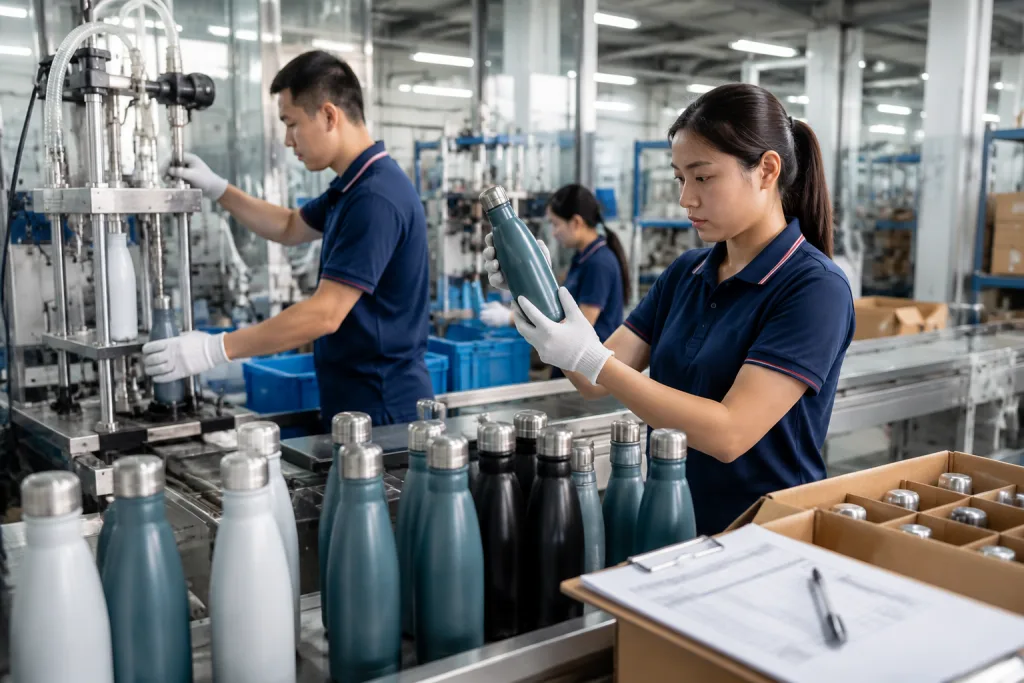
Key Takeaways
- For most 304 sport bottles, a safe trial MOQ is 1,000-3,000 pcs per SKU and color
- Use 304 inner/outer steel only when you need full food-contact confidence; 201 outer bodies reduce cost but raise corrosion complaints
- AQL 2.5 major / 4.0 minor is typical, but leakage, odor, and rust should be treated as critical defects
- Expect 25-35 days for repeat production after sample approval, longer for molded lids or complex gift boxes
A 304 stainless steel sport bottle factory can look sharp on a video call: polished samples, tidy assembly tables, cartons stacked by the loading door. Trouble shows up later, after artwork approval and a 30% deposit. Paint chips. Caps leak. The logo shifts 3 mm because the screen-print jig was reset between runs. The carton says 500 ml, but QC fills the bottle to the safe line and gets 455 ml.
If you buy custom drinkware for retail, promotion, or distributor programs, spec against failure instead of hoping the line “understands.” We see this every week in Hangzhou, Zhejiang export production. A workable order starts with 304 stainless grade, weld quality, coating thickness, lid fit, leak testing, and AQL 2.5 inspection rules written on the PO before tooling or mass production. One buyer once flagged a single typo, “matte back” instead of “matte black,” and he was right to push; that small mistake can turn into 3,000 wrong bottles.
Material grade mistakes start early
The first failure mode looks boring on paper and gets expensive after discharge: the bottle is not the steel grade you thought you bought. In our RFQ inbox, about 3 out of 10 new buyers write only “stainless steel” and assume SUS304 everywhere. Bad assumption. A bottle can be quoted as 304 inner wall with 201 outer wall, 304 body with 430 stainless accessories, or a 304 cup body with a cheap spring or pin hidden inside the lid. QC pulled one lid sample last year where the pin rusted after a 24-hour salt spray check, while the body passed.
For a sport bottle, the inner wall is the food-contact surface. If you sell into Europe or North America, specify SUS304 / 18/8 stainless steel for all liquid-contact metal parts. If you accept 201 stainless on the outer shell to save USD 0.20-0.45 per unit, write it clearly on the PO and accept the tradeoff: coastal humidity, dishwasher misuse, and scratched powder coating bring rust complaints. We ship mixed-grade builds when the buyer asks for them. The problem starts when the quotation hides the construction, or when a buyer flags “rust on stainless” in week 6 and the math no longer works.
Ask for mill certificates, but do not treat them as proof by themselves. For a serious order, request incoming material PMI testing by XRF on coils or drawn parts. At BottleForge Industrial in Zhejiang, our standard sampling for new 304 bottle programs checks material before forming and again from finished goods if the order is over 10,000 pcs. We run the XRF gun on the coil edge before deep drawing, then QC checks 5 finished bottles from the packed lot if the buyer’s spec calls for it. It is not dramatic. It prevents arguments after shipment.
Your purchase order should name the grade, wall thickness tolerance, and test requirement. A typical vacuum sport bottle uses about 0.4-0.5 mm inner wall and 0.5-0.6 mm outer wall before forming. Ultra-light bodies look good in a freight spreadsheet, but dent claims rise when you push too thin. We measure wall thickness with a digital micrometer at the rim cut and after forming, and the buyer once sent a PO typo calling for “0.35 mm outer” when their approved sample was 0.55 mm. If your brand targets outdoor retail, do not chase the last 20 grams of weight savings. That is the wrong place to save cost.
Vacuum failure is not random
Buyers often treat temperature retention as a marketing number. On the line, we treat it as a process-control number. A double-wall vacuum bottle can fail from a 0.2 mm weld gap, oil left on the inner shell before brazing, weak pumping time, or a pinhole near the base seal. The bottle still looks clean under normal light. QC pulled one sample last month that passed appearance, then the ice was gone in 2 hours.
For insulated bottles, define the test method, not just the claim on the carton. We run a common check by filling with 95°C water, closing the lid, and measuring after 6 hours at 20°C ambient with a calibrated probe. For 500-750 ml 304 sport bottles, 7 of 10 standard shapes should hold roughly 60°C or above after 6 hours, depending on body shape, mouth diameter, cap design, and copper coating. Cold retention is tougher. A buyer once flagged a wide-mouth lid because the spec said “24H cold,” but the open-mouth size made the math fail.
Production control matters more than a polished pre-production sample. A proper 304 stainless steel sport bottle factory should test vacuum performance in-line, not only at final inspection. On our Zhejiang lines, capacity for stainless sport bottles is about 450,000 units per month across standard models, but we still split vacuum sampling by batch and model, with the batch card tied to welding shift and furnace lot. Fast output without test discipline just makes defects faster.
Write your acceptance rule like this: vacuum failure, heat transfer through the body, sweating on the outer wall, or abnormal base bulging is a critical defect. Do not bury it as a minor cosmetic issue. For a custom canteen program, especially one sold as premium outdoor or corporate gift drinkware, one container of weak vacuum units can hurt your distributor faster than a late shipment; we have seen buyers accept 12 days vs 18 days on delivery, but not warm water after one afternoon.
Lids leak where drawings are vague
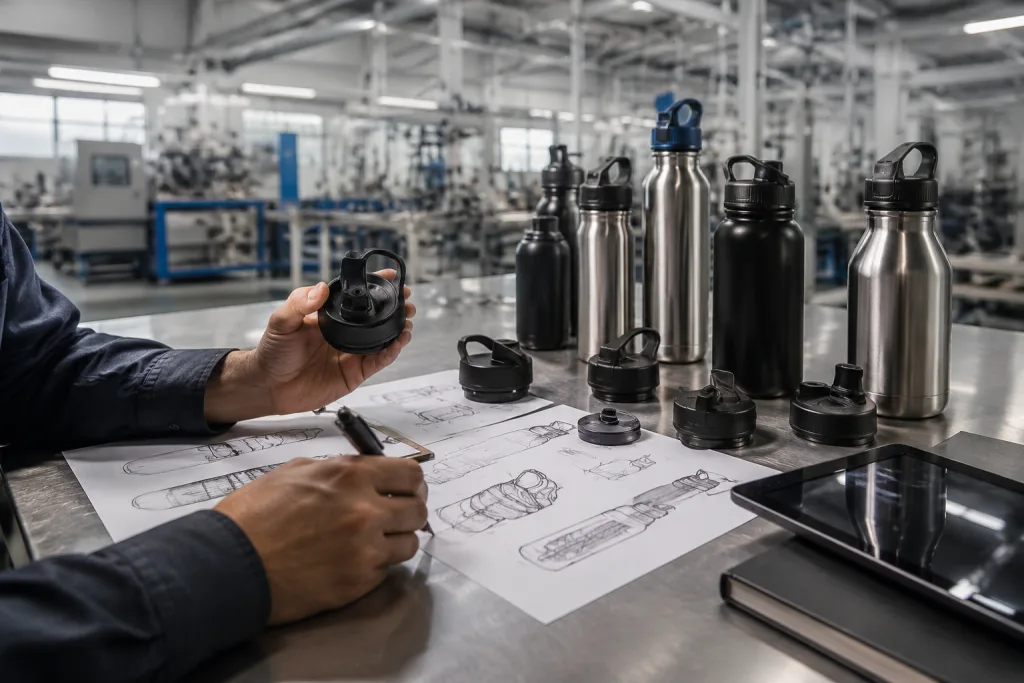
The lid is where 6 out of 10 canteen customized projects get into trouble. Buyers spend hours on Pantone color, logo size, and carton artwork, then sign off a cap after checking one desk sample. Risky move. On the line, a 2 Shore A shift in gasket hardness, 0.15 mm less thread bite, loose hinge pins, uneven straw cutting, or a silicone vent with flashing can turn a clean sample into a leaking shipment. We’ve seen this go sideways after QC pulled 32 bottles from a pilot run and found water beads under the flip button.
Specify the actual use case. Is it a bike bottle tossed sideways in a gym bag, a school bottle for kids, or a canteen promotional item where the buyer flagged price before one-hand drinking? Different caps need different tests. A screw cap with a silicone gasket is safer than a flip lid, but slower to drink from. A straw lid sells convenience, then adds 4 extra parts, more assembly labor, and more leakage points. The wrong question is “Which lid looks better?” Ask how the bottle will be carried, washed, dropped, and packed.
Your RFQ should list lid material and compliance: PP or Tritan where applicable, food-grade silicone gasket, BPA-free declaration, LFGB or FDA food-contact testing depending on market, and odor control after hot water exposure. We run resin checks against the BOM before tooling confirmation, because “food grade” typed on a PO is not a test report. If your canteen vendor cannot identify the plastic resin or sends a report with the model number missing, slow down. One buyer once sent us “Trian” on the PO; QC caught it before the lab submission, but that typo would have delayed approval by 5 working days.
Use mechanical tests. We recommend 100% leak testing for closed bottles where practical, plus random inverted testing for 30 minutes during final QC. For flip lids, add open-close cycling; 500 cycles is a reasonable buyer-side requirement for mid-market products, and we track it with a simple hinge cycling jig at the inspection table. Drop testing should be defined by height and surface. A 1.0 m drop onto plywood is not the same as concrete. For retail bottles, we usually test filled units at 0.8-1.0 m on base, side, and cap. If the cap cracks, your customer will not care that the stainless body survived.
Coating defects hide behind samples
Powder coating and spray painting sell the bottle on the shelf, but they also drive a big share of after-sales claims. In our Hangzhou line, a golden sample might be handled by one senior worker, cured in a clean oven, then checked under a D65 light box before it goes to the buyer. Bulk is different. We run pretreatment, drying, coating, curing, and packing at 1,200-1,800 pcs per shift, and small drift shows up fast. If surface oil, dust, 65% humidity, or a curing oven set at 180°C drops by 10°C, QC pulled the sample will find pinholes, orange peel, color shift, weak adhesion, or chips around the bottom rim.
For custom drinkware, write down the finish system before price confirmation. Powder coating usually beats standard wet spray paint on scratch resistance, but the math does not work if the buyer asks for tight color matching and still pushes for the cheapest finish. Pantone numbers help with artwork files, but coating suppliers match against a physical color plate under fixed lighting, not a PDF on a laptop. A Delta E tolerance of 1.5-2.0 is strict; 3.0 may be acceptable for promotional programs. Metallic and gradient finishes are harder to repeat than matte black or white, and we have seen one PO typo, “mat black” instead of “matte black,” delay approval by 4 days.
Add adhesion testing. No shortcut here. A cross-hatch tape test based on ASTM D3359 is a practical baseline, and the factory should record the blade spacing, tape brand, and pull angle instead of just writing “pass.” Rub testing for printed logos, dishwasher simulation if you make that claim, and salt spray for exposed metal parts belong in the control plan when the order is sold as outdoor-grade. If you are a canteen distributor selling to outdoor retailers, coating durability matters more than saving USD 0.08 per bottle. We have seen this go sideways when a buyer approved the color only, then flagged bottom-rim chipping after 3 cartons arrived at their warehouse.
Logo placement also needs a tolerance. For cylindrical bottles, silkscreen printing can shift when the fixture is loose by 0.5 mm or the body taper is not the same as the approved sample. Laser engraving is cleaner on powder coating, but contrast changes by color; black powder gives a sharp mark, while champagne and silver can look weak under store lighting. Heat transfer and UV printing handle complex artwork, but they add abrasion and curing risk, especially near the shoulder curve. Write the acceptable position tolerance, such as ±1.5 mm for logo height and ±2 mm for rotation. Without that, your inspection team is arguing by opinion at the packing table.
Capacity claims create retailer disputes
Capacity looks simple until retail sends the first chargeback. We had a buyer order a 24 oz sport bottle, carton artwork showed 710 ml, the Shopify page showed 750 ml, and QC pulled the sample at the filling bench because the safe fill line sat lower once the lid gasket was tightened. That gap can mean returns, relabel stickers, or compliance emails from the retailer. Customizable canteen and customizable drinkware projects often carry old catalog data from 2 or 3 mold revisions back, and nobody checks it again after the CNC insert is changed by 1.5 mm.
First decide what you are selling: brim-full capacity or practical drinking capacity. Brim-full means filled to the top edge, measured on a digital scale after taring the bottle. Practical capacity leaves headspace so liquid does not spill when the cap, straw, or ice goes in. For sport bottles, the gap can be 20-60 ml depending on mouth size and lid design. If you advertise 500 ml, the wrong question is “does it hold 500 ml at the brim?” The buyer expects the user to fill 500 ml, close the lid, shake it once, and not wipe the table.
Dimensional tolerance hits racks and gift boxes before anyone talks about branding. A 73 mm diameter bottle may fail in a car cup holder built around 70 mm, and we have seen a 0.8 mm powder coating build-up turn a clean sample into a tight retail display fit. A custom growler or customized growler for beer, coffee, or outdoor refill use gets less forgiveness because volume is part of the promise on the label. For growler-style bottles, confirm whether the buyer means 32 oz / 946 ml, 40 oz / 1,180 ml, or 64 oz / 1,890 ml, and whether local labeling rules require metric first.
Put the approved specification sheet under document control: capacity, height, body diameter, mouth diameter, weight, carton size, gross weight, and barcode position. It sounds like office work. It saves the order. A canteen factory can run several similar molds on the same line, and the wrong one gets used if the PO only says “same as sample”; we had one PO where the buyer typed 750ML in the title and 24OZ in the item table. The sample should carry a code, date, and signed approval photo, then QC can match it with a caliper and scale before mass production starts.

Inspection plans must name failures
AQL works only when the defect list matches the bottle on the table. We still see 7 out of 10 buyer QC files say only “AQL 2.5/4.0,” with no failure names. That is not coverage. If leakage sits under major defects, the lot can pass on paper while several bottles in the sample leak on the bench. Bad math. For drinkware, leakage, rust, sharp burrs, loose internal debris, abnormal odor, wrong material, and failed vacuum should be critical defects with zero tolerance in the inspection sample. QC pulled one sample last winter with a 0.6 mm burr inside the mouth rim; the outside looked fine, but that unit should never ship.
For a 5,000 pc order, a common final inspection under ANSI/ASQ Z1.4 General Inspection Level II may pull 200 pcs. Pull from different cartons, colors, and production time slots, not just the clean stack near the door. Check appearance, assembly, logo, barcode scan, carton drop, capacity, leak, smell, coating adhesion, and packaging against the signed sample and PO. Scan every retail barcode with the same Zebra scanner the warehouse uses. If your order is for Amazon FBA, add FNSKU scan, suffocation warning where relevant, master carton weight, and drop-test expectations. Heavy drinkware cartons should usually stay under 15-18 kg for safer handling; we had one buyer flag a 19.6 kg carton because their 3PL charged a manual-handling fee.
Do not let the inspection happen after the container is loaded. Too late. The right timing is when 100% of goods are produced and at least 80% packed, with pallets still open enough for carton selection. For new canteen suppliers or new lid tooling, add during-production inspection at 20-30% completion. This catches coating, vacuum, and print problems before the whole batch is finished. We have seen this go sideways: the line ran 2,400 lids before QC found the silicone plug was 0.3 mm short, and every unit failed the shake leak test.
At BottleForge Industrial in Hangzhou, China, our normal custom drinkware lead time is 30-40 days after deposit and approved sample, with MOQ from 1,000 pcs for selected stock-body sport bottles and 3,000-5,000 pcs for new colors or custom molded lids. If a canteen vendor promises 12 days for a complex customized canteen with new packaging, ask what inspection steps they removed. We run laser logo checks, lid torque checks, and vacuum spot checks before packing; skipping those saves days, not risk. One PO even had the color code typed as “Pantone 286U” instead of “286C,” and QC caught it before the powder-coating line started.
Packaging failures cost freight twice
Packaging is not decoration after production. It is the part that gets your goods through Yiwu or Hangzhou inland trucking, sea freight, warehouse unloading, and parcel delivery without turning good bottles into dented stock. We have seen 3,000 pcs of 304 stainless bottles pass leak testing, then arrive with shoulder dents because the buyer chose a thin white box with no corner crush strength. Painful lesson.
Define the packaging route first. Distributor canteen orders moving pallet-in, pallet-out can run a different pack than e-commerce single-piece shipping. For retail, you need color boxes, hang tags, instruction sheets, country-of-origin marking, and barcode labels, but each one should be checked against the buyer’s receiving guide, not added blindly. For Amazon or other marketplace logistics, the unit box must survive individual handling, and the master carton must scan correctly. If cartons are too large, warehouse workers drop them; if they are too tight, bottles rub and chip. QC pulled one sample last month where the EAN code printed 1 digit wrong on the side mark, and the buyer flagged it before booking.
Use material specs. We run 5-ply export carton for heavier bottles, edge protection for gift boxes, clear polybag or tissue wrap rules, desiccant when humidity risk is high, and dividers for painted bottles. A 750 ml stainless bottle may weigh 330-420 g bare, but a 24 pc master carton can still reach 11-14 kg depending on box and accessories. For custom canteen sets with extra lids, straws, brushes, or sleeves, carton compression changes fast; the math does not work if sales quotes the carton before the final insert tray is confirmed. The line checks carton size in mm, then warehouse tests stacking with a 2-carton load before mass packing.
Marking matters for customs and traceability. Include item number, quantity, gross/net weight, carton dimensions, made in China marking where required, batch code, and purchase order number. If there is a complaint six months later, batch traceability lets you separate one coating lot from the whole season. We once caught a PO typo where “matte black” became “mate black” on the carton mark file; small mistake, big receiving headache. Good canteen manufacturers treat carton marks as part of the export product, not artwork left for the last 12 hours before container loading.
Send your bottle spec before you request pricing
We will check steel grade, lid risk, MOQ, decoration method, and export packaging before quoting your custom sport bottle order.
Frequently asked questions
What MOQ should I expect from a 304 stainless steel sport bottle factory?
For stock-body bottles with your logo, a practical MOQ is usually 1,000 pcs per model, sometimes 500 pcs if you accept existing colors and slower scheduling. For custom powder coating, new lid colors, or retail packaging, expect 3,000 pcs per SKU. For a fully new mold, MOQ often starts at 5,000-10,000 pcs because tooling, fixtures, and line setup need to be amortized. If you are a new canteen distributor, start with one proven body and two colors instead of five untested designs. Your landed cost will be cleaner, and QC risk is lower.
How much does a customized 304 sport bottle cost FOB China?
For a typical 500-750 ml double-wall 304 stainless sport bottle, FOB China pricing often sits around USD 3.20-6.80 depending on steel thickness, lid complexity, coating, logo method, and packaging. A simple single-wall canteen customized for promotion may be lower, while a premium vacuum bottle with straw lid, powder coating, laser logo, and color box can exceed USD 7.50. Freight, duty, testing, and inspection are not included in FOB. Be careful with quotes that are USD 0.60 lower than the market; the saving usually comes from thinner steel, cheaper caps, weak coating, or reduced inspection.
Which tests are important for Europe and North America?
For Europe, buyers commonly request LFGB or EU food-contact testing, REACH screening for coatings or silicone, and sometimes BSCI or Sedex factory audit status. For North America, FDA food-contact expectations, California Proposition 65 risk review, and CPSIA rules may apply if the product is for children. ASTM drop or use testing is not always mandatory, but it is useful. For production QC, specify leak testing, vacuum retention, coating adhesion, odor check, capacity measurement, barcode scan, and carton drop testing. A third-party pre-shipment inspection usually costs about USD 250-350 per man-day in China.
Is laser engraving better than silkscreen printing for custom drinkware?
Laser engraving is more durable because it removes the surface coating and does not rely on ink adhesion. It works well for premium distributor drinkware and outdoor bottles, especially on powder-coated finishes. Silkscreen printing is cheaper for larger logos and simple one- or two-color artwork, but it can scratch if ink, curing, or surface prep is poor. For complex full-color artwork, UV printing or heat transfer may be needed. As a rough guide, laser logos may add USD 0.10-0.35 per unit, while silkscreen can be lower at volume but needs careful rub testing and placement tolerance approval.
How do I compare canteen vendors without only choosing the lowest price?
Ask each canteen vendor for the same written specification: steel grade, wall thickness, capacity method, lid resin, silicone grade, coating type, logo process, packaging, MOQ, lead time, AQL, and test reports. Then compare what is included. One canteen manufacturer may quote 304 inner and 201 outer, while another quotes full 304. One may include color box and leak testing; another may quote bulk pack only. Request recent production photos, audit status, and sample from mass-production tooling, not a showroom sample. A price difference of USD 0.30 is often justified if it prevents leakage or coating claims.