Key Takeaways
- Quote 304 stainless steel sport bottle custom projects by capacity, wall thickness, lid type, MOQ, decoration method, and Incoterm
- For standard molds, realistic MOQ is usually 1,000 pcs per color and 30-45 days bulk lead time after PP sample approval
- Ask for LFGB, REACH, FDA, AQL, and material grade proof before paying a 30% deposit
- A complete PO should lock artwork, packaging, carton marks, inspection level, spare parts, and shipping terms
Ask three canteen suppliers for “a stainless sport bottle with logo,” and the quotes will not match. One factory prices 201 steel, another assumes a 0.4 mm wall, and the third uses a flip lid that cracks at around 2,000 open-close cycles on a simple torque test jig. We’ve seen this go sideways. For B2B buyers, the dangerous cost is not the unit price. It is a loose RFQ.
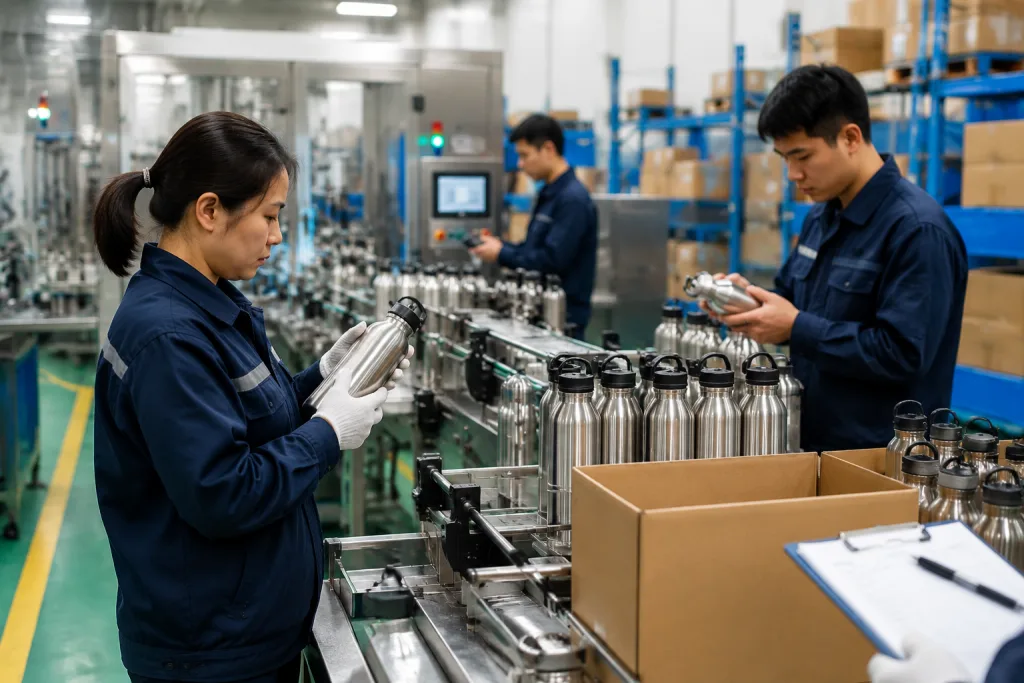
A 304 stainless steel sport bottle custom project needs a clean handoff at each stage: RFQ with capacity, wall thickness, lid style, carton spec, and test standard; engineering confirmation with 2D drawing; decoration sample checked under a 3M tape test; pre-production sample before the bulk PO; then AQL 2.5 inspection and shipping. Our Hangzhou, Zhejiang team runs 120,000 stainless bottles per month, with MOQ from 1,000 pieces per color for standard molds. Last month QC pulled a sample because the PO said “matte black” but the artwork file showed PMS 433C gloss. That is exactly the kind of small mismatch we fix before the line starts.
Start with an RFQ buyers can quote
Your RFQ is not a formality. It is the sheet that decides whether canteen manufacturers quote the same bottle or chase different guesses. For a 304 stainless steel sport bottle custom project, send specs tight enough that our engineer can check them with a digital caliper, not a phone call.
At minimum, include capacity, shape, finish, lid, logo method, packaging, test requirements, and target market. A 750 ml single-wall sports bottle is not the same cost as a 600 ml vacuum insulated bottle; the tube weight, forming time, and scrap rate change. A powder-coated body needs rack spacing and coating protection that a brushed body does not. A straw lid has more leakage risk than a screw cap; QC pulled 32 pcs from one trial run last year because the silicone valve sat 0.3 mm off-center. If you are comparing a canteen factory in Zhejiang with another canteen supplier elsewhere in China, your RFQ must force the same bill of materials. Otherwise the math doesn't work.
A clean RFQ line could read: 750 ml single-wall 304 stainless steel sport bottle, 0.55 mm body thickness, 304 inner and outer wall where applicable, matte powder coating, PP screw lid with silicone seal, one-color silkscreen logo, individual white box, export carton, FOB Ningbo, 3,000 pcs, EU market, LFGB and REACH required. This is quotable. Our costing team can put it into the BOM, check the 0.55 mm coil price, and confirm whether the logo fits the curved body before sample cutting.
For a distributor canteen program, tell the factory whether the item is for retail, corporate gift, event merchandise, school use, or outdoor chain distribution. Those are not small words on a brief. A canteen promotional order may accept a lighter carton and simpler logo; we ship those in standard 5-layer export cartons with fewer insert cards. A retail-customizable drinkware program usually needs barcode labels, shelf-ready packaging, and tighter color control, often within Delta E 1.5 after the buyer flags the first powder-coating sample.
- PO-ready RFQ fields: item number, capacity, material grade, thickness, finish, lid, logo, packing, MOQ, target price, Incoterm, destination, compliance, sample deadline. Add any artwork file name too; we once received a PO with “logo final.ai” listed, but the file sent was “logo final final 2.pdf.”
- Do not write: “good quality, best price, fast delivery.” No serious canteen vendor can cost that accurately, and the line cannot reserve steel, lids, or carton printing from that kind of sentence.
Confirm material before decoration talk
Buyers often start with logo size and print position. Wrong first question. For stainless drinkware, we confirm material grade and body construction before any decoration drawing goes to the pad-printing desk. “304 stainless steel” should mean food-contact 18/8 stainless steel, usually around 18% chromium and 8% nickel. It resists rust better than 201 steel, and it is the standard grade we ship for EU and North American custom drinkware programs. QC checks the incoming coil certificate against the PO; one buyer once typed “403 stainless” on a reorder, and we stopped the line before sampling.
For sport bottles, choose single-wall or double-wall vacuum before you price the logo. Single-wall bottles are lighter and lower cost, so they fit gym promos, cycling giveaways, and outdoor events where weight matters. Double-wall vacuum bottles cost more, but they support cold retention claims, usually 12-24 hours depending on shape, lid, and test method. We run a 20°C room test with 4°C water when the buyer wants claim wording on the carton. If you are sourcing a custom growler or customizable growler for beer, carbonation, and larger capacity, do not treat it like a sport canteen custom order. The lid seal and pressure expectation are different, and we have seen that go sideways when a buyer only checked capacity.
Ask the canteen manufacturer to state thickness in writing. For most 500-750 ml stainless sport bottles, 0.45-0.60 mm body material is normal. Below 0.4 mm, denting risk rises, especially during FBA or retail distribution. The math does not work if the bottle saves USD 0.06 but arrives with side-wall dents. Lids should use food-grade PP or Tritan where applicable, with silicone seals. If the bottle has a carry handle, ask for pull test data; we usually test handle assemblies at 8-12 kg static load depending on design. QC pulled one sample last month where the handle pin shifted 1.5 mm after the drop test, so we changed the pin length before mass production.
Compliance should be named, not assumed. For Europe, ask for LFGB food contact and REACH for coatings or surface treatments. For the United States, ask for FDA food-contact documentation and CPSIA only if the item is clearly for children. A canteen customized for schools may need ASTM checks if marketed to kids. We attach the test scope to the PI, because “FDA approved” in an email is not enough for a retailer’s document review. The buyer flagged this twice in 2024, both times at carton artwork approval stage.
Good stainless steel sourcing is boring on purpose: material certificate, coating report, leak test, salt spray where relevant, and an agreed AQL plan before bulk production. No drama. Just paperwork and samples that match.
Price the real landed product
Unit price only means something when it covers the landed product your warehouse will receive and your sales team will sell. One canteen supplier quotes USD 2.35 and another quotes USD 2.80; the USD 2.35 price can miss logo setup, inner box, spare silicone seals, carton labels, or inspection support. We see this go sideways on repeat orders. For a 304 stainless steel sport bottle custom program, split the price into product body, decoration method, packaging set, compliance cost, and freight basis. On our line, QC pulled a 750ml sample last month where the bottle was correct, but the carton mark on the PO had one digit wrong.
For standard molds from our Zhejiang facility, a common MOQ is 1,000 pcs per color, with sample lead time around 7-10 days after artwork confirmation and bulk lead time 30-45 days after deposit and PP sample approval. That is the normal run. New mold projects need tooling cost, 25-35 days for mold development, and a higher MOQ, often 3,000-5,000 pcs depending on size and finish. The mold room checks mouth diameter with a digital caliper, usually to 0.1 mm, because a loose cap thread becomes a leak claim after sea freight, not during the quote stage.
Use FOB Ningbo or FOB Shanghai if you already control freight. Use EXW only if your team knows China inland trucking and export paperwork; otherwise the math doesn't work. For smaller trial orders, DDP air or rail is convenient, but it hides which cost belongs to freight, duty, or last-mile delivery. Distributor drinkware buyers usually get better control with FOB plus their own forwarder once order volume passes 5-8 CBM. We ship Ningbo most weeks, and a buyer once flagged a “cheap” EXW offer after local trucking added 1.8 CBM worth of surprise cost.
Your RFQ should ask each canteen vendor to return a costed option table. Ask for plain bottle, one-color silkscreen with film charge, laser engraving with logo size in mm, powder coating plus engraving with scratch-test standard, individual kraft box, and retail color box with insert card. This is the wrong question to ask: “What is your best price?” Ask which version fits the channel. Then you can decide whether the product is a promotional canteen, a retail custom canteen, or a premium customized drinkware item. In pre-production, we run the logo on one curved body first; 38 mm artwork often looks fine on PDF and crowded on a tapered bottle.
- Typical payment: 30% deposit, 70% balance before shipment after inspection.
- Typical inspection: AQL 2.5 for major defects, 4.0 for minor defects, zero tolerance for safety defects.
- Typical quote validity: 15-30 days, because stainless steel coil price and USD/RMB rate move during the week.
Build samples like purchase orders
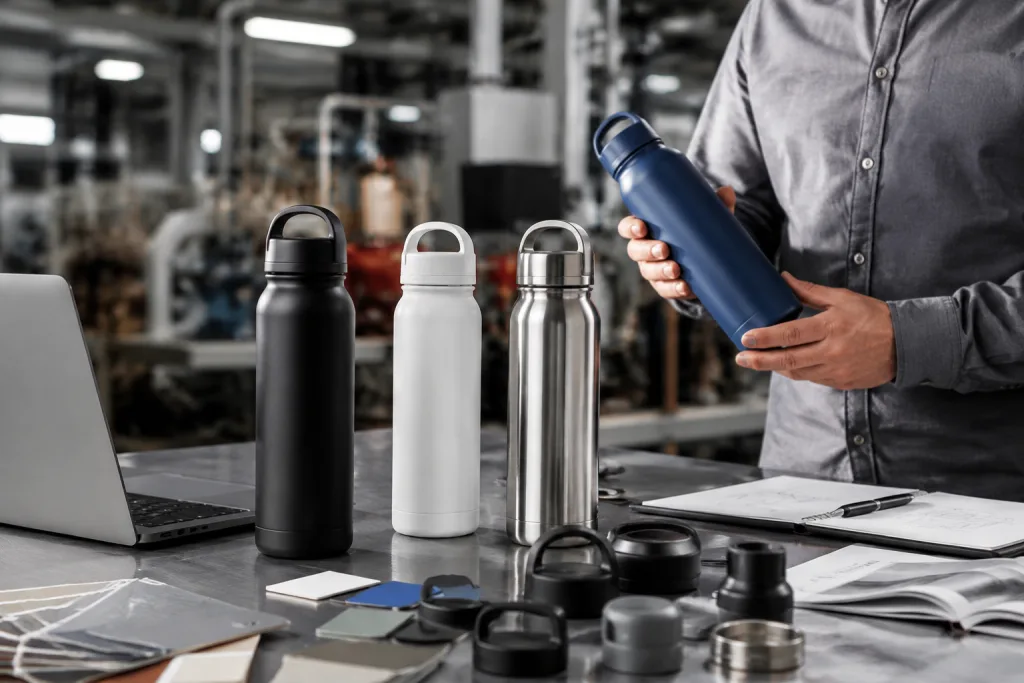
A sample request should not read like a casual email. Treat it as a small PO with one approval target. We normally run three sample stages, and each one should close one decision: a stock sample to confirm the bottle body and lid, a logo sample to confirm the decoration, and a pre-production sample to lock the same setup the line will use for bulk. Put the sample model code on the request; one buyer once sent “SB-750” while the PO showed “SB-705,” and QC pulled the wrong bottle before packing.
A stock sample checks shape, capacity, hand feel, lid function, and general finish. It may be the wrong color and have no branding. That is acceptable. Do not burn 10 days waiting for a perfect logo before you know the lid torque feels right. A logo sample checks decoration size, color, position, and durability. A pre-production sample, often called a PP sample, should match bulk production in material, finish, logo, lid, packaging, barcode, and carton marks. We check the PP sample with a caliper at the mouth thread and a 3M tape test on the logo; if the cap wobbles or the print lifts, the math does not work for 3,000 pcs.
For a canteen customizable range, prepare artwork files in AI, PDF, or EPS format. Specify Pantone numbers for printed logos and powder colors. For laser engraving, approve the engraving position and the exposed metal contrast, because 304 stainless under black powder coat can look grey rather than bright silver. Silkscreen works well for one- or two-color logos on smooth bottles, with the print jig set from the seam line. Laser engraving is durable and clean for corporate programs. Heat transfer can handle gradients, but we run abrasion testing first; we have seen soft gradient films fail after 20 rubs on the fixture.
Your sample PO line items should be specific: 3 pcs stock sample, 5 pcs logo sample, 2 pcs PP sample, courier account, requested finish, artwork revision limit, and approval deadline. About 6 out of 20 sample delays we see come from buyers approving a photo but not the physical sample. Photos hide problems. For canteen distributors selling into retail, approve the actual sample in hand before bulk coating begins, especially if the carton needs barcode scanning and a retail color sticker. Once the powder coating line starts, changing Pantone 186C to 187C is not a quick note; it means cleaning guns, rechecking panels, and losing a half day.
In China, a normal custom sample fee is USD 50-150 depending on decoration, plus courier cost. Refund policies vary. The better question is whether the factory records the approved sample with photos, measurements, and a signed sample tag. We attach the tag to the retained sample in the QC room, then match bulk against it under the light box before final inspection.
Lock the bulk PO details
The bulk PO is where we stop arguments before they start. For 304 stainless steel sport bottle custom production, the PO should read like a work order the line can follow, not a short buying memo. Put the SKU and factory item code first, then spell out color quantities, capacity, 304 stainless material, wall thickness, lid color, logo process with size, packing method, target carton size, carton weight limit, Incoterm, ship window, and inspection standard. QC pulled one sample last month because the PO said “blue” while the approved color chip was Pantone 296C. That one word cost 2 days.
Example: 3,000 pcs total, 1,000 pcs black, 1,000 pcs navy, 1,000 pcs white; 750 ml; 304 stainless steel body; 0.55 mm nominal thickness; matte powder coating; one-position laser engraving 45 x 32 mm; PP screw cap with silicone gasket; one spare gasket per 100 pcs; individual white box; 24 pcs per export carton; FOB Ningbo; AQL general inspection level II; major 2.5, minor 4.0; EU LFGB and REACH documents required. We also like to add target gross weight, for example “under 14.5 kg per carton,” because warehouse buyers flag heavy cartons fast. Simple detail. Fewer emails.
If you are a distributor growler or distributor canteen buyer handling several end customers, add each customer’s carton mark and SKU label as its own PO line. If you sell on marketplaces, specify FNSKU labels, suffocation warning where needed, carton barcode, and master carton dimensions before production. Do not ask the canteen factory to “follow standard packing” unless you accept their standard white box, their label position, and their carton layout. We have seen this go sideways: one PO missed a single digit in the FNSKU, and the buyer flagged 86 cartons after pre-shipment inspection.
Bulk production starts after deposit, confirmed artwork, approved PP sample, and packaging files are all in hand. If one of those four items is late, the lead time clock should not start; this is the wrong question to fight about after the ship window is already tight. In Zhejiang, we run stainless bottle production through forming, welding, polishing, coating, printing, assembly, and packing, with the coating line scheduled by color and rack space. Changing a powder color after coating begins is not a small change. It means stripping parts, counting scrap, rebooking the spray booth, and often a 7-14 day delay.
Inspect before the container closes
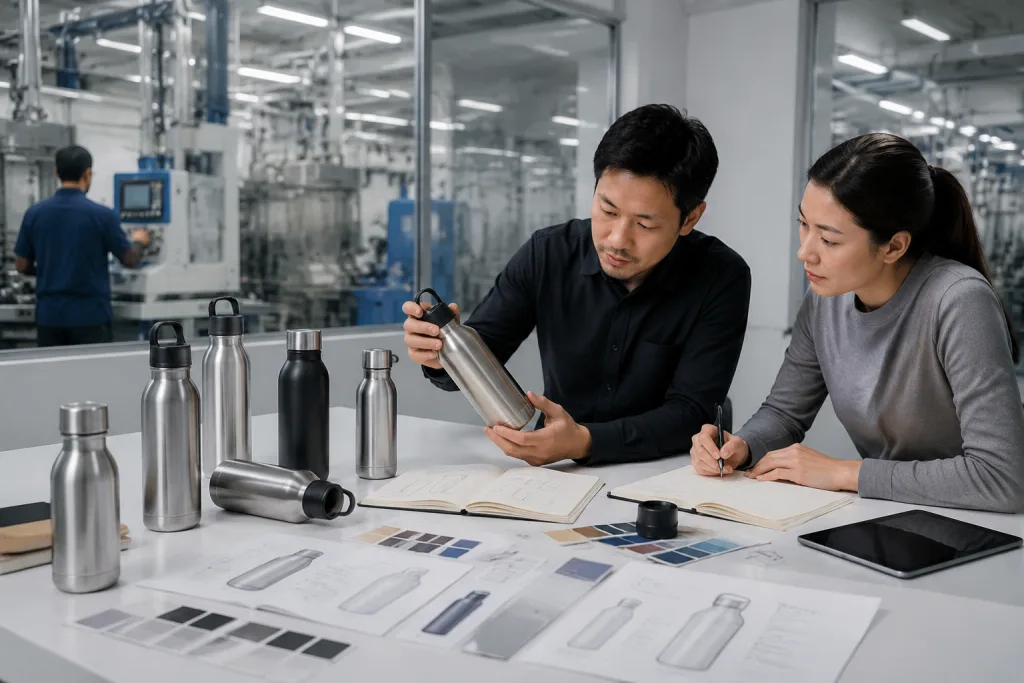
Inspection is not about distrusting your canteen manufacturers. It is about stopping normal line problems before they land in your warehouse. We see the same defects every season: leaking caps, scratched powder coating, logos off by 3-5 mm, dented bodies, dirty inner walls, loose handles, weak cartons, and two colors mixed on one pallet. QC pulled a sample last month where the bottle looked fine, but the silicone ring was twisted under the cap. It leaked in 40 seconds.
Use a third-party or buyer inspection when production is 100% finished and at least 80% packed. For repeat programs, some buyers also request a during-production inspection at 20-30% completion, especially when testing a new canteen vendor. The inspection checklist should match the PO and approved PP sample, including logo size, Pantone number, carton mark, and packing method. AQL general inspection level II is common, with critical defects not accepted. Leakage should be tested with water, inversion, shaking, and time; we usually run a 10-minute upside-down check on random samples. For vacuum bottles, add temperature retention checks, though full thermal testing takes about 18-24 hours, not the 2-3 hours of a normal final random inspection.
Do not rely only on photos. Photos help, but they will not tell you whether a lid thread feels rough or whether the carton board is too soft for a 20-foot container. This is where the math doesn't work: saving USD 180 on inspection can turn into 600 leaking bottles in a retail claim. For export cartons, ask for 5-ply corrugated material when bottle weight is high, with gross weight usually kept under 15-18 kg for manual handling. We check carton hardness by hand first, then confirm dimensions with a tape measure before the line stacks pallets. If the order ships to North America retail distribution, carton drop resistance matters. If it ships to Europe for promotional repacking, outer carton strength matters more than a perfect inner box.
A useful inspection report includes defect photos, measured capacity, weight, logo position, coating color comparison, barcode scan result, carton dimensions, and loading quantity estimate. Ask the inspector to record actual bottle capacity in ml, not just “pass,” because a 304 stainless sport bottle marked 750 ml should not measure 710 ml at the fill line. If defects exceed AQL, agree on sorting, rework, replacement, or discount before paying the 70% balance. Once the container leaves China, your options get slower and cost more. We have seen this go sideways over one PO typo: “matte black” on the artwork, “gloss black” on the order sheet.
Plan reorder data from day one
The first order should make the second order easier. Ask your canteen supplier to keep a production file with approved artwork, Pantone references, coating supplier, lid version, gasket size, carton layout, compliance documents, and inspection history. We run this file against the signed gold sample, the laser-etched mold code on the lid, and the carton drop-test photos before repeat production starts. For customized canteen programs using the same bottle body across 6 customer logos or two seasonal campaigns, this file saves arguments later.
Reorder risk usually comes from small changes nobody records. A lid mold gets updated, the white powder coating shifts from Pantone White C toward a warmer tone, the logo moves 3 mm to avoid the shoulder curve, or the carton packing changes from 24 pcs to 20 pcs. Small change. Big headache. None of this sounds dramatic until your customer puts old and new inventory on the same shelf. We have seen this go sideways after QC pulled the sample and the buyer flagged a 1.5 mm logo height difference. For distributor drinkware buyers, consistency is part of the product.
If you plan a canteen customizable program, build a controlled option list: 4 bottle colors with fixed powder codes, 2 lid styles with separate gasket drawings, 3 logo methods with tested print areas, and fixed logo zones marked in mm on the bottle body. Too many choices slow the line and raise the chance of mixed parts. The math does not work when a 1,000 pcs MOQ is split into 18 tiny variations. A structured program is easier for canteen vendors to produce and easier for your sales team to sell.
After shipment, record claim rates. If leakage complaints are 0.3% and coating complaints are 0.8%, you have data for improvement. If you only report “some customers unhappy,” the factory cannot solve much. Send photos, order number, lid type, and whether the issue showed up after dishwasher use or carton transit. At BottleForge Industrial in Hangzhou, Zhejiang, we prefer reorders with clear defect data because engineering can adjust gasket hardness from 55 Shore A to 60 Shore A, extend coating cure time by 4 minutes, or add 2 mm foam protection before the next batch.
For serious B2B sourcing, the goal is not one cheap shipment. The goal is a repeatable custom drinkware supply chain from China that your sales team can quote with confidence and your warehouse can ship without sorting mixed lids at 9 p.m.
Send your sport bottle RFQ for engineering review
Share capacity, logo, quantity, market, and target ship date. We will return practical MOQ, lead time, and production comments.
Frequently asked questions
What MOQ should I expect for a 304 stainless steel sport bottle custom order?
For an existing mold, expect MOQ around 1,000 pcs per color for most 500-1,000 ml stainless sport bottles. Some simple promotional canteen projects can start at 500 pcs if stock bodies are available, but color, lid, and logo options will be limited. For new molds or exclusive shapes, MOQ is usually 3,000-5,000 pcs, plus tooling. If you need three colors at 1,000 pcs each, treat that as a 3,000 pcs PO, not one 1,000 pcs order split freely across colors. MOQ is driven by coating setup, printing setup, material purchasing, and packing line efficiency.
How long does sampling and bulk production usually take?
A stock sample can usually ship in 3-5 working days if the bottle is available. A logo sample normally takes 7-10 days after artwork and sample fee are confirmed. A full PP sample with final packaging can take 10-15 days, especially for powder coating or color box printing. Bulk production for a standard 304 stainless steel sport bottle custom order is typically 30-45 days after deposit and PP sample approval. Add 7-14 days if you change color, lid, or packaging after approval. Ocean freight then adds about 25-40 days to Europe or North America depending on port.
Is laser engraving better than silkscreen printing for custom canteen branding?
Neither is always better. Laser engraving is very durable, clean, and good for corporate or outdoor bottles, especially on powder-coated stainless steel. It does not peel, but the color effect depends on the coating and base metal contrast. Silkscreen printing is better when you need a specific Pantone logo color and a lower decoration cost on larger quantities. For one-position, one-color logos, silkscreen is cost-efficient. For rough use, repeated washing, or premium distributor canteen programs, laser engraving is often worth the added cost. For gradients or full-color artwork, heat transfer or UV printing may be more suitable.
What tests should I request from a canteen manufacturer?
At minimum, request material confirmation for 304 stainless steel, food-contact testing for your market, leakage testing, coating adhesion testing, and basic dimensional checks. For Europe, ask for LFGB and REACH documents. For the U.S., ask for FDA food-contact documentation. For coated bottles, cross-hatch adhesion and rub testing are useful. For vacuum bottles, add heat or cold retention checks using a defined starting temperature and time, such as 95°C water tested after 6 hours. For final inspection, AQL level II with major 2.5 and minor 4.0 is common for B2B custom drinkware shipments.
What should be included on my bulk purchase order?
Your PO should include SKU, quantity by color, capacity, material grade, wall thickness, finish, lid type, logo method, logo size, artwork file reference, packaging, carton marks, barcode or FNSKU label requirements, Incoterm, delivery port, lead time, payment terms, inspection standard, and required compliance documents. Also include spare parts if needed, such as extra silicone gaskets or straws. A weak PO says “750 ml customized canteen with logo.” A strong PO states exactly how the factory should build, decorate, pack, inspect, and ship the product. That difference prevents most disputes.