Key Takeaways
- A 500 ml 304 stainless bottle usually lands at USD 2.10-4.80 FOB China depending on structure, finish, and lid
- Practical MOQ starts at 1,000 pcs per color for existing molds and 3,000-5,000 pcs for custom canteen shapes
- Normal lead time is 30-45 days after deposit and artwork approval, plus 7-10 days for samples
- Decoration method can add USD 0.08-0.65 per unit and 2-7 days to production
If you are sourcing from a 304 stainless steel reusable water bottle manufacturer for the first time, do not judge the order by unit price alone. We see this mistake often. A low quote can mean 0.38 mm body steel instead of 0.45 mm, weak vacuum after a 6-hour temperature test, powder coating that chips on the cross-cut tape test, or a production slot that moves by 20 days after deposit.
From our factory work in Zhejiang, China, clean launches usually start with cost drivers and lead time, not the lowest FOB number. That cheap number is the wrong question to ask first. You need to know what changes price, what changes MOQ, and where custom drinkware projects lose time; last month QC pulled 12 samples from the line because the buyer changed the logo size by 3 mm after the film was already made.
Start with the real bottle specification
Before you compare suppliers, lock the base specification. A 304 stainless steel reusable water bottle manufacturer cannot quote honestly from a photo and the words “high quality.” We see this on RFQs every week, and the math doesn't work. For a 500 ml insulated bottle, the standard body is double-wall 304 stainless steel inside and outside, usually 0.4-0.5 mm sheet before forming. Our caliper check on incoming coil is simple: if the sheet is off by 0.03 mm, QC pulls the sample before the line starts. Some cost-down versions use 201 stainless outside with 304 inside. That can pass for certain promotional orders, but write it clearly in your RFQ.
Capacity changes tooling and cost. No shortcut here. Common sizes like 350 ml, 500 ml, 750 ml, 1,000 ml, and 1,900 ml are easier because most canteen manufacturers in China already run these molds. A custom growler or customized growler with a special shoulder, handle, or wide-mouth lid may need new tooling. We had one buyer flag a 3 mm shoulder difference after sampling, and that small change meant a new stretch die. A simple new lid mold can cost USD 800-2,500. A new body mold can run USD 2,000-8,000 depending on shape and forming difficulty.
Ask every canteen supplier for the same data sheet: steel grade with inside and outside material listed, wall thickness in mm, insulation target in hours, lid material, gasket material, coating type, packing method, test standard, and FOB port. Ningbo and Shanghai are common ports for Zhejiang factories. Put the port on the PO too; we once received a PO with “FOB China,” which is not a shipping term we can book against. Without these details, you are not comparing a canteen factory against another canteen factory. You are comparing guesses.
FOB cost drivers buyers miss
For existing molds, a basic 500 ml 304 insulated bottle usually lands at USD 2.10-3.20 FOB China with single-color powder coating and a one-color logo at 3,000 pcs. We run this spec on a 68 mm body line often, and QC checks coating thickness with a film gauge before packing. A heavier retail bottle with upgraded lid, carry loop, silicone boot, gift box, and tighter appearance sorting can move to USD 3.80-4.80. Large custom growler sizes, 1.2 L to 1.9 L, often sit between USD 5.80 and USD 11.50, mostly driven by cap structure and surface finish.
The biggest cost drivers are easy to miss. Steel weight comes first. Adding 20 g of stainless steel can add USD 0.05-0.09 depending on the metal market; when nickel jumps, the math changes fast. Powder coating is usually cheaper than gradient spraying because the line needs fewer color changes and less hand masking. A standard screw lid may cost USD 0.25-0.45, while a leakproof push-button or straw lid can be USD 0.65-1.20. Retail packaging can add USD 0.18-0.75 per unit, especially for four-color gift boxes with inserts; we once had a buyer flag a 2 mm loose paper tray because the bottle rattled in the carton.
Decoration is another line item buyers try to squeeze. Laser engraving is clean and durable, often USD 0.12-0.30 per position. Silkscreen can be USD 0.08-0.18 for one color. Full-wrap heat transfer may add USD 0.35-0.65. If you are buying canteen promotional goods, pushing decoration cost too low is the wrong question to ask. QC pulled the sample after a 3M tape test last month: the logo lifted at the edge, and the buyer saved less than USD 0.04 per bottle. That goes sideways fast.
MOQ tiers and what they mean
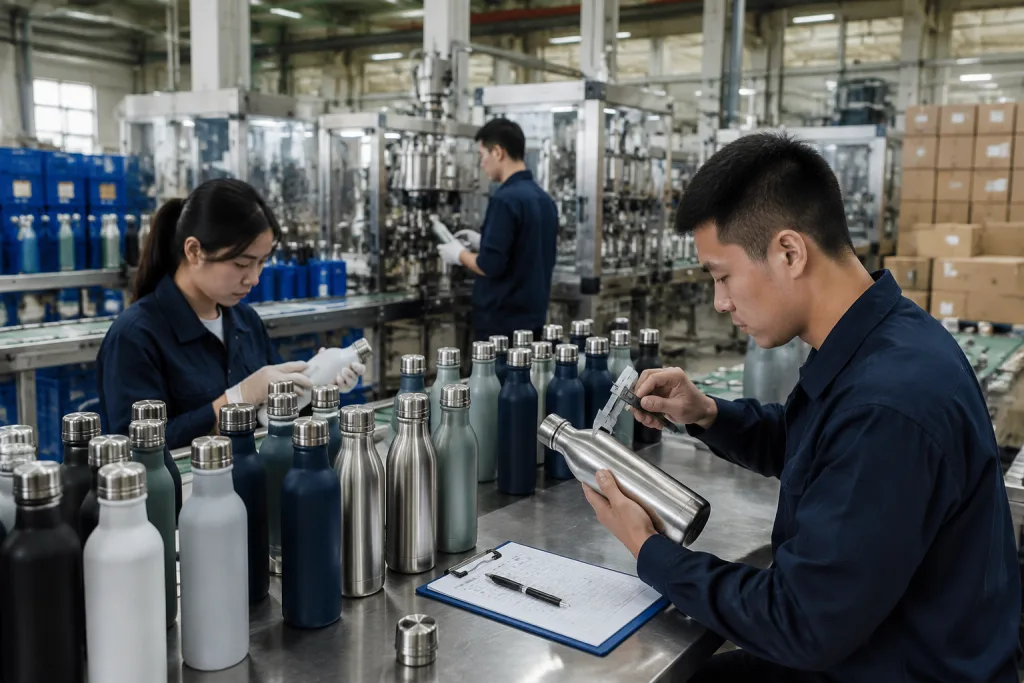
MOQ is not a punishment. It covers spray-gun setup, color-change scrap, logo jig time, and box line setup. On our Zhejiang line we run 280,000-350,000 stainless drinkware units per month; a 300 pcs stop means the powder booth gets cleaned, the conveyor slows, and QC still has to pull samples under the same AQL 2.5 routine. The math doesn't work. That is why serious canteen suppliers quote tiered MOQ instead of accepting any quantity.
For existing bottle molds, practical MOQ is usually 1,000 pcs per color for powder coating, 500 pcs for plain stainless steel, and 3,000 pcs if you need a non-standard Pantone color. For a canteen customizable program with three colors, expect 1,000 pcs per color, not 1,000 pcs total. We still see POs with “1,000 pcs assorted colors” typed in the remarks column, then the buyer gets surprised when the line rejects it. For a customized canteen with a new shape, MOQ often starts at 3,000-5,000 pcs because tooling trials, line balance, and defect tuning take time; one new lid thread can cost two rounds of 0.2 mm gauge checks before mass production is stable.
A canteen distributor or distributor drinkware buyer should think in carton quantities too. If one master carton holds 24 pcs and your FBA or retail allocation requires exact case packs, order quantities should align with that; 1,000 pcs leaves 16 loose units, and warehouse teams hate loose units. For small market tests, ask for 500-1,000 pcs using stock colors and laser logo. Simple and clean. For a real retail launch, 3,000-10,000 pcs gives better pricing and steadier production priority because we can book coating, assembly, and carton packing as one proper run.
Practical rule: if the order needs custom color, custom lid, and custom box, treat it as a production project, not a sample order.
Lead time from sample to shipment
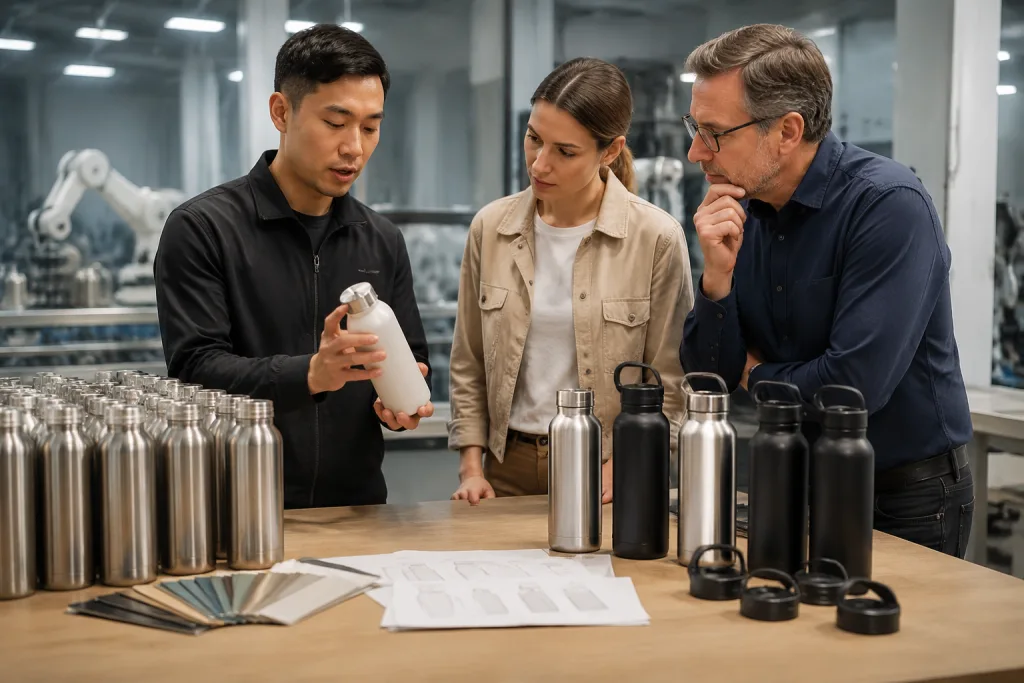
A realistic timeline protects both sides. For an existing 304 bottle mold, we run pre-production samples in 7-10 days after artwork confirmation, assuming the logo file is clean and the PO color code matches the spec sheet. Custom Pantone coating adds 3-5 days for spray-out panels or bottle samples; our painter checks the wet film with a 120μm gauge before QC signs off. For a new lid or new body, tooling and first trial take 20-35 days before the normal sample clock starts.
Mass production normally takes 30-45 days after deposit, sample approval, and packaging file approval. Peak season in China, March to June for summer programs and August to October before holiday shipping, pushes the line to 50-60 days. If a canteen vendor promises 15 days for 10,000 pcs with custom coating and gift box, this is the wrong question to ask: ask which step is being skipped. We have seen this go sideways when the buyer flagged a soft-touch coating scratch at AQL 2.5 after 6 cartons were already packed.
The timeline looks like this in our factory: 2-3 days for quotation and specification check, 3-5 days for artwork adjustment, 7-10 days for sample, 2-5 days for buyer approval, 30-45 days for production, and 3-5 days for final inspection and booking. Small delays start early. A missing “matte black” note on the PO or a 0.3 mm logo position change can stop the sample bench for a full day. Ocean freight to Europe or North America adds 25-40 days port to port. Air freight is faster, but on bulky drinkware the math doesn't work when freight costs more than the bottle.
For Amazon or retail distribution, build in time for barcode labels, FNSKU if required, drop tests, and carton markings. QC pulled the sample carton last month because the side mark showed 24 pcs while the packing list said 25 pcs. These details look small until a container waits at the warehouse gate because outer cartons are wrong.
Quality checks that affect price
Quality control costs money. Returns cost more. For stainless bottles, we run AQL inspection with critical defects at 0, major at 2.5, and minor at 4.0. Our QC table normally covers vacuum insulation performance, leakage, coating adhesion, ΔE color consistency, odor, lid fitting, welding, polishing, capacity, carton strength, and barcode scan. Last month QC pulled 32 samples from a 3,000 pcs lot and found 2 lids with rough threads; small issue, but the buyer flagged it before shipment.
Vacuum performance needs numbers on the inspection sheet. A 500 ml insulated bottle, for example, can be filled with 95°C water and checked after 6 hours at 23°C room temperature. Depending on the body shape and lid structure, we expect about 55-68°C after 6 hours. For cold retention, write the starting temperature, ambient temperature, and test duration on the PO. “Keeps hot 12 hours” is the wrong question to ask if nobody defines the test method. We use a calibrated probe thermometer, not a hand touch test.
Compliance changes both cost and factory choice. For Europe, ask for LFGB, REACH, and food-contact declarations. For the U.S., FDA food-contact requirements and California Proposition 65 may apply depending on the plastic parts, coating, and sales channel. Kids bottles need tighter review under ASTM or CPSIA-related requirements, especially for straws, spouts, and painted logos. A BSCI or ISO 9001 audited canteen manufacturer may quote USD 0.08-0.20 more per piece than a small workshop, but the test reports, material declarations, and batch records are cleaner. We have seen this go sideways when a supplier could not match the silicone ring material to the report.
If you work with 2 or 3 canteen vendors, use the same inspection checklist. Otherwise, one factory may include carton drop testing from 76 cm and another may skip it completely. The cheaper quote may exclude the work you thought was standard. On our line, we add barcode scan, gross weight check, and 5-layer export carton review before final packing; if those items are missing from the checklist, the math does not work.
Choosing the right supplier model
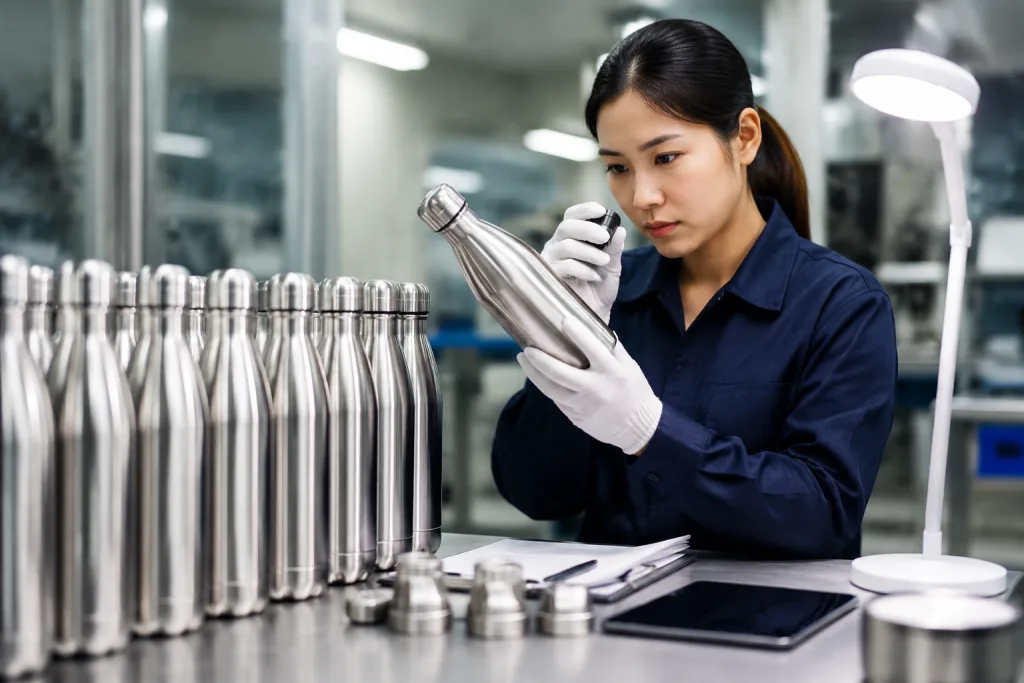
Not every buyer should use the same supplier. A brand owner launching customized drinkware with gift-box packaging should talk to a canteen factory or export manufacturer that controls forming, welding, polishing, coating, and assembly under one roof. We run this line with seam-weld checks, 100% air-leak testing, and coating thickness readings in μm before packing. You get engineering feedback before the mistake reaches the carton. A distributor canteen buyer placing 300-800 pcs per design is better served by a canteen vendor with stock bodies and stock colors.
Factory-direct makes sense when annual volume is above 20,000 pcs, when you need cost transparency, or when you are building a long-term line with repeat lids and packaging. Trading companies and sourcing agents work for mixed products across 4-6 categories, but cap changes and logo placement changes move slower because the message passes through extra hands. We have seen this go sideways when a buyer approved a 72 mm lid drawing, then the PO came back with 73 mm typed by mistake. For distributor growler and distributor drinkware programs, the clean setup is factory-direct for core SKUs and stock-based sourcing for small seasonal runs.
Ask potential canteen manufacturers for production photos, recent inspection reports, audit documents, and a written defect handling policy. A useful policy says what happens if leakage exceeds agreed AQL, who pays for rework, and how replacement units ship. QC pulled the sample; now who pays for the second inspection? That is the wrong question to ask after mass production. Ask for a quotation that separates bottle, lid, decoration, packaging, testing, and inland freight, so you can see why a custom canteen costs USD 3.60 instead of USD 3.10.
BottleForge in Zhejiang runs OEM and ODM drinkware projects with typical MOQ from 1,000 pcs per color and standard lead time of 30-45 days after approval. That is not the fastest promise in China. It is a schedule we can plan around, with tooling checks, pre-production samples, and carton drop-test results before we ship.
Send your bottle spec for a factory quote
Share capacity, quantity, color, logo method, and target market. We will return a practical FOB cost and lead-time range.
Frequently asked questions
What is the normal MOQ for a custom stainless steel canteen?
For an existing mold, normal MOQ is 1,000 pcs per color for powder-coated bottles and about 500 pcs for plain stainless steel if the production schedule is open. If you need a special Pantone color, custom lid, or retail gift box, plan on 3,000 pcs. For a canteen customized with a new body shape, MOQ usually starts at 3,000-5,000 pcs because tooling trials and defect tuning create real setup cost. Some canteen vendors offer 300 pcs, but they usually use stock bottles and limited decoration only.
How much does a 304 stainless steel reusable bottle cost FOB China?
A standard 500 ml double-wall 304 stainless bottle usually costs USD 2.10-3.20 FOB China at 3,000 pcs with one-color logo and normal powder coating. A more retail-ready item with upgraded lid, silicone boot, gift box, and tighter appearance inspection may cost USD 3.80-4.80. Larger customized growler sizes can run USD 5.80-11.50. The price depends on steel weight, lid structure, decoration method, packaging, testing requirements, and order quantity. Always ask suppliers to separate these costs instead of giving one unexplained number.
Can I use 201 stainless steel outside and 304 inside?
Yes, some promotional projects use 201 stainless steel on the outer wall and 304 stainless steel on the food-contact inner wall to reduce cost by roughly USD 0.08-0.20 per unit, depending on size and market steel price. For premium reusable bottles, we usually recommend 304 inside and outside because corrosion resistance is better, especially around scratches, bottom edges, and humid storage. If you choose 201 outside, state it clearly on the purchase order and confirm whether your market claims allow that structure.
How long should I allow for samples and production?
For existing molds, allow 7-10 days for samples after artwork approval, then 30-45 days for mass production after deposit and sample sign-off. Custom Pantone coating can add 3-5 days. New tooling can add 20-35 days before sample approval. During peak season in China, production can move to 50-60 days, especially for 10,000 pcs or more with custom packaging. If you are shipping by sea to North America or Europe, add roughly 25-40 days port to port.
Which logo method is best for reusable drinkware?
For long-term reusable bottles, laser engraving is the most durable and usually costs USD 0.12-0.30 per logo position. Silkscreen is economical at about USD 0.08-0.18 for one color and works well for simple promotional orders. Heat transfer or full-wrap printing gives stronger retail shelf impact but may add USD 0.35-0.65 per unit and needs stricter adhesion testing. For textured powder coating, always test the logo before mass production because ink behavior changes with surface roughness and curing temperature.