Key Takeaways
- Specify inner and outer SUS304, not just “stainless steel”, with 0.45-0.60 mm wall thickness for most bottles
- Use AQL Level II with critical defects at 0, major 2.5, minor 4.0 for bulk drinkware inspection
- Leak testing should cover 100% of units, including 30 seconds inverted after vacuum and lid assembly
- Carton specs matter: 5-ply export carton, 12-18 kg gross weight, and 60-70 cm drop test are practical baselines
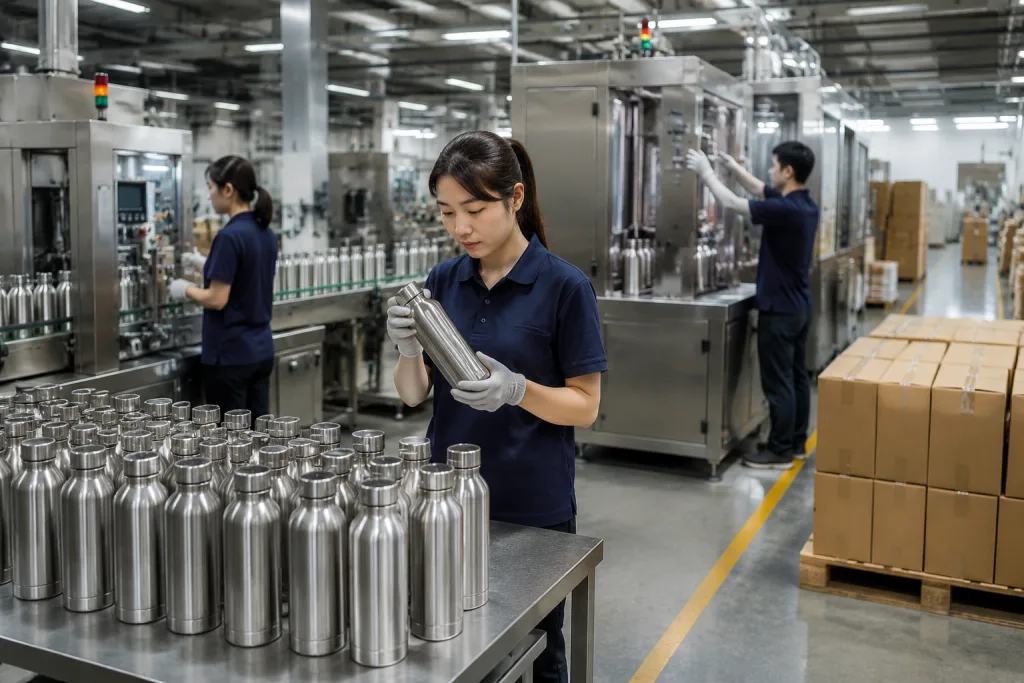
Buying 304 stainless steel reusable water bottle bulk usually goes wrong in small, boring places: a lid gasket compressed 0.3 mm too far, powder coating pre-treatment skipped for 6 minutes, or a 5-layer export carton that fails a 70 cm drop test. The gold sample looks fine. The problem shows up when 8,000 units land at your 3PL and QC pulls 32 pieces with chipped coating near the base.
BottleForge Industrial is in Hangzhou, Zhejiang. We run stainless drinkware for export buyers who need specs their warehouse team can check with a caliper, not loose promises. Our standard MOQ is 1,000 pcs per color for most bottles, trial orders start from 500 pcs on selected stock bodies, and normal custom production is 25-35 days after artwork approval in China. We’ve seen this go sideways when a PO says “matte black” but the approved sample was PMS Black 6C, so we lock color, logo position, carton mark, and lid structure before the line starts.
Material shortcuts that become rust claims
The first rust claim in 304 stainless steel reusable water bottle bulk usually starts quietly. We see a quote that says “food grade stainless” and does not name the grade. For drinkware wholesale, write SUS304 or 18/8 stainless steel for the inner wall; if the retail program needs a cleaner claim, put SUS304 on the outer wall too. A quote marked “304 inner, 201 outer” can work for a low-cost promotion, but price it with your eyes open: 201 carries higher manganese and lower nickel, so humid warehouses and coastal sell-through are tougher on it. QC pulled one sample last season with the XRF gun and the outer shell read as 201 after the buyer’s PO said “full 304.” That claim was expensive.
For reusable water bottles, we run 0.45-0.60 mm sheet thickness before forming as the normal safe range. Thin bodies look fine on a sales desk. They fail in cartons. On the line, our inspector checks wall feel after forming with a digital caliper at the mouth and shoulder, then we run a 4-hour vibration table check before packing approval. For bulk canteen and wholesale canteen programs in outdoor or workwear channels, ask for a heavier gauge and confirm finished weight tolerance, for example ±5% per unit. Do not approve a bottle only by volume and photos; the math does not work when a 500 ml sample is 18 g lighter than the signed sample.
Your spec sheet should state the inner wall as SUS304 and the outer wall as SUS304 or a declared alternative with the grade printed in the quotation. For the lid, name PP or Tritan. For the seal, write silicone ring LFGB or FDA grade, with no BPA. For Europe, add LFGB and REACH expectations. For North America, FDA food contact compliance applies, and kids’ items may need CPSIA or ASTM checks. A factory in Zhejiang, China can source these materials, but the requirement must be written before pricing is locked. We have seen this go sideways because a buyer typed “304 inside bottle” on the PO and forgot the lid gasket; QC found a non-LFGB ring during incoming inspection at 3,000 pcs.
Cheap stainless is not always fraud. The failure is when the grade is not declared, tested, and priced honestly.
Vacuum loss hides until winter
Vacuum failure hurts because it often slips past a 10-minute incoming check. The bottle can look clean, pass a shake test, and still lose insulation after the seal relaxes in cold weather. For 304 stainless steel reusable water bottle bulk, write the claim as a test condition, not a sales line: hot water at 95°C, room at 20°C, after 6 hours temperature remains above 60°C for a 500 ml bottle. QC pulled a 500 ml sample last January that held 63°C in Hangzhou but dropped to 54°C after the buyer stored cartons in a 5°C warehouse. That is the point. Larger bulk growler and beer growler bulk items need their own benchmarks because volume, cap thread depth, and mouth diameter change the result.
The usual production faults are base weld leakage and dirty inner shells before vacuum sealing; powder coating heat can also punish a weak joint if the oven runs 190°C for 18 minutes instead of the set 170°C. We run automated vacuum testing on insulated models, then pull random units for hot-water retention checks with a calibrated probe, not a hand-touch guess. For export orders, require test records by batch and carton range. Not a promise. If you are buying growler wholesale or beer growler wholesale bulk for craft beverage channels, do not skip this. A 1.9 L or 64 oz growler with a weak vacuum becomes a heavy single-wall jug, and the buyer will flag it after the first cold-chain delivery.
Design can cause the same complaint. Wide-mouth bottles clean faster, but the neck area is harder to insulate; slim vacuum bottles hold heat better, but a 45 mm ice cube or standard bottle brush may not fit. We have seen this go sideways when a PO says “best insulation” and the artwork file shows a 58 mm mouth for fruit tea. The best wholesale drink bottle is matched to the use case, not the boldest temperature claim on a catalog page.
Lids leak for mechanical reasons
About 70% of leak complaints we see start at the lid, not the bottle body. In drinkware bulk orders, a 0.2-0.5 mm mismatch between thread depth, silicone gasket hardness, and lid torque can create a slow leak; our QC tech checks this with a thread plug gauge and a 0.01 mm caliper before the line packs cartons. We do not approve a cap from one sample and a bottle body from another sample unless the full assembly is tested together. We have seen this go sideways.
Your specification should call out the lid type with the exact drawing number, gasket material and gasket color, straw material if used, and whether spare gaskets are packed in the polybag or master carton. Silicone hardness around 50-60 Shore A is common for water bottle seals; we run a Shore A durometer check on incoming gasket lots, usually 8 pieces per batch. Softer rings seal well on day one but can deform after heat exposure. Harder rings survive more abuse but need cleaner threads. For sports bottle and canteen wholesale programs, ask for 100% leak testing after final assembly: fill, close, invert for 30 seconds, and check under the lid and mouth area.
For alcohol flask bulk, alcohol flask in bulk, and alcohol flask wholesale bulk, the leak standard needs to be tighter because the liquid is thinner, smells stronger, and often rides in pockets or bags. Hinged caps and captive caps look convenient, but the pin and seal need a separate check after repeated opening; on one 5,000 pcs flask order, QC pulled the sample after the hinge pin walked out by 1.5 mm. A practical test is 300 open-close cycles on pre-production samples, followed by an inverted leak check.
One more detail: tell the factory if your buyer expects dishwasher safety. About 6 out of 10 painted lids, bamboo details, or printed coatings we see are not dishwasher-safe unless the coating system was selected for it. If that line is missing from the PO, the math does not work: the bottle passes leak testing, then the lid finish fails in a home dishwasher and the buyer flags it as a warranty claim.
Coating failures start before spraying
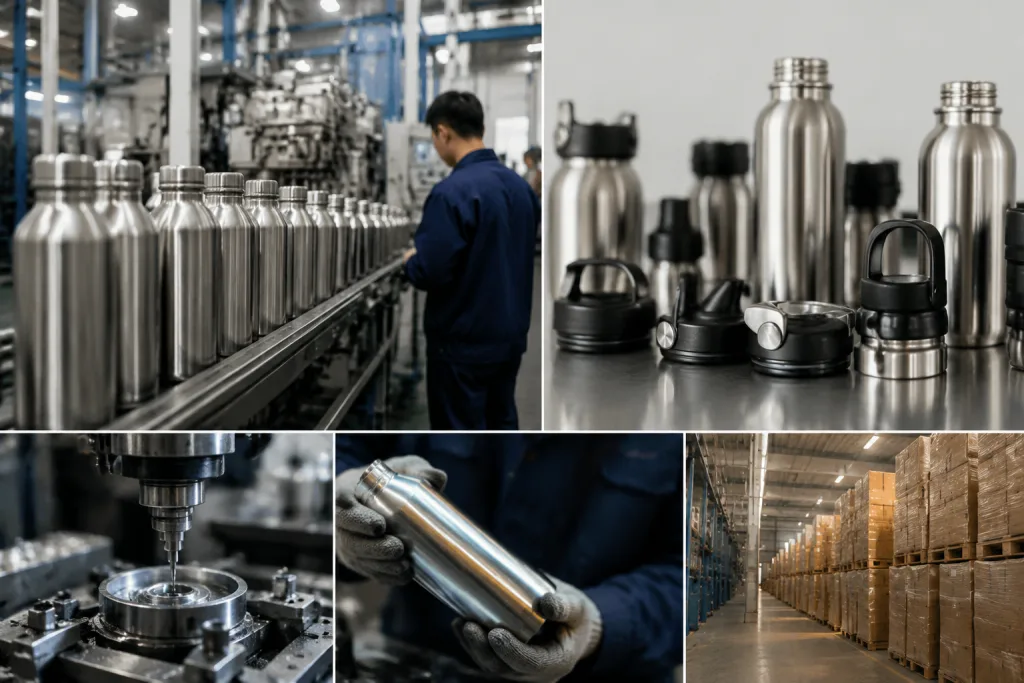
Powder coating, spray painting, and printing problems usually start before the spray gun is switched on. Forming oil, polishing wax, or fingerprints can sit on 304 stainless if the wash process is weak; the finish looks clean in the sample room, then chips after 2-3 weeks of carton rubbing and retail handling. Ask how the factory runs degreasing, whether phosphating or an equivalent pre-treatment is used, what curing temperature is recorded on the oven chart, and how film thickness is checked with a coating gauge. A common powder coating thickness is 60-90 microns, but the exact range depends on the finish. QC pulled one matte sample last month at 47 microns near the shoulder. It failed tape pull. The math doesn't work if the coating line is rushed.
If you are ordering matte black drinkware bulk, be careful. Matte black sells well, but it shows key scratches and oily fingerprints faster than semi-gloss; buyers have flagged this after only one trade-show display day. If the bottle is for gym, outdoor, or hardware channels, ask for a cross-hatch adhesion test with a 1 mm cutter, an alcohol rub test with the rub count stated, and a 3M tape pull test on pre-production samples. For silkscreen logos, confirm ink type and curing time, not just the Pantone number. For laser engraving, confirm whether the mark exposes stainless steel or creates a dark oxidation mark, because different coatings react differently under the laser head.
Beer tumbler bulk and beer tumbler wholesale orders often use large logo areas, sometimes 80-120 mm wide on a curved wall. Big prints move. Around a taper, the left edge can sit 2 mm higher than the right if the artwork is treated like a flat label. Do not send only a flat PDF and assume it will wrap perfectly. Ask for a digital mockup and a physical pre-production sample if the logo crosses a taper or seam. On our rotary screen jig, QC checks the first 5 pieces before the line keeps running; we have seen this go sideways when a PO file name says “final” but the logo version is still the old one.
Our Hangzhou, Zhejiang facility can produce about 450,000 stainless drinkware units per month across bottles, tumblers, canteens, and growlers. At that volume, coating control is not luck. We run a stable line, wipe fixtures when powder buildup reaches the hook area, and inspect batches before packing instead of arguing after shipment. Clean racks matter. So does batch inspection.
Wrong packaging destroys good bottles
A bottle can pass vacuum test, leak test, and visual QC, then arrive dented because packing was treated like the last line on the PO. For 304 stainless steel reusable water bottle bulk, we spec packaging by sales channel, not by habit. Club-store pallets need tray stability and clean shelf-facing cartons; Amazon FBA needs scannable labels and drop survival; distributor transfers need cartons that can take forklift vibration for 800-1,200 km; promotional events often need lower cost with faster unpacking on site. QC pulled the sample last month after the buyer flagged corner dents on matte black bottles. The bottles were fine. The carton was the problem.
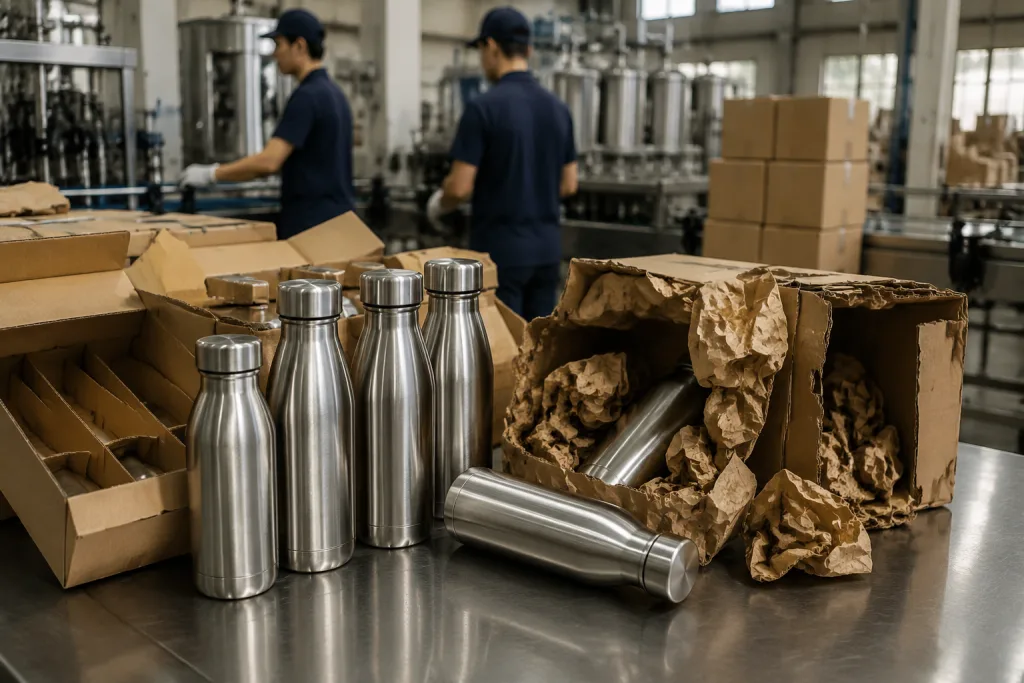
For standard export cartons, we run 5-ply corrugated board, dividers for powder coating or mirror finish, and a gross carton weight of 12-18 kg. Above 20 kg, the math doesn't work for manual handling; warehouse staff drag cartons, tape opens, and corners crush. Drop testing from 60-70 cm on one corner, three edges, and six faces is our baseline before mass packing. If you use individual color boxes, specify paperboard gauge, insert material, and the exact inner packing: polybag with 0.03 mm thickness, tissue wrap for scratch control, or molded pulp tray for retail presentation. Small details matter. A 2 mm loose insert can leave a ring mark after sea freight.
For wholesale growler, beer growler in bulk, and beer tumbler in bulk orders, carton compression risk goes up because each unit takes more space and adds more weight per cubic meter. Pallet height should be set in cm, not guessed from a warehouse photo. We usually ask for max pallet height, stack limit, and whether the line should add corner protectors or stretch film at 18-20 microns. If goods move through a North American 3PL, add barcode placement, FNSKU if needed, suffocation warnings on polybags, and master carton labels showing SKU, quantity, gross weight, net weight, and country of origin. We have seen this go sideways from one PO typo: “24 pcs/ctn” entered as “42 pcs/ctn,” and the carton design failed before the shipment left Ningbo.
China export packing is strong when the buyer gives real requirements. It gets weak when the instruction is “standard packing” but the expectation is e-commerce-grade survival after courier drops, conveyor belts, and warehouse re-labeling. Standard packing is not a specification; it is where damage claims start. Send the channel, carton weight limit, label template, and any drop-test requirement before the pre-production sample, and we can build the packing into the cost instead of patching it after mass production.
QC plans fail when nobody owns them
The last failure mode is ownership. We see it in roughly 6 out of 10 first-time projects: the buyer writes “good quality” on the PO, then nobody pins down who signs off each checkpoint. For 304 stainless steel reusable water bottle bulk, assign owners for material, vacuum, leakage, appearance, packing, and labeling before the line starts. We run a simple three-gate plan: incoming material inspection with a PMI gun or material certificate check, in-process inspection after forming and coating, and final random inspection before shipment.
For final inspection, AQL Level II is common. Set critical defects at 0, major defects at 2.5, and minor defects at 4.0 unless your retailer has a stricter manual. Critical defects include unsafe sharp edges, contaminated interiors, wrong material, broken glass components if used, or severe leakage. Major defects include visible dents, coating peel, wrong logo position, failed barcode, and insulation below the agreed standard. Minor defects include small cosmetic marks inside an agreed viewing distance, often 30-45 cm under normal light. QC pulled the sample last month for a 1.5 mm logo shift; the buyer flagged it because their shelf display used a front-facing barcode strip.
For canteen bulk, wholesale canteen, growler bulk, alcohol flask wholesale, and beer tumbler wholesale bulk, ask for a control sample sealed by both sides. Do not inspect from memory. The inspector should compare against that sealed sample, not a phone photo with bad workshop lighting. Confirm Incoterms at the same time. FOB Ningbo or FOB Shanghai is common from Zhejiang, China; EXW looks cheaper on the quotation, but the math often fails once local trucking, export handling, and customs coordination move to your side. We have seen a USD 0.18 “saving” disappear after one 28 kg carton pickup charge.
If you are new to bulk drinkware, start with one body, one lid system, and two colors before building a full range. This is the wrong stage to chase 12 SKUs. Complexity multiplies defects: one extra powder color means another spray gun setup, another curing check, another chance for shade drift. A focused first order gives you real market data and a cleaner factory learning curve.
Send your bottle spec for a factory review
We will check material, MOQ, logo method, packaging, and realistic China lead time before you commit to a bulk order.
Frequently asked questions
What MOQ should I expect for 304 stainless steel reusable water bottle bulk?
For a custom color and logo, a realistic MOQ is usually 1,000 pcs per color per model. Some stock shapes can start at 500 pcs if you accept existing bottle bodies and standard lid options. Custom molds, special caps, or uncommon powder colors may require 3,000-5,000 pcs because material setup and line cleaning costs increase. If a supplier offers 100 pcs fully custom at a very low price, check whether it is trading stock, hand-applied printing, or a non-industrial process. For procurement planning, ask for price breaks at 1,000, 3,000, 5,000, and 10,000 pcs.
How do I confirm the bottle is really 304 stainless steel?
Put the grade in the purchase order and ask for a material declaration plus third-party testing when the order value justifies it. A simple magnet test is not enough; some stainless steels show weak magnetism after forming, and it does not prove food-contact compliance. For larger orders, request XRF or chemical composition testing on random inner-wall samples. The report should identify chromium and nickel levels consistent with 304 stainless steel. You can also require FDA, LFGB, or REACH-related food contact documentation, depending on your market. Keep one approved pre-production sample and compare weight, finish, and construction during final inspection.
What is a normal lead time for wholesale drinkware from China?
For stainless steel bottles with existing tooling, normal production is 25-35 days after deposit, artwork approval, and pre-production sample confirmation. Add 7-10 days if you need a physical sample with custom coating and logo before mass production. Peak season before summer promotions and Q4 retail can push lead times to 40-50 days, especially for powder coating and gift box packing. Sea freight to Europe or North America can add roughly 25-45 days depending on port and service. If you need goods for a fixed retail launch, work backward from the delivery date and include inspection and buffer time.
Should I choose FOB, EXW, or DDP for drinkware wholesale orders?
FOB is usually the cleanest term for experienced importers. From Zhejiang, FOB Ningbo or FOB Shanghai lets the factory handle local export procedures while your forwarder controls ocean freight, insurance, and destination charges. EXW can look 2-5% cheaper on paper, but you then manage pickup, export customs, and local China charges. DDP is convenient for small importers, but you must verify duties, taxes, and importer-of-record responsibility. For bulk drinkware orders above 1,000 pcs, FOB gives better cost visibility. Ask for carton dimensions and gross weight early so your forwarder can quote accurately.
Can one supplier make bottles, canteens, growlers, tumblers, and flasks?
Yes, if the supplier has stable stainless forming, welding, polishing, coating, and assembly lines. The risk is assuming all categories share the same QC logic. A 500 ml reusable bottle, a bulk growler, a wholesale canteen, a beer tumbler bulk program, and alcohol flask wholesale order each fail differently. Growlers need stronger handles and vacuum checks. Flasks need tighter leak control. Tumblers need rim comfort and lid fit. Canteens need dent resistance and strap or cap durability. You can source them under one program, but approve separate samples, test methods, packing specs, and AQL defect lists for each product family.