Key Takeaways
- A practical MOQ for custom 304 stainless bottles is usually 1,000-3,000 units per shape and color
- Single-wall, double-wall vacuum, growler, tumbler, canteen, and flask formats solve different buyer problems
- 304 stainless steel is the baseline for food contact; 316 is only worth paying for in specific high-corrosion uses
- Lead time from Zhejiang, China is typically 30-45 days after deposit and artwork approval
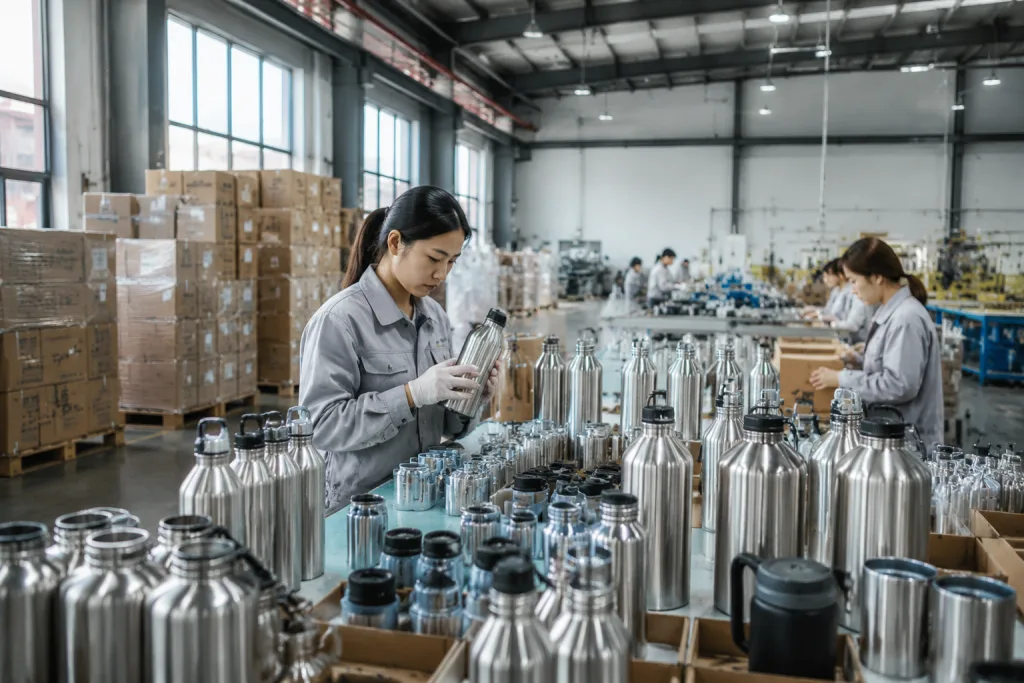
If you are buying 304 stainless steel refillable water bottle wholesale, finding 20 suppliers is the easy part. The harder call is choosing the right build before you print 5,000 logos on a bottle that feels thin, leaks after a drop test, or lands 18 cents over your retail target. We’ve had QC pull samples at the packing table because a 0.45 mm body dented under thumb pressure. Bad sign.
On our Zhejiang line, the same brief arrives under 4 names: bulk canteen for outdoor clubs, beer growler wholesale for breweries, drinkware wholesale for corporate programs, or alcohol flask bulk for gift sets. This is the wrong question to ask if the buyer only compares capacity and unit price. Wall thickness, lid thread depth, coating method, LFGB or FDA testing, and 5-layer export carton spec change the risk fast; last month one buyer flagged a PO typo that said “matte power coating” instead of “matte powder coating,” and that single word would have sent the sample room in the wrong direction.
The spec table buyers actually need
Wholesale drinkware quotes look the same until we line them up in a spreadsheet and check samples with a 0-25 mm micrometer. Price per unit is the wrong first question. Compare usable capacity, measured body thickness, vacuum insulation result, cap sealing design, logo process with placement tolerance, and the result after a 1.2 m carton drop from the rack.
This is the head-to-head view we run with procurement teams when the buyer asks for the “best” wholesale drink bottle but the PO still says only “stainless bottle, black, logo.” We have seen that go sideways. Last month QC pulled 6 samples from a 5000 pcs pilot order because the cap thread felt gritty after powder coating.
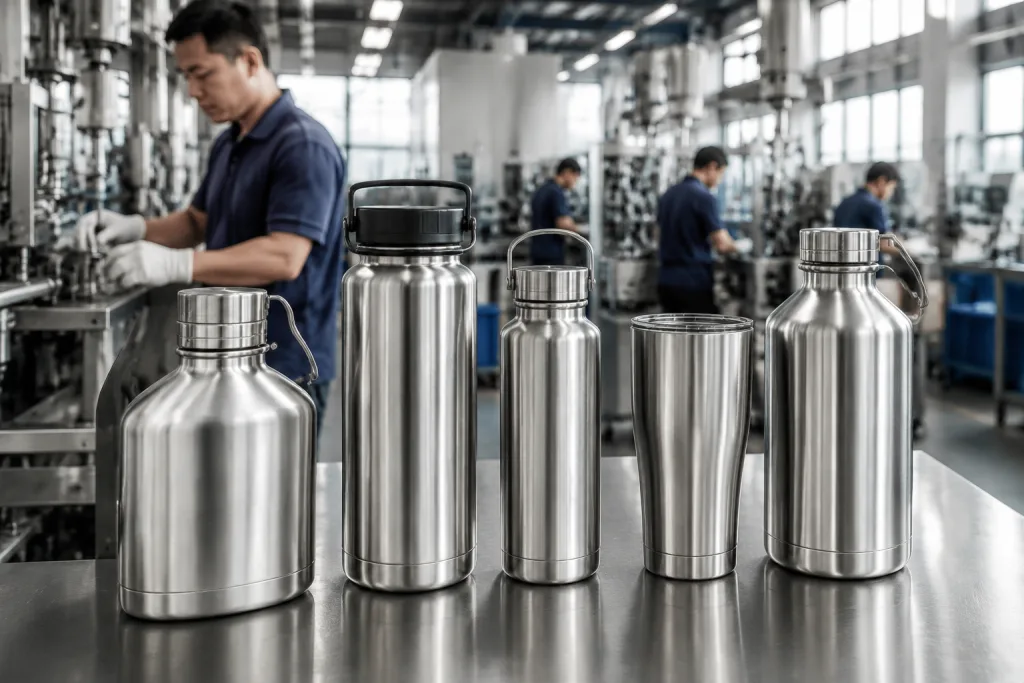
| Format | Typical size | Construction | Use-case fit | Common FOB range |
|---|---|---|---|---|
| Standard refillable bottle | 500-1000 ml | 304 inner, 201 or 304 outer, vacuum optional | Corporate gifts, retail, school programs | USD 2.60-6.20 |
| Canteen | 750-1200 ml | Single or double wall, carry loop | Outdoor kits, camping ranges, military-style assortments | USD 2.20-5.80 |
| Growler | 32-64 oz | Thicker body, pressure-aware cap design | Beer, kombucha, brewery merchandise | USD 5.50-12.80 |
| Tumbler | 12-30 oz | Double-wall vacuum, sip lid | Commuter retail, café counters, event resale | USD 3.20-8.50 |
| Hip flask | 4-8 oz | Single-wall 304, welded neck | Gift sets, promotional alcohol accessories | USD 1.40-3.20 |
For a first program, do not chase the lowest line item. A 0.40 mm body can look clean in supplier photos but dent during drinkware bulk shipping, especially when the master carton hits 18 kg. For mid-market Europe and North America, 0.45-0.55 mm stainless body thickness is a safer commercial range. If you need a rugged outdoor wholesale canteen, specify 0.55 mm or ask for a reinforced base, then have QC check the base wobble on a flat glass plate before shipment.
304 stainless versus cheaper alternatives
For food-contact refillable bottles, 304 stainless steel is the safe starting point: it draws cleanly, resists tea and coffee stains, passes common food-contact testing, and still keeps the BOM under control. In China, a serious factory buys coil or sheet with material certificates, then checks the heat number before deep drawing, welding, and polishing. On our Zhejiang line, QC uses an XRF alloy analyzer on incoming sheet lots, and we keep the report with the batch card; if the inner wall touches water, tea, coffee, beer, or acidic drinks, we run 304 stainless at BottleForge Industrial.
You will still see cheaper quotes using 201 stainless. 201 is acceptable for an exterior shell where it never contacts liquid, but it is the wrong question to ask if the bottle is for daily refilling; the inner tank needs 304. 201 has lower nickel content and weaker corrosion resistance. We had one EU buyer flag rust dots after 9 days of salt-spray comparison on a competitor sample, and the PO only said “stainless steel bottle.” If your buyer base includes hikers, gym users, or customers filling electrolyte drinks, write “304 inner wall” clearly on the purchase order, not just in the email thread.
316 stainless gives better resistance against chloride corrosion, but for everyday wholesale drinkware the math often does not work. It makes sense for marine gift programs, harsh cleaning cycles, or premium insulated food jars. For most 304 stainless steel refillable water bottle wholesale projects, spend the budget on stable vacuum retention, a lid gasket that holds after 3,000 open-close cycles, thicker powder coating, and AQL inspection. QC pulled a 500 ml sample last month with perfect steel but a 0.6 mm gasket mismatch; that bottle leaked, so the stainless grade did not save the order.
Practical wording: “Inner tank SUS304, food contact grade; outer shell SUS304 or SUS201 as approved; LFGB or FDA food-contact test available on production sample.”
If a supplier avoids naming the grade, treat the quote as unfinished. If they claim everything is 304 but the price sits 8–12% below the current market, ask for a magnet test, PMI spot check, and third-party report before deposit. We have seen this go sideways: one PO typo changed “SUS304 inner” to “SS inner,” and the buyer only caught it during pre-shipment inspection.
Canteen, growler, tumbler, or flask
About 6 out of 10 buyers start with “wholesale drinkware” on the RFQ, then the sample review proves the body shape is wrong. A bulk canteen is not a bottle with a larger cap. For a canteen bulk order, we check the flatter side profile against a 3 mm carton clearance, pull-test the carry loop, and add paper sleeves so the cap does not rub through the powder coat in transit. It sells well for outdoor retail and university camping clubs; military-style merch and emergency kits need a tougher loop spec, not just a darker green color. We have seen this go sideways when the PO says “canteen” but the buyer sends a round bottle photo.
A growler bulk project runs on different checkpoints. Beer growler wholesale buyers care about mouth diameter, cap sealing, internal finish, and safe handling for carbonated beverages during normal use. A 64 oz wholesale growler with a weak cap thread becomes a complaint machine. If you are buying beer growler in bulk for brewery merchandise, request 100% leak testing on the line and carton drop testing before shipment. For beer growler wholesale bulk, we normally recommend laser engraving or a powder-coated body with laser logo because brewery users wash the product often; QC pulled one sample last year where the screen print lifted after 12 dishwasher cycles.
Beer tumbler bulk programs follow another logic. A beer tumbler in bulk is usually a double-wall vacuum item with a press-fit or slider lid. It is used at events and taprooms; sports clubs and gift packs often need a cleaner retail box and a barcode sticker placed within 2 mm tolerance. For beer tumbler wholesale bulk, lid fit and drinking rim comfort matter more than chasing insulation claims. Simple truth. A tumbler that keeps liquid cold for 8 hours but has a loose lid is still a bad buy, and the math does not work when returns cost more than the cup.
Alcohol flask wholesale is more price-sensitive and driven by packaging. Alcohol flask in bulk often ships in gift boxes with funnels, so check set assembly labor and box crush strength; we run a 10 kg top-load check before approving the master carton. For alcohol flask wholesale bulk, the weld around the neck should be clean and the cap hinge should sit tight with no rattle. The internal polishing must be smooth enough to avoid metallic odor complaints. One buyer flagged a “304 stainless” typo on the PO after packing, so we now match the carton mark, gift box, and inspection sheet before sealing.
Where price differences really come from
When two factories quote the same 750 ml bottle and the gap is USD 0.80, don’t assume one is being kind. The money usually hides in wall thickness, lid resin, coating yield, vacuum reject rate, packaging, or inspection level. We have seen this go sideways: one buyer approved a 0.42 mm inner wall sample, then received a mass-production offer based on 0.36 mm. QC pulled the sample with a micrometer, and the math changed fast.
For a typical double-wall 304 stainless refillable bottle, the cost stack looks like this: stainless body forming and welding, vacuum brazing, polishing, leak and insulation testing, lid molding, silicone gasket, powder coating or painting, logo decoration, inner polybag or paper wrap, carton, labor, factory overhead, and export handling. A color-matched powder coating may add USD 0.25-0.60 per unit versus a plain brushed body. Laser engraving is often USD 0.08-0.25 per position. Multi-color silk screen can cost less per unit once the order hits volume, but the line needs film setup, Pantone control, and tighter artwork checks. One missing 1 mm bleed on the AI file can stop printing for half a shift.
MOQ matters. For our Zhejiang production planning, a normal custom color MOQ is 1,000 units per SKU if using available bottle mold, and 3,000 units is more realistic when you need custom lid color, custom coating, retail box, and barcode labeling. Monthly stainless drinkware capacity is about 600,000 units across bottle, tumbler, canteen, and growler lines, but capacity does not erase setup waste. Small mixed-SKU orders cost more because every color change and logo setup creates downtime. We run the powder room by batch; switching from matte black to sand beige means gun cleaning, booth cleaning, and first-piece approval before mass coating starts.
Ask for FOB Ningbo or FOB Shanghai terms if you want a clean comparison from China suppliers. EXW often leaves out inland trucking, export documentation, and loading costs. DDP works for some Amazon sellers and small distributors, but it bundles freight, duty, and tax into one number that is hard to check. This is the wrong question to ask if you only compare the unit price. Last month a buyer flagged a PO typo, “FOB Hangzhou,” which sounds harmless, but the nearest port handling still had to be quoted separately.
Logo, coating, and retail finish
Your decoration choice has to fit the channel. For corporate drinkware wholesale, we run powder coating with one-position laser engraving on most repeat orders because it survives handling and keeps rejects low, usually under 1.5% in our final QC. Retail drinkware bulk is different. Full-color artwork, gradient coating, or wrap print can raise shelf value, but QC pulled the sample more than once for a 0.4 mm scratch near the shoulder, and the buyer flagged it fast because defects show under store lighting.
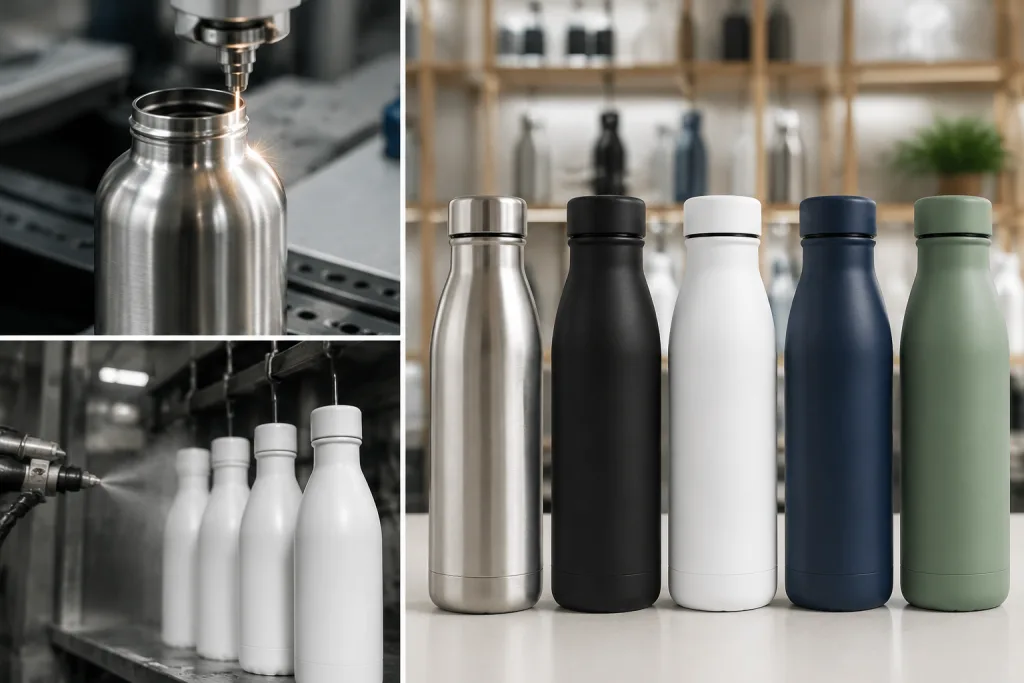
Silk screen works for simple one- or two-color logos. It suits straight bottle bodies and orders of 3,000 units or more, where the screen setup cost makes sense. Laser engraving is cleaner on 304 stainless steel because it cuts through the coating and shows the metal below. No peeling. That is why we ship it often for growler wholesale, canteen wholesale, and beer tumbler wholesale projects, especially with matte black powder coat. Heat-transfer print gives richer graphics, but the math does not work unless the bottle passes abrasion testing; on outdoor and gym SKUs, we usually run a 3M tape pull plus 500-cycle rub test before approving mass production.
For powder coating, define the finish before the line starts. “Black” is not a spec. Use Pantone or RAL references, then approve a sprayed sample under normal daylight, not only under the office LED lamp. Last month a PO said “dark navy,” but the artwork file called Pantone 2965C, and that 1-line mismatch held sampling for 2 days. If the product is for the EU, ask whether coating and food-contact parts can support REACH and LFGB testing. For the US, FDA food-contact compliance is the normal baseline, and children’s items may trigger CPSIA requirements.
Packaging is part of finish. A plain brown box is fine for distributor stock. Retail needs a 300-350 gsm white box or color box, barcode, country of origin, warning text where needed, and sometimes FNSKU labeling for marketplace fulfillment. We have seen this go sideways when a buyer approved the bottle but forgot the carton dieline; production finished in 12 days, then shipment waited another 14 days while the printer fixed the barcode size from 28 mm to 36 mm. Saving USD 0.20 on packaging can still cost two weeks at the warehouse door.
Inspection plan before shipment
Do not inspect only the logo. That is the wrong question to ask. For 304 stainless steel refillable water bottle wholesale, our pre-shipment checklist covers visible dents under the light box, mouth diameter in mm with a digital caliper, actual capacity by water fill, lid torque with a torque meter, leakage, vacuum performance, coating adhesion by 3M tape test, barcode scanning, carton compression, and packing quantity. For most B2B orders we use AQL 2.5 for major defects and AQL 4.0 for minor defects unless the buyer requires a different standard. QC pulled 80 samples from a 5,000 pcs lot last month; 6 had small black dots in the powder coating near the shoulder.
On double-wall vacuum bottles and tumblers, insulation testing cannot be skipped. We run hot water at 95°C, close the lid, check outside surface temperature after 30 minutes, then record heat loss on the inspection sheet. Simple. For cold-use beer tumbler wholesale and sports bottles, we also run a condensation check in the sample room at 23°C. If water beads appear on the outside of a vacuum product during the test, the vacuum failed and that carton does not ship.
Leak testing should be practical, not theoretical. We recommend 100% in-line leak testing for screw-cap bottles, growlers, and flasks because one wet carton can cost more than the test labor. For wholesale canteen products with loop caps, add a 10-second shake test and a 15-minute upside-down test after assembly. For alcohol flask bulk orders, check cap threading with a go/no-go feel and hinge alignment by eye; those small parts drive complaints. We have seen this go sideways when a PO said “silver cap” but the buyer meant brushed cap, not mirror cap.
Carton testing matters for North American and European distribution. A standard export carton for stainless bottles often holds 24 units, with 5-ply corrugated board for heavier products. For a 64 oz beer growler bulk order, cut the carton to 12 units or increase board strength after a drop test from 76 cm. The math does not work if the carton saves USD 0.18 but fails at the 3PL. A carton that passes at the China warehouse but collapses in a European 3PL creates chargebacks you cannot recover from the end customer.
A practical RFQ template
A clear RFQ saves more money than hard bargaining. Send only “send price for stainless bottle” and the supplier has to guess the mold, wall thickness, lid, packing, and test standard. Then you compare 6 different assumptions and pick the wrong quote. We see this weekly; QC pulled one 750 ml sample last month that was quoted as 304 stainless, but the lid straw was PP with no food-contact report.
Put the format at the top: bottle, wholesale canteen, wholesale growler, beer tumbler wholesale, or alcohol flask wholesale. Then give capacity in ml or oz; single-wall or double-wall vacuum; 304 inner requirement; target body thickness in mm; lid style with material; coating type; logo method and logo size; packaging; certification market; order quantity; delivery term; and required shipment date. If you have a target retail price, share it. Some buyers push back on this, but the math doesn't work if the factory is guessing whether you need a 0.4 mm promotional body or a 0.5 mm retail-grade body.
Here is a clean example: “We need 3,000 pcs 750 ml double-wall vacuum bottle, SUS304 inner, powder coated black, one-position laser logo, retail color box, FDA food-contact test, FOB Ningbo, delivery within 40 days after artwork approval.” That is enough to quote meaningfully. Our sales desk would enter that into the cost sheet, check the mold rack, and ask the line for coating capacity before sending a price.
For new molds, add 25-35 days for tooling and first samples. For existing molds with custom color and logo, sample time is usually 7-10 days, and mass production is 30-45 days after deposit and signed sample. Before Q4, book earlier. Zhejiang factories can move fast, but we cannot safely squeeze coating curing, vacuum testing, carton drop checks, and final AQL 2.5 inspection into the last three days because your vessel is already booked.
Send us your bottle spec and target landed cost
BottleForge will review capacity, material, logo, packaging, MOQ, and FOB options before you commit to tooling or deposit.
Frequently asked questions
What is the normal MOQ for 304 stainless steel refillable water bottle wholesale?
For an existing mold, a realistic MOQ is 1,000 units per color and logo. If you need a custom lid color, custom powder coating, retail box, barcode labeling, and multiple logo positions, 3,000 units per SKU is a safer planning number. Some China suppliers will accept 500 units, but the unit price may rise by USD 0.40-1.20 because coating setup, logo setup, carton printing, and inspection costs are spread over fewer pieces. For a mixed bulk drinkware order, ask whether the supplier can combine bottles, tumblers, and canteens in one shipment while keeping each SKU above its production minimum.
Is 304 stainless steel enough for beer growler wholesale projects?
Yes, 304 stainless steel is normally suitable for beer growler wholesale when the internal finish is smooth, the cap seals correctly, and the growler is used as a refillable container rather than a pressure vessel. For a 32 oz or 64 oz beer growler in bulk, the cap is the critical component. Ask for leak testing, gasket material details, and a sample filled and inverted for at least 30 minutes. If your customer stores carbonated beer for long periods, make sure your product instructions are conservative. For brewery merchandise, laser engraving on powder coating is usually more durable than low-cost print.
How should we compare FOB prices from different China factories?
Compare the same specification only. Confirm capacity tolerance, 304 inner wall, outer material, body thickness, vacuum or single-wall construction, lid material, coating, logo process, packaging, inspection standard, and export port. FOB Ningbo and FOB Shanghai quotes from Zhejiang factories are usually easy to compare. If one quote is USD 0.70 lower, ask whether it uses 201 stainless outside, thinner 0.35-0.40 mm body material, cheaper paint instead of powder coating, or a plain carton instead of a retail box. Also confirm whether third-party testing and AQL inspection are included or charged separately.
What tests do European and North American buyers usually request?
For EU buyers, LFGB food-contact testing and REACH screening are common. For the US, FDA food-contact compliance is the baseline, and children’s drinkware may require CPSIA-related checks. Many procurement teams also request BPA-free confirmation for plastic lids and silicone gaskets. On the factory side, use AQL 2.5 for major defects and AQL 4.0 for minor defects unless your retailer demands stricter criteria. Functional tests should include leakage, insulation, coating adhesion, logo abrasion, barcode scan, capacity check, and carton drop testing. Testing cost depends on scope, but budget USD 300-900 for common third-party reports.
Which format is best for a first wholesale drinkware program?
If you need the widest market fit, start with a 500-750 ml double-wall 304 stainless bottle or a 20 oz travel tumbler. These sizes work for corporate gifts, retail shelves, gyms, schools, and distributor catalogs. If your audience is outdoor-focused, a 1,000 ml canteen wholesale item may be stronger. If you serve breweries, beer tumbler bulk or growler wholesale makes more sense. Avoid launching six shapes at once. Start with 1-2 proven molds, 2-3 colors, and 1 logo method. A focused 3,000-5,000 unit first run gives you better pricing and cleaner quality control.