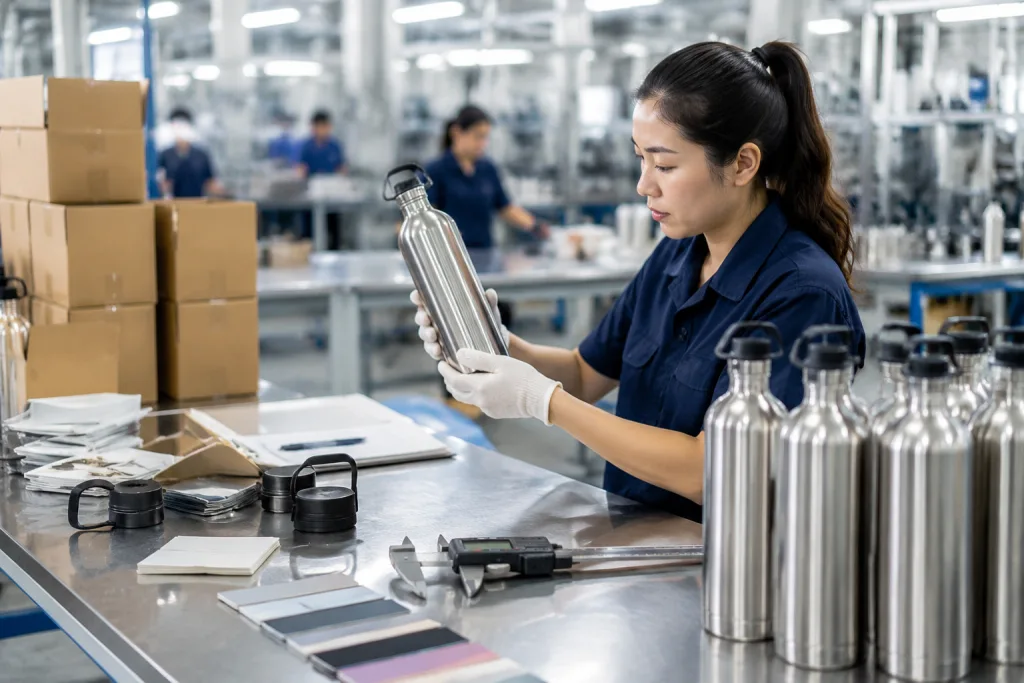
Key Takeaways
- For 304 stainless steel bottles, confirm inner wall 0.4-0.5 mm and outer wall 0.5-0.6 mm before tooling approval
- Typical private label MOQ is 1,000-3,000 units per color, with 25-35 day production after artwork approval
- Powder coating usually adds USD 0.35-0.70 per unit versus polished stainless, depending on color and rejection rate
- Use AQL 2.5/4.0 inspection, LFGB or FDA food contact testing, and drop-tested export cartons for retail programs
A 304 stainless steel refillable water bottle private label project looks simple until the quotation sheet arrives. We see it every week. Two bottles both list 500 ml, double wall, powder coated, and custom logo, yet one clears a retail audit while the other gets returned for rust marks near the weld seam, lids that wobble after 3 torque tests, or export cartons crushed at the bottom of a 40HQ.
If you buy custom drinkware for a brand, promotion, or distributor program, the wrong question is “who is cheaper by USD 0.08?” You need to compare wall thickness in mm, powder coating adhesion after cross-cut tape test, cap gasket fit, FDA or LFGB paperwork, and carton strength. Our Hangzhou, Zhejiang team has watched buyers lose USD 4,000 on vague specs before the line even ran 10,000 pcs.
Spec Table Buyers Actually Need
Too many canteen manufacturer quotations bury the real spec under friendly sales wording. Make every canteen factory or canteen supplier fill in this same table, then check it cell by cell with a digital caliper and a magnet at sample review. If a canteen vendor cannot state wall gauge, steel grade, or coating method, it is not an engineering quote. It is a price guess.
| Item | Budget Bottle | Retail Private Label Bottle | Outdoor / Distributor Bottle |
|---|---|---|---|
| Steel | 201 outer, 304 inner | 304 inner and outer | 304 inner and outer, 316 optional |
| Wall thickness | 0.35/0.45 mm | 0.4/0.5 mm | 0.5/0.6 mm |
| Capacity | 350-500 ml | 500-750 ml | 750 ml-1.9 L custom growler |
| Finish | Spray paint | Powder coat or brushed | Powder coat, rubber paint, laser |
| MOQ | 1,000 units | 2,000 units per color | 3,000 units per model |
| Target FOB | USD 2.10-3.20 | USD 3.40-5.80 | USD 6.20-11.50 |
For a 304 stainless steel refillable water bottle private label order, I would not approve a sample under 0.4 mm inner wall unless it is a rock-bottom canteen promotional program. Thin walls dent during necking, then dent again in courier handling; QC pulled one 0.35 mm sample last month with 3 visible flats near the shoulder after a 1.2 m carton drop. “How cheap can you make it?” is the wrong question to ask. Zhejiang factories can make lighter bottles, but the math does not work when return claims start.
At BottleForge Industrial in Zhejiang, our regular stainless bottle line runs about 420,000 units/month, with private label MOQ from 1,000 units on stocked shapes and 3,000 units for new color combinations. Normal lead time is 25-35 days after deposit and confirmed artwork; if the PO says “mat black” instead of “matte black,” we stop the line confirmation until the buyer fixes the color note. Small typo. Big headache.
304 Versus Cheaper Steel
The steel grade is where we start. 304 stainless steel is not a fancy upsell; it is the safe baseline for refillable bottles that touch water, tea, electrolyte drinks, and light acidic beverages. The normal 18% chromium and 8% nickel mix gives better rust resistance than 201 stainless steel. On our line, QC pulled a 500 ml sample last month and checked the inner wall with a handheld XRF gun before vacuum testing. No guessing.
Some canteen suppliers quote 201 outer wall with 304 inner wall to cut USD 0.20-0.45 per unit. That can pass for a 3,000 pcs short-term customized canteen promotion if the bottle will sit on a desk for one season. It is the wrong question to ask for a premium customizable drinkware line, outdoor retail, or a distributor canteen program where customers compare the powder coat, the rim finish, and dents after 6 months in a backpack. We have seen this go sideways when a buyer approved 201 outer steel, then flagged rust spots near the bottom seam after salt-spray feedback from Chile.
- 304 inner and outer: our default for retail shelves and reusable bottle private label where buyers check finish consistency, wall thickness, and repeat orders.
- 304 inner, 201 outer: workable for tight-budget canteen promotional orders if the powder coating passes cross-hatch tape testing and the MOQ pressure is real.
- 316 inner: better for coastal markets and hot tea programs, plus higher-end custom growler or customizable growler ranges where the buyer will pay for the upgrade.
Do not rely on a supplier declaration alone. Ask for material certificates and keep the right to run random PMI or chemical composition testing; we normally write this into the PI before deposit, not after production starts. For Europe, pair the steel declaration with LFGB or EU food contact migration testing. For North America, ask for FDA food contact compliance and, where relevant, California Proposition 65 review. Serious canteen manufacturers in China handle this paperwork every week. Weak canteen vendors act surprised, or they send a certificate with the grade typed as “403 stainless” on the PO attachment.
Shape Fit By Sales Channel
A bottle that looks sharp on a showroom table can still be wrong for your channel. We have seen this go sideways: a distributor approved one slim sample, then two resale accounts complained because it rocked in standard car cup holders during their own checks. The right custom canteen specification starts with the selling point, decoration method, and who pays for after-sales claims. Distributor drinkware buyers need tighter control than consumer brands, because one bad model can hit 6 or 8 resale accounts at once.
For a retail shelf, a 500 ml or 750 ml bottle with a 70-75 mm body diameter fits most cup holders and planograms. We check this with a digital caliper on the line; 72.3 mm is safer than a pretty 82 mm body that blocks shelf facing. For sports clubs and outdoor accounts, 750 ml to 1 L works better, but the bottle needs a carry loop and stronger lid hinge, such as a 3.0 mm hinge pin instead of a thin plastic tab. For a distributor growler or customized growler range, 1.2 L to 1.9 L needs a wider mouth, thicker outer wall, and a cap seal that survives repeated torque on our manual torque tester.
Do not choose capacity first. Choose the use case, then capacity, then decoration area.
A canteen customizable for events needs a large flat logo panel, so straight-wall bodies usually win. A premium customized drinkware line can use a tapered silhouette, but tapered bodies cut usable print space and raise rejection for full-wrap artwork; QC pulled one sample last year where the logo tail shifted 4 mm near the curve. If you want laser engraving, brushed or powder coated surfaces behave better than glossy paint. For full-color graphics, heat transfer or UV printing needs a cleaner cylindrical section, and the fixture must hold the bottle without wobble.
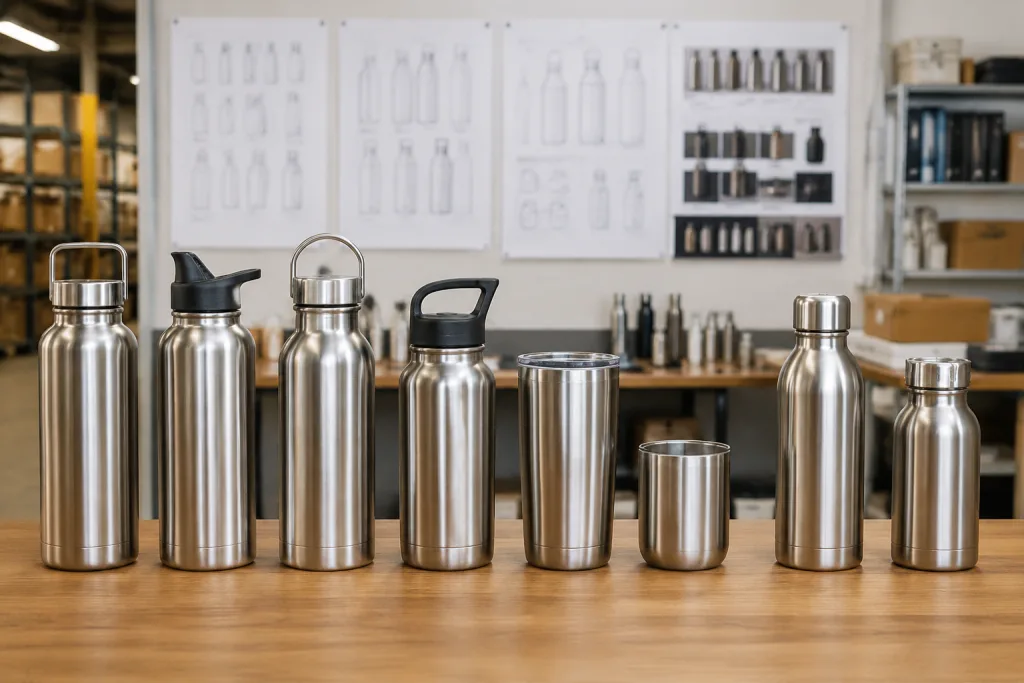
For canteen distributors, we run two core bodies rather than six experimental shapes: one 500-600 ml daily bottle and one 750-1,000 ml outdoor bottle. Six shapes sound attractive in a catalog, but the math doesn't work once you add MOQ, spare lids, silicone gasket colors, and carton inserts. You can change caps and packaging sets without multiplying molds or filling the spare-part rack with slow-moving parts.
Logo Methods Compared Plainly
Private label buyers often send a clean AI or PDF logo, then leave the decoration method as “factory decide.” That is the wrong question to ask. Last month QC pulled 32 matte-black samples where the body looked fine, but the silkscreen logo walked about 0.6 mm on the curve and the buyer flagged it in the pre-shipment photos.
| Method | Best For | Typical Cost Add | Watch Point |
|---|---|---|---|
| Silkscreen | 1-2 color logos | USD 0.08-0.18 | Registration gets tricky past 55 mm logo width on round walls |
| Laser engraving | Premium mark on powder coat | USD 0.12-0.35 | No Pantone color match, only exposed metal or coating underlayer |
| Heat transfer | Full-color artwork with wrap effect | USD 0.35-0.75 | Needs a clean cylinder area with no seam, groove, or taper |
| UV print | Short-run detailed graphics | USD 0.45-0.90 | Adhesion test required on the actual coating batch |
| Embossed mold logo | Long-term brand line | Tooling USD 600-1,800 | Hard to change later if the buyer updates the logo |
For a 304 stainless steel refillable water bottle private label launch, we usually run laser on powder coat when the buyer wants a premium look without color arguments. The math works: no ink mixing, no Pantone drift, fewer rejects at AQL 2.5. On our line, the operator checks the laser depth with a 10x loupe before packing the first 20 pcs. We still do not promise full dishwasher safety unless the coating and lid are tested together.
For canteen promotional goods, silkscreen keeps the unit cost down and suits simple logos under 2 colors. For customizable canteen SKUs sold online, UV printing gives SKU flexibility, but we have seen this go sideways when buyers approve artwork on a polished lab sample. We test on production-coated bottles: 3M 610 tape pull after 24 hours, cross-hatch cut with a 1 mm blade, and 500-cycle rub on the Sutherland tester. A smart canteen manufacturer does not decorate a sample that never enters mass production.
Caps, Seals, And Leak Risk
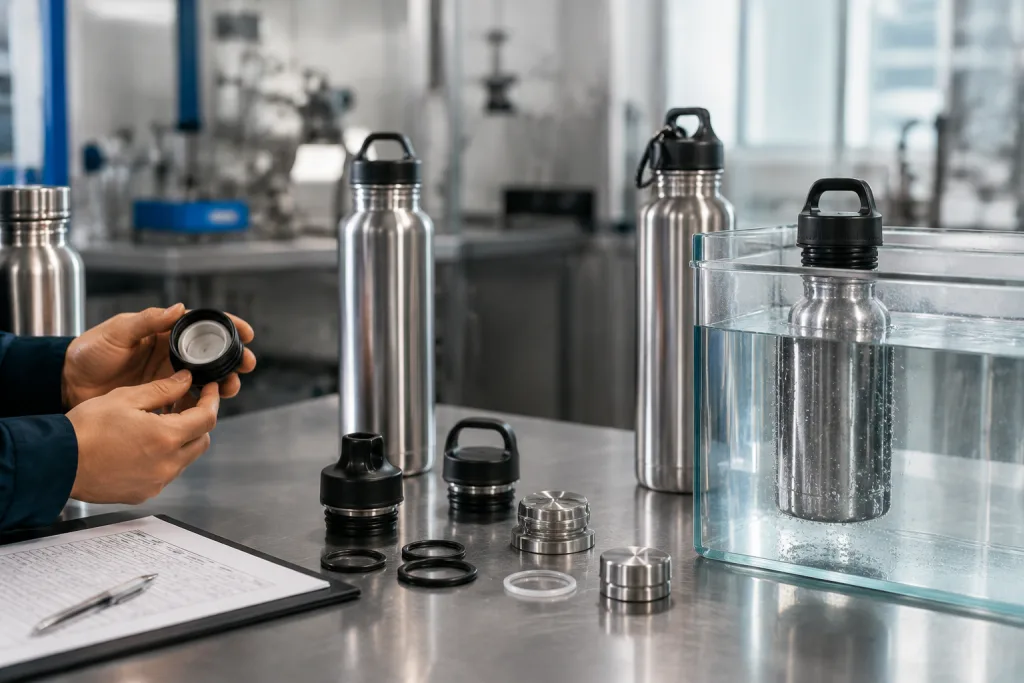
Lids create more complaints than bottle bodies. We ship a nice vacuum bottle and still lose the program if the PP cap feels soft, the silicone ring is 0.3 mm undersize, or the threads bind after powder coating. QC pulled a 750 ml sample last month where the body passed vacuum, but 6 caps leaked after a 30-minute inverted test. Compare cap systems as carefully as steel grade.
Screw caps are the safest choice for private label water bottles. Fewer moving parts. Lower tooling cost. Better leak control when the gasket groove stays within tolerance on the caliper. Flip lids sell well for sports channels, but we run cycle testing before signing off, because the hinge pin and lock tab take the abuse. Straw lids are convenient for buyers, but the math gets rough: straw, valve, hinge, spring, dust cover, plus spare-part stock and color matching on reorders.
- Daily retail bottle: screw cap with food-grade silicone gasket, 3-4 thread turns.
- Sports bottle: flip lid with locking tab, tested to 3,000 open-close cycles.
- Kids bottle: straw lid, ASTM and small-parts review for North America.
- Custom growler: wide-mouth cap with thicker gasket and higher torque control.
Ask for 100% leak testing on the line, not just random inspection at carton-out. We run inverted water testing after assembly, then QC samples again before final packing under AQL 2.5; the buyer flagged it once when a PO typo changed “leak test” to “look test,” and yes, that went sideways. For vacuum insulated models, add thermal retention testing: hot water at 95°C, measured after 6 hours and 12 hours. A realistic 500 ml double-wall bottle should keep water above 55-60°C after 6 hours, depending on cap design and a 20-25°C room. If a canteen vendor promises magic numbers without a test method, this is the wrong claim to trust.
Compliance And Inspection Terms
Compliance is not paperwork decoration. It decides whether your shipment clears at port, whether a retailer accepts the line, and whether your insurance team signs off without another call. For customized drinkware entering Europe, REACH, LFGB food contact testing, and packaging heavy-metal limits are common; last quarter QC pulled a 304 stainless sample from the line because the gift-box ink test showed lead above the buyer’s limit. For North America, FDA food contact status, ASTM considerations for children’s products, CPSIA where applicable, and Proposition 65 risk review may be needed.
Use one golden sample, one signed specification sheet, and one inspection standard. Keep it simple. I suggest AQL 2.5 for major defects and 4.0 for minor defects on most custom drinkware orders, with the sample sealed in a PE bag and marked by SKU, color code, and approval date. Critical defects, such as sharp edges, leaking, wrong material, mold contamination, or unsafe small parts, should be zero tolerance. Put that in the purchase order, not only in emails; we once saw a PO typo list “matte black” while the approved sample was “sand black,” and the buyer flagged it after 3,000 pcs were already coated.
A practical inspection checklist for canteen distributors should include:
- Capacity check with water fill tolerance, usually ±3%, measured on a digital scale after tare.
- Coating adhesion with cross-hatch cutter and 3M tape pull, checked after the coating line cools.
- Logo position tolerance, often ±1.5-2 mm, measured from the bottom seam or centerline jig.
- Leak test after 30 minutes inverted and shaken, including 10 pcs from each color batch.
- Carton drop test from 60-80 cm depending on carton weight, then check lids, dents, and barcode readability.
Factory audits also matter. BSCI, Sedex, ISO 9001, or retailer-specific audits do not make a bottle good by themselves, but they cut avoidable risk. This is the wrong question to ask if the buyer only says, “Do you have a certificate?” A canteen factory in Zhejiang or elsewhere in China should show production flow, polishing dust control, coating line conditions, and final inspection records; we run dust-collection checks near the polishing wheels because black specks under powder coating are easy to miss until packing. If access is blocked, assume the risk is yours.
Pricing, MOQ, And Freight Reality
FOB unit price is only one line on the costing sheet. A 750 ml 304 double-wall bottle may quote at USD 4.20 FOB Ningbo, but once we add powder coating, laser logo, retail box, insert card, barcode label, and a stronger K=A master carton, the real factory price often lands at USD 5.10-5.60. Then add ocean freight, duty, customs brokerage, inland trucking, and warehousing before you compare suppliers. We had one buyer flag a USD 0.18 carton upgrade as “optional”; QC pulled the drop-test sample from 80 cm, the corner crushed, and the math changed fast.
For stocked shapes, a canteen manufacturer may accept 1,000 units per color. For custom mold bodies or new cap tooling, 3,000-5,000 units is more realistic because the line needs stable setup time, not 40 minutes of tuning for a tiny run. Tooling can range from USD 800 for a simple lid insert to USD 6,000-15,000 for a new body and cap system. A canteen vendor promising 300 units with custom shape, custom color, retail packing, and a low price is selling a dream; we’ve seen this go sideways when the PO says Pantone 5483C but the approved sample card says 5435C.
Lead time should be split. Sampling takes 7-12 days for logo mockups and 15-25 days for new tooling prototypes. Mass production is usually 25-35 days after sample approval, assuming the powder line has open capacity and the laser jig is already confirmed within 0.5 mm. Sea freight from China to North America or Europe often takes 25-45 days port to port, then customs and trucking take another 4-10 days in a normal week. If you need a seasonal launch, work backward from the shelf date, not from the factory completion date.
For distributor canteen and distributor drinkware programs, buy spare lids at 2-3% of order quantity. Lids are cheap compared with customer complaints. We ship them in a separate inner box marked “spare lids” because warehouse teams lose loose parts when mixed with bottle cartons. Standardize carton dimensions when possible; mixed cartons slow picking, and FBA or retail routing gets less forgiving when one carton is 59 cm long and the next is 63 cm.
Send your bottle spec and target landed cost
We will compare steel, finish, cap, MOQ, and packing options before you commit to tooling or a private label purchase order.
Frequently asked questions
What MOQ should I expect for a private label 304 stainless bottle?
For existing BottleForge shapes, MOQ is usually 1,000 units per color with one logo method. If you need a custom Pantone powder coat, expect 2,000-3,000 units because coating setup and rejection control need volume. A new cap or body mold normally starts at 3,000-5,000 units, with tooling charged separately. Some China suppliers offer 500 units, but the unit price can rise 20-40% and color consistency is harder to control. For a first order, I prefer 1,000-2,000 units on a proven body before you invest in a fully customized canteen mold.
Is 304 stainless steel enough for reusable water bottles?
Yes, 304 stainless steel is the normal practical grade for refillable water bottles, corporate custom drinkware, and most retail canteen customized programs. It handles water, coffee, tea, and many sports drinks better than cheaper 201 stainless steel. For saltwater environments, highly acidic beverages, or a premium custom growler line, 316 stainless steel can be worth quoting. The bigger issue is verification. Ask your canteen supplier for material certificates and keep the right to run random third-party chemical testing. Also check weld quality, polishing residue, and passivation, because good steel can still be processed badly.
Which logo method is best for private label bottles?
For premium 304 powder coated bottles, laser engraving is the safest method because it is durable and avoids ink color drift. Typical added cost is USD 0.12-0.35 per unit depending on logo size and run speed. Silkscreen is better for simple canteen promotional orders at about USD 0.08-0.18 per unit, but it needs adhesion and rub testing. Heat transfer works for full-color artwork, usually USD 0.35-0.75 per unit. If you are building customizable drinkware for multiple clients, keep the body shape consistent and vary the decoration method by account.
How do I compare quotes from different canteen manufacturers?
Force every canteen manufacturer to quote the same specification sheet: steel grade, wall thickness, capacity tolerance, cap material, gasket material, coating type, logo method, packing, MOQ, lead time, FOB port, and inspection standard. A quote at USD 3.40 is not cheaper than USD 3.80 if it uses thinner walls, 201 outer steel, weak cartons, or no food contact testing. Ask whether the price includes retail box, barcode, FNSKU or carton label, and spare lids. Use AQL 2.5/4.0 and require pre-shipment inspection photos plus measurement records.
What lead time should I plan for Europe or North America?
Plan 7-12 days for logo samples on existing bottles, then 25-35 days for mass production after approval. Add 3-7 days for final inspection, carton labeling, and export booking. Ocean freight from China to Europe or North America is commonly 25-45 days port to port, but congestion can add another week. If you need Amazon FBA, retail routing labels, or mixed SKU palletization, add 5-10 days of operational buffer. For a hard launch date, confirm artwork, compliance testing, and purchase order at least 90 days before the goods must reach your warehouse.