Key Takeaways
- Typical MOQ starts at 1,000 pcs per color for stock molds and 3,000-5,000 pcs for deeper customization
- A realistic custom stainless bottle timeline is 35-55 days after artwork and deposit approval
- Decoration can add USD 0.08-0.95 per unit depending on print, laser, coating, and packaging
- Use AQL inspection, LFGB or FDA-grade contact materials, and carton drop testing before shipment
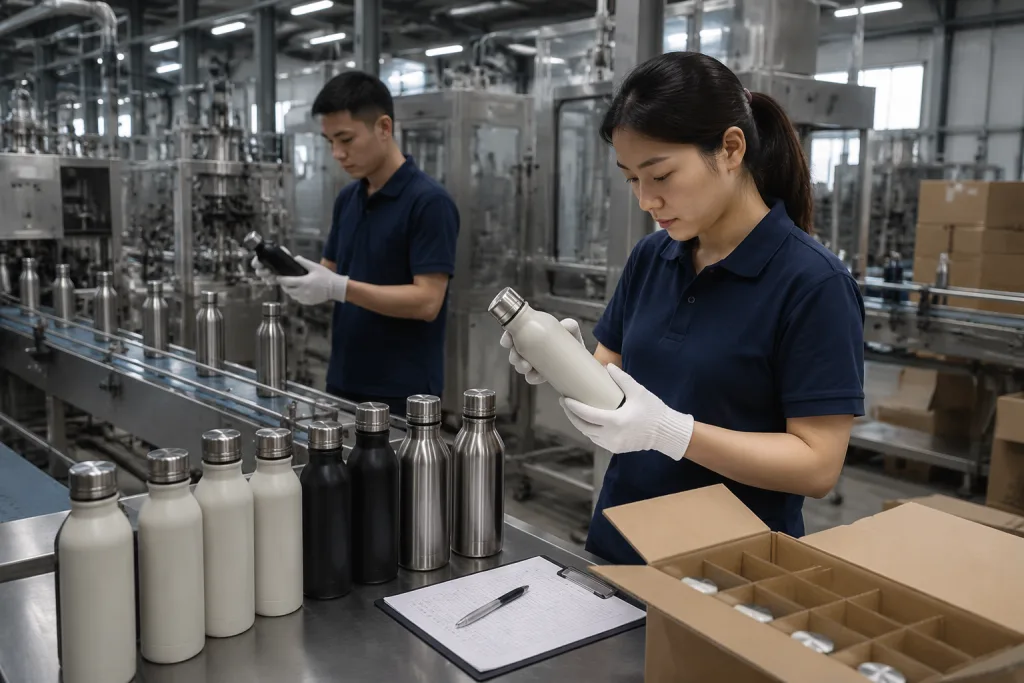
If you are sourcing from a 304 stainless steel refillable water bottle manufacturer, the quote is only the starting point. The real buying decision sits in wall thickness, lid design, decoration method, carton spec, inspection level, and whether your launch date survives production reality. QC pulled a 750 ml sample last month with a 0.42 mm body where the PO said 0.50 mm. Small gap. Big problem.
At our Hangzhou, Zhejiang factory, buyers often ask for a clean FOB price in one line. We can do that, but this is the wrong question to ask first. A custom drinkware buyer should know why one 750 ml bottle is USD 2.35 and another is USD 4.80 before freight: steel gauge, cap seal, powder coating loss rate, logo position jig, and 5-layer carton spec all change the math. We run this on the line every week, and the buyer flagged it when a launch plan allowed 12 days for production that needed 18 days. China can still be competitive, but only when the specification is locked from day one.
Start With The Real Specification
A 304 stainless steel refillable water bottle manufacturer cannot quote from a product photo with any accuracy. We need a working spec sheet. At minimum, list capacity, insulation type, steel grade, body diameter in mm, height in mm, lid material, coating, logo method, carton quantity, and target market compliance. If the RFQ only says “500 ml custom canteen,” the sales team will guess. The drawing desk may assume 70 mm diameter, the line may plan a standard powder coat, and QC may check against a lid you never approved.
For most B2B projects, 304 stainless steel is the right baseline for the inner wall because it handles water, tea, coffee, and common sports drinks without giving us corrosion trouble in normal use. For a vacuum bottle, we run 304 on the inner wall and 304 or 201 on the outer wall, based on the target price. If you sell into Europe or North America, 304 inner wall should be fixed on the PO. The buyer sometimes asks, “Can we use 201 inside to save cost?” We push back. The math doesn't work when one container has 3% complaint risk from rust spots or metallic taste.
Wall thickness changes the quote fast. A common range is 0.4-0.5 mm for mass-market bottles, while heavier outdoor models may use 0.55-0.6 mm. Thicker steel improves dent resistance, but it raises material cost and makes forming harder on the hydraulic press. QC pulled the sample last month on a 0.6 mm body because the shoulder radius was not forming cleanly after deep drawing. A customized growler with a large 1.9 L body needs stronger tooling and tighter weld control than a 500 ml bottle.
Before asking ten canteen vendors for pricing, lock the spec in a one-page RFQ. For distributor drinkware programs, include barcode requirements, carton marks, pallet limits, and whether you need FNSKU labeling for marketplace fulfillment. Put the carton size and gross weight target on the sheet too; a 24 pcs carton that passes the quote stage can fail your warehouse limit by 1.5 kg. We have seen this go sideways over a PO typo where “matte black” became “matt black” and the buyer flagged it during pre-shipment inspection. A vague RFQ gets a cheap quote. A clear RFQ gets a price you can buy.
Unit Cost Drivers You Control
The FOB unit cost usually comes from six places: steel weight, bottle construction, lid parts, surface finish, decoration method, and packaging spec. In Zhejiang, China, a standard 500-750 ml double-wall 304 inner stainless bottle often lands in a broad FOB range of USD 2.20-4.20 at factory level, depending on order size and finish. A single-wall canteen for a promo order sits lower. A powder-coated vacuum bottle with a carry handle, straw lid, and retail gift box sits higher. Simple math. Last month our costing sheet changed by USD 0.18 because the buyer changed the box from 300 gsm white card to 350 gsm kraft with a PET window.
Steel weight is the quiet cost driver. A 750 ml vacuum bottle can use 160-240 g of stainless steel depending on shape and wall thickness. When stainless prices move, the quote moves with it. We run the sample through an electronic scale before quoting repeat orders, because a 22 g difference on 10,000 pcs is not a rounding error. A reliable canteen manufacturer should be able to tell you approximate unit weight; if they cannot, the quote may be copied from an old project. We have seen this go sideways when a PO says “same as sample” but the sample on the buyer’s desk is 0.5 mm thicker than the factory file.
Lids matter more than new buyers expect. A simple screw cap may add USD 0.25-0.45. A flip lid with silicone seal, PP body, carry loop, and straw parts can add USD 0.60-1.20. If the lid needs color matching, mold adjustment, or a custom strap, the cost rises again. Ask whether the silicone is food-grade and whether spare gaskets are available. QC pulled the sample on one straw lid order because the gasket groove was 0.3 mm shallow, and 7 pcs leaked during the inverted water test. A leaking lid costs more than a higher initial quote. The math doesn't work if you save USD 0.15 and then pay for replacements.
Surface finish is another cost lever. Polished steel is usually cheaper than full powder coating. Powder coating gives better retail shelf appeal and grip, but the line needs masking, curing, and scratch testing. Matte coatings often show oil marks faster than semi-matte coatings; the buyer flagged this on a black 750 ml bottle after our QC handled it with bare fingers. For canteen promotional orders, silk screen on a painted body is economical. For premium customized drinkware, laser engraving or 3D embossing makes more sense even if unit cost rises. Ask for one finished pre-production sample, not only a color chip.
MOQ Tiers And Price Breaks
MOQ is not a punishment. It is how the canteen factory pays for line setup, coating loss, logo fixture setup, packaging prep, and inspection hours. At BottleForge Industrial in Hangzhou, Zhejiang, we run about 450,000 stainless drinkware units per month across bottle lines and tumbler lines, with custom growlers scheduled in longer welding windows. Even with that capacity, a 300-piece custom color order burns time: the powder booth still needs cleaning, the spray gun still needs adjustment, and QC still pulls samples for tape test and color ΔE check.
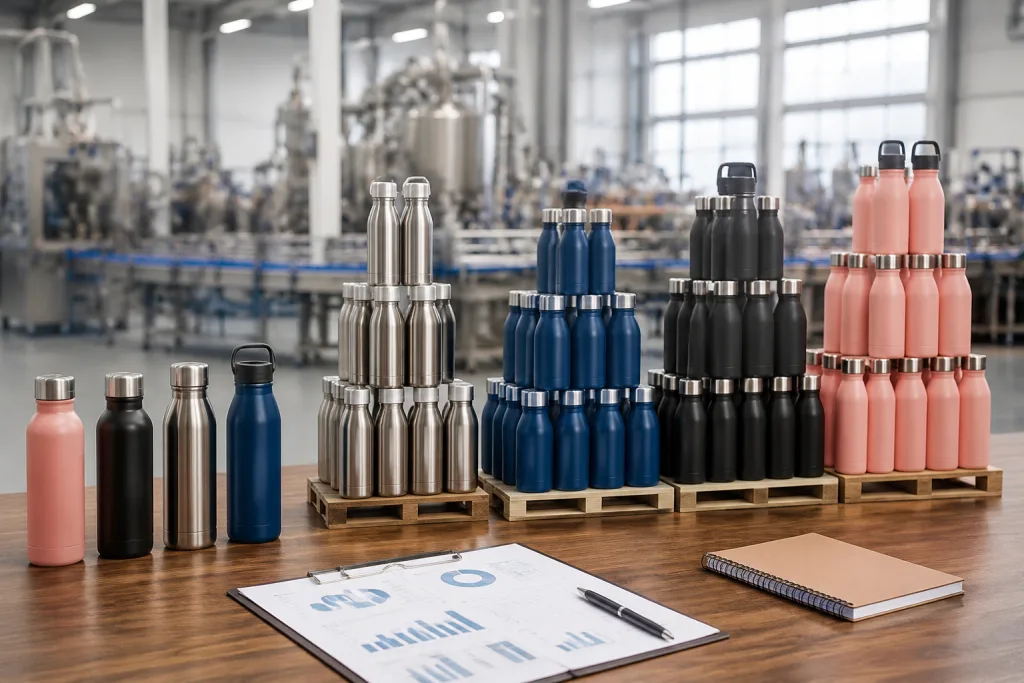
For stock mold bottles in standard colors, a workable MOQ is usually 1,000 pcs per color. For a canteen customizable with logo only, 1,000-2,000 pcs is realistic. For a custom canteen with exclusive shape, custom lid, or special powder color, expect 3,000-5,000 pcs. For new tooling, 5,000-10,000 pcs is the range we see most often because mold cost recovery and production tuning take real shifts on the line. Last month a buyer asked for 800 pcs with a new flip lid; the math did not work after CNC sample fitting and silicone gasket testing.
Price breaks are usually visible at 1,000, 3,000, 5,000, and 10,000 pcs. A 1,000-piece order carries more coating and printing setup cost per unit because the screen frame, pad-print jig, and oven warm-up do not shrink with order size. At 5,000 pcs, the same setup cost spreads out, and raw material purchasing improves. At 10,000 pcs, you may save another 3-8% if the design is stable and packed in efficient master cartons. Small detail, big cost: changing from a 24 pcs carton to a 20 pcs carton can add pallet space and push LCL freight the wrong way.
For distributor canteen and distributor growler programs, do not chase the lowest MOQ if you plan to reorder. This is the wrong question to ask. A slightly higher first order can secure better color consistency, stable tooling, and reserved production time. If demand is uncertain, start with one body mold and two colors, not four body shapes with six colors. We have seen this go sideways: the buyer flagged three slow SKUs after 60 days, while the best color sold out before the repeat PO was even approved. Fragmented SKUs turn a good FOB quote into warehouse waste.
Decoration And Branding Costs
Customizable drinkware looks simple on a sales deck. On the factory quote sheet, decoration cost comes from the bottle surface, artwork size, color count, and the test standard the buyer expects. A one-color silk screen logo may add USD 0.08-0.18 per unit after a screen setup fee of USD 30-60 per color. Multi-color screen printing needs tighter registration, so we run a 0.2 mm alignment check and allow more rejects at QC. Heat transfer can handle gradients and larger artwork, often adding USD 0.35-0.80 per unit. Laser engraving commonly adds USD 0.15-0.45 depending on size and position.
For premium customized canteen projects, laser is usually the safest long-term branding choice because it does not peel in wash testing. QC pulled the sample after 24 hours in a 60°C soak test, and the engraved logo was still clean while one printed edge started lifting. The trade-off is simple: the mark color depends on the coating and base material. On powder-coated bottles, laser usually reveals the stainless substrate. On bare steel, it creates a subtle etched effect. If your brand needs exact Pantone color, screen print or transfer is the better route.
Full-wrap artwork is possible, but this is where we have seen jobs go sideways. Curved stainless bodies are not flat paper. Large wraps can distort near the shoulder and base, especially on tapered shapes, and the buyer flagged a 3 mm logo drift on one 750 ml trial run last spring. If you are buying canteen promotional units for an event, choose a straight-wall bottle with a simple logo panel. If you are building retail custom drinkware, ask for a printed pre-production sample before approving mass production. It saves arguments.
Packaging also belongs in branding cost. A plain egg-crate carton is cheapest. A white box may add USD 0.12-0.25. A four-color retail box can add USD 0.25-0.65 depending on paper grade and order quantity. Insert cards, care manuals, QR labels, and retail hang tags are small line items, but together they can add USD 0.10-0.30 per unit; we once caught a PO typo where a buyer wrote “1 card” but expected 2 inserts plus a QR label. Good packaging reduces complaints. Oversized packaging raises freight, so get marketing and logistics into the same costing round.
Tooling, Samples, And Approval Timing
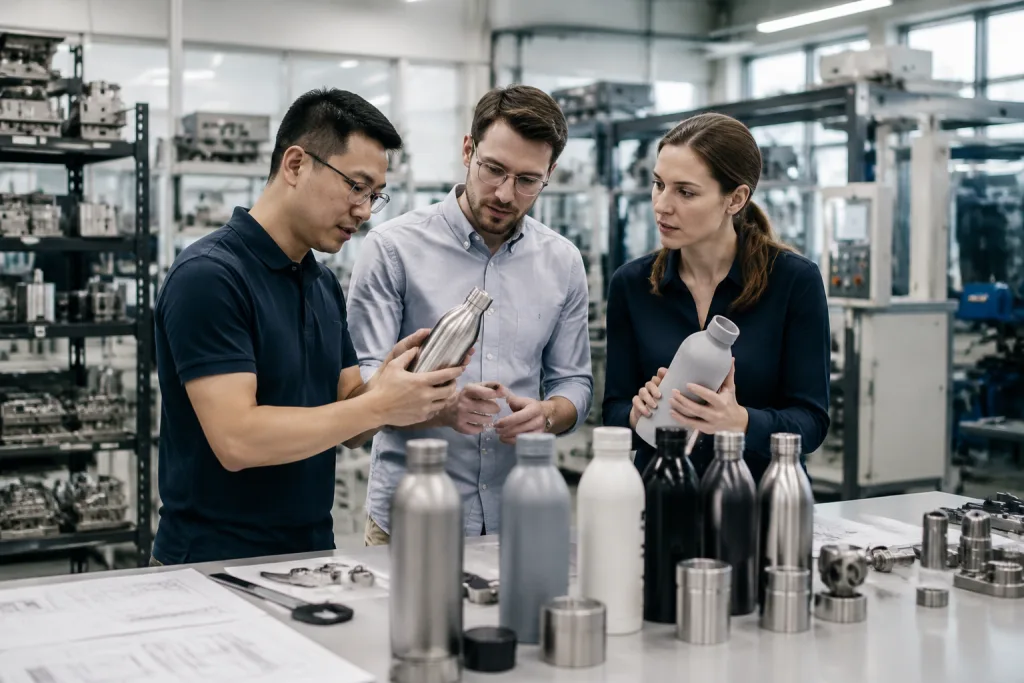
For stock molds, sample timing is usually 5-10 days if the body and color are already on the line. Add 3-7 days for custom logo work. If you need a new powder-coat color, allow 7-12 days because the color card check, spray gun setup, oven curing, and 3M tape adhesion test all take real shop time. No shortcut here. A pre-production sample for a customized growler or customized drinkware retail program should be a required gate, not a nice extra.
Tooling cost depends on what is new. A logo screen may be USD 30-60. A laser fixture may be USD 50-150. A custom silicone part can run USD 800-2,500. A new plastic lid mold can be USD 3,000-12,000 depending on structure. A new stainless body mold may range from USD 2,500-8,000, and complex shapes cost more. We have seen buyers push back on tooling, then accept a USD 0.18 higher unit price without noticing the payback after 20,000 pcs. Some canteen vendors quote low tooling and recover it in the unit price. The math is not always wrong, but you should know which model you are buying.
A realistic approval sequence is: RFQ clarification in 1-3 days, sample invoice and payment in 1-2 days, sample production in 7-15 days, courier shipping in 3-6 days, buyer review in 2-5 days, then final artwork and deposit. If your internal approval takes three weeks, the factory lead time has not started. We run into this often: procurement approves the bottle, marketing changes the Pantone, legal asks for a warning line on the box, and the distributor waits. In our last 10 delayed sample cases, 6 were stuck on buyer-side signoff, not China manufacturing.
For new buyers, approve the bottle first, then approve the sales materials separately. Check physical construction against the sample in hand: lid thread fit, straw length, gasket position, and whether QC pulled the sample with the same 304 stainless body as the order. Then check decoration and packaging with signed artwork, color code, logo size, lid version, carton spec, and PO number. We have seen this go sideways over one retail box typo. For canteen distributors handling multiple accounts, keep a signed sample record. That record protects both sides when reorder discussions happen six months later.
Production Lead Time By Order Type
After the deposit lands, artwork is confirmed, and the approved sample is signed off, stock-mold 304 stainless bottles usually need 30-45 days. For 5,000-20,000 pcs with standard powder coating and one logo, we quote 35-50 days because the line still needs coating slots, logo fixtures, and final AQL 2.5 inspection time. Custom lid development, new body tooling, or a custom growler with a special finish should be planned at 55-75 days before shipment. These ranges assume normal factory loading in China, no major compliance retesting, and no PO typo like “matte black” in one file and “gloss black” in another.
Production is not one long conveyor belt. Stainless sheet or tube preparation, forming, welding, vacuuming, polishing, coating, printing, assembly, leak testing, packing, and inspection all take separate scheduling. QC pulled one vacuum sample last month at 96°C fill temperature, and it failed the 6-hour heat retention check; better cartons would not save that batch. Powder coating also needs curing and adhesion checks such as cross-hatch testing, usually with a 3M tape pull after the grid cut. Rush it, and defects show up.
For seasonal programs, book capacity early. March to June fills up fast for summer hydration launches, and August to October is heavy for holiday and Q4 distributor drinkware orders. If you need goods in a European warehouse by May 1, ocean freight at 30-40 days port to port plus customs and inland trucking means the purchase order cannot wait until late March. The math does not work. We see this go sideways when the buyer approves the color chip on April 3, then asks why packing is not finished on April 20.
Air freight saves days and eats margin. A 12 kg carton of stainless bottles can cost more to fly than the profit on the carton, especially on 750 ml vacuum bottles packed 24 pcs per master carton. For urgent launches, split the shipment: send 5-10% by air for photography, sales samples, or the first retail allocation, then move the remaining 90-95% by sea. We ship this way often. A disciplined canteen supplier should flag the freight problem early, not pretend every late approval can be repaired at the end.
Quality Checks Before The Balance
Do not release the balance just because production photos look clean. Run a final random inspection against AQL. For drinkware, our retail and distributor buyers usually set AQL 2.5 for major defects and 4.0 for minor defects, with critical defects at 0. Critical issues include sharp edges, leakage, wrong material contact parts, strong odor, rust contamination, and unsafe packaging staples. Major defects include poor vacuum performance, incorrect logo position, visible coating chips, and lid fit problems. QC pulled one 500ml sample last season with a burr inside the mouth rim; the photo looked fine, but the fingertip check caught it in 3 seconds.
Ask your canteen manufacturer for material declarations and, when needed, third-party test reports. For Europe, buyers commonly request LFGB, REACH, and sometimes food contact migration testing. For the United States, FDA food-contact expectations and California Proposition 65 screening apply depending on distribution. Kids bottles need extra ASTM or CPSIA-related review. A general “food grade” statement is not enough for retail or distributor canteen channels. We have seen this go sideways when a PO says 304 stainless, but the lid spring or tea infuser was never listed on the material declaration.
Functional tests should match the bottle. Leak testing should include inverted and side-position checks, not just a quick shake by the packing table. Vacuum bottles should be tested with hot water temperature retention, often measured over 6, 12, or 24 hours depending on the claim; our line records start temperature, room temperature, and final reading on a simple QC sheet. Coating should pass tape or cross-hatch checks, and cartons should pass a drop test based on gross weight. If you use Amazon or similar fulfillment, confirm FNSKU labels, suffocation warnings for polybags, and master carton weight limits before packing starts. One buyer flagged a 0.8 kg overweight master carton after 42 cartons were sealed. Painful rework.
Quality control costs less at the factory than at your warehouse. Our Zhejiang quality team checks incoming steel with a PMI gun, in-process welding, vacuum performance, coating appearance, and packed-carton conformity before loading. Your own third-party inspection still makes sense, especially for first orders above USD 10,000. The best result is not “we found no defects.” The better target is simple: force both sides to define defects before the first bottle is made, including logo tolerance in mm and what counts as a coating scratch.
Send your bottle spec for a costed production plan
Share capacity, quantity, logo method, market, and delivery date. We will return MOQ, FOB pricing, sample timing, and production lead time.
Frequently asked questions
What is the normal MOQ for a custom 304 stainless steel bottle?
For a stock mold with your logo, 1,000 pcs per color is a normal starting MOQ. If you need a custom powder color, plan for 2,000-3,000 pcs. For a new lid, exclusive shape, or fully customized canteen, 3,000-5,000 pcs is more realistic. New tooling projects may require 5,000-10,000 pcs to keep unit cost sensible. Very small runs are possible only when the bottle body and color are already in stock, but the unit price will be higher and decoration options are limited.
How much should I budget for a 750 ml vacuum bottle?
A typical 750 ml double-wall vacuum bottle with 304 stainless inner wall often prices around USD 2.60-4.50 FOB China, depending on steel weight, lid, coating, logo, and packaging. A basic screw-cap design with one-color print sits near the lower end. A powder-coated bottle with handle lid, laser logo, retail box, and barcode labeling moves toward the higher end. Freight, duty, insurance, inspection, and warehousing are not included in FOB pricing, so landed cost must be calculated separately.
How long does production take after I approve the sample?
For stock molds and standard decoration, allow 30-45 days after deposit and final sample approval. For 5,000-20,000 pcs with custom color and retail packaging, 35-50 days is a safer planning range. If your project includes new tooling, custom lid development, or a special custom growler finish, 55-75 days is normal. Add ocean freight time separately: roughly 25-35 days to many North American ports and 30-40 days to many European ports, depending on routing.
Is 304 stainless steel enough for European and North American markets?
304 stainless steel is the right standard for the inner food-contact wall of most refillable water bottles, but material grade alone is not the full compliance answer. For Europe, buyers often request LFGB food-contact testing and REACH screening. For the U.S., FDA food-contact expectations and Proposition 65 review may be relevant. If the lid uses PP, Tritan, silicone, or TPE parts, those materials also need documentation. Ask your canteen supplier for current test reports, not only a verbal “food grade” claim.
Can one factory support both promotional and retail drinkware programs?
Yes, but the specification discipline is different. Canteen promotional orders usually prioritize price, fast lead time, simple decoration, and event delivery dates. Retail customized drinkware needs stronger packaging, barcode control, color consistency, AQL inspection, and often compliance files for major buyers. A capable canteen factory should separate these workflows instead of treating every order the same. For a distributor drinkware program, we normally suggest stock molds for promotional volume and a narrower set of upgraded models for retail accounts.