Key Takeaways
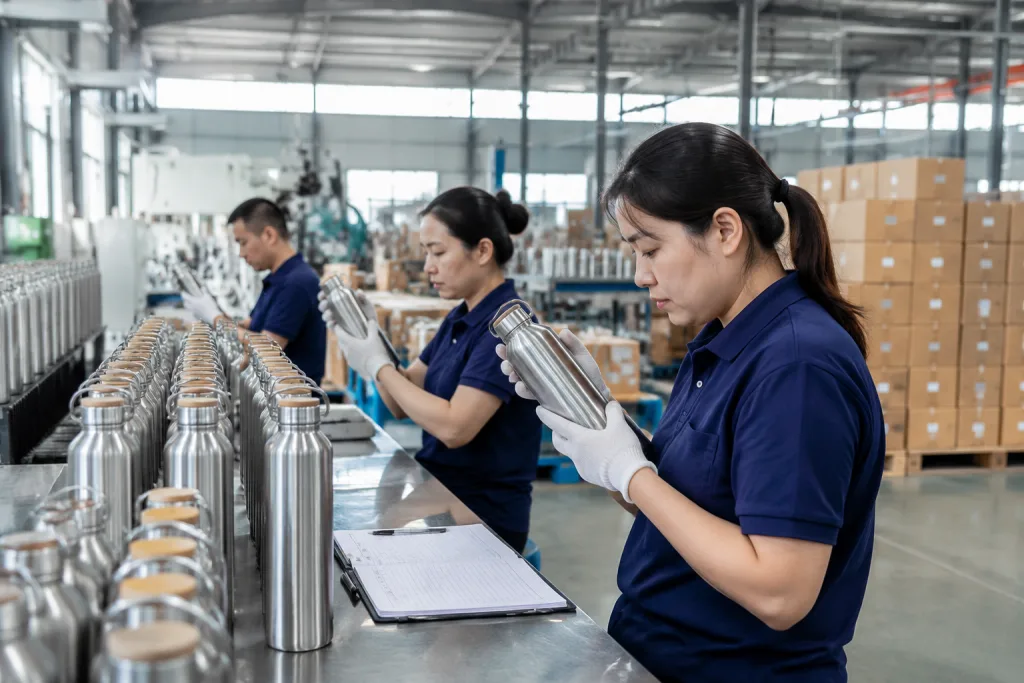
- For 304 stainless bottles, ask for material testing and keep AQL at 2.5 major / 4.0 minor for final inspection
- A realistic MOQ is 1,000 pcs per color for stocked shapes and 5,000-10,000 pcs for private mold projects
- Vacuum insulation failure should be checked by hot water testing, not only by visual inspection
- FOB China unit price changes quickly with coating, lid type, carton specification, and logo method
If you are comparing a 304 stainless steel refillable water bottle factory for a retail line, corporate program, or distributor drinkware catalog, finding a supplier is the easy part. Proving the quote is safe before you wire the deposit is harder. We see 20 quotes a week that all say the same thing: 500 ml bottle, powder coating, logo, carton packing, FOB China. The trouble sits in the details QC checks with a magnet, caliper, vacuum tester, cross-hatch blade, and carton drop test: steel grade, vacuum failure rate, coating adhesion, carton strength, and how fast the factory fixes a bad batch. Samples can lie.
BottleForge Industrial runs from Hangzhou, Zhejiang, close to China’s mature stainless drinkware supply chain. We handle custom drinkware, custom canteen, and distributor growler projects where buyers need repeat production that matches the approved sample, not one nice showroom piece. Our standard MOQ starts at 1,000 pcs per color for common models, with 25-35 day production after sample approval. Last month, a buyer flagged a 0.3 mm logo position shift on the pre-production sample; that is the right time to catch it, before 6,000 pcs are printed on the line.
What should you verify first?
Start with the parts that touch water, lips, or repeat orders. A 304 stainless steel refillable water bottle factory should confirm the inner wall material, outer shell material, lid contact material, silicone grade, and coating system before artwork or carton layout starts. On our line, QC checks incoming coil with a handheld XRF gun; one batch last year read 201 on the outer shell after the PO said “304 body.” For most export projects, we run 304 stainless steel for the inner wall, food-grade PP or Tritan-type plastic for specified lids, and LFGB or FDA-grade silicone gaskets. Some canteen factory quotes use 201 stainless steel on the outer shell to cut about USD 0.18-0.35 per bottle. That can be acceptable if it is declared. Selling it as full 304 construction is where the math and the trust both fail.
Ask the canteen supplier to write the material structure directly on the proforma invoice or technical sheet. Not “stainless steel bottle.” Too loose. A European or North American buyer needs wording such as “304 inner wall / 201 outer wall / PP lid / FDA-grade silicone gasket,” and the PO should match it line by line. We have seen this go sideways over one typo: the buyer flagged “304 SS” on the invoice while the approved sample tag showed 304/201. If you sell into the EU, request REACH-related coating data and food contact test options. If you sell into the U.S., ask whether the product can support FDA food contact documentation and, for children’s bottles, CPSIA-related checks where needed.
Practical buying checklist:
- Inner wall: 304 stainless steel, usually 0.4-0.5 mm before forming; ask for the steel grade report, not just a catalog photo.
- Outer wall: 304 or 201 stainless steel, declared clearly on the PI, tech sheet, and carton spec if your customer requires traceability.
- Vacuum layer: no rattling, no visible base deformation, tested after finishing; we normally pull samples after powder coating because heat can expose weak vacuum units.
- Gasket: removable silicone ring, odor controlled after boiling water test; QC pulled one sample at 95°C for 30 minutes and rejected it for rubber smell.
- Coating: powder coating or spray paint with cross-hatch adhesion test; use a 3M tape pull, not a fingernail scratch in the showroom.
- Inspection plan: AQL 2.5 for major defects and 4.0 for minor defects; define scratches, dents, color spots, and lid leakage before mass production.
Good canteen manufacturers do not push back on these questions. Weak canteen vendors answer “same as sample” and avoid written specifications. This is the wrong place to save 10 minutes. Once 5,000 bottles are packed and the buyer finds mixed steel claims during inspection, the dispute is no longer about drinkware; it is about who pays for rework, testing, and late shipment.
How do MOQ and pricing work?
For B2B custom drinkware, MOQ is driven less by 500 ml vs 750 ml and more by finish, lid color matching, carton spec, and whether we run an existing mold. On a normal line in Zhejiang, a 500 ml or 750 ml insulated bottle from open tooling can start at 1,000 pcs per color; QC checks the first powder-coated pieces with a 60° gloss meter and PMS card before mass packing. A canteen with a special cap color, retail box, and PMS powder coating usually needs 2,000-3,000 pcs because the coating room and cap supplier both need a clean batch. A fully customized growler with new tooling can require 5,000-10,000 pcs before the mold cost and line changeover make sense.
Be careful with low MOQ claims. We have seen a canteen vendor accept 100 pcs, then ship trading stock with mixed batches and loose color control; the buyer flagged the second shipment because the matte black looked 2 shades off under D65 light. That can work for a one-time promotional event. It does not work for a distributor canteen program where the same SKU must repeat across three shipments. The wrong question is “What is your lowest MOQ?” Ask, “At what MOQ can you hold color, packing, and lead time reliably?”
FOB Ningbo or FOB Shanghai pricing for 304 stainless bottles moves with steel, coating powder, and exchange rate, but buyers can still use a rough reference. A standard 500 ml double-wall bottle with powder coating and one-color silk screen often lands around USD 3.20-5.20 FOB China at 1,000-3,000 pcs, depending on lid complexity and packaging; our costing sheet separates the lid gasket, 0.5 mm carton upgrade, and logo charge so the math is visible. Laser engraving may add USD 0.15-0.45 per unit. Individual color boxes can add USD 0.18-0.45. Heavier cartons for e-commerce or Amazon FBA-style handling can add another USD 0.10-0.25 per unit.
Checklist before accepting a quote: confirm Incoterm and port, carton quantity with gross weight, sample cost with mold cost if any, payment terms with logo setup included or listed separately. We once saw a PO typed as “FOB Shanghai” while the quote said “FOB Ningbo”; that small typo added 2 days of back-and-forth before booking. If you compare canteen suppliers without these details, you are not comparing the same product.
Which customization choices matter most?
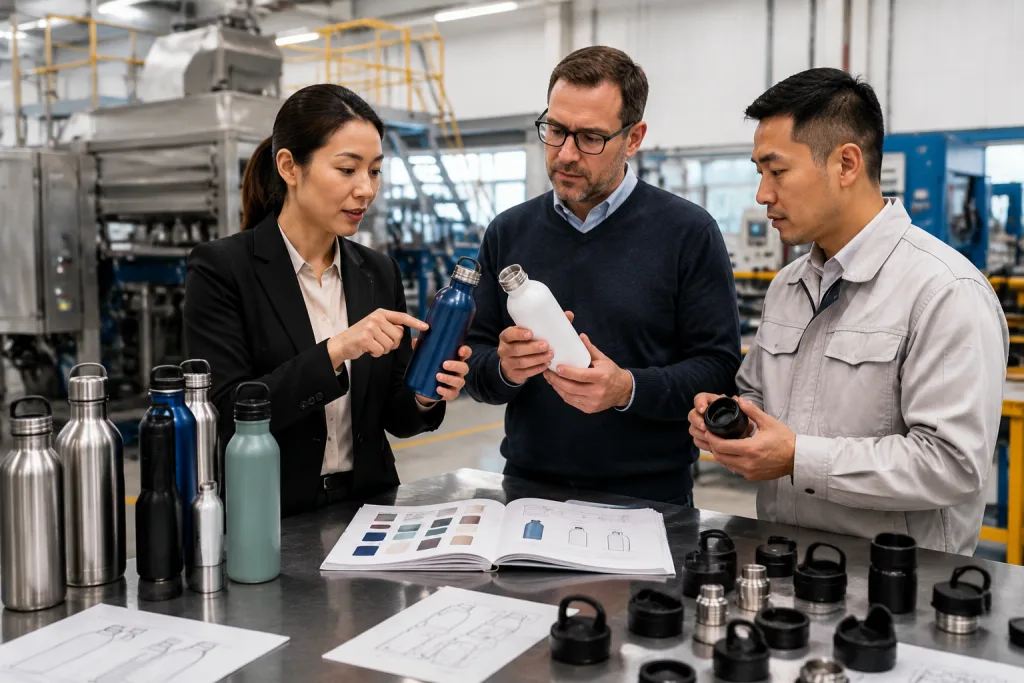
Customization is where 7 out of 10 projects lose margin. A custom canteen does not sell better because every part has a new color, new texture, and new mold. That is the wrong question to ask. The right question is: which change helps your channel move cartons? For retail shelves, coating gloss, lid hand-feel, barcode placement, and the color box window matter; we have seen buyers reject a PO because the EAN sticker sat 6 mm too close to the box seam. For corporate gifting, logo position and ship date usually beat fancy packaging. For outdoor distributor growler programs, we run pull checks on the handle, 24-hour inverted leak tests, and abrasion checks before talking about a gift box.
The main decoration methods are silk screen printing, laser engraving, heat transfer, water transfer, and sometimes UV printing. Silk screen is the safe choice for one or two colors on simple artwork, and the line can hold 0.3 mm edge detail if the screen mesh is set right. Laser engraving looks clean on powder-coated bottles and survives rough use, but it will not print full-color artwork. Heat transfer works for wraparound designs, yet the reject rate can move from 2% to 6% if temperature and pressure drift; QC pulled the sample last month after a 4 mm seam overlap showed on a gradient bottle. For customized drinkware with metallic, gradient, or photo graphics, approve a pre-production sample, not only a digital mockup.
A customizable canteen or customizable growler also needs component decisions. Wide-mouth openings are easier for ice and cleaning, often 50-58 mm. Narrow-mouth designs drink better in a car or on a train, but cleaning brushes do not always reach the shoulder. Straw lids raise shelf value, but they add 3-5 parts and more leak points. Screw lids are safer for bulk promotional programs. Simple wins. If you are a canteen distributor serving 4 or 5 client types, keep one base bottle body and change decoration or lid options; the math does not work if every buyer gets a new mold, new carton, and new gasket color.
Customization checklist:
- PMS color target for coating, with measured delta tolerance, such as ΔE under 1.5 if your brand team checks by spectrophotometer.
- Logo file in AI, EPS, or high-resolution PDF, with fonts outlined before we send it to the screen-print room.
- Logo size in mm, not just “same as picture”; we need height, width, and distance from the bottom edge.
- Lid type, gasket color, and spare gasket requirement, including whether the gasket is packed loose or pre-installed.
- Retail box dieline, barcode, FNSKU label, or warning label position, with the label side marked so the packing team does not guess.
- Master carton drop-test requirement, especially for e-commerce, including carton weight limit and whether you need 1A or 2A testing.
As a canteen manufacturer in China, we ask buyers to lock functional parts first and looks second. Changing a lid after sample approval can change the leak-test result, carton height, and final cost. We have seen this go sideways: one buyer swapped to a taller flip lid after approval, and the master carton gained 18 mm, which cut container loading by 420 pieces.
How should samples be approved?
Sample approval is a technical gate, not a photo review on WeChat. For a 5,000 pcs canteen promotional order, one signed sample controls the whole run. If approval is loose, final inspection turns into arguing: our line says production matches the sample, while the buyer remembers the Pantone color from a phone screen. We have seen this go sideways over a 2 mm logo shift that QC pulled from the first packed carton.
We run three sample steps for serious customized canteen projects. First, send an existing sample to confirm the body profile and grip feel, then twist the lid 20 times to check thread bite and gasket pressure. This can ship in 3-7 days if the model is available. Second, make a logo sample or color panel, usually 7-12 days depending on silk screen, laser, powder coating, or heat-transfer setup. Third, approve a pre-production sample with final components, final logo, final carton or box artwork, and final gasket color. For high-volume distributor canteen orders, this third sample is worth the time; skipping it to save 8 days is the wrong question to ask when the PO says 12,000 pcs.
When the sample arrives, do simple checks before you sign. Fill the bottle with boiling water and leave it for 6 hours; the outside should not get hot on a vacuum bottle. Turn it upside down for 30 minutes on white tissue to check leakage. Smell the lid after hot water contact. Scratch the coating lightly in a hidden area with a fingernail and check whether it flakes too easily. Not fancy. These are not laboratory tests, but they catch obvious problems before production, like the black lid gasket smell a buyer flagged after our 90°C water test.
Approval checklist to sign off: bottle capacity tolerance in ml, net weight range in g, coating color under D65 light box, logo position in mm from the bottom, logo size against the AI file, lid fit after 20 open-close cycles, leakage result, carton marking, barcode scan result, and any warning text. If your canteen vendors resist a written approval record, take it seriously. A professional canteen factory wants clear records because they protect both sides; one buyer once sent a PO with “matte back” instead of “matte black,” and the signed sample saved the order.
What quality controls prevent surprises?
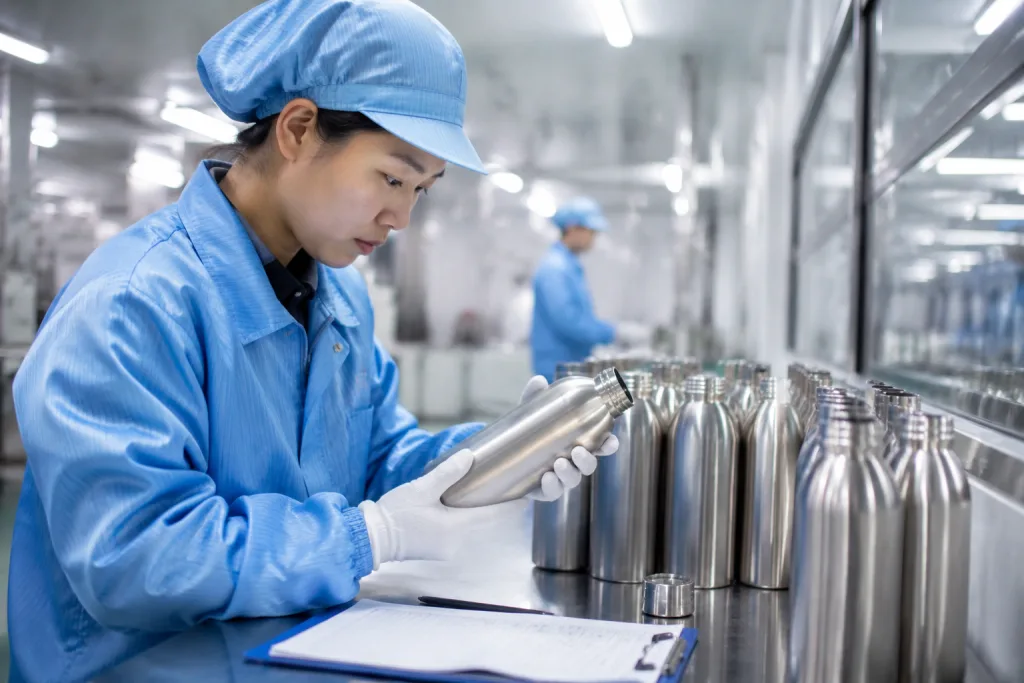
For stainless steel refillable bottles, QC has to run on the line, not just at the warehouse door. We see the same trouble points again and again: vacuum loss, coating scratches, dirty interiors, leaking lids, weak welds, poor printing, dented bodies, and crushed retail boxes. A final inspection can catch some of them, but the math does not work after 20,000 pcs are already in master cartons. Last March, QC pulled 32 samples with a flashlight and found polishing dust under 5 inner shoulders; that problem had to be stopped before packing, not argued about at loading.
At BottleForge Industrial, our regular output capacity is about 300,000-500,000 stainless drinkware units per month across common bottle and tumbler lines in Zhejiang, China. For large customized drinkware programs, we run inline checks at three points: after body forming and polishing, after coating or printing, and before carton sealing. Simple reason: defects get cheaper when found early. Finding a shifted logo 2 days before the container leaves Ningbo is where we have seen orders go sideways, especially when the buyer already booked a retail promotion.
Use AQL standards for final inspection. A typical setting is AQL 0 for critical defects, 2.5 for major defects, and 4.0 for minor defects. Critical defects include sharp edges, foreign matter inside, serious leakage, unsafe odor, or wrong material. Major defects include obvious dents, failed vacuum insulation, wrong logo, unreadable barcode, or coating peeling. Minor defects include small specks, slight shade variation within approved tolerance, or minor carton rub marks. We usually check bottle mouths with a 0.05 mm feeler gauge when the inspector flags a burr, because “looks smooth” is the wrong question to ask.
Factory QC checklist:
- Material incoming check with stainless steel grade verification when required; for 304 stainless, we match the mill sheet against the PO before blanking starts.
- Vacuum test using hot water or temperature retention sampling; the line records 95°C fill temperature and rechecks sample bottles after the holding window.
- 100% leak test for lids on selected high-risk designs; flip straws and push-button lids get extra attention because buyers flag wet cartons fast.
- Coating adhesion check, such as cross-hatch tape test on samples; QC uses 3M tape and rejects panels when squares lift at the edge.
- Print position jig to control logo alignment; a 2 mm drift looks small on the bench but ugly on a matte black bottle.
- Carton drop test for retail or courier channels; we test packed cartons at order weight, not empty display boxes.
If you are a distributor growler buyer, add handle pull strength and cap torque checks. Growlers carry more liquid weight, so a comfortable handle is not enough; it has to survive real use. We run pull tests with a hanging weight on sample handles, and one buyer once pushed back after seeing a 1.9 kg filled growler swing from a carabiner at an outdoor event.
Which compliance documents are realistic?
Compliance requests should match the market, the sales channel, and the exact bottle build. Asking for 12 certificates on a 3,000 pc trial order looks safe on email, but the math does not work. We see this go sideways when a buyer sends one old LFGB report for a powder-coated black tumbler and wants it to cover a white 304 stainless growler with a PP flip lid and silicone straw. QC pulled that kind of sample last month, and the lid gasket alone changed the test scope. Food-contact reports are tied to material, coating, color, and sometimes the model drawing. A 0.45 mm body wall bottle with a different cap is not always covered.
For Europe, we usually check LFGB for food contact, REACH for coating and restricted substances, plus packaging rules if the carton enters retail waste reporting. For North America, FDA food-contact expectations come first, then California Proposition 65 risk review if the bottle sells into California. CPSIA applies when the product is for children, and a kids bottle may need ASTM checks and small-parts review on the spout, straw, and handle. The line has a simple test jig for pull force on small accessories, but the lab report still decides what your retailer will accept. For factory social compliance, BSCI or Sedex status can support a brand file, but it does not replace product testing.
Timing matters. A new report usually takes 7-15 working days after samples reach the lab; in August and before Chinese New Year, we plan closer to 18 working days. Budget matters too. Food-contact and chemical testing often runs from USD 350 to USD 1,200 per SKU or material group, depending on coating, lid material, and test scope. If you are buying one 1,000 pc canteen promotional order, existing applicable reports plus a written risk review may be enough. If you are building a 12-month customized retail line, pay for SKU-specific testing. The buyer may not like that answer, but retailers ask for the report number, not our promise.
Document checklist: business license; product specification sheet with 304 stainless grade, capacity, and coating code; applicable test reports; factory audit status if your brand requires it; inspection report with AQL 2.5 results; packing list; commercial invoice; certificate of origin if your customs broker needs it. A good canteen manufacturer will not promise “all certificates included” before checking your destination market and sales channel. We once had a PO typo listing “FDA + LFGB + CPSIA” for an adult 750 ml bottle, and the buyer flagged it only after the deposit. Fix the document scope before production starts.
How do you manage shipping risk?
Shipping damage is boring until the claim hits your inbox. We have seen a 304 stainless bottle order lose 3.6% at receiving because the outer carton used 5-ply paper that tested at 5.8 kg burst strength instead of the agreed 7.2 kg. The bottle body is tough; the powder coat, laser logo, and retail box corners are not. A normal export master carton works for palletized B2B delivery from Ningbo. It can go sideways in parcel networks, Amazon FBA receiving, or when a distributor cross-docks the same carton through 2 warehouses.
Lock the packing before artwork approval. We run the usual setup as 1 bottle in a PE bag or tissue wrap, 1 white box or color box, then 24 pcs per master carton. For 950 ml bottles, growlers, or gift-box sets, we often cut it to 12 pcs per carton so gross weight stays near 14-16 kg. The math doesn't work if a 21 kg carton is expected to survive 6 handlings and a DHL-style belt drop. If you need FNSKU labels, suffocation warnings, carton barcodes, or mixed SKU pallet plans, send the file before the line starts packing; QC pulled one sample last year because the PO said “matte black” but the carton mark read “matt balck.”
Lead time is not just production days. For a normal refillable bottle order from China, plan 7-12 days for sampling, 25-35 days for production after deposit and approval, 3-7 days for booking and customs handling, then ocean transit by destination. Air freight works for urgent promotional programs, but stainless drinkware is bulky: 10,000 pcs of 750 ml bottles can take 18-22 CBM before pallets. We ship samples by FedEx in 3-5 days; full cartons by air can cost more than the bottle if the delay is found after final inspection.
Shipment checklist: final inspection before balance payment with AQL 2.5 photos, carton drop test from 76 cm on 1 corner and 3 edges, pallet height limit, shipping marks, HS code confirmation, FOB port, forwarder contact, and container loading photos showing seal number. If you buy from canteen distributors inside your market, you skip import work. You also lose control over wall thickness, coating grade, spare lid stock, and repeat cost. Direct sourcing from Zhejiang, China works best when we settle these details before deposit, not after the vessel sails.
Send your bottle spec for a factory quote
Share capacity, quantity, logo method, market, and target FOB price. We will reply with MOQ, lead time, and practical production notes.
Frequently asked questions
What is the normal MOQ for a custom 304 stainless steel bottle?
For an existing mold, a practical MOQ is 1,000 pcs per color for a standard 500 ml or 750 ml bottle with one logo. If you need a custom PMS powder coating, special lid color, retail box, or multiple decoration processes, expect 2,000-3,000 pcs. A private mold or unique customized growler body usually starts around 5,000-10,000 pcs because tooling, fixtures, and production trials must be amortized. Very low MOQ can work for sampling or small promotional runs, but color consistency and repeat production are harder to control.
Is 304 stainless steel always required for the whole bottle?
The inner wall should be 304 stainless steel for food contact. The outer wall can be 304 or 201 stainless steel depending on cost target, corrosion risk, and buyer positioning. Many export bottles use 304 inside and 201 outside to control price, but this must be declared clearly. For premium retail, coastal markets, or long warranty programs, full 304 construction is easier to defend. Ask the factory to write the material structure on the specification sheet and confirm whether any test report covers the exact material and coating.
How long does a customized canteen order take from sample to shipment?
For a normal customized canteen using an existing bottle shape, plan 7-12 days for logo or color sample preparation, then 25-35 days for mass production after approval and deposit. Add 3-7 days for final inspection, booking, customs, and loading. If you need new tooling, add 25-45 days for mold development and trial samples before production starts. Peak seasons before summer promotions and Q4 retail can add another 7-14 days, so confirm capacity before issuing a purchase order.
Which logo method is best for distributor drinkware?
For distributor drinkware, laser engraving and one-color silk screen are the safest options. Laser engraving is durable, clean, and good for repeat corporate orders, usually adding about USD 0.15-0.45 per unit depending on size. Silk screen is cheaper for simple logos and larger quantities, especially one-color artwork. Heat transfer is better for full-wrap graphics but needs stronger sample control and may have higher reject rates. If your customers reorder frequently, keep decoration simple and document logo size, position, and color in millimeters.
What inspection standard should we use before paying the balance?
Use a third-party or factory final inspection based on AQL. A common setup is AQL 0 for critical defects, 2.5 for major defects, and 4.0 for minor defects. Critical defects include sharp edges, unsafe odor, foreign matter, and serious leakage. Major defects include failed vacuum insulation, wrong logo, obvious dents, peeling coating, and unreadable barcodes. The inspection should include functional tests, carton checks, quantity verification, shipping marks, and photos. Do it before balance payment and before the goods leave the factory.