Key Takeaways
- A 1,000-piece custom 304 bottle order usually costs USD 3.20-6.80 FOB depending on size, finish, lid, and packaging
- Standard logo orders take about 25-35 days after deposit and artwork approval; molded parts can add 15-25 days
- 304 stainless steel body thickness is commonly 0.45-0.60 mm for export-grade reusable bottles
- MOQ drops are possible for stock shapes, but fully customized canteen projects normally need 3,000-5,000 pieces
A 304 stainless steel refillable water bottle custom project looks simple until 3 suppliers send 3 different quotes. One price includes powder coating and a 350gsm gift box. One leaves out tooling, carton drop testing, and logo setup. The cheap one often uses a thinner wall than the buyer asked for; QC pulled a sample last month at 0.38mm when the PO said 0.45mm. That math does not work.
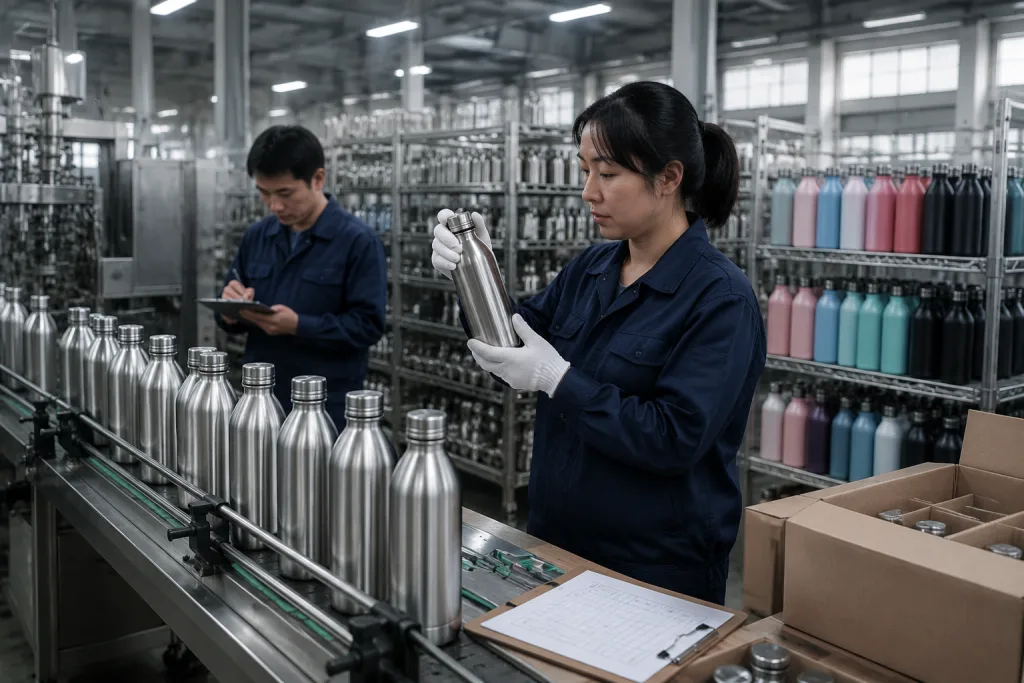
If you buy custom drinkware for retail, promotional campaigns, or distributor programs, lock the cost and lead-time map before artwork approval. BottleForge Industrial in Hangzhou, Zhejiang runs stainless bottle production for export buyers, with typical MOQs from 1,000 pieces and monthly output around 450,000 units across bottle, tumbler, and canteen factory lines in China. We run this through real stations: tube cutting, water expansion, laser welding, powder coating, logo printing, and AQL 2.5 final inspection before we ship.
Start with the bottle specification
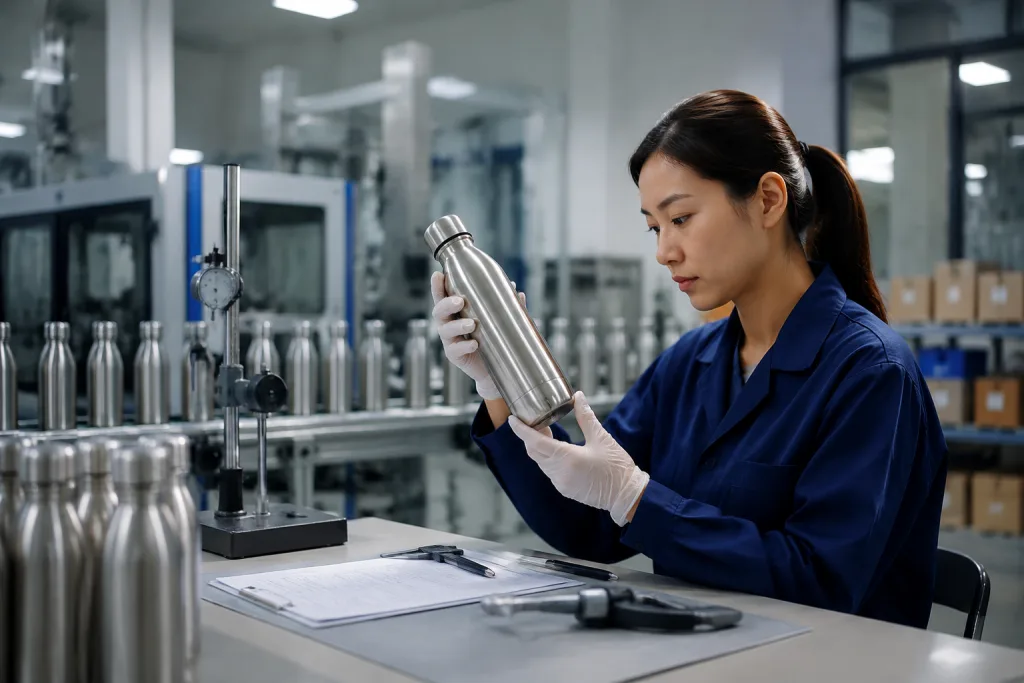
Before you compare any 304 stainless steel refillable water bottle custom quote, freeze the bottle spec first. Price is the wrong question to ask if the item is still vague. A 500 ml single-wall bottle and a 750 ml double-wall vacuum bottle are built on different lines; a 1 L canteen custom design needs more 304 stainless, longer TIG welding, extra leak testing, and a bigger master carton. On our line, QC also checks mouth roundness with a 0.02 mm caliper because a small oval mouth will make the lid feel cheap even when the bottle body looks fine.
For most export orders, 304 stainless steel is used for the inner wall, drinking contact area, or full body. The usual sheet thickness is 0.45-0.60 mm for the body, with slightly different gauges at the base and mouth area. If you push the wall thinner to save USD 0.15, the math often does not work: we have seen dent rejects move from 2% to 7% after polishing, and sea freight pressure marks show up more often in 9 kg cartons. For premium retail, we run tall bottles over 700 ml at no less than 0.50 mm unless the buyer accepts higher dent risk in writing.
The second decision is insulation. Single-wall bottles are cheaper and lighter, but they sweat with cold drinks and do not hold temperature. Double-wall vacuum bottles add welding, vacuum pumping, copper lining options, and heat-retention testing. A normal vacuum specification is 6-12 hours depending on size, lid seal, mouth diameter, and test temperature; our QC pulled one 750 ml sample last month at 95°C fill, 20°C room temp, and logged 63°C after 6 hours. Simple test. Hard to fake.
Then define the lid. PP, stainless cap, bamboo top, handle lid, straw lid, flip lid, and sports spout all change the mold, gasket, assembly time, and leak-test risk. A canteen customizable order with a wide-mouth screw cap and silicone loop is easier than a leakproof one-touch lid with five plastic components; we have seen this go sideways when the PO said “black lid” but the buyer expected a matte black PP button, not a glossy ABS button. If you are a canteen distributor or outdoor distributor growler buyer, ask for a lid exploded drawing, not only a photo. Small lid parts cause 30-40% of after-sales complaints on mixed-lid programs.
Real FOB cost ranges
A China FOB quote is built line by line: 304 stainless steel coil, forming, welding, vacuuming, polishing, surface finish, logo, lid, inner box, export carton, inland trucking to Ningbo or Shanghai, and factory margin. On our Zhejiang line, QC checks wall thickness with a digital caliper before polishing; a 0.1 mm change can move the quote. For BottleForge projects, a standard 304 stainless steel refillable water bottle custom order usually lands in these working ranges:
- 500 ml single-wall bottle: USD 2.10-3.60 FOB at 3,000 pieces, with the spread mainly coming from cap material, coating type, and whether the logo is screen print or laser.
- 500-600 ml vacuum bottle: USD 3.20-5.20 FOB at 1,000-3,000 pieces, before special retail packaging or Amazon label work.
- 750 ml vacuum bottle: USD 4.20-6.80 FOB at 1,000-3,000 pieces, depending on body diameter, lid structure, and powder coating yield.
- 1 L outdoor canteen customized model: USD 5.50-9.50 FOB, especially with handle lid, powder coating, or gift box.
- Custom growler or customized growler, 1.5-2 L: USD 8.50-16.00 FOB depending on insulation spec and cap system.
These are not magic numbers. They are guardrails. If a canteen supplier quotes USD 2.40 for a 750 ml double-wall powder coated bottle with retail box at 1,000 pieces, the math doesn't work. We have seen this go sideways: QC pulled the sample and found a non-vacuum body, 201 steel outside with thinner inner 304, a loose stock lid, or a 5-ply carton replaced by a weak 3-ply carton that crushes after 18 kg stacking.
Logo cost looks small on the PI, but it changes landed cost fast. One-color silk screen is often USD 0.08-0.18 per piece. Laser engraving is usually USD 0.12-0.35 per piece depending on logo size. Full wrap heat transfer can add USD 0.45-1.20. Last month the buyer flagged a 72 mm wrap logo that crossed the bottle seam; we had to move the artwork 4 mm and remake the film. A canteen promotional order with four-color artwork and an individual barcode sticker can spend more on finishing than the buyer planned.
Packaging is another hidden driver. A plain white box may add USD 0.12-0.25. A custom color box adds USD 0.25-0.65 at normal MOQ. Insert cards and hang tags sound harmless, but FNSKU labels, master carton printing, and Amazon carton rules need quoting before you issue the purchase order. We once caught a PO typo that said “24 pcs/carton” while the approved carton drawing was 12 pcs/carton; that single line would have changed carton size, gross weight, and booking volume.
MOQ tiers that actually change pricing
MOQ is not a punishment from the canteen manufacturer. It is where we can spread 42-60 minutes of line setup across enough bottles: coating booth clean-down, logo jig change, box proofing, and AQL 2.5 QC all cost time before the first sellable piece comes off the line. For stock bottle shapes, BottleForge can often discuss 1,000 pieces per model and 500 pieces per color if the finish is standard. For a fully custom canteen with new mold, new lid, or special body shape, 3,000-5,000 pieces is more realistic; below that, the math does not work after tooling trial and leak-test sorting.
We usually price custom drinkware against these MOQ breaks, and QC pulled the sample before quote release if the buyer asks for a finish we have not run in the last 90 days:
- 1,000 pieces: Best used for a stock body with a stock lid, one standard powder color, one logo position, and a plain or stickered box. Unit cost is higher, but lead time can stay around 25-30 days because the line is not waiting for new tooling.
- 3,000 pieces: A safer level for canteen customizable programs with 2 colors, retail box artwork, barcode labels, and a more stable FOB price. We can run carton drop-test samples and still keep packing efficiency reasonable.
- 5,000-10,000 pieces: This is where distributor canteen or distributor drinkware replenishment programs start to make sense. We can push powder coating loss down, improve carton loading, and often absorb logo screen setup if the artwork file is clean.
For customized drinkware, color MOQ matters as much as total MOQ. A buyer may ask for 3,000 units split into six colors. That is only 500 per color, which is awkward for powder coating; we still clean the gun, reset oven temperature, tape the mouth thread, and wait for first-piece approval on each color. Expect an upcharge or a lead time closer to 38 days vs 30 days. We have seen this go sideways when a PO says “matte green” but the approved sample is actually Pantone 5605C.
For packaging, printed color boxes usually need 1,000-3,000 pieces per artwork. If your canteen vendors say they can do 300 custom boxes at a low cost, check whether they are using digital printing, 250gsm thin paperboard, or a shared box with sticker label. That can pass for a trial order. It will not look right on a retail shelf in Europe or North America, and the buyer flagged it last year when the box corner crushed during a 10kg carton compression check.
A practical approach is to start with a stock 304 body and custom logo for the first order, then move to a customized canteen mold after sell-through data is clear. We ship this way for new programs because it keeps cash tied to proven demand, not a drawing. One buyer pushed for a private mold at 1,200 pieces; we said no, then ran 1,000 stock bottles first and changed the lid spec by 2 mm after market feedback.
Timeline from drawing to shipment
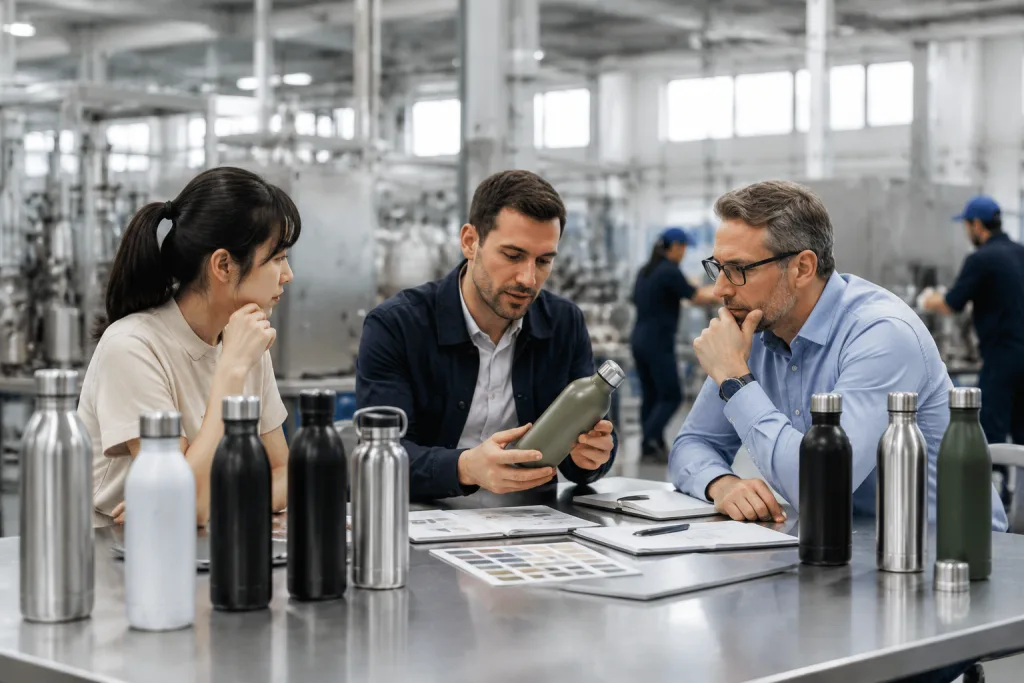
The fastest orders usually come from buyers who lock the spec sheet early, not from the factory that promises magic. We run into delays when the logo file changes after sampling or the PO says “matte black” while the approved mockup says PMS Black 6C. A normal 304 stainless steel refillable water bottle custom timeline from China looks like this:
- Day 1-3: Confirm bottle capacity in ml, lid type with silicone ring size, coating finish with PMS code, logo process with print area in mm, export carton pack, Incoterms, and FDA or LFGB needs for the target market.
- Day 4-7: Factory quotation, dieline check in AI or PDF, and digital mockup with logo position marked against the body seam.
- Day 8-15: Pre-production sample for a stock body with logo, if required; QC pulled the sample last week for a 0.6 mm logo shift, so this step is not just for photos.
- Day 16-20: Sample review, color correction against a Pantone book, PO check, and 30% deposit release.
- Day 21-45: Mass production for standard custom drinkware, including welding, vacuum test, coating, logo printing, and AQL 2.5 inspection on packed goods.
- Day 46-50: Final inspection, carton sealing, vessel booking, and FOB handover at Ningbo or Shanghai.
The honest lead time is 25-35 days after deposit and final artwork approval for stock molds. Not from the first email. If you need a new lid mold, add 15-25 days for CNC tooling, T0 trial fitting, and leak testing with a 24-hour inverted sample. If you need a new bottle body mold, add 30-45 days, especially for vacuum insulated shapes where the weld bead, mouth roundness, and vacuum loss rate need validation.
Peak season bites. Before summer campaigns and Q4 retail orders, a Zhejiang line can receive 40+ RFQs in a week for custom canteen and travel tumbler projects, and the buyer often asks for the same 750 ml body in five coating colors. A production slot open on Monday may be taken by Friday. If your delivery date is fixed, book capacity after sample approval; waiting for committee approval on every color is where we have seen this go sideways.
Sea freight to Europe or North America sits outside the factory lead time. FOB Ningbo or Shanghai is common for Zhejiang factories, and our shipping clerk will usually need the carton size, gross weight, and HS code before the forwarder confirms space. After vessel departure, plan 25-40 days to major European ports and 18-35 days to North America west or east coast, depending on routing. Air freight solves some emergencies, but stainless drinkware is heavy; at 0.28-0.45 kg per bottle, the math often does not work.
Compliance and inspection costs
For B2B buyers, compliance is not decoration on a file folder. It protects the account that will actually sell the bottle. A canteen manufacturer shipping to Europe or North America needs to know food-contact rules, migration testing, material declarations, and factory audit records. For 304 stainless steel, ask for the coil or tube grade confirmation, then check the parts buyers forget: powder coating, silicone seals, PP or Tritan lids, pad-print ink, and gift-box paper. We had one PO last year that said “304 body” but forgot to list the painted straw lid; QC pulled the sample and the buyer flagged the lid material before booking the lab.
Typical compliance work includes LFGB or EU food contact testing for Europe, FDA-related food contact documentation for the United States, REACH screening for coatings or components, and California Proposition 65 review when your channel asks for it. If the product is for children, the test list can move into CPSIA, ASTM, small parts, and coating safety. A kids bottle is not a small adult bottle. That is the wrong question to ask. On the line, we measure detachable parts with a small-parts cylinder, and a 6 mm silicone plug can turn into a compliance problem faster than a buyer expects.
Third-party lab testing can cost USD 250-1,200 per model depending on market and test scope. Factory audit support, such as BSCI or ISO-related documentation, should be discussed before deposit, not after the cartons are printed. If your retailer requires a certain audit grade, do not place the order first and ask later. The math does not work. We have seen a 3,000 pcs trial order held for 18 days because the buyer’s portal needed an audit file the factory had not prepared, while normal pre-production approval would have taken 12 days.
Inspection also needs a budget line. AQL inspection is common before shipment. For drinkware, buyers often use AQL 2.5 for major defects and 4.0 for minor defects, with critical defects set to zero acceptance. Inspectors check leakage, dents, scratches, coating adhesion, logo placement, capacity, carton marking, barcode readability, and drop-test performance. A basic third-party inspection in China may cost USD 250-350 per man-day. In our packing area, the inspector usually opens cartons with a 9 mm cutter, checks carton marks against the PO, then fills bottles to the thread line before the 30-minute upside-down leak check.
Do not skip leak testing to save half a day. For vacuum bottles and canteen customized lids, we run a 100% factory leak test plus random AQL inspection; that is the minimum I would accept for distributor drinkware resold under your brand. We have seen this go sideways: 2 leaking sport caps in a 200 pcs pre-shipment sample can mean dozens of customer complaints after a 20,000 pcs launch.
Where buyers lose money
Most overruns on custom drinkware start with late decisions, not steel price. We see it on the line when a buyer approves a matte black powder-coated sample, then asks for a rubberized hand feel after the golden sample is signed. Different finish, different route. Powder coating, spray paint, electro-polishing, or raw stainless all need separate jig setup, curing time, and adhesion checks with the cross-hatch cutter. That change can turn a normal 18-day sampling window into 28 days before mass production even starts.
The second money leak is chasing the lowest quote without locking the spec sheet. One canteen vendor quotes 304 inside and 201 outside. Another quotes 304 full body. One includes copper lining. Another leaves it out. One uses a 0.48 mm body. Another uses 0.38 mm. On a 10,000 pcs order, that is not a small gap. We once had a buyer flag a USD 0.42 price difference, then QC pulled the sample and found the lighter wall thickness with a digital micrometer. The math did not work.
The third problem is weak packaging for e-commerce. A bottle that survives pallet shipment to a distributor canteen warehouse can still fail parcel delivery after 6 drops from 76 cm. If you sell online, specify carton strength, inner box material, wrap type, drop-test height, and FNSKU label position. We ship Amazon-style orders with 5-layer export cartons more often now because a USD 0.20 stronger box can prevent a USD 12 customer complaint. Cheap cartons look good only on the PO.
The fourth problem is vague ownership of artwork and molds. For a custom growler, custom lid, or private body shape, state who owns the tooling, whether the mold can be used for other customers, and what happens after 12 months without repeat orders. Tooling for a simple plastic lid part may be USD 800-2,500. A stainless body mold set can be several thousand dollars or more depending on complexity. Put it in the PI, not just a WeChat message; we have seen this go sideways when a buyer changed agents after the first run.
A practical RFQ should include capacity, dimensions, steel grade, insulation requirement, lid type, logo size, logo method, Pantone color, packaging, test standards, target FOB port, quantity by color, and required ship date. Better yet, send one locked PDF plus one Excel sheet, because a single typo on a PO, like 500 ml becoming 550 ml, can hold the line for 2 days. Good canteen suppliers respond faster when the question is precise.
How to buy from Zhejiang
Hangzhou and the Zhejiang belt work well for stainless drinkware because the shops sit close together: tube forming, polishing, powder coating, plastic injection, silicone gasket molding, color box printing, then truck to Ningbo or Shanghai. On a normal week we can send a 24 mm neck ring to the polishing vendor in the morning and get corrected samples back before dinner. Still, this is the wrong question to ask if you only ask “Are you in Zhejiang?” A canteen vendor with a nice catalog can still fail on rim roundness, coating adhesion, or export packing.
When you compare canteen manufacturers, ask for last week’s production schedule, not only a PDF catalog. A serious canteen manufacturer can tell you the coating line output per shift, sample room lead time in days, and whether your requested vessel date matches the line. At BottleForge, normal stainless drinkware capacity is about 450,000 units per month, but we reserve line time by confirmed PO and deposit. No deposit, no slot. Last month one buyer pushed for 18 days ex-factory on a 12,000 pcs matte black order; QC pulled the sample after tape test because the powder coat was too soft, so the real answer was 26 days, not sales talk.
For a first order, keep the commercial structure clean. Use FOB Ningbo or FOB Shanghai if your forwarder already handles China exports. Use EXW only if your team knows inland pickup, customs paperwork, and who pays when the truck waits 6 hours at the gate. New buyers usually pay 30% deposit and 70% before shipment after inspection. Larger distributor growler or canteen distributor programs can discuss staged shipments or blanket orders after 2 or 3 clean cycles, but the math does not work if the first PO has 9 SKUs, 4 lids, and a typo in the carton mark.
Samples are engineering evidence, not souvenirs. Check weight, capacity, mouth diameter, lid torque, coating hand feel, logo edge sharpness, and carton fit with a real caliper and a torque meter if you have one. Fill the bottle, invert it for 30 minutes, shake it 20 times, then leave hot water inside to check silicone or plastic smell. For vacuum bottles, measure heat retention using the same water temperature and room temperature you gave the factory; we run 95°C water and log the reading after 6 hours unless the buyer specifies another method.
The buying process should stay boring: define the product, approve one physical sample, freeze the artwork, inspect before shipment, then review defects after delivery. We’ve seen this go sideways when buyers approve a photo, change the logo 3 days before coating, and skip carton drop testing. Do the basic controls, and a 304 stainless steel refillable water bottle custom project becomes a managed production job, not a daily firefight.
Get a costed bottle quote before sampling
Send your capacity, logo, quantity, packaging, and delivery date. We will return a practical FOB quote with MOQ and lead time.
Frequently asked questions
What is a realistic MOQ for a 304 stainless steel custom bottle?
For a stock body with your logo, 1,000 pieces per model is realistic, and some factories may allow 500 pieces per color if the finish is standard. For a custom canteen shape, custom lid, or special mold, expect 3,000-5,000 pieces. Printed retail boxes can also push MOQ up because packaging suppliers prefer 1,000-3,000 pieces per artwork. If you are testing a market, start with a stock 500 ml or 750 ml body, one or two colors, and laser or silk screen branding. That keeps the first order manageable while still looking like customized drinkware.
How much should I budget per unit for a custom 304 bottle?
A normal 500-600 ml double-wall 304 stainless steel refillable water bottle custom order usually lands around USD 3.20-5.20 FOB China at 1,000-3,000 pieces. A 750 ml vacuum bottle often costs USD 4.20-6.80 FOB. Single-wall bottles can be lower, around USD 2.10-3.60 depending on cap and finish. Add USD 0.08-0.35 for common logo work, USD 0.25-0.65 for a custom color box, and more for full-wrap graphics or special coatings. Always compare quotes using the same steel grade, wall thickness, lid, packaging, and test requirements.
How long does production take after I approve the sample?
For a stock mold with custom logo and standard finish, plan 25-35 days after deposit and final artwork approval. If you need a new plastic lid mold, add about 15-25 days. If you need a new stainless body mold or a complex customized growler design, add 30-45 days before mass production is stable. Shipping time is extra. From FOB Ningbo or Shanghai, sea freight often takes 18-40 days depending on destination. Buyers often lose time during artwork revisions, not production, so freeze Pantone color, logo size, and packaging before issuing the PO.
Is 304 stainless steel enough for Europe and North America?
304 stainless steel is the common choice for reusable drinkware because it has good corrosion resistance and is accepted by most B2B buyers. But compliance is not only the metal. You also need to check silicone seals, plastic lids, coating, ink, and packaging. For Europe, buyers often request LFGB or EU food contact testing plus REACH review where relevant. For the United States, FDA food contact documentation and Proposition 65 review may be requested by retailers. If the bottle is for children, CPSIA and ASTM-related requirements may apply. Confirm the testing scope before mass production.
Should I choose laser engraving or silk screen for my logo?
Laser engraving is durable, clean, and good for stainless or powder coated bottles. It usually costs USD 0.12-0.35 per piece depending on logo size and position. Silk screen printing is cheaper for one-color logos, often USD 0.08-0.18 per piece, and works well for promotional canteen orders. However, it can scratch if the coating, ink, or curing process is weak. For retail custom drinkware, laser is safer for long-term brand appearance. For large promotional campaigns with simple artwork, silk screen can be cost-effective if you approve adhesion testing before production.