Key Takeaways
- For 304 stainless steel bottle bulk orders, workable MOQ is usually 1,000-3,000 pcs per color or logo
- Ask for SUS304 inner steel, food-contact test reports, and AQL inspection level before deposit
- Vacuum bottle lead time is commonly 35-50 days after artwork and sample approval
- FOB China price changes quickly when you add powder coating, gift box, barcode, spare lid, or FBA carton rules
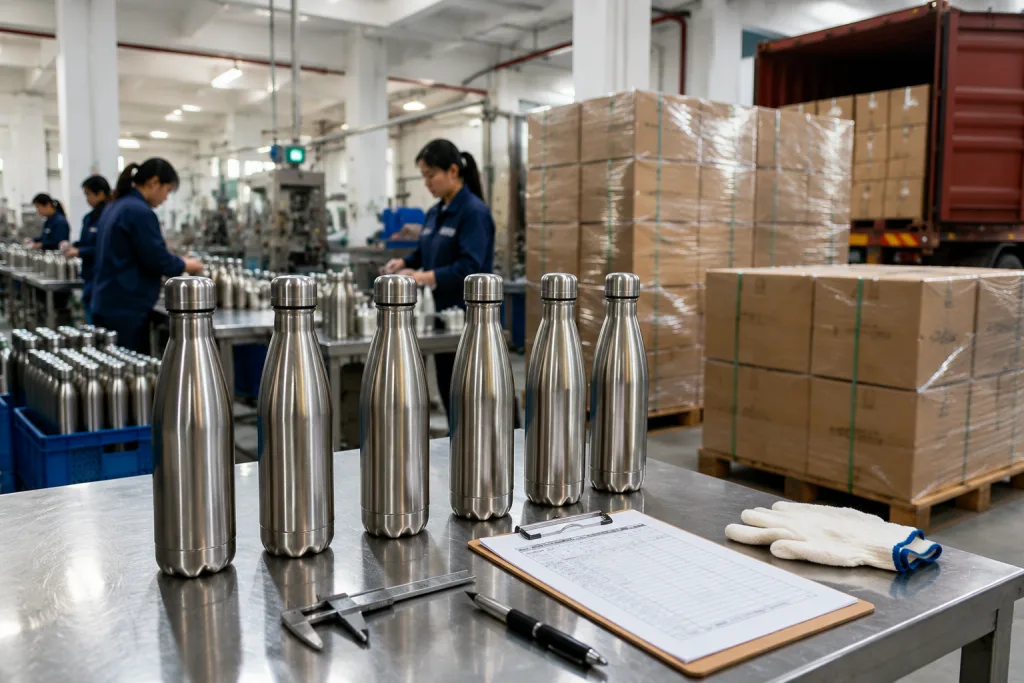
You are buying more than a bottle. You are buying a supply program we have to repeat on the line: 304 stainless steel grade, vacuum hold, powder-coat adhesion, gift-box fit, 5-layer carton strength, barcode scan rate, and the ship date your sales team already put on a PO.
Buyers asking our Zhejiang team about 304 stainless steel refillable water bottle bulk orders usually start with price, but that is the wrong question to ask first. The problem is the spec. A 500 ml bottle can be USD 2.10 or USD 5.80 FOB China depending on 0.4 mm vs 0.6 mm wall thickness, lid structure, coating process, test standard, and packing method; last month QC pulled the sample because the buyer's PO said matte black, but the artwork file said Pantone 426C. This checklist is how we brief a procurement manager before sampling.
Start With The Real Use Case
The first buyer question should be: who refills this bottle, where, and how often? Ask that before price. A gym retail program, a corporate ESG gift, and an outdoor bulk canteen order put different stress on the body, coating, and lid. If the RFQ only says “best price 750 ml stainless bottle,” 8 out of 10 factories in China will quote the lightest acceptable version; on our line that can mean a thinner outer shell checked by micrometer at incoming QC.
For daily commuting and corporate wholesale drinkware, 304 stainless steel inner and outer shells are usually enough. For sports, school, or outdoor resale, spec a thicker outer wall, tougher powder coating, and a lid carry loop with a pull-strength test, not just a nice photo. QC pulled the sample last month on a school bottle because the loop stretched after a 15 kg pull. For beer growler bulk or wholesale growler programs, mouth diameter, cap seal, and carbonation pressure behavior matter more than a fashionable shape. The math doesn't work if the growler looks good but leaks in a distributor carton.
Practical checklist before you request a quote: Send this with the RFQ. We run it against the mold list, lid stock, coating line schedule, and carton drop-test requirement before giving a serious price.
- Capacity: 350 ml, 500 ml, 750 ml, 1,000 ml, 1.9 L, or 64 oz growler.
- Use: office refill, retail shelf, outdoor canteen wholesale, beer growler wholesale, or promotion.
- Insulation target: 6 hours, 12 hours, or 24 hours.
- Sales channel: distributor carton, retail gift box, or Amazon FBA with FNSKU.
- Compliance market: EU, UK, Canada, or US.
A Zhejiang factory with 450,000 bottle units/month capacity can produce 60+ regular shapes, but your specification must say which performance trade-off is acceptable. Otherwise you compare random samples, not suppliers. We have seen this go sideways when a PO had “750 ml” in the item name but “500 ml” in the packing notes, and the buyer flagged it only after the carton artwork was finished.
What 304 Stainless Really Means
For a 304 stainless steel refillable water bottle bulk order, “304” is not a sales slogan. It means austenitic stainless steel, usually around 18% chromium and 8% nickel. On our line, the inner wall is the food-contact part QC checks first with an XRF gun before polishing. The outer wall can be 304 as well, or 201 on low-cost promotional runs where the buyer is chasing a lower FOB price. For brand owners, we push for 304 inner and 304 outer. If the target price needs 201 outside, say it clearly on the PO, because this is where claims go sideways.
Ask the supplier to write SUS304 or 18/8 stainless steel on the proforma invoice and pre-production sheet. No shorthand. We have seen a PO typo change “304 inner” to “SS inner,” and the buyer flagged it during document review three days before deposit. If you sell into Europe, request LFGB or REACH-related food-contact documentation where applicable. For the US, ask about FDA food-contact compliance and, for kids items, whether ASTM and CPSIA considerations apply. Testing costs are not free; a full third-party food-contact test can add several hundred USD per material/color combination, but it protects your listing and distributor relationship.
Wall thickness is where buyers miss money. Many vacuum bottles use inner wall around 0.4 mm and outer wall around 0.5 mm, with variation by shape. A bottle cut too light saves maybe 12 to 20 grams, then dents when cartons take pressure in a 16 kg master carton. Too heavy, and the math does not work on freight or retail margin. For premium wholesale drink bottle projects, we run target unit weight beside capacity, not after the mold is opened.
Do not approve a bulk sample only because it looks good on a desk. Fill it, shake it, drop it from 80 cm in packaging, wash it, and check odor after 24 hours. QC pulled one sample last month that passed visual inspection but smelled like cutting oil after hot-water soaking.
Price Questions Buyers Should Ask
FOB China pricing for 304 stainless steel bottles starts with steel weight, cup body forming, lid material, coating, logo process, packing, reject allowance, and order quantity. On our line, a plain 500 ml single-color vacuum bottle usually lands around USD 2.20-3.20 FOB Ningbo or Shanghai at 3,000 pcs, assuming standard 0.4 mm outer shell and no retail insert. A 750 ml retail-ready bottle with powder coating, laser logo, silicone boot, gift box, instruction sheet, and stronger carton can move to USD 4.20-6.50, and QC pulled the sample last month because the boot added 38 g and changed the carton compression result. A beer growler in bulk, especially 1.9 L or 64 oz, eats more 304 stainless and carton space, so the freight ratio jumps fast once the master carton passes 18 kg.
Chasing the lowest unit cost is the wrong question to ask. Ask what got cut. Did the supplier switch powder coating to spray paint? Did the lid gasket move from food-grade silicone to a cheaper TPE ring? Is the carton 5-ply, or a thin export carton that caves in after 2 pallet rows? Is the bottle packed in polybag only instead of a white box? We have seen this go sideways: the buyer saved USD 0.08 per pc, then flagged 92 coating scratches during inbound inspection.
MOQ is usually 1,000-3,000 pcs per model for stock color with custom logo, and 3,000-5,000 pcs per custom Pantone color. For canteen bulk, alcohol flask bulk, and beer tumbler bulk, mold sharing, lid inventory, or welding fixture limits can push the number higher; the math does not work if the line changes color every 200 pcs. If you need mixed colors under one PO, ask whether the factory can run 500 pcs per color while keeping total MOQ at 3,000 pcs. Get it written on the PI. One buyer once sent a PO with “Pantone Black” as the color code, and production stopped for 2 days waiting for a real number.
Quote request line you can copy: “Please quote FOB Ningbo for 3,000 pcs and 5,000 pcs, SUS304 inner/outer, powder coating, one-position laser logo, individual white box, AQL 2.5/4.0 inspection, lead time after sample approval.”
Logo, Finish, And Retail Packaging
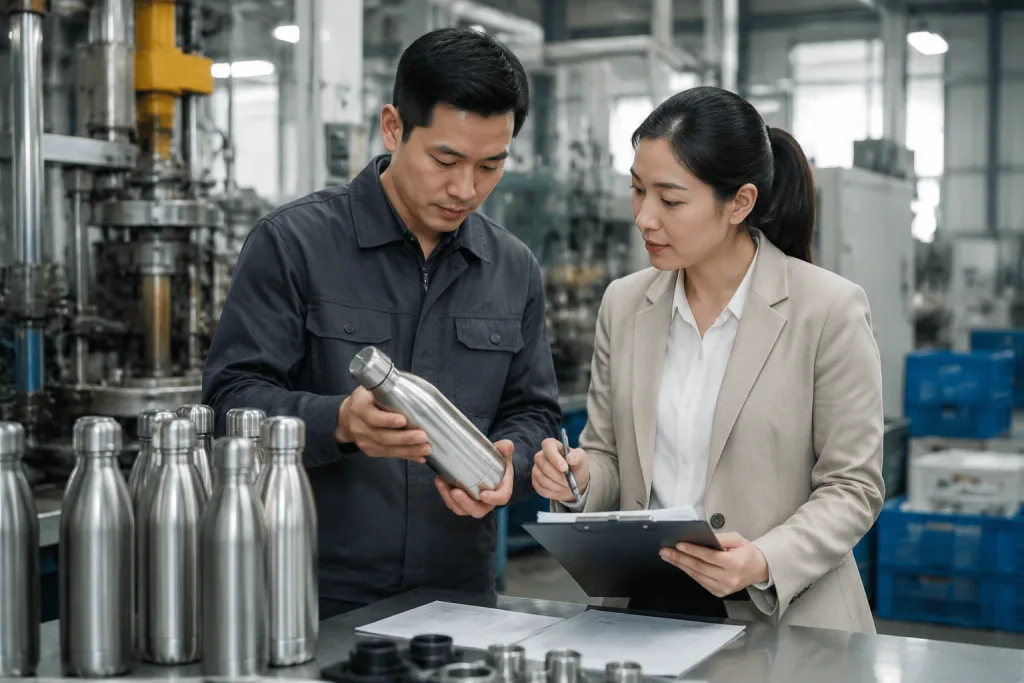
Brand owners sometimes spend 14 days choosing the bottle shape, then send a 72 dpi JPG logo 1 day before sampling. That holds the sample room. For wholesale drinkware, send vector artwork in AI, PDF, or EPS, with Pantone references on the same file. If you need laser engraving, the logo must still read in one color. If you need silk screen, avoid reversed text under 1 mm stroke width; QC pulled a film last month with 0.6 mm letters, and the ink closed up on the first production trial.
We run five decoration options most weeks: laser engraving for clean corporate orders, silk screen for one-color or two-color budget jobs, heat-transfer print for photo-style graphics, water-transfer print for irregular surfaces, and full-wrap powder coating when the brand wants a solid retail look. Laser is durable and neat for corporate programs. Silk screen keeps cost down. Heat-transfer looks stronger on shelf, but the math does not work if the artwork is messy and every sample needs rework after a 3M tape scratch test. For alcohol flask wholesale or alcohol flask wholesale bulk, laser and embossing are safer choices because the product gets rubbed in pockets, bags, and gift sets.
Packaging changes landed cost and shelf value. A distributor selling canteen wholesale may only need a kraft box plus a 5-ply master carton. A retail brand may need a color box, hang tag, barcode sticker, warning text, and insert cards split by language: English for the US, French for Canada, German for DACH orders, or Spanish for Mexico. Amazon-oriented wholesale drinkware needs FNSKU labels, carton weight control, and carton drop testing. We usually keep master cartons under 15 kg when possible; the buyer flagged a 16.8 kg drinkware bulk carton in inspection once, and the warehouse team refused hand unloading.
Before mass production, approve a golden sample with logo position measured in millimeters, not “centered.” Centered is the wrong word to use on the line. For curved bottles and bulk growler bodies, visual center can differ from mathematical center, so we mark the position with a height gauge and record, for example, 82 mm from the bottom edge and 0 mm from the front seam.
Quality Control Before Shipment
Quality control is where seasoned buyers protect margin. On a 5,000 pc 304 stainless steel refillable water bottle bulk order, finding a lid leak after the cartons land in Hamburg, Rotterdam, Los Angeles, or Toronto usually costs 6–9 times more than stopping the goods in Zhejiang. We have seen this go sideways: one buyer skipped final inspection to save USD 180, then paid for 312 replacement lids by air. Put the inspection standard in the PO before we run the line, including AQL level, test method, carton drop requirement, and who signs off the golden sample.
For standard drinkware wholesale orders, most buyers we ship for use AQL 2.5 for major defects and 4.0 for minor defects under general inspection level II. Critical defects need zero tolerance: sharp edges, contamination, wrong material, serious leakage, missing safety label, or barcode mismatch. No debate there. For vacuum bottles, the factory should run 100% vacuum testing during production, then final inspection checks another sample set before packing release. In our workshop, QC pulls bottles from the line, fills 95°C hot water, records the start temperature with a probe thermometer, checks cap sealing in the inverted position, and touches the outer wall after the set hold time. If the wall warms too fast, the math does not work for a vacuum claim.
Inspection checklist for bulk drinkware:
- Capacity and net weight against the approved sample, checked with a digital scale and measuring cylinder.
- Inner steel marking and material declaration, including 304 stainless confirmation on the supplier file.
- Leakage test in upright and inverted positions, with 10 minutes per position on the QC bench.
- Coating adhesion by cross-cut or tape test where applicable, especially on powder-coated bodies.
- Logo size, color, and placement, measured in mm against the artwork sheet.
- Odor, oil residue, burrs, dents, scratches, and weld marks, since QC often finds these around the mouth rim.
- Gift box, barcode, FNSKU, carton mark, and pallet requirement, including any PO typo the buyer flagged before shipment.
If you are ordering beer tumbler wholesale bulk or beer growler wholesale bulk, check cap fit, gasket seating, thread smoothness, and accessory packing consistency. This is the wrong place to rush. A missing silicone gasket that costs RMB 0.18 can turn into 200 customer service emails once the goods hit Amazon FBA or a retail DC.
Choosing The Right Supplier
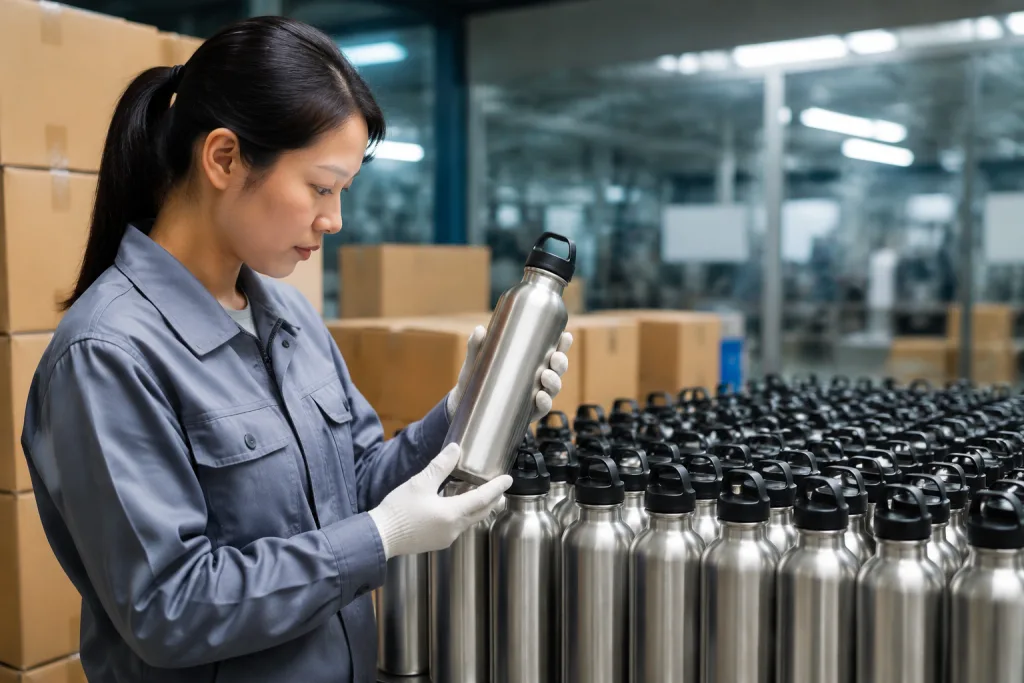
A good supplier is not the factory with the lowest first quote. That is the wrong question to ask. You need a team that explains trade-offs before they turn into claims, such as why a 0.45 mm inner wall may pass price review but dent too easily after drop testing. In China, especially in Zhejiang where bottle, tumbler, and flask supply chains are clustered, stronger factories keep forming, polishing, coating, assembly, and packing under steady control. Ask what is done in-house and what is sent out. Outsourced coating is not a problem by itself, but the owner of the defect must be clear when QC pulled the sample and found orange peel on 18 pcs out of 200.
For a wholesale drink bottle program, ask for recent audit status such as BSCI, Sedex, or ISO 9001 if your customers require it. Ask for monthly capacity, normal lead time, and peak-season limits. Our practical planning window is 7-10 days for sample preparation on existing molds, 35-50 days for mass production after deposit and artwork approval, and 20-35 days ocean freight to European and North American ports depending on route and season. We run capacity by line, not by wishful thinking; a 500 ml powder-coated bottle line may handle 28,000-35,000 pcs per week, but laser logo work slows that down if the logo is 70 mm tall instead of 35 mm.
Be careful with suppliers who accept every request instantly. Custom Pantone coating, mixed cartons, retail inserts, alcohol flask in bulk, beer growler wholesale, and canteen bulk programs all need line planning. If a supplier says yes to 12 SKUs, 6 colors, 3 logos, and 1,000 pcs total with no price change, check the details twice. We have seen this go sideways when the buyer flagged carton marks after production because the PO had one digit wrong in the SKU code.
Send a professional RFQ, compare like for like, then use samples and inspection reports to confirm. Short beats messy. A clear PO, approved artwork, signed sample, and agreed AQL standard work better than a long email chain. For wholesale canteen or growler bulk sourcing, we ship cleaner when the pre-production sample is sealed in the sample room, the caliper reading is recorded, and the inspection checklist states AQL 2.5 before the deposit hits our account.
Send Your Bottle Spec For A Factory Quote
Share capacity, quantity, logo, packaging, and destination port. We will respond with MOQ, FOB pricing, lead time, and sample options.
Frequently asked questions
What is a realistic MOQ for 304 stainless steel refillable water bottle bulk orders?
For existing molds, a realistic MOQ is usually 1,000-3,000 pcs per logo or color. If you use stock bottle colors and add laser engraving, some factories can support 1,000 pcs. For custom Pantone powder coating, expect 3,000-5,000 pcs because the coating line, color change, and reject allowance need volume. For beer growler bulk, bulk canteen, or alcohol flask wholesale projects, MOQ depends on mold availability and accessory count. A small trial order is possible, but the FOB price may be 10-25% higher than a normal production run.
How do I verify the bottle is really 304 stainless steel?
Ask for the material declaration to state SUS304 or 18/8 stainless steel for the inner wall, and preferably for the outer wall too. Include this wording in the PI and purchase order. For higher-value wholesale drinkware, request third-party food-contact testing for the exact material and surface finish, not just an old generic report. During inspection, a lab can perform material identification, but that adds cost and time. A reliable factory in China should also keep incoming steel records and production batch traceability. Do not rely on a magnet test alone; it is not precise enough for procurement decisions.
What lead time should I plan for custom logo bottles?
For an existing mold with one logo, plan 7-10 days for sample preparation after artwork confirmation. Mass production normally takes 35-50 days after deposit and sample approval. Peak season before summer and Q4 gifting can stretch this by 10-15 days, especially for powder coating and retail gift box packing. Ocean freight to Europe or North America may add 20-35 days on the water, plus customs and inland delivery. If you need drinkware bulk for a fixed launch date, work backward at least 90 days from your required warehouse arrival.
Which logo method is best for wholesale drinkware?
Laser engraving is the safest choice for durability, especially on powder-coated 304 stainless bottles, alcohol flask bulk programs, and corporate canteen wholesale orders. It has no ink to peel, but the logo appears as a single engraved tone. Silk screen is cheaper and good for simple one- or two-color artwork, with a typical setup charge of USD 30-80 per color. Heat-transfer or full-wrap printing gives stronger retail shelf impact but needs scratch testing and better artwork control. For outdoor or dishwasher-exposed products, test the decorated sample for coating adhesion before approving mass production.
Can one supplier handle bottles, canteens, growlers, tumblers, and flasks?
Sometimes, but check the real production capability. A stainless bottle factory may handle vacuum bottles, beer tumbler wholesale, beer tumbler in bulk, and some bulk growler items using shared forming and polishing processes. Alcohol flask wholesale bulk may use different tooling and polishing fixtures. Large beer growler in bulk orders also need stronger leak testing and carton design because the product is heavier. It is efficient to source related items from one Zhejiang supplier if they control quality well, but do not assume every SKU is made on the same line or under the same AQL risk.