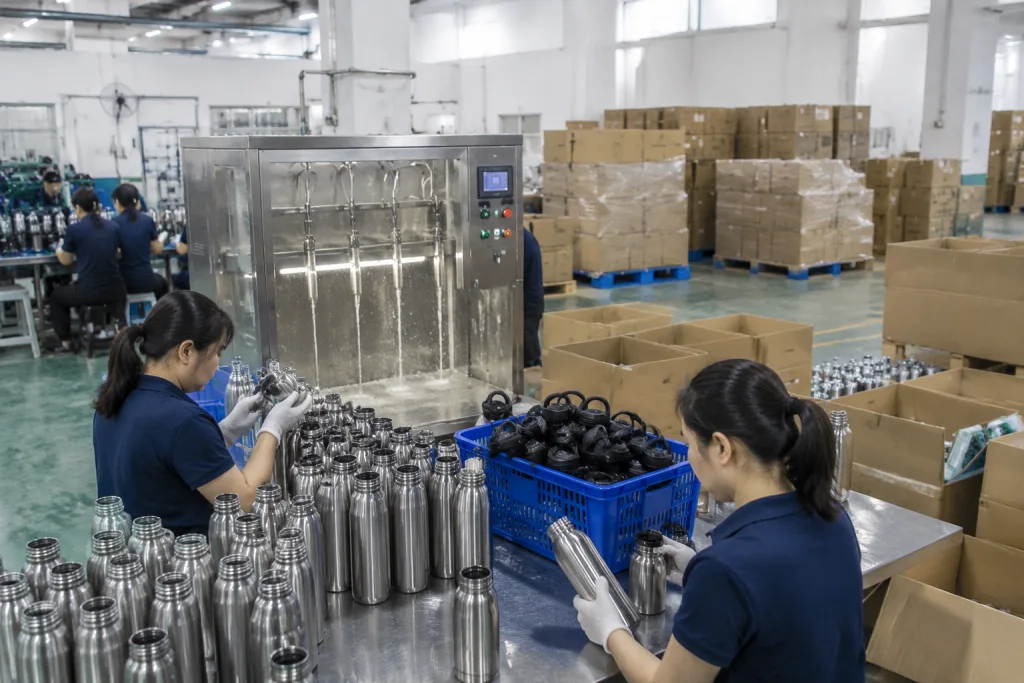
Key Takeaways
- Set the application first: canteen, tumbler, growler, flask, or promotional drinkware each needs different 304 steel thickness and PP lid design.
- A practical China MOQ is usually 1,000-3,000 pcs per SKU, with 35-50 days lead time after artwork approval.
- For EU and North America, request LFGB or FDA food-contact reports, REACH checks for coatings, and AQL 2.5/4.0 inspection terms.
- Decoration choice changes defect risk: laser engraving is stable at 0.3-0.5 mm line width, while full-color print needs tighter color approval.
If you are buying 304 stainless steel polypropylene bottle wholesale for a retail line, promotion program, or distributor catalog, finding 20 factories on Alibaba is the easy part. The harder job is choosing the bottle build, test documents, printing process, and carton spec that will hold up after a 1.2 m drop test, 18 kg master carton loading, and a buyer asking why the lid gasket smells after hot-water rinse.
From our Hangzhou, Zhejiang factory network, we see one mistake almost every week: buyers chase unit price before they define the use case. Wrong question. A 1 L outdoor canteen, a 64 oz beer growler wholesale order, and an alcohol flask bulk program should not share the same lid tooling, wall thickness, carton drop standard, or MOQ. Last month QC pulled a pre-shipment sample where the PO said “PP lid black,” but the artwork file showed transparent PP; that one typo delayed approval by 3 days. Start with the decisions below before you ask for FOB pricing.
Start With The Drinking Use Case
The first decision is not whether the quote is USD 2.10 or USD 2.45 FOB Ningbo. The better question is what the bottle must survive after it leaves the carton. We run 304 stainless steel polypropylene bottle wholesale orders with a 304 stainless inner or single-wall body, then pair it with a polypropylene lid, cap, handle, straw part, or inner stopper. Simple on paper. On the line, a 0.3 mm lid-fit gap or a PP thread that feels rough after 20 open-close cycles can change the whole sample approval.
For outdoor and school programs, a wholesale canteen needs impact resistance, a carry loop, leak testing, and powder coating that holds up after abrasion. Our QC team usually does a 1.2 m drop test on a full bottle, then checks the base dent and lid crack with a go/no-go gauge. For office and retail drinkware wholesale, buyers push harder on finish consistency and shelf packaging; last month one buyer flagged a 2 Pantone shade drift between the approved chip and mass production. For beer growler wholesale or bulk growler programs, the priorities move to capacity tolerance, seal strength, odor control, and carbonation pressure expectations. If you are sourcing beer tumbler wholesale bulk, rim feel and insulation time matter more than a complicated cap. The math doesn't work if you spend the budget on a fancy lid and then get complaints about hot rims.
Use a short decision table before you request samples. It saves 5 to 7 days because the sample room does not need to remake the same bottle with a different lid mold. We have seen this go sideways when the PO says “black lid” but the artwork file says “matte charcoal PP,” and QC pulled the sample only after carton printing had started.
- Canteen bulk: 500 ml to 1,200 ml, PP screw lid, carry handle, anti-leak gasket, outdoor coating tested for scratches after 100 rubs.
- Drinkware bulk: 350 ml to 750 ml, straw lid or flip lid, retail color range, gift box or belly band with barcode position confirmed before printing.
- Growler wholesale: 1 L to 2 L, wide mouth, heavy cap seal, thicker body, stronger carton packing with 5-ply export cartons for heavier loads.
- Alcohol flask wholesale: 4 oz to 10 oz, compact body, food-grade gasket, gift packaging, tighter surface inspection under a 60 cm lightbox check.
When a buyer says they want the best wholesale drink bottle, we ask one thing first: best against which complaint? Drop damage, dishwasher failure, leakage, logo wear, rust marks, or late delivery. Each answer points to a different specification and a different cost. For example, a laser logo passes wear testing better than a low-cost pad print, but if the MOQ is only 1,000 pcs and the buyer needs 6 colors, the setup cost bites fast.
Specify 304 Steel And PP Clearly
304 stainless steel is our normal pick for mid-market wholesale drinkware because it gives a workable balance on corrosion resistance, forming loss, unit cost, and food-contact paperwork. Do not put only “stainless steel bottle” on the RFQ. That line causes trouble. Write SUS304 or 18/8 stainless steel for the food-contact area, then state single-wall or double-wall vacuum. On canteen wholesale and beer tumbler bulk orders, we usually quote inner 304; outer 304 depends on the target price and structure. Last month a buyer sent a PO saying “SS bottle” only, and QC pulled the sample after the magnet check because purchasing had costed a mixed-material outer shell.
Wall thickness is where cheap quotes hide. A common stainless drink bottle body may use 0.4 mm to 0.5 mm material before forming. Dropping thickness can save a few cents, but dent claims go up, mainly on large bulk growler bodies. For 1.9 L beer growler in bulk, we spec the body tighter than a 500 ml promotional bottle because the sidewall is bigger and carton crush marks show faster after sea freight. We’ve seen this go sideways: 18 pcs in one AQL 2.5 inspection had visible side dents after a 76 cm drop test on the master carton.
Polypropylene needs the same level of detail. PP works well for lids because it is light, easy to mold, food-contact suitable, and handles normal hot-fill contact better than cheaper plastics such as PS. Define the PP lid grade, silicone gasket grade, straw material if used, and food-contact documents for the color masterbatch. Black PP lids are easier to judge on the line. White and transparent PP parts show flow marks and black specks fast; our injection team checks them under a 6000K inspection lamp before packing.
For Europe, ask for LFGB or EU 10/2011 food-contact support where relevant, plus REACH screening for coatings and plastics. For North America, FDA food-contact declarations and Prop 65 review depend on the sales state and retailer rules. A Zhejiang supplier can arrange testing through SGS, TUV, Intertek, or BV, but you need to choose the test scope: material report, finished-product migration test, or both. The wrong question is “Do you have certificates?” Ask which exact part was tested, because we have seen reports for a black lid used to approve a beige PP lid on a new order.
Choose Capacity, Lid, And Seal
The lid fails before the 304 body. We see it on the line: QC fills 300 samples, turns them upside down for 30 minutes, and the first drip usually comes from the PP cap thread or silicone plug. For 304 stainless steel polypropylene bottle wholesale, the lid choice changes mold cost and the defect rate. A basic PP screw cap is often the safe pick for school canteen and promo programs, because there are fewer moving parts. A flip lid or straw lid can raise the shelf price by USD 0.35 to 0.80, but now we run hinge pins, springs, silicone seals, straws, and extra gauges at inspection.
Capacity changes the packing math. A 500 ml bottle normally has 20 plus existing mold options in Zhejiang and Guangdong, so sampling is fast and carton size is predictable. A 750 ml or 1 L canteen bulk item often still fits standard tooling. A 1.9 L wholesale growler or beer growler wholesale bulk order is different: the carton needs stronger K=K board, and our packers check vacuum or leakage after the bottle sits for 12 hours, not just after filling. For alcohol flask in bulk, the problem is smaller but less forgiving. QC pulled the sample last month because the cap sat 0.6 mm off center, and the buyer flagged the polished face under shop lighting.
Put leak testing in the purchase order. Do not leave it for the claim email. For screw-lid bottles, we run a 100% inline leak check on water-holding items, then a random pre-shipment check under AQL. A practical inspection plan is AQL 2.5 for major defects and 4.0 for minor defects, with critical defects set to 0. For growler bulk orders, add cap torque or seal compression checks when the lid is new; our torque meter normally catches loose seals before cartons close, but only if the PO says the test is required.
Cleaning gets ignored too often. This is the wrong question to ask: “Which lid looks best?” Ask who has to wash it after 30 days of use. Wide-mouth bottles reduce odor complaints and dry faster on a rack, especially with a 50 mm mouth opening. Narrow-mouth canteens pour cleanly, but bottle brushes miss the shoulder area. Straw lids sell in drinkware bulk channels, yet they need spare straw planning for Amazon and club retail; we usually quote 2% spare straws in the master carton because warranty buyers notice missing parts fast.
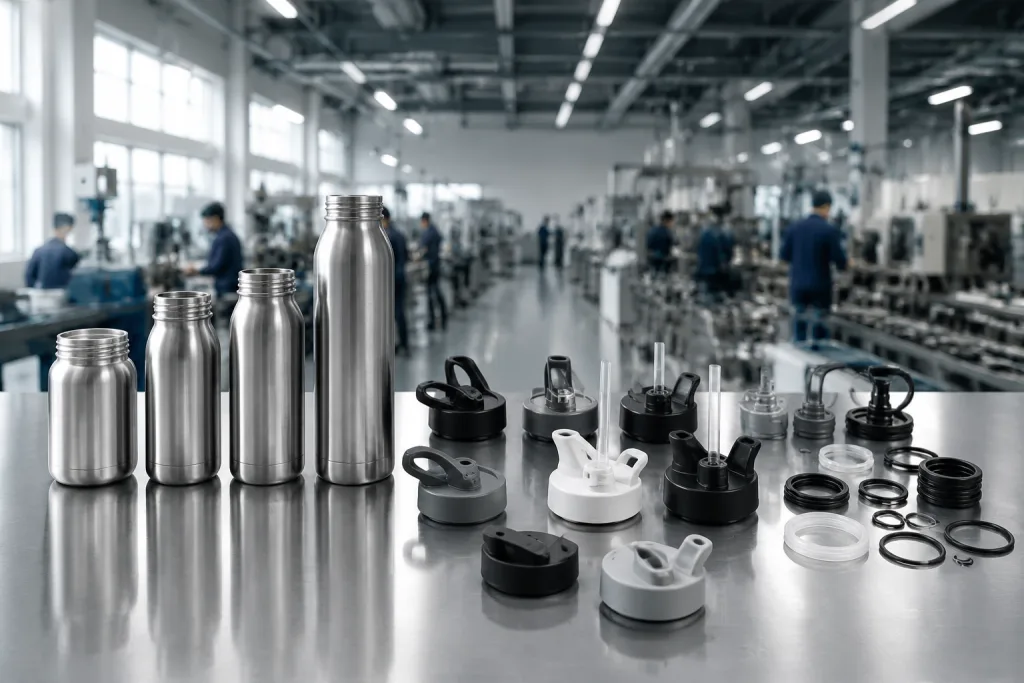
Decoration Is A Manufacturing Decision
Logo method is a manufacturing decision, not a branding afterthought. It changes defect rate, sampling time, and reorder consistency. For 304 stainless steel polypropylene bottle wholesale, the usual choices are laser engraving, silk screen printing, pad printing, heat transfer, water transfer, and powder coating with secondary decoration. Each one earns its place on the line, but some fail fast on the wrong radius or plastic cap. QC pulled one sample last month where the logo sat 6 mm too close to the shoulder curve; the print passed on the PDF and failed on the bottle.
Laser engraving is the safest option for stainless bodies and coated surfaces when the design is simple. Fine text should usually stay above 0.3 mm to 0.5 mm stroke width, depending on coating and curvature. We run a rotary jig for round bodies, and if the bottle wobbles more than 1 mm, small letters start to look dirty. It fits premium wholesale drinkware, alcohol flask wholesale, and corporate programs where the buyer cares more about wear resistance than bright color. Full-color artwork is the wrong ask here. Laser will not do it.
Silk screen printing keeps cost under control for one- or two-color logos. It works on cylindrical bottles if the print area stays away from a taper, weld line, or curve transition. Full wrap printing needs tighter fixtures and better tolerance control; the cheap quote often loses money after two rounds of rejected samples. For beer tumbler wholesale or canteen wholesale with large logos, ask the factory for a print area drawing before artwork approval. A logo that looks fine on a flat PDF can stretch on a curved 750 ml body, and we have seen buyers flag a 2 mm oval distortion as a brand issue.
Powder coating adds grip and shelf value, but color control needs real management. For repeat wholesale drinkware programs, approve a physical color chip, not only a Pantone code. Different coating batches can shift slightly, especially matte light colors. If you sell sets, carton mixing must be controlled so one customer does not receive visibly different shades; we mark batch codes on the inner carton when one PO splits across colors. Our Zhejiang production partners typically run 80,000-120,000 stainless units per month, but color batching still needs planning when you split one order into six or eight SKUs. The math doesn’t work if the buyer expects eight perfect shades from three small coating runs.
MOQ, Pricing, And Tooling Trade-Offs
Most buyers ask us for the lowest MOQ. This is the wrong question to ask. The better MOQ is the lowest quantity that keeps the unit price clean, the PP color stable, and the line away from shortcuts. For existing molds, we usually run a 304 stainless steel polypropylene bottle wholesale MOQ of 1,000 to 3,000 pcs per color or SKU. Below 1,000 pcs, the math often breaks because one color change on the injection machine still takes about 2 hours and 8-12 kg of PP purge material. For custom PP lids, new handles, special caps, or private molds, MOQ moves to 5,000-10,000 pcs because injection molding setup, trial shots, and masterbatch color control need volume.
FOB China pricing changes with capacity, wall construction, surface finish, lid design, and packaging. A basic 500 ml single-wall stainless bottle with PP lid may sit around USD 1.50-2.40 FOB when we use a stock body and standard 3-layer carton. A double-wall vacuum bottle can move into USD 3.20-6.80, mainly because vacuum welding, copper coating, and the 24-hour temperature test add labor. A 1.9 L beer growler wholesale item lands higher because the steel weight, cap structure, and carton volume push up both factory cost and CBM. Alcohol flask wholesale bulk pricing can look cheap per piece, but we have seen this go sideways when the buyer forgot the gift box, funnel, mirror polishing, and individual bag check; QC pulled 18 scratched flasks from one 200 pcs inspection tray last month.
Tooling needs a commercial decision, not a design mood board. If you can use an existing body mold and only change logo, lid color, and packaging, we ship faster and carry less risk. A laser logo fixture may cost only a few hundred dollars, while custom PP injection parts or stainless forming tools can run several thousand dollars after 2D drawing, CNC electrode work, and T1 sampling. For a new PP flip lid, we normally check the hinge gap at 0.20-0.35 mm with a feeler gauge before we approve the mold. Tooling ownership should be written into the contract, including maintenance, storage, and whether the factory can use it for other customers.
Lead time from China is usually 35-50 days after deposit, artwork approval, and sample confirmation for standard wholesale drinkware. Add 7-15 days for new color matching, custom packaging, or third-party testing. Real example: a buyer once sent a PO with “Pantone 186C” in the file name but “Pantone 185C” inside the artwork, and that typo cost 3 days before the line could book material. If your retail delivery window is fixed, do not spend four weeks debating a USD 0.08 price difference and then ask the factory to recover the schedule.
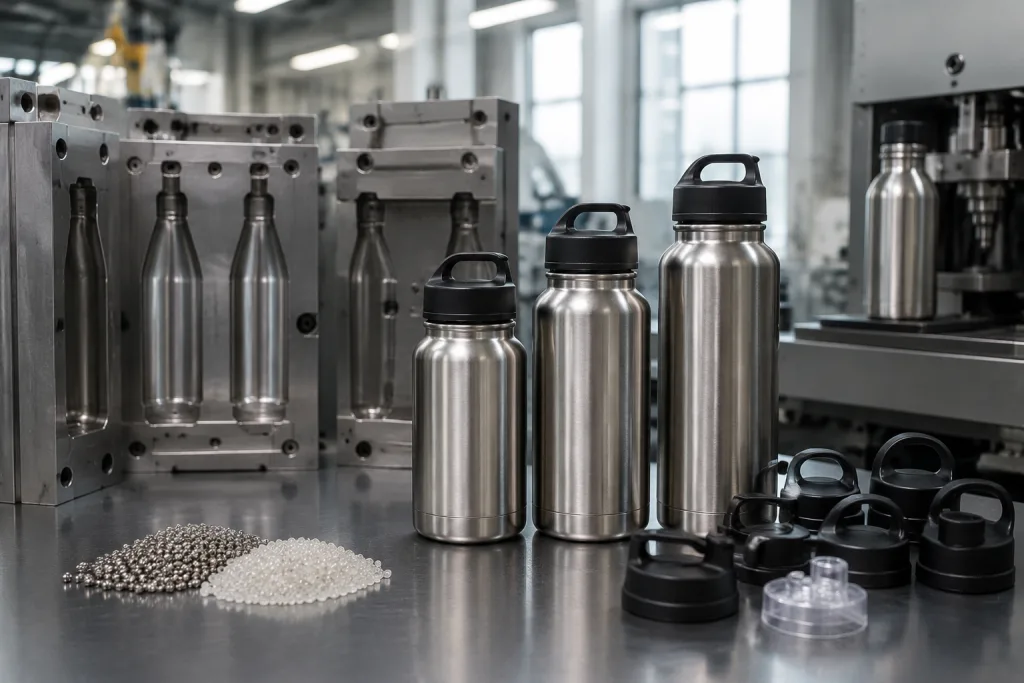
Compliance And Inspection Before Shipment
Compliance is not exciting, but it is cheaper than a recall. For 304 stainless steel polypropylene bottle wholesale orders going to Europe or North America, we build the document checklist before the first 500 pcs trial run, not after packing. At minimum, ask for material declarations for 304 stainless steel body sheet, PP resin grade, silicone gasket, powder coating, logo ink, plus any straw or spout part. QC keeps these in the order folder with the BOM and color card. Then lock the finished-product tests your market needs before the line starts welding.
For EU buyers, LFGB sensory and migration testing is common for food-contact drinkware. EU 10/2011 applies to plastic components, so PP lids and straws need their own review; we once had QC pull a lid sample because the PP supplier code on the bag did not match the PO. REACH matters for coatings, inks, restricted substances. For North American buyers, FDA food-contact compliance is the baseline, and some distributors ask for ASTM-related physical checks, CPSIA when the bottle is clearly for children, or Prop 65 review. Kids bottle orders need extra caution. The standard sports bottle test package is the wrong question to ask.
Inspection should cover what the buyer will actually reject: appearance, function, packing marks. A pre-shipment checklist should include capacity check by measuring cup, 30-minute leak test upside down, vacuum performance when the item is insulated, 3M tape coating adhesion, logo position tolerance in mm, barcode scan, carton drop test, plus gross weight verification on the floor scale. For Amazon FBA or large retail DC shipments, add FNSKU label position, carton label format, master carton dimensions, and pallet plan. We have seen a wrong barcode hold 1,200 cartons at receiving; a 2 mm scratch would have been easier to settle.
Use AQL terms in your purchase order. We run many export inspections with AQL 2.5 for major defects, AQL 4.0 for minor defects, and 0 tolerance for critical safety issues such as sharp edges, metal dust, broken glass accessories, or severe leakage. Put those words on the PO, not only in a WeChat message. If you are ordering beer growler in bulk or beer tumbler in bulk for beverage-related retail, odor testing and inner cleanliness need more attention than buyers usually give them; last month the buyer flagged 18 pcs with polishing paste smell after QC opened the inner bags.
Packing And Freight Affect Margin
Drinkware eats container space fast. We have seen two 304 stainless bottle quotes look equal on FOB, then split by USD 0.11 per unit after we checked the carton CBM in our loading sheet. Before you approve a bulk drinkware order, ask for unit net weight, gross weight, product dimensions, gift box dimensions, master carton dimensions, carton quantity, and loading quantity for 20GP, 40GP, and 40HQ; our merchandiser usually puts these beside the PI so the buyer can see the math. This is the wrong question to ask if you only compare factory profit. For wholesale growler and beer growler bulk programs, one 64 oz body with handle can burn carton volume faster than 2 slim bottles, and the line feels it when the master carton jumps from 12 pcs to 6 pcs.
For standard bottles, we run one polybag or tissue wrap per unit, then white box, color box, or egg-crate divider inside master carton. For retail wholesale drinkware, color box quality matters: 300-350 gsm paperboard is common, but heavy bottles may need corrugated E-flute or reinforced inserts after QC pulls a box and sees corner whitening on the shake table. For alcohol flask wholesale, gift box presentation can sell the product, but the inner tray must lock the flask, funnel, and cap tightly enough for parcel shipping; we once had a buyer flag 18 loose funnels in a 200 pcs trial carton because the PET tray cavity was 2 mm too wide.
If you sell through e-commerce, build for parcel abuse. Factory stacking is not courier handling. Ask for a 76 cm drop test on packed units if the item ships individually, and ask the factory to show photos from all 6 faces plus 3 edges after testing. For palletized distributor orders, check carton compression and pallet overhang; a 10 mm overhang looks harmless in the sample room, then the bottom layer crushes after 18 days at sea. Moisture is another issue on ocean freight from China, so we ship with desiccants and a dry loading check because the math does not work when 300 cartons arrive with mold spots or rust complaints from trapped moisture.
Your final buying decision should weigh landed cost, not only FOB. A USD 0.20 stronger carton may cut replacements, chargebacks, and customer service tickets, especially when Amazon or a supermarket DC rejects crushed retail boxes. A slightly smaller gift box may increase container loading by 8-12%; on a 40HQ, that can mean hundreds of extra units without changing the bottle mold. Those are real margins. The better suppliers discuss packing before production, not after the first claim arrives and everyone starts checking the PO for the carton-size typo.
Send Your Bottle Spec For A Factory Quote
Share capacity, lid type, logo method, MOQ, market, and packing needs. We will respond with practical FOB pricing and production timing.
Frequently asked questions
What MOQ should I expect for 304 stainless steel polypropylene bottle wholesale?
For existing bottle and lid molds, expect 1,000-3,000 pcs per SKU or color from a serious China factory. If you want a custom PP lid, special handle, new cap color with low-volume resin purchase, or private body shape, the MOQ can move to 5,000-10,000 pcs. For mixed wholesale drinkware programs, some factories will accept 3 colors under one PO if each color reaches 1,000 pcs. Be careful with very low MOQ offers such as 100-300 pcs for fully customized goods; they often mean stock bodies, limited colors, higher unit price, and weaker control over replacement parts or reorder consistency.
Is 304 stainless steel enough for beer growler wholesale orders?
304 stainless steel is suitable for most beer growler wholesale and beer growler bulk programs, but construction matters more than the steel name alone. For a 1 L to 2 L growler, check wall thickness, weld quality, inner polishing, cap seal design, and carton protection. If the growler is promoted for carbonated beverage storage, ask the supplier what pressure or seal testing they perform; do not assume a standard water bottle lid is suitable. For beer growler wholesale bulk, we usually recommend a wide mouth, robust PP or stainless cap, food-grade silicone gasket, and a pre-shipment leak check under AQL 2.5/4.0.
Which logo method is best for canteen wholesale and drinkware bulk?
For durable branding, laser engraving is the safest choice on coated or uncoated stainless steel, especially for wholesale canteen, alcohol flask wholesale, and corporate drinkware bulk. It has low color risk because it does not depend on ink matching. For colorful retail artwork, silk screen or heat transfer can work, but you need physical pre-production samples and a defined print tolerance. On curved bottles, keep fine lines above roughly 0.3-0.5 mm and avoid placing logos near strong tapers. If you plan repeat wholesale drinkware orders, keep a signed color chip, artwork file, and logo position drawing with measurements.
What compliance documents do European and North American buyers need?
For Europe, ask for LFGB or relevant EU food-contact testing, EU 10/2011 support for PP plastic parts, and REACH review for coatings, inks, and restricted substances. For North America, request FDA food-contact declarations and consider Prop 65 review if selling into California. If the bottle is for children, CPSIA and additional physical safety checks may apply. The practical point is to test the finished product, not only raw steel. A 304 body, PP lid, silicone gasket, coating, ink, and straw can each create compliance exposure. Budget 7-15 days for third-party testing if reports are not already valid.
How long does production and shipping take from Zhejiang, China?
For standard 304 stainless steel polypropylene bottle wholesale orders, production usually takes 35-50 days after deposit, artwork approval, and sample confirmation. Add 7-15 days for new color matching, custom packaging, or third-party lab testing. Ocean freight from Ningbo or Shanghai to major European ports often takes about 30-40 days on the water, while North America West Coast routes may be around 18-25 days, excluding customs and inland trucking. If you need a fixed retail launch, approve samples early and freeze packaging data before mass production. Late barcode, carton, or FNSKU changes can cost more time than the factory assembly itself.