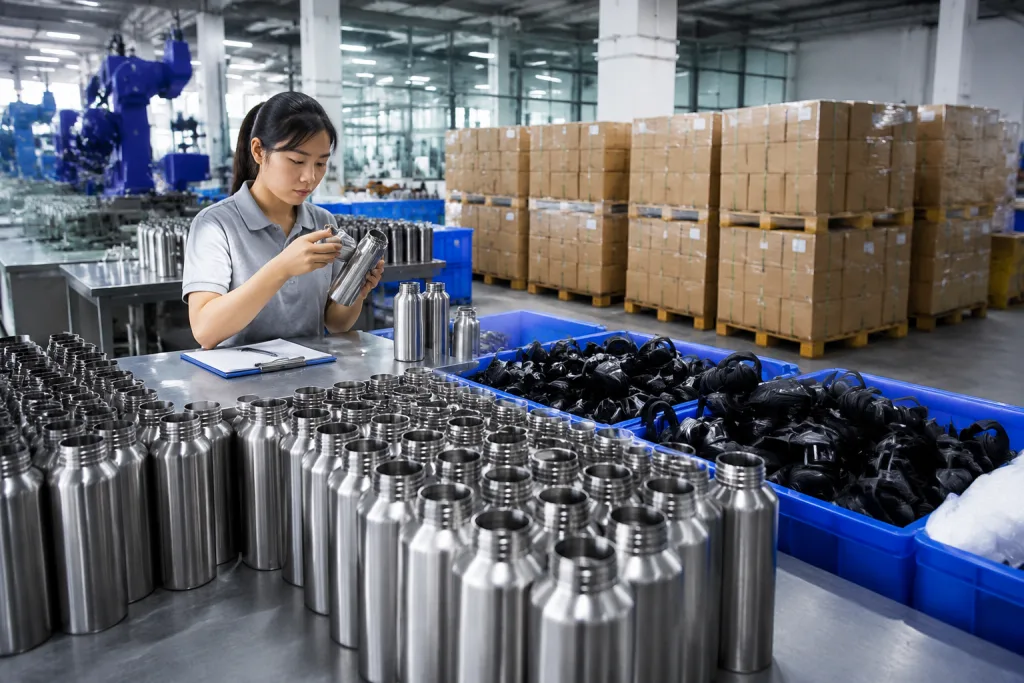
Key Takeaways
- State 304 stainless steel inner wall, PP lid grade, capacity tolerance, and decoration method in the first RFQ
- Expect 7-10 days for plain samples and 10-15 days for logo samples after artwork confirmation
- Use AQL 2.5 for major defects and AQL 4.0 for minor defects on bulk drinkware orders
- For custom canteen projects, practical MOQ is usually 1,000-3,000 pcs per color depending on finish
Buying from a 304 stainless steel polypropylene bottle supplier looks simple until the first quote lands with “SS” instead of 304 stainless, “PP lid” with no grade, no FDA or LFGB line, and a unit price that moves after the logo file is opened. We see this every week. One buyer sent us a PO with “pantone 186c” typed two ways, and QC pulled the sample because the red lid and red print did not match under the light box.
You need a process that makes the canteen factory quote the same bottle you plan to buy. At our Hangzhou, Zhejiang export desk, the stronger buyers lock the RFQ, sample approval, and purchase order line items before the 30% deposit. China can make solid stainless and polypropylene bottles, but the spec has to read like a production sheet: steel grade, PP contact parts, capacity tolerance in ml, logo position in mm, carton weight, test standard. A mood board is not enough. We’ve seen this go sideways when the buyer asks only, “What is your best price?” That is the wrong question to ask.
Start with a strict RFQ
Your RFQ is not a request for “best price.” That is the wrong question to ask. It is the first control document for the order. If you ask five canteen manufacturers for a “750 ml stainless bottle with PP lid,” you will get five versions: 0.42 mm or 0.50 mm body steel, loose or seated lid gasket, mirror polish or rough 320-grit finish, 24 pcs or 50 pcs per carton, and different return risk. We have watched QC pull the sample, check the body with a Mitutoyo caliper, and find the quoted bottle was 38 g lighter than the approved sample. A serious 304 stainless steel polypropylene bottle supplier should quote to a locked specification, not push the buyer to guess.
For a distributor drinkware program, put these RFQ lines in writing before anyone talks price:
- Product: 304 stainless steel bottle with polypropylene screw lid and food-grade silicone gasket; ask for lid thread photos if the cap is not a stock part.
- Capacity: 500 ml for promo use, 750 ml for outdoor retail, or 1,000 ml for sports channels, with tolerance of ±5%.
- Steel: SUS304 inner and outer, or SUS304 inner with 201 outer if your market accepts cost-down construction.
- Wall thickness: common single-wall 0.45-0.55 mm; vacuum double-wall 0.35-0.45 mm each shell depending shape.
- Plastic: PP lid, BPA-free, odor test required after hot-water fill, with Pantone color matching if the buyer has a brand book.
- Finish: powder coating for grip, spray paint for low MOQ color work, polished steel for no-coating claims, matte steel for retail shelves, or printed wrap when artwork covers most of the body.
- Decoration: laser engraving for metal logos, silk screen for 1-2 color marks, heat transfer for full artwork, or UV print with logo width and height in mm.
- Packing: white box for wholesale, kraft box for outdoor brands, color box for retail display, or bulk carton; add barcode or FNSKU placement if Amazon stock is involved.
- Commercial term: FOB Ningbo or Shanghai for normal export orders, EXW Zhejiang when your forwarder picks up, or DDP only after duty and compliance costs are confirmed.
Your first PO draft should carry the same details: model number, capacity, steel grade, PP lid color, logo method, carton quantity, test requirement, Incoterm, and requested ship date. Keep it boring. We once saw a PO typo list “PP lid PMS 186U” while the approved sample was PMS 186C; the buyer flagged it only after the line had mixed 3,000 red lids. A tight PO stops the canteen vendor from quoting a cheap base item, then adding USD 0.18 for coating, USD 0.06 for logo, and USD 0.12 for stronger packaging after your buyer has approved the retail price. The math does not work at that stage.
Check the material stack
A bottle sold as “304 stainless steel polypropylene” is not one material. We check at least four: 304 stainless body, PP lid, silicone gasket, and coating or print layer. Miss one line on the BOM and it becomes a claim later. For EU buyers, we normally ask whether the file needs LFGB or EU food-contact declarations before tooling starts; for North America, FDA food-contact suitability and the relevant ASTM drop or leakage expectations are more common. REACH and California Proposition 65 screening also come up for retail channels. QC once pulled a pre-shipment sample where the PO said “PP lid” but the artwork file called out soft-touch coating on the cap. Different test scope. Different cost.
304 stainless steel sells well because it gives a fair balance of corrosion resistance, forming, and price. It is not magic. Bad TIG welding, polishing paste left near the seam, or weak passivation will still show rust dots, often around the mouth thread where the brush cannot reach cleanly. For a custom growler or customized growler used with beer, acidic drinks, or storage over 24 hours, ask for pickling/passivation control and a 24-hour water contact odor check. We run the odor check with filled samples at room temperature, then QC opens them side by side with a blank bottle. For a canteen promotional order used at events, the math often points to single-wall 304: lower weight, lower unit cost, and no need to chase 12-hour thermal performance.
Polypropylene is usually the right lid material here because it takes impact better than many cheap plastics, handles heat better than PS, and molds cleanly in multi-cavity tools. Still, write “food-grade PP” on the spec, not “plastic lid.” That one word saves arguments. If the lid has a carry loop, hinge, straw, or press button, request a cycle test with a clear pass/fail rule. We use 3,000 opening cycles for a simple flip part and a 1.2 m drop test on three filled units, then check leakage, cracked pins, and whitening around the hinge with a 10x loupe.
At BottleForge Industrial in Zhejiang, our normal bottle output is about 420,000 units/month across stainless sports bottles, travel tumblers, and canteen customized runs. Capacity only helps when the buyer locks the bill of materials. Changing from PP black lid to Pantone-matched PP after sample approval can add 5-7 days and a color MOQ, even in China. We have seen this go sideways when a buyer approved a black lid sample on Monday, then sent “same lid, PMS 186C” on the final PO; the injection line had already booked black resin and the first available color slot was 6 days later.
Price the real landed product
Unit price only matters when it covers the bottle you will receive. We see 8 out of 10 canteen vendors quote the bare shell first, because buyers compare Excel sheets too fast. Break the quotation into visible cost lines for custom drinkware programs; decoration, packing, and rework time are where the margin disappears. Last month QC pulled a powder-coated sample from the line with a 0.3 mm logo shift, and that “small” fix changed the quoted cost.
Ask the supplier to quote with separate lines for:
- Base bottle: stainless body plus standard PP lid, with capacity and body thickness stated.
- Surface finish: powder coating, spray painting, electro-polish, or brushed steel, including the approved color code or finish sample.
- Logo: one-color silk screen, laser engraving, UV print, or full-wrap transfer, with print size in mm.
- Tooling: mold charge for a new lid, custom cap, handle, or embossed feature, plus who owns the mold after payment.
- Packaging: color box, insert card, instruction sheet, master carton, palletization, and carton mark layout.
- Testing: third-party lab reports, internal leak test, dishwasher claim testing if requested, with the test standard named.
- Freight basis: FOB, CIF, DAP, or DDP with port named clearly, not just “China port.”
For a 750 ml single-wall 304 bottle with PP lid, a realistic China FOB range can be roughly USD 2.10-3.40 depending on finish, logo, and order size. A double-wall vacuum version may run USD 4.20-7.50. A customizable canteen with a new lid mold is a different job. Injection tooling can be USD 1,200-4,500, and lead time for mold trial may be 20-30 days before production samples. We run the first T1 sample on the injection machine, check lid fit with a go/no-go gauge, then do a 24-hour inverted leak test before sending photos.
Your PO line items at pricing stage should show quantity per SKU, unit price, decoration cost, packaging cost, mold cost, payment term, and currency. If you are a canteen distributor selling to 3 retailers, do not hide split shipments until the end. This is the wrong question to ask: “Can you keep the same price?” Two delivery addresses, mixed cartons, or retailer-specific labels change labor cost and carton marks. We have seen this go sideways when a PO typo listed “DAP Hamburg” while the buyer expected DDP; the math does not work after cartons are already packed.
Approve samples like contracts
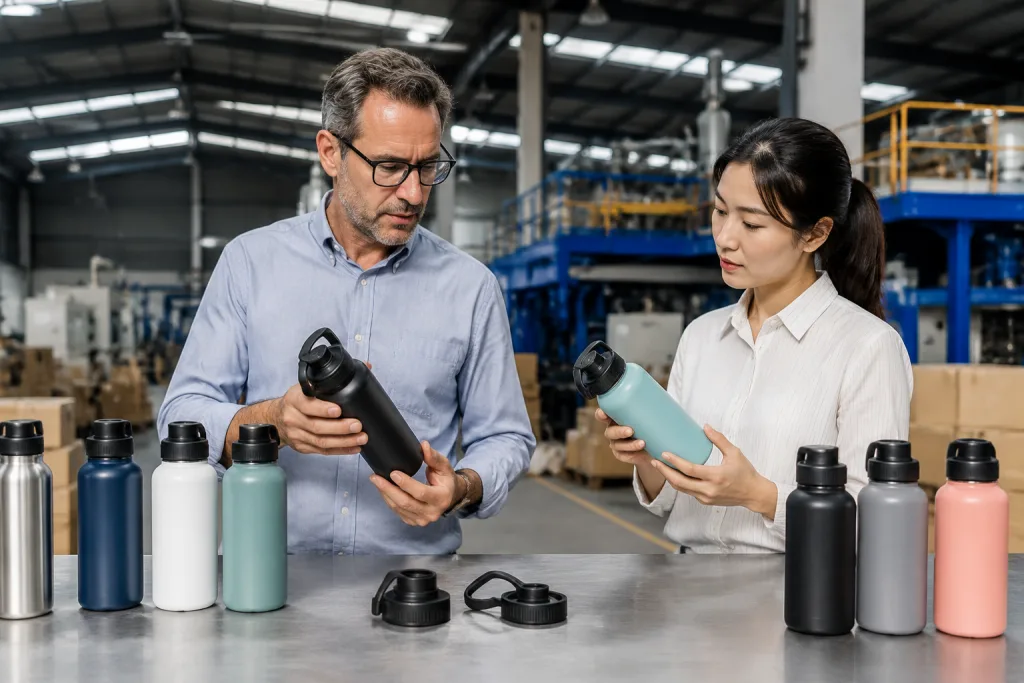
Samples are not souvenirs. They are physical contracts. Once you approve a bottle sample with no written remarks, the canteen manufacturer will put it beside the line as the production reference. Fair enough. We do the same in Hangzhou: QC seals the approved sample in a PE bag, writes the PO number on masking tape, and checks bulk goods against it. Treat that sample with the same discipline as a purchase agreement.
For a plain stock sample, 7-10 days is normal from Zhejiang if the model is already on the shelf. For a logo sample, allow 10-15 days after vector artwork, Pantone number, and logo position are locked; we have seen buyers lose 4 days because the PO said “blue logo” while the AI file showed Pantone 2935C. If the bottle is a custom canteen with new lid tooling, first mold samples can take 25-35 days. Air courier to Europe or North America usually adds 3-6 days, and DHL dimensional weight can jump when the carton passes 45 cm on one side.
Your sample approval checklist should include:
- Net capacity measured with water on a bench scale, not guessed from catalog name.
- Empty weight in grams, plus wall thickness spot check with a digital caliper at the body and shoulder.
- PP lid fit, thread smoothness, gasket seating, and leak result after 30 minutes inverted.
- Logo size and position in mm, Pantone match, edge sharpness, plus abrasion resistance after 50 rubs.
- Coating adhesion using cross-hatch tape test when applicable; QC pulled the sample if paint lifts at the rim.
- Odor check after 24 hours closed with warm water at around 60°C.
- Carton drop and color box crush resistance if e-commerce is planned, because Amazon buyers flag dented gift boxes fast.
When you approve, issue a sample approval record with photos and limits. Example PO wording: “Bulk production must match approved sample BF-750PP-2406-A, except logo increased to 58 mm width and lid changed to Pantone Black 6C.” That wording works. “Sample approved” is too weak, and we have seen this go sideways when a buyer later says the lid feels tighter than the pre-production piece. For customized drinkware, keep one signed sample at your office and one at the factory; we normally add a red signature label across the base and cap so nobody swaps parts during packing. If there is a dispute later, both sides compare against the same canteen customized reference.
Write the bulk PO tightly
The bulk purchase order is where a sourcing job either gets under control or starts leaking time. A proper PO for a 304 stainless steel polypropylene bottle supplier should read like a production sheet, not a payment note. If you are buying for distributor canteen channels, spell out the delivery promise too; we have seen a buyer miss a school opening date because the PO only said “assorted colors” and the line packed 600 blue, 300 black, and 100 white.
At minimum, include these PO line items:
- SKU and model: supplier item number plus your item code, for example HZ-750PP / BUYER-CAN-24.
- Quantity: split by color, logo version, packaging version, and carton loading; QC should not need to guess from a WeChat screenshot.
- Material: SUS304 body, food-grade PP lid, silicone gasket, coating type, and wall thickness if your buyer specified 0.45 mm or 0.50 mm.
- Decoration: artwork file name, logo dimensions, print position, Pantone numbers; write “logo 42 mm wide, 18 mm below rim,” not “same as sample.”
- Compliance: REACH, LFGB, FDA food-contact, BSCI factory audit, or the customer-specific protocol named on the retail spec sheet.
- Inspection: AQL 2.5 major, AQL 4.0 minor, critical defects not accepted; list leak test, coating adhesion cross-cut, and barcode scan if needed.
- Payment: common term is 30% deposit, 70% before shipment after inspection approval; if the buyer wants 30 days credit on a first order, the math does not work for most factories.
- Lead time: for repeat models, 25-35 days after deposit and sample approval; write 45-60 days for custom mold work when a PP lid tool must be opened.
- Shipping: FOB Ningbo, carton marks, pallet requirement, latest vessel date, and whether we run 5-ply export cartons or inner boxes only.
MOQ should be honest. For canteen promotional orders, 1,000 pcs per color works when we use stock bodies and standard lids. For powder coating with Pantone color, 2,000-3,000 pcs per color is a safer number because the spray booth setup and color change waste are real. For a fully customizable growler or new PP lid color by injection, MOQ can move higher; one resin batch may be 500 kg, and the injection line does not stop cheaply for 300 lids.
Do not rely on chat messages for final changes. If the buyer says “make the lid darker” on WeChat or email, revise the PO with a Pantone reference or an approved production photo. China factories move fast once the deposit lands. We ship what is written; unclear changes after material purchase often turn into scrap, rework, or a 7-day delay when QC pulled the sample and the buyer flagged the lid color.
Control production before shipment
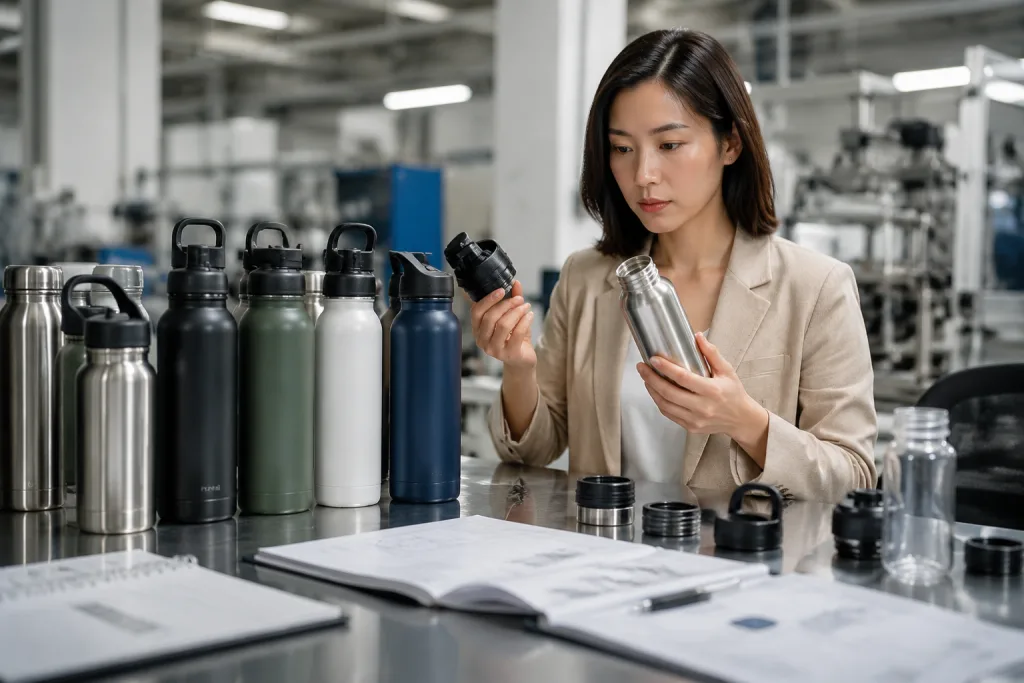
Bulk production control starts before the first carton is sealed. Ask your canteen supplier for a pre-production confirmation after steel sheet, PP resin, coating powder, and packaging arrive at the line. For orders above 5,000 pcs, we run a mid-line inspection before full packing; it catches a logo sitting 3 mm too low, coating dust from the spray booth, or a lid color drifting from the approved PMS chip. Do it early. A mistake found on day 12 costs less than a full rework after day 18 when cartons are already taped.
A practical inspection plan needs factory checks plus buyer-side sampling. First, the factory should run 100% leak checks for bottles with threaded lids or vacuum construction, usually with a water fill, upside-down hold, and pressure check. Second, internal QC should compare production against the approved sample for appearance under 800 lux light, capacity with a measuring cylinder, lid torque with a torque tester, and packing marks on the outer carton. Third, you or a third-party inspector should perform final random inspection under AQL. For drinkware, critical defects mean sharp edges that cut a cotton swab, leakage after 30 minutes upside down, unsafe odor, contamination inside the bottle, cracked lid parts, or a wrong material declaration. Major defects include coating peel larger than your limit, wrong logo position, loose assembly, or missing cartons. Minor defects are small dust points, slight print feathering, or scuff marks that stay inside the signed tolerance board.
For e-commerce or distributor drinkware programs, packaging needs its own inspection line. Confirm carton drop test, barcode scan with a handheld scanner such as a Zebra DS2208, FNSKU label placement, polybag warning language where needed, and master carton gross weight. QC pulled one sample last season where the bottle was perfect, but the FNSKU label sat on the carton seam and tore during opening. The buyer flagged it. A good customized canteen still fails at receiving if Amazon-style labels are wrong or a North American retailer cannot read the carton marks from 1 meter away.
Before balance payment, request production photos, packing list, carton dimensions, inspection report, and commercial invoice draft. If shipping FOB from Zhejiang through Ningbo or Shanghai, book space 14-21 days earlier during September-November because vessel space tightens before holiday season. Check the PO too; we once saw “matte black” typed on page one and “gloss black” buried in the packing note. A canteen vendor who refuses inspection or says “our quality is always good” is asking you to carry their risk. The math does not work.
Plan reorders and variations
The first order proves the supplier. The second order proves whether your own control sheet works. If you are a canteen distributor or brand owner, set reorder rules before the first shipment leaves Ningbo port. We have seen this go sideways on a 3,000 pcs bottle repeat where the buyer’s PO said “same as last time,” but the last approved lid photo was sitting in a WeChat chat, not in the order file.
Keep one locked specification file for each SKU: approved sample photos, AI artwork, Pantone code, 304 stainless steel grade, PP lid resin, gasket hardness if specified, packaging dieline, carton mark, inspection record, and allowed tolerance. Put a revision number on it. Send that file again with every reorder. QC pulled the sample on one canteen job because the carton mark had a one-letter typo against the PO; that is the kind of small miss that turns into chargebacks when the retail shelf needs to look identical.
If you want line extensions, split color changes from tooling changes. Body color and logo method are usually straightforward if the powder coating line already has the color card and the silk-screen fixture still fits. Lid shape, mouth diameter, handle design, straw system, and growler cap thread are engineering changes, not “just a variation.” This is the wrong question to ask: “Can we keep the same price?” For a custom growler, a 0.5 mm cap gasket change can affect carbonation leakage, and we run that back through sample testing before mass production.
Reorders normally move faster: 20-30 days for repeat models if materials are available and no new compliance tests are needed. Still, confirm capacity before you launch a promotion. Our Zhejiang lines get tight for about 5-6 weeks after Lunar New Year, then again before the July export rush. A good canteen supplier will say “18 days for coating, 7 days for packing, ship on day 30.” A weak vendor promises 15 days, then blames cartons, coating rework, or a missed vessel cut-off.
Send a bottle RFQ with real production specs
Share capacity, material, logo, packaging, target MOQ, and delivery market. We will quote the buildable version, not a vague catalog guess.
Frequently asked questions
What MOQ should I expect for a 304 stainless steel PP bottle?
For stock body shapes with a standard PP lid, practical MOQ is often 1,000 pcs per logo and 1,000-2,000 pcs per color. If you need Pantone powder coating, expect 2,000-3,000 pcs per color because the coating line setup and color change have fixed costs. A new PP lid, carry handle, or molded custom feature can push MOQ higher, sometimes 5,000 pcs, depending on tooling and resin color. If a canteen factory accepts 200 pcs with full customization, check whether it is using digital print on existing inventory rather than true production customization.
Is 304 stainless steel always better than 201 for canteens?
For most export custom drinkware, 304 is the safer specification because it has better corrosion resistance and is widely accepted for food-contact stainless bottles. 201 can reduce cost on the outer shell of some double-wall products, but using 201 for liquid-contact surfaces is not recommended for serious European or North American programs. If price pressure is high, you can specify SUS304 inner wall and 201 outer wall, but this must be declared clearly in the PO. For single-wall canteen customized projects, full 304 construction is cleaner and easier to defend during compliance review.
How long does sampling and bulk production usually take?
Plain samples from an existing model usually take 7-10 days before courier shipment. Logo samples normally need 10-15 days after artwork, Pantone colors, and print position are confirmed. If you need a new PP lid mold or special cap structure, first tooling samples can take 25-35 days. Bulk production for repeat stainless bottles is typically 25-35 days after deposit and sample approval. Add 5-10 days if you require third-party lab testing, special retail packaging, or split packing by distributor canteen SKU.
Which logo method is best for promotional canteens?
For canteen promotional orders, one-color silk screen is usually the best cost-to-visibility option, especially on powder-coated bottles. Laser engraving is more durable and looks cleaner, but it is less visible on some steel finishes and costs more on large logos. UV print works for colorful artwork but needs abrasion testing before bulk approval. For a 1,000-3,000 pc custom canteen order, ask for one logo sample and a rub test. Your PO should state logo size in mm, position from bottle base or centerline, Pantone color, and accepted tolerance.
What quality standard should I put on the PO?
Use AQL 2.5 for major defects and AQL 4.0 for minor defects, with critical defects at zero tolerance. Critical defects should include leakage, sharp edges, unsafe odor, wrong food-contact material, contamination, and broken functional parts. Major defects include wrong logo, poor lid fit, obvious coating peel, severe dents, and incorrect packaging. Minor defects can include small dust points or slight scuffs within an agreed visual limit. Also state the approved sample code, inspection method, carton drop requirement, and whether the factory must perform 100% leak testing before final inspection.