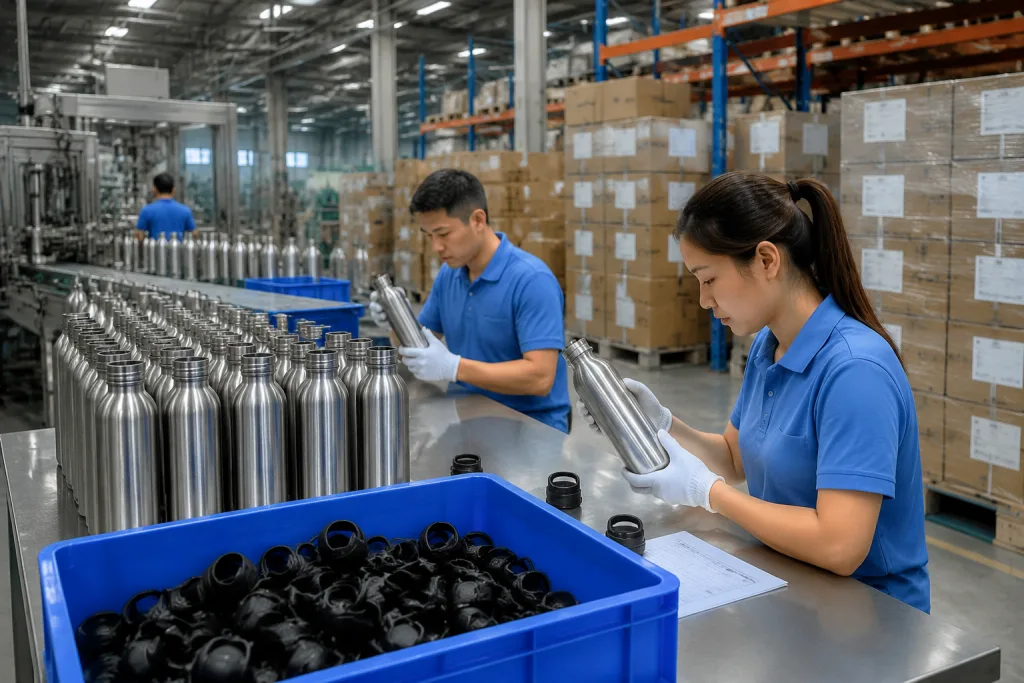
Key Takeaways
- Use SUS304 inner steel at 0.4-0.5 mm wall thickness for most private label canteens
- A realistic MOQ is 1,000 pcs per color for powder coating and 3,000 pcs for custom molded PP lids
- Plan 30-45 days production after deposit and approved pre-production sample
- Test against LFGB, FDA, REACH, and AQL 2.5/4.0 before shipment
A 304 stainless steel polypropylene bottle private label project looks simple on a quotation sheet. Then QC pulls the first sample with a digital caliper and finds 0.45 mm body steel instead of 0.50 mm, PP shown as “food grade” with no resin grade, and a logo method that rubs off after 50 tape tests. We’ve seen this go sideways on 3,000-piece trial orders.
If you buy for a retail brand, promotion agency, or canteen distributor, get the practical answers before you issue the PO. BottleForge Industrial is in Hangzhou, Zhejiang, China, and our monthly output is about 420,000 stainless bottles and tumblers. The checklist below is what we run with new B2B customers when comparing canteen manufacturers and building a private label spec that survives production, AQL inspection, and export cartons stacked 5 layers high on the pallet.
What are you really buying?
Ask for a 304 stainless steel polypropylene bottle private label quote and you are buying a set of parts, not one bottle. We price the body, lid system, surface finish, decoration, packaging, inspection, and export handling as separate cost lines. On our line, a 0.1 mm change in body thickness can move the FOB price more than a small logo print. One blended FOB number hides too much.
The usual build is a SUS304 stainless steel inner or single-wall body with a polypropylene cap, often with a silicone seal ring and a stainless carry loop. For an outdoor custom canteen, 304 steel is the safe default because it handles tea, coffee, juice, and light acidic drinks better than cheaper 201 steel. For the PP part, specify food-contact polypropylene, not mixed recycled plastic. QC pulled one sample last year where the cap looked fine, but the resin smell was obvious after 24 hours with warm water inside. Recycled PP is acceptable for non-food parts; it should not touch drinking water unless the compliance file is clear.
Private label goes past logo printing. You may need a Pantone color, retail box, barcode, instruction sheet, FNSKU label, carton mark, and custom cap color. If you sell through distributor drinkware channels, packaging consistency matters as much as the bottle. We have seen this go sideways: the buyer flagged a PO typo where the carton mark said “750ML” but the barcode file said “700ML,” and the warehouse held 312 cartons at receiving. Canteen distributors dislike mixed carton information because it slows receiving and creates claims.
Our practical advice: build a one-page product specification before asking canteen suppliers for pricing. Include capacity, steel grade, wall thickness, cap material, logo process, packaging type, test standard, target market, and estimated annual volume. Add the MOQ and inspection level too; AQL 2.5 and a 1,000 pcs trial order do not cost the same as a loose factory check. Cheap quotes are easy. Usable quotes need the details.
Material checks before any deposit
Start with material verification before you pay a deposit. “304” should mean SUS304 or equivalent 18/8 stainless steel, usually with around 18% chromium and 8% nickel. For 6,000 pcs of customized drinkware, we run 0.4 mm body wall for lightweight promotional orders, while 0.5 mm feels safer for retail and outdoor programs. QC checks the incoming coil with a handheld XRF gun, then measures cut samples with a 0.01 mm micrometer. If you are buying a customized canteen for camping or corporate gifting, saving USD 0.08 by switching to thin, soft steel is the wrong question to ask unless your market is a 30-day promotion.
For polypropylene, ask the canteen manufacturer to confirm whether the lid is virgin PP, the temperature range, and the seal design. PP works well because it is light, cost-friendly, easy to mold, and usually dishwasher-tolerant on the top rack. The weak point is not the plastic itself. It is poor lid engineering. We have seen this go sideways: a buyer approved a cap from a desk sample, then the line found a 0.35 mm silicone gasket and shallow thread engagement during leak testing. A cap with a shallow thread or thin silicone gasket may pass a desk test and fail after three weeks in a backpack.
Use this material checklist before deposit:
- Steel: SUS304 for food-contact parts, no magnetic 201 substitution.
- Thickness: 0.4-0.5 mm for most single-wall or outer shells.
- Plastic: virgin food-contact PP for lids and mouth parts.
- Seal: food-grade silicone gasket, preferably removable for cleaning.
- Tests: FDA for the US, LFGB for Germany, REACH where coating or plastic compliance is relevant.
A serious canteen supplier in China should provide material declarations and third-party test reports before deposit. Check the model number, material grade, and report date against your PO; last month we caught one PO with “SUS304” in the spec sheet but “201” typed into the Chinese production note. If the report is five years old and issued for a different model, treat it as a reference, not proof.
How private label cost is built
Unit price alone is the wrong question to ask. On our line in Hangzhou, a standard 750 ml stainless PP-lid bottle from a Zhejiang canteen factory usually quotes around USD 3.20-4.80 FOB Ningbo or Shanghai at 3,000 pcs, after we check body weight on a 0.1 g scale, coating spec, cap structure, and packing method. A heavier retail-grade version with powder coating, laser logo, color box, and spare gasket often lands at USD 5.20-6.80. Not fixed market prices. They are a quick way to catch the USD 2.60 quote that later turns into thinner steel, loose lid fit, or a carton downgrade.
Decoration moves the budget fast. One-color silkscreen works for canteen promotional orders, and we usually see a setup charge of USD 40-80 per artwork; last month QC pulled the sample because the logo sat 3 mm off the center line after the jig was changed. Laser engraving costs more per unit, but it holds up better on premium custom drinkware and looks clean on matte powder coating. Full-wrap heat transfer or UV printing gives stronger shelf impact, but approve abrasion and adhesion testing before mass production; we run 3M tape pull checks and 500-cycle rub tests before releasing the batch.
Private label packaging adds real money, not just “box cost.” A plain white box may add USD 0.18-0.35. A printed retail box can add USD 0.35-0.80, depending on paperboard grade, lamination, and order quantity. Amazon-ready or retail-ready cartons need tighter labeling discipline; one buyer flagged a PO typo where the FNSKU on the carton mark missed one digit, and that would have been ugly at the warehouse. If you work as a distributor canteen buyer, ask whether the canteen vendor can apply barcode labels, warning labels, and carton marks during packing instead of paying your team to relabel 120 cartons after arrival.
Tooling is the line item buyers underestimate. Custom molded PP lids usually require a mold fee from USD 2,500 to USD 8,000 and a MOQ of 3,000-5,000 pcs per first run; the mold shop will ask for a 2D drawing with gasket groove width in mm before they cut steel. If your volume is smaller, use an existing cap first and change color, logo, and packaging. The math doesn't work on a new PP lid mold for a 1,000 pcs trial order.
MOQ, samples, and realistic timelines
MOQ is where about 6 out of 10 custom canteen projects start to wobble. For existing bottle molds, BottleForge usually starts at 1,000 pcs per color for powder-coated stainless models and 500 pcs for some plain stainless SKUs. For Pantone-matched coating, 1,000 pcs is practical because the coating line needs stable setup time, and our spray booth still has to purge the previous color before the next run. For a new PP lid mold, expect 3,000 pcs minimum, and more if the cap uses multiple components. If the buyer asks for 800 pcs across 4 colors, the math doesn't work.
Sampling should not be rushed. A stock sample can leave our Hangzhou, Zhejiang office in 3-5 days if available. A logo sample usually takes 7-10 days after artwork approval, assuming the AI file has outlined fonts and the logo size is marked in mm. A pre-production sample with custom color, retail box, and final logo can take 12-18 days. QC pulled one sample last month because the lid gasket sat 0.6 mm proud and caused a slow leak. If a canteen manufacturer promises a fully customized sample in 48 hours, they are probably showing you something close, not exact.
Mass production normally takes 30-45 days after deposit and approved sample. Peak season before summer and Q4 gifting can push this to 50-60 days, especially for customized growler or large-capacity canteen customized programs using special lids. We run these jobs through polishing, coating, logo printing, assembly, then leak testing; one missing silicone ring can stop the line for half a shift. Ocean freight to Europe or North America adds another 25-40 days depending on port pair and congestion.
A practical order timeline looks like this: 3 days for spec confirmation, 7-15 days for sample, 2-5 days for approval, 30-45 days for production, 2-3 days for inspection, and 1-2 days for container loading. Short version: plan backward. If your launch date is fixed, reverse-calculate from the shelf date, not the factory ship date. We’ve seen this go sideways when a PO typo listed “matte black” but the approved sample tag said “Pantone 426C,” and the buyer flagged it only after carton photos were sent.
Quality questions buyers should ask
Quality is not a slogan. It is a checklist with numbers, signatures, and rejects marked in red pen. For stainless steel polypropylene bottle private label orders, we run AQL inspection at general level II, with critical defects at 0, major defects at 2.5, and minor defects at 4.0. For premium retail programs, some buyers tighten major defects to 1.5; that only makes sense if the unit margin can carry more sorting time. Last month QC pulled 200 samples from a 5,000 pcs lot and found 7 lids with flash on the PP thread, which is exactly the kind of small defect that becomes a return ticket later.
Ask your canteen suppliers how they test leakage. Get the method in writing. Our usual leak test is a filled bottle in inverted position, then shaking or pressure simulation for a set time, usually 3-5 minutes on the bench before packing release. For screw PP lids, thread fit and gasket compression matter more than the bottle body; a 0.3 mm gasket mismatch can ruin a clean 304 stainless body. Drop testing also tells the truth: a filled bottle dropped from 80-100 cm onto a hard surface will show whether the cap cracks too easily. Not every product needs to survive outdoor abuse, but define the test before production or the math does not work when the buyer flags leaking cartons at arrival.
Surface finish needs its own control sheet. Powder coating should be checked for color difference, adhesion, scratches, orange peel, and contamination, with the inspector using a D65 light box instead of judging under yellow warehouse lamps. A simple cross-hatch adhesion test and 3M tape pull can reveal weak coating fast. For laser logos, check position tolerance, usually within ±1.5 mm for standard cylindrical bottles; we mark the seam line with a caliper before running the fixture. For silkscreen, check color registration and rub resistance, because we have seen this go sideways when a PO says “Pantone 186C” but the artwork file says “186U.”
Do not approve mass production from a beautiful photo. Approve from a physical pre-production sample and a written quality checklist.
If you are comparing canteen vendors, ask for photos of their incoming material inspection, coating line, assembly line, and final random inspection area. Better, ask for 6 photos from the same production day, not a brochure set from 2019. A factory that cannot show process control usually cannot guarantee repeat distributor growler or canteen promotional orders; on our line, the final inspection table has barcode labels, carton weight checks in kg, and a rejected-sample tray that the buyer can review before shipment.

Picking the right supplier
The right canteen supplier is not always the lowest quotation. We see this go sideways when a buyer saves USD 0.08 on the bottle and loses USD 0.22 on packing, rework, or freight. A customizable canteen with a 55 mm wide mouth is easier to clean and takes ice from a hotel bar scoop, but it needs a larger PP cap and a gasket that passes a 24-hour inverted leak test. A slim bottle fits most 70 mm car cup holders, but the logo panel may shrink to 38 mm and the bottle can wobble on a retail shelf. A custom growler or customizable growler gives you a bigger print area, often 90 mm by 120 mm, but the math does not work if the carton jumps from 12 kg to 18 kg and your forwarder charges by volume weight. QC pulled the sample last month because the cap torque felt loose at 1.4 N·m.
Check whether the supplier is a trading office, a canteen factory, or a factory group using outside coating and packing shops. Trading companies have a place, but private label programs need visibility. Ask who runs the steel body forming line, who polishes the weld area, who sprays the powder coat, and who packs the master cartons after assembly. If three canteen manufacturers sit behind one quotation, this is the wrong question to ask: “Who gave the best price?” Ask who owns the AQL report when 6 out of 200 lids show flash on the PP thread. On our line, the body height is checked with a digital caliper before coating because a 1.5 mm drift can make the sleeve artwork look off-center.
For buyers in Europe and North America, compliance is not a decoration on the quote sheet. Ask for BSCI or a similar social audit if your retailer asks for it in onboarding. Ask for ISO 9001 when your customer wants process records, incoming material checks, and signed corrective action reports. Packaging also needs work: recycling marks, Prop 65 warnings where applicable, and the right market language on the color box. We have seen a PO typo list “304 stainless” on the bottle spec but “201 stainless” on the carton mark, and the buyer flagged it before shipment. China export experience matters because one missed carton mark or an incomplete commercial invoice can hold a container for 3 days even when the bottles are clean.
At BottleForge Industrial in Zhejiang, we prefer to discuss your sales channel before quoting. A distributor drinkware order for 5,000 trade show giveaways, a retail customized canteen with barcode labels, and an online customized drinkware program with drop-test packing need different specs. Good sourcing starts with the use case. Then we choose the bottle, the 304 stainless body thickness, the PP cap style, and the MOQ that will not jam the line.
Send your bottle spec for a practical factory quote
Share capacity, color, logo, packaging, and target market. We will return MOQ, FOB pricing, sample timing, and compliance options.
Frequently asked questions
What is a realistic MOQ for a 304 stainless steel polypropylene bottle private label order?
For an existing bottle shape, 1,000 pcs per color is a realistic MOQ for most powder-coated private label orders. Plain stainless or black/white stock colors may be possible at 500 pcs, depending on inventory. If you need a custom Pantone coating, printed retail box, and logo, plan around 1,000-3,000 pcs. A new polypropylene cap mold changes the math: mold tooling is usually USD 2,500-8,000, and the first production MOQ is commonly 3,000-5,000 pcs. For a first order, we usually advise buyers to use an existing cap and invest budget into better packaging, testing, and decoration.
Is 304 stainless steel always better than 201 for custom drinkware?
For food-contact drinkware, 304 stainless steel is the safer B2B choice. It has better corrosion resistance than 201, especially with coffee, tea, sports drinks, and acidic beverages. 201 can reduce unit cost by roughly USD 0.20-0.50 depending on bottle size and market steel pricing, but it creates higher risk for staining, rust complaints, and retailer rejection. If you sell a canteen promotional item for short-term use, some buyers accept 201. For private label retail, distributor canteen programs, or any product advertised as durable outdoor drinkware, specify SUS304 and require a material declaration or test report.
Which logo method should I choose for a customized canteen?
Choose based on finish, budget, and expected wear. One-color silkscreen is economical and works well for canteen promotional orders, with setup charges often around USD 40-80 per artwork. Laser engraving costs more per unit but is very durable on stainless or powder coating and suits premium corporate programs. UV printing handles multi-color logos, but you should request rub and adhesion testing before mass production. For large retail graphics, heat transfer can look strong, yet minimum quantity and defect control are more demanding. For first-time private label buyers, laser or one-color silkscreen is usually the lowest-risk choice.
How long does production take after sample approval?
For most 304 stainless steel polypropylene bottle private label orders, production takes 30-45 days after deposit and written approval of the pre-production sample. If the order includes a custom PP lid mold, add 25-35 days for mold development and testing before normal production starts. Peak season can add another 7-15 days, especially before summer outdoor campaigns or Q4 gifting. You should also include inspection and logistics time. A practical timeline for Europe or North America is 8-12 weeks from final artwork to warehouse arrival by sea freight.
What tests should I require before shipment?
At minimum, require an AQL final random inspection, leak testing, visual inspection, capacity check, logo position check, carton drop test, and packaging verification. For AQL, many B2B buyers use general level II with critical defects 0, major 2.5, and minor 4.0. For compliance, request FDA or LFGB food-contact testing depending on your market, and REACH review for coatings and plastics when selling in Europe. If the bottle is for children, add relevant child-use requirements and be more conservative with small parts. The inspection should happen after 80-100% of goods are packed, not during early assembly.