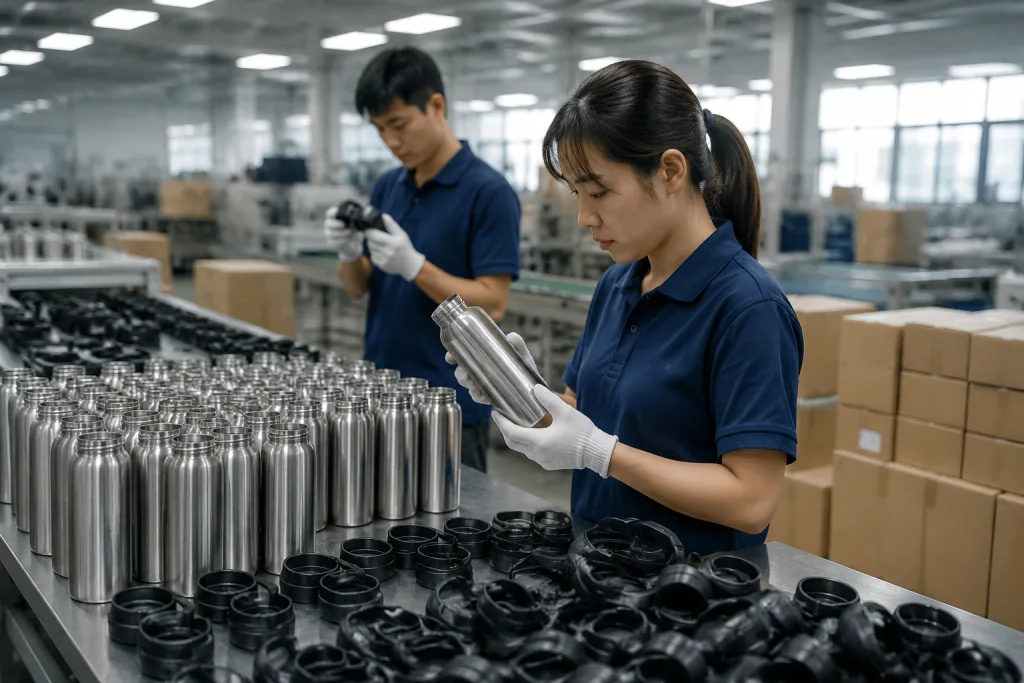
Key Takeaways
- For a practical custom canteen order, expect MOQ from 1,000 to 3,000 pcs per color and 30-45 days production after sample approval
- 304 stainless steel should be verified by mill certificate, internal inspection, and food-contact testing when required
- Polypropylene parts are common for lids, handles, inner straws, and shells, but tooling tolerance must be confirmed before mold opening
- FOB China pricing changes quickly with steel gauge, lid complexity, carton size, and decoration method
If you are looking for a 304 stainless steel polypropylene bottle manufacturer, you are not buying a stock bottle off a shelf. You need the 304 inner body confirmed, the PP lid or sleeve matched to the drawing, decoration that survives tape testing, and repeat orders that do not drift by 1.5 mm at the mouth. Small misses cost money. On our line, QC pulled a 600 ml sample last month where the lid thread passed by hand but failed on the torque gauge after 20 cycles.
From our factory in Hangzhou, Zhejiang, we see 4 mistakes from new buyers again and again: no clear steel grade, drawings without tolerances, logo artwork sent as a low-res JPG, and packaging approved without a drop test. China can ship solid custom drinkware, but the wrong question is “what is your cheapest price?” The better question is whether the supplier can control material, tooling, printing, and carton strength before you pay the deposit; we have seen this go sideways after a PO typo changed PP from black to “blank.”
What are you actually buying?
A 304 stainless steel polypropylene bottle is a hybrid build, not a single-material item. The body or inner liner is 304 stainless steel, usually 0.4 mm to 0.6 mm wall thickness depending on capacity and shape. Food-grade PP normally goes into the lid, carry handle, push button, straw set, protective base, or outer shell. Be precise. If your RFQ only says “304 bottle with PP,” our quoting engineer has to guess the mold set, lid structure, and whether the PP touches drinking water.
Spell out the structure before asking for price. Single-wall or double-wall vacuum? PP used for strength or just decoration? Does the mouth ring touch hot water at 95°C? Does the lid need to pass leak testing at 45 degrees, or upside down for 8 hours? On the line, QC usually pulls 3 samples after assembly and checks the silicone gasket with a torque cap tester; this is where cheap lid designs get exposed. A solid canteen manufacturer asks these questions before quoting. A weak canteen vendor quotes in 2 hours, then comes back 12 days later with a revised price. We have seen this go sideways.
For B2B buyers, the common capacities are 500 ml, 650 ml, 750 ml, 1,000 ml, and 1.2 L. For a custom growler, the range is often 1.2 L to 2 L, with thicker steel and larger cartons. If you buy for distribution, carton volume matters as much as unit price; a 750 ml bottle packed 24 pcs per carton can look cheap until the carton hits 62 cm length and wastes pallet space. The math does not work if the buyer only compares EXW unit price.
At BottleForge Industrial in Zhejiang, our standard stainless and PP bottle lines run about 450,000 units per month across drink bottles, travel tumblers, sports bottles, and canteen customized projects. We run laser welding, vacuum testing, powder coating, and final AQL 2.5 inspection under one production schedule. That scale helps, but it does not replace a clear specification sheet; last month one PO typed “PP outer” when the approved sample was stainless outer with PP base, and the buyer flagged it before mass production.
Buyer question: is 304 enough?
304 stainless steel is our default for custom drinkware because it resists normal corrosion, keeps the quote workable, and is easy to source from Zhejiang and Jiangsu coil suppliers. For water bottles, tea tumblers, coffee cups, electrolyte drink bottles, and school canteens, 304 usually does the job. It is not magic. Last year QC pulled 8 samples from a pilot run after the buyer soaked orange juice in them for 48 hours; the weld area showed light staining, and the buyer flagged it as “rust.” If your end user fills the bottle with salty soup, acidic juice for two days, or chlorine-heavy liquids, talk about 316 stainless steel or print clear usage warnings on the insert.
For procurement, “is it 304?” is the wrong question to ask. Ask how the canteen factory controls the material after it lands at the workshop. We check the steel mill certificate against the coil label, then run incoming material inspection before the line starts cutting discs at 0.4 mm or 0.5 mm thickness. Ask for the steel mill certificate, incoming material inspection record, and confirmation that the supplier can support LFGB, FDA food-contact, REACH, or California Proposition 65 testing if your market needs it. For kids’ bottles, 3 out of 10 buyers we ship to also request ASTM F963-related heavy metal screening for coatings, although the exact test plan depends on the product and sales channel.
Checklist before deposit:
- Confirm 304 grade for every liquid-contact stainless part, including inner wall, tea strainer, straw tube, and welded base plate.
- Confirm PP grade for all food-contact plastic parts, preferably with resin documentation and the same color masterbatch planned for bulk production.
- Set pass criteria for rust spots over 0.3 mm, polishing marks, plastic smell after hot-water rinse, leakage, and lid fit.
- Use AQL, commonly Critical 0, Major 2.5, Minor 4.0 for mass inspection.
- Require pre-production samples made with production materials, not hand-picked showroom samples from the sales room.
If your brand claims “BPA free,” “food-grade,” or “recyclable,” make sure the test evidence matches the sales market. The math does not work if the PO says FDA but the carton artwork says LFGB; we have seen this go sideways at shipment booking. European buyers usually ask us for LFGB and REACH, while North American buyers ask for FDA-related food-contact documentation and CPSIA considerations for children’s items. Before deposit, send the exact claim list and artwork version, even if the file name has an ugly typo like “botttle_v7_final.ai.”
Questions to ask every factory
Compare canteen manufacturers with one fixed question sheet. If not, the low quote looks good on Excel and then bleeds money on the line. A serious 304 stainless steel polypropylene bottle manufacturer should answer drawings, pricing, and test requirements with numbers, not “no problem.” Last month QC pulled a sample with a 0.35 mm lid gap after assembly; that small miss became a carton rework issue.
Ask these directly:
- What is the MOQ per model and per color? Our usual MOQ is 1,000 pcs for existing molds and 3,000 pcs when a special color PP part is required.
- What is the lead time after sample approval? A normal production window is 30-45 days, and before Chinese New Year we quote 45-60 days because PP color matching and carton booking slow down.
- Which parts require new tooling? PP lids, handles, buttons, silicone gaskets, and custom bases may each need separate molds, with separate 2D drawings and trial shots.
- Can you provide BSCI, ISO 9001, or third-party audit support? Ask for the latest report date, not just the certificate cover page.
- What is included in the FOB China price: inner box, master carton, polybag, hangtag, barcode label, spare gasket? We have seen POs miss one digit in the EAN code, and the buyer flagged it after 18 cartons were packed.
For canteen promotional orders, decoration is often the cost item buyers underestimate after material. A one-color silkscreen logo is cheap and fast; we run it on curved bottles with a simple jig, but fine text under 1.2 mm can fill in. Laser engraving lasts, but it only works on the stainless surface. Powder coating with logo masking looks clean, yet the math does not work if the buyer refuses a scratch test and still expects retail shelf quality. Full-wrap artwork can sell the customized canteen well, but approve a wet proof or production sample before mass printing. We have seen this go sideways when a blue brand color shifted after oven curing.
Ask who owns the mold. If you pay full tooling cost for a custom canteen or customizable growler, write ownership and exclusivity into the purchase order, including the mold number and storage period. Do not rely on a chat message. One buyer once sent “exclusive” in WhatsApp, but the PO said shared tooling; the factory followed the PO.

Pricing that changes the quote
Buyers ask for one target price, then add a carry loop, thicker steel, a second lid color, and gift box printing after the first quote. The quote moves. We build it from the parts that hit the cost sheet: steel gauge in mm, bottle capacity, lid structure, PP color, coating type, decoration method, packaging spec, and test requirements. A basic 600 ml single-wall 304 stainless bottle with PP lid may sit around USD 2.20-3.20 FOB Ningbo or Shanghai at 3,000 pcs, while a double-wall vacuum 1,000 ml bottle with custom PP lid and powder coating can move into the USD 5.50-8.50 range. These are planning ranges, not binding offers. Last month QC pulled a 600 ml sample because the buyer’s drawing said 0.5 mm body steel, but the PO line showed 0.4 mm. That 0.1 mm changed the price.
A custom growler is a different job on the line. Larger bodies use more 304 stainless steel, heavier tooling inserts, taller cartons, and extra leak-test time on the vacuum station. A 1.9 L vacuum growler with customized growler logo work may cost two or three times a simple sports bottle. We’ve seen this go sideways when a distributor compares only the unit price. If you are a distributor growler buyer, ask for both unit price and carton dimensions before you compare suppliers; a 12 kg master carton versus a 17 kg carton changes sea freight and warehouse handling.
Polypropylene color matching is another cost that gets missed. Standard black, white, gray, and clear PP parts run cleanly because material is already in stock beside the injection machine. Pantone-matched PP may require a higher MOQ, usually 3,000-5,000 pcs, because the factory must compound or purchase special material. Small orders can use standard PP with custom decoration instead. The math does not work for 500 pcs of special PP color unless the buyer accepts a color-material surcharge; our material supplier will not open one 25 kg bag for a tiny trial run.
Practical buying advice: give the canteen supplier the sales channel before asking for the lowest FOB price. Corporate gifting usually needs a clean logo and decent gift box; Amazon FBA needs barcode placement, drop-test cartons, and tighter cosmetic checks; school programs care more about lid safety and easy cleaning. Distributor canteen catalogs need stable SKUs that we can ship again 6 months later. You can remove cost without weakening the product if the use case is clear. “Cheapest” is the wrong question to ask first.
Customization without creating defects
Customizable drinkware sells because the buyer sees their logo on the shelf, not another stock bottle. Custom work also creates new defect points. We design a canteen customizable program around repeat runs: same fixture, same curing window, same operator check sheet. Nice artwork is not always production-safe artwork; last month QC pulled the sample because a 0.35 mm line in the logo filled in after powder coating.
For stainless surfaces, laser engraving is still the safest long-term mark. It does not peel, it survives dishwashing better than most prints, and it fits corporate logos that need a clean edge. Silkscreen keeps cost down for canteen promotional orders, especially one or two colors, but curved bodies need the right jig, not hand “adjustment” on the line. Heat transfer and water transfer cover larger areas, but we test adhesion, abrasion, and color shift before we quote big volume. Powder coating feels premium, yet it needs cross-hatch adhesion testing and drop testing from around 1 meter if the bottle is sold as outdoor drinkware. We use 3M tape after the cross-hatch cut; if flakes lift, the math doesn’t work no matter how good the Pantone match looks.
For PP components, decoration has tighter limits. PP has low surface energy, so printing fails when surface treatment is skipped or rushed. If you want a logo on a PP lid, we run pad printing, laser on an insert, or molded branding depending on the lid structure. Molded logos look clean. They also lock you into one design, and we have seen this go sideways when a buyer changed the campaign name after the mold text was cut at 1.2 mm depth.
For a customized canteen or customizable canteen series, we recommend one gold sample signed by both sides, then a pre-production sample made with mass materials. If the PP lid color, silicone gasket hardness, or powder coat texture changes after approval, treat it as a new approval. This is not paperwork for fun. It stops you from receiving 5,000 good-looking bottles with a lid that leaks under pressure; we once found this during a 30-second inverted leak test after the buyer flagged “black” as matte on the PO but approved a semi-gloss sample.
Quality control before shipment
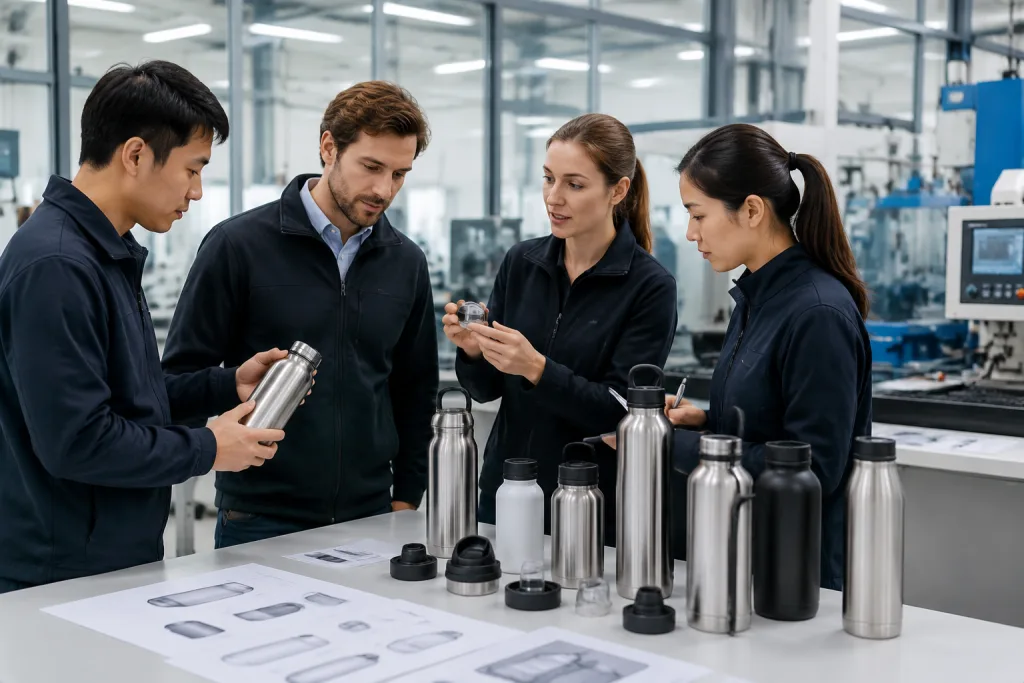
Quality control for a 304 stainless steel polypropylene bottle manufacturer should not start after all cartons are sealed. It starts at the drawing table, with the mouth ID, thread pitch, gasket groove, and coating area marked in mm before the line opens. We run checks at incoming material inspection, welding, polishing, vacuum testing, coating, assembly, and final inspection. If the factory cannot point to its control points on a traveler sheet, the buyer is carrying risk for no reason.
For vacuum bottles, every unit should pass vacuum performance screening. On our line, QC pulls bottles after the vacuum furnace and checks temperature retention with 95°C hot water, then flags air leakage and inner wall scratches under a borescope. Single-wall bottles need a different eye: burrs, seam marks, mouth roundness, lid torque, and leakage matter more than heat loss. PP parts need checks for flash, sink marks, color streaks, warping, odor, and gasket fit; we have seen a 0.4 mm gasket mismatch turn into a full-carton leak complaint.
Shipment inspection checklist:
- Visual inspection under consistent light, not a dark warehouse corner; we use a 600–800 lux bench so coating pinholes show up.
- Leak test with water, shaken and inverted, using a defined sample size; “test a few pcs” on a PO is how this goes sideways.
- Carton drop test, often 10 drops from 76 cm for export cartons depending on gross weight, with corner crush and cap cracking recorded.
- Barcode, FNSKU, carton mark, and retail label verification for North American channels; one buyer once flagged a single wrong digit in the FNSKU after 1,200 cartons were packed.
- Random dimension check for mouth diameter, height, base diameter, and lid thread fit, measured by caliper instead of judged by hand.
Canteen distributors should book a third-party inspection for first orders over USD 5,000. The math is simple: a USD 180–300 inspection costs less than one rejected pallet. Put AQL terms in the purchase order before production starts, not after a dispute; AQL 2.5 for major defects is a common starting point. Ask for production photos at welding, coating, and packing stages, not only the finished carton shot. China ships a lot of drinkware, but good shipment results still come from process control, not hope.
Ordering path that works
A clean ordering path saves more money than hard bargaining over USD 0.05. Start with a written brief, even if it is only 1 page: capacity in ml, body structure, target market, material grade, lid type, decoration method, packaging style, compliance needs, and 6-month forecast. Then ask 3 canteen vendors to quote against the same file. We see the difference fast. One buyer sent us a PO with “304 stainless” in the title and “201 stainless” in the item line; QC pulled the sample request before the line wasted time on the wrong steel.
A typical project path is simple. First, confirm an existing mold or open a new one. Second, approve 2D artwork and 3D structure if needed. Third, make samples in 7-15 days for existing molds, or 25-35 days if a PP lid mold is required. Fourth, approve color against a Pantone code, logo position in mm, leakage result, packaging layout, and test plan. Fifth, pay deposit and start mass production. Sixth, inspect before balance payment and shipment. On the floor, we run the leak test with water at the fill line, then shake the bottle upside down for 30 seconds; that small step catches problems a catalog photo will never show.
Payment terms for new buyers are usually 30% deposit and 70% before shipment. FOB Ningbo and FOB Shanghai are common for Zhejiang factories. EXW can look cheaper, but it pushes export handling and local trucking back to you, and the math often does not work after the forwarder adds warehouse and document fees. If you are an experienced canteen distributor with your own forwarder, FOB is the cleaner comparison. Last month a buyer flagged a USD 180 “local charge” difference between EXW and FOB Ningbo; after checking the booking sheet, FOB still landed lower.
The best canteen manufacturers will say no when your requirement is risky. Good sign. A supplier who accepts every idea without asking about tooling, PP shrinkage, coating adhesion, or carton strength is not protecting your purchase order. We have seen this go sideways on a 0.6 mm wall PP lid where shrinkage changed the fit after cooling, so the lid passed on the sample table but failed after 12 hours in the warehouse. Ask the hard questions before deposit.
Send your bottle spec before opening tooling
Share capacity, lid style, logo, market, and target quantity. We will reply with practical MOQ, FOB pricing, and sample timing.
Frequently asked questions
What MOQ should I expect for a custom canteen order?
For existing molds, a realistic MOQ is usually 1,000 pcs per model, with 500 pcs per color sometimes possible if you use standard PP parts and standard coating colors. For a canteen customized with Pantone PP lid parts, new silicone colors, or exclusive packaging, expect 3,000-5,000 pcs. New mold projects need a separate discussion because tooling cost and trial runs can make very small orders expensive. If your project is for promotional distribution, tell the supplier the firm quantity and delivery date first. A canteen factory can sometimes combine production with other orders, but only when materials and colors match.
Is polypropylene safe for lids and food-contact parts?
Food-grade polypropylene is widely used for bottle lids, straws, handles, and inner components because it is lightweight, durable, and handles normal beverage temperatures well. You should still confirm the exact PP grade and whether the part touches liquid directly. For Europe, ask about LFGB and REACH-related documentation. For the United States, discuss FDA food-contact expectations and any children’s product concerns if applicable. PP can carry odor if poor material or recycled feedstock is used, so require virgin PP for food-contact parts unless your compliance team approves otherwise. A practical inspection also includes smell check, hot water soak, color consistency, and gasket fit.
How long does production take after I approve the sample?
For an existing stainless body and existing PP lid, mass production is normally 30-45 days after sample approval and deposit. Add 7-15 days for sample making. If you need a new PP mold for a custom canteen or customized growler, add about 25-35 days for tooling and first trial samples. Timelines stretch before Chinese New Year, usually from mid-December through February, because material suppliers and coating lines become overloaded. For time-sensitive distributor drinkware programs, lock artwork, carton marks, and testing requirements before production starts. Late FNSKU or barcode changes can delay shipment even when the bottles are finished.
Which logo method is best for customized drinkware?
For durability, laser engraving on stainless steel is the safest option, especially for corporate gifts and outdoor products. For lower-cost canteen promotional orders, one-color silkscreen works well when the artwork is not too fine and the surface curve is manageable. Powder-coated bottles can use laser, silkscreen, or transfer printing, but adhesion and scratch resistance should be tested before mass production. PP lids are trickier because printing on PP needs correct surface treatment. For a canteen customizable program with many logos, use a standard bottle and change the logo method rather than creating a new mold for every client.
How do I compare canteen suppliers fairly?
Give every canteen supplier the same specification sheet: capacity, 304 grade, wall thickness target, PP part details, lid function, decoration, packaging, testing, order quantity, and Incoterm. Ask whether the quote is FOB Ningbo, FOB Shanghai, or EXW, because freight handling changes the real cost. Compare carton dimensions and gross weight, not only unit price. Also ask for AQL standards, sample lead time, audit status, and whether the supplier is a direct canteen manufacturer or a trading vendor. The cheapest quote may exclude inner boxes, spare gaskets, retail labels, or inspection support, which can add USD 0.15-0.60 per unit later.