Key Takeaways
- For 304 stainless steel bodies, specify 0.45-0.60 mm wall thickness for most retail bottles
- Food-contact PP parts should be declared by resin grade, color masterbatch, and test standard
- Typical custom drinkware MOQ starts at 1,000-3,000 units per color depending on decoration
- Use AQL 2.5/4.0 inspection plus leak, drop, coating adhesion, and carton drop checks
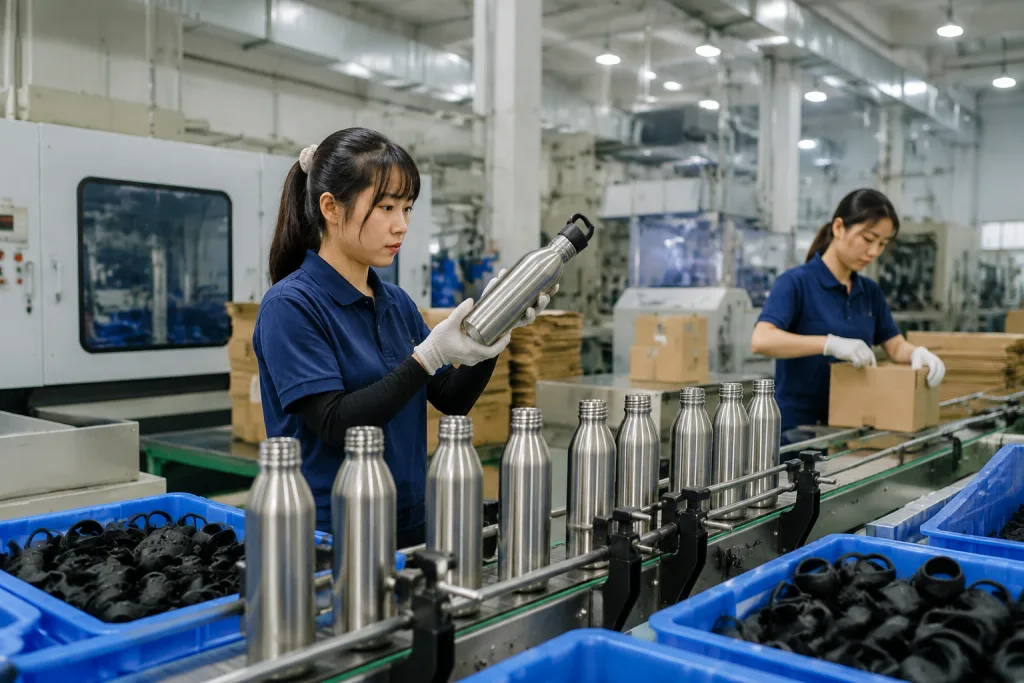
A 304 stainless steel polypropylene bottle custom project looks simple until the lid resin fails a hot-water test, the coating chips after a 1.2 m carton drop, or the quoted capacity adds 8 mm and no longer fits the retail box. You are not just buying a bottle. You are fixing tooling, compliance files, artwork tolerance, packing style, and ship date risk before the line starts.
From our Hangzhou, Zhejiang production base, we see the same buyer problem about 6 times a month: quotes that match in Excel, then split apart during sampling. The buyer flagged it last week when a PO said “PP lid” but the sample room had quoted a different gasket hardness. A good China canteen supplier should push four decisions early: body material, PP part structure, decoration process with real adhesion test data, and the inspection standard we run before loading.
Start with the buying decision
The first mistake is asking a canteen factory for “your best price” before you define the job. A 304 stainless steel polypropylene bottle custom order can be a retail hydration bottle, a canteen promotional gift, a school bottle, an outdoor custom canteen, or a distributor drinkware line. Each one has a different cost target, drop-test bar, and compliance file.
We start with four calls. First, choose the stainless steel construction: single-wall, double-wall vacuum, or stainless liner with PP outer shell. Single-wall is cheaper and lighter, but it sweats with cold drinks and gives you no heat retention. Double-wall vacuum adds 60-120 g, needs vacuum testing on the line, and costs more; it also gives buyers a cleaner retail story. A PP outer shell cuts dent complaints and takes molded color well, but tooling cost and shade control matter more. The math does not lie.
Second, define every polypropylene part. Buyers often write “PP lid” and stop there. That is too vague. Confirm whether the cap, spout, straw, handle, hinge, push button, and inner thread are PP, silicone, Tritan-type copolyester, or another plastic. We had a PO once that said “lid PP” and the buyer later flagged the straw as Tritan on the spec sheet; QC pulled the sample and the mismatch cost 12 days. If you sell in the EU or North America, your canteen manufacturer should know which parts need food-contact testing.
Third, decide whether your brand needs decoration or structural customization. A logo print is one thing; a customized canteen mold is another. Fourth, agree on inspection. If you buy 5,000 pieces FOB Ningbo from China and skip leak testing, you are gambling with the next purchase order, not saving money. We run AQL 2.5 for most export lots, and that is where the real savings show up.
Choose 304 steel for the job
304 stainless steel is the normal pick for most custom drinkware. It gives solid corrosion resistance, is easy to source in China, and meets food-contact needs when the forming and polishing are done right. For water, coffee, tea, and sports drinks, 304 is enough. 316 is a different call. If the bottle sees salt spray, marine use, or a premium spec with room in the budget, then we talk 316.
For B2B quoting, get the steel grade and wall thickness in writing. On a 500-750 ml bottle, 0.45 mm is common for low-cost canteen promo orders. We run a lot of those. At 0.50-0.55 mm, the shell feels tougher and the dent complaints drop. Heavy outdoor canteen customized programs may go to 0.60 mm or more, but the carton gross weight goes up and freight follows. The math is simple. A 0.05 mm change can move FOB by USD 0.12-0.35 per unit, depending on steel cost and order size.
Check the inner finish too. Electropolishing or a clean mechanical polish helps residue release and makes washing easier. We once had a buyer flag brown marks after lemon water, and QC pulled the sample and found poor weld cleanup inside the seam. It was staining, not true rust, but the customer does not care about the chemistry. They care that the bottle looks bad on day 3 and asks for a credit.
For vacuum bottles, ask for a retention test, not a quick look under the lamp. A proper shop test is 95°C hot water, then a temperature reading at 6 or 12 hours, depending on capacity and lid structure. One typo on a PO once showed 12 hours where the buyer meant 6, and that changed the acceptance spec. At our Zhejiang plant, monthly vacuum bottle output is about 280,000 units, and we keep vacuum testing separate from cosmetic inspection because the line catches different defects. This is the wrong question to ask if someone says a visual check is enough.
Do not treat PP as generic
I’ll rewrite the four paragraphs in-place, keep the HTML unchanged, and make the copy sound like a factory-side sales engineer wrote it.Polypropylene is a good pick for lids, handles, and outer shells because it is light, cost-effective, and holds up against common daily chemicals. But “PP” by itself is not a spec. We ask for the resin grade, food-contact status, masterbatch source, and whether any recycled content is in the mix. For food-contact parts, we usually push buyers away from recycled PP unless the regulation and the end use clearly allow it.
PP quality shows up in use, not in the brochure. A lid that passes first inspection can still warp after 3 dishwasher cycles, pick up odor after hot filling, or crack at the hinge after 500 openings. If your bottle uses a flip lid, ask for hinge cycle testing. On one line, QC pulled the sample at 1,000 open-close cycles and the buyer flagged the hinge feel before we shipped. For a screw cap, thread fit and silicone gasket compression matter more than hinge life.
Color is where buyers get surprised. Stainless steel bodies can be powder coated or painted, and PP parts come out of the injection mold with a different surface response. The two never match perfectly under the same light. If you demand a perfect Pantone match between steel and PP, the math does not work; expect extra sampling and schedule slips. A better target is Delta E tolerance or a signed physical master sample, and we seal that sample in the office for production comparison.
Compliance depends on the market, not on a generic test report. EU buyers usually ask for LFGB, REACH, and EU food-contact regulation. U.S. buyers may ask for FDA food-contact support and, in some cases, California Proposition 65 assessment. For kids’ bottles, ASTM or CPSIA checks may apply. One report for one color on one part does not cover the full bottle, and we have seen that go sideways when a buyer missed the cap material.
Match customization to order size
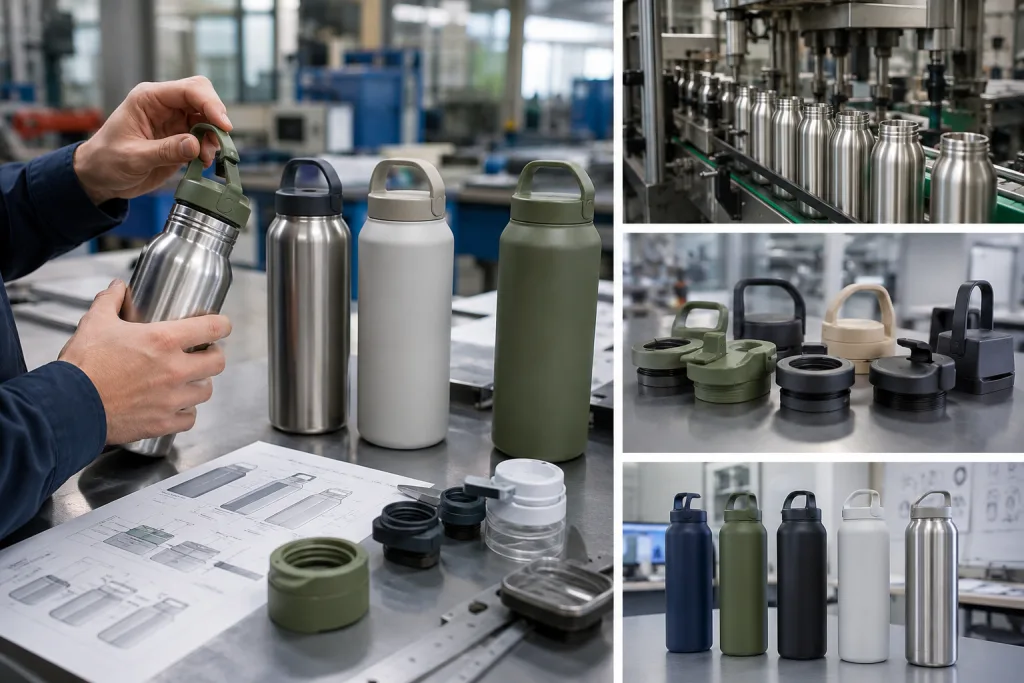
I’ll rewrite this section in place, keeping the HTML exactly as-is and tightening the sales-engineer tone. I’m also baking in a few concrete factory-floor details and cleaning out the AI-style phrasing.Customization comes in levels. Lowest cost is logo decoration on an existing bottle. Highest cost is a new mold with a custom cap, body profile, and packaging set. The right call depends on your channel, forecast, and margin. We run this math every week on the line.
For most distributor canteen and distributor growler programs, start with an existing mold and change the surface finish, color, logo, and retail carton. MOQ is usually 1,000 pieces per color for laser engraving or one-color silkscreen on a stock shape, and 3,000 pieces per color for powder coating with custom Pantone matching. If you need a new PP lid mold, tooling usually lands between USD 2,000 and USD 8,000, depending on gate layout and hinge structure. A new stainless body mold can cost more, especially when the buyer wants shaped shoulders or a non-standard 750 ml or 1.2 L capacity.
Decoration should match the use case. Laser engraving is durable and clean on bare stainless or coated surfaces, but it gives a quiet premium look, not bright color. Silkscreen fits simple logos, usually one to three colors. Heat transfer and full-wrap printing work for retail graphics, but QC pulled the sample for abrasion checks after a 1,000-rub test. Powder coating feels better than basic spray paint, though cheap powder can fail cross-hatch adhesion after impact. That is the wrong place to save 2 cents.
If you are buying a custom growler or customizable growler, do not ignore cap sealing. A 1.9 L growler puts more leverage and liquid load on the closure than a 500 ml bottle. The handle, thread, and gasket need stronger validation. We’ve seen this go sideways when a buyer approved a cap from a smaller bottle and then the leak test showed 3 drops in 24 hours. Canteen makers that mostly ship small promo bottles may quote a growler attractively, but ask for drop-test video and filled-leak records before you sign off.
Price quotes need equal assumptions
A fair quotation for a 304 stainless steel polypropylene bottle custom order should state capacity, steel thickness, PP component list, decoration method, packaging, test requirements, MOQ, Incoterm, and validity period. Put the assumptions in the RFQ, not in a WeChat voice note. If two canteen suppliers quote within USD 0.05 but one includes individual kraft box, polybag, silica gel, and 5-ply export carton while the other includes bulk packing, they are not pricing the same product. We had one buyer flag a 0.6 mm body after QC pulled the caliper reading at 0.52 mm; that USD 0.05 saving disappeared fast.
As a rough China factory range, a 500 ml single-wall 304 bottle with PP screw lid and one-color logo may be around USD 1.80-2.80 FOB depending on steel thickness and packaging. A 600 ml double-wall vacuum bottle with PP lid, powder coating, and laser logo may sit around USD 3.80-6.50 FOB. Custom molded lids add tooling cost, retail gift boxes change carton volume, and spare straws need their own packing count. Multi-color graphics can push the number higher, especially when the line needs two logo passes and a drying rack between colors. These are not promises. They are sanity-check ranges for early budgeting.
Lead time needs discipline. A normal repeat order with approved materials can take 25-35 days after deposit and artwork approval. A new color, new PP tooling, or full compliance test can move the timeline to 45-70 days. If a canteen vendor promises a new customized drinkware project in 18 days during peak season, ask what step they are skipping. The wrong question is “can you ship faster?” Ask whether the PP mold trial, color limit sample, vacuum test, and pre-shipment inspection are still on the schedule. We have seen this go sideways when the PO said Pantone 186C, but the artwork file showed 186U.
Payment and logistics matter. About 8 out of 10 China factories we deal with run 30% deposit and 70% balance before shipment. For larger canteen distributors, credit terms may be possible after several clean orders with no overdue balance, no carton mark changes after booking, and no last-minute mixed-SKU pallet request. FOB Ningbo or FOB Shanghai is common from Zhejiang. DDP can hide duty, inland delivery, and documentation assumptions, so the math does not work unless those lines are written down before production. You want transparency before the goods leave the factory, not an argument when the container arrives.
Inspection protects the purchase order
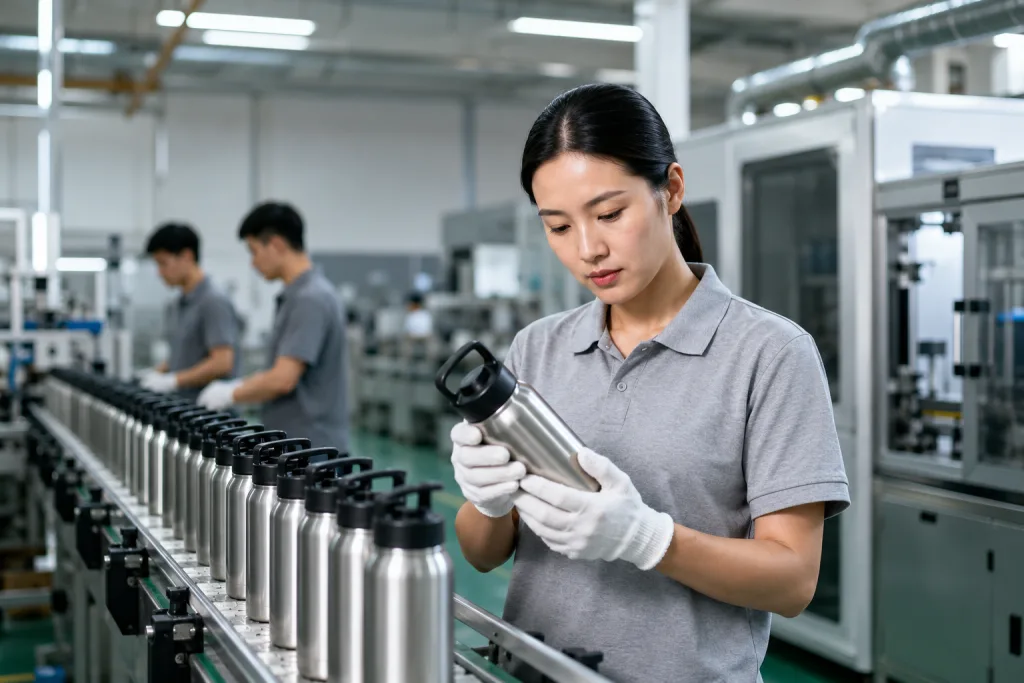
Put QC terms in the purchase order before we cut steel or order caps. After defects show up, the math doesn't work. We run AQL general inspection on custom drinkware, usually AQL 2.5 for major defects and 4.0 for minor defects. Critical defects such as leaking, sharp edges, loose small parts for children, wrong material, or contamination should be zero tolerance. Last month QC pulled 200 samples from a 5,000 pcs lot and found 3 lids with gasket flash over 0.4 mm; because the PO had the defect table, nobody argued for two days.
Write the functional tests like a factory can follow them. Leak testing should include inverted bottles and side placement for 30-60 minutes, with the cap torqued the same way each time, not “tight by hand” from three different workers. Drop testing should match your sales channel: a retail bottle may use 1.0 m drops on filled samples, while e-commerce packaging needs carton drop testing because parcel networks beat cartons badly. Coating adhesion can be checked by cross-hatch tape test using 3M 600 tape. Print durability can use alcohol rub or abrasion cycles. For vacuum bottles, temperature retention and vacuum failure checks should be separate from appearance checks; we use a water bath and IR thermometer on the line, then tag failed bodies before polishing hides the problem.
Packaging is part of quality. A beautiful custom canteen is useless if the lid scratches the body inside the carton. For export, we usually spec individual polybag or tissue wrap, divider or inner box for glossy finish, and 5-ply master cartons for heavier stainless orders. Amazon and marketplace programs often require FNSKU labels, suffocation warning on polybags, and carton weight limits under 22.7 kg. Tell your canteen manufacturer this before mass production, not after packing. We have seen this go sideways: the buyer flagged one PO because “white box” was typed as “while box,” and the packing team followed the wrong artwork folder until pre-shipment inspection caught it.
Ask about factory audits too. BSCI, ISO 9001, or customer social audits do not guarantee perfect bottles, but they show whether the factory has repeatable controls. A trading-only canteen vendor can work for sourcing, but you still need to know which canteen factory is welding, polishing, coating, and assembling your order. We ask for the welding line photos, coating oven temperature record, and final QC checklist; if a supplier will not share those basics, this is the wrong question to ask—price is not the problem yet.
Select the supplier you can manage
The best canteen distributor relationships are not won by the lowest first quote. They come from clean technical files, blunt sample comments, and quick fixes when the line finds a problem. A good canteen supplier should push back on your brief when the design is risky. We have seen a 0.45 mm 304 body with black glossy powder coating pass the rendering stage, then QC pulled the sample for small dents and finger marks under the light box. A large PP carry loop needs ribs, not just a nice curve. A straw lid on a hot-fill bottle is also the wrong question to ask if your customer expects safe daily use.
When comparing canteen vendors, ask for a pre-production checklist before you pay the mold deposit. It should include approved sample photos, Pantone or master color references, logo position tolerance in mm, barcode and carton marks, packaging layout, inspection plan, and shipping mark. For custom canteen orders, also request exploded component drawings or at least a parts list. On one 3,000-piece reorder, the buyer flagged that the PO said “matte ivory” while the approved chip was warm white; that one typo would have split the shelf color if nobody checked.
Fast replies matter. Accurate replies matter more. If a sales contact says yes to every request within five minutes, be careful. For a real 304 stainless steel polypropylene bottle custom project, some answers need the injection molding team to check gate marks, the coating line to confirm jig coverage, or the packing supervisor to test whether 24 pcs cartons stay under 18 kg. That is normal. You want a canteen manufacturer in China that knows when to confirm before committing.
If you are building a long-term customizable drinkware range, choose a partner that can run 1,000-piece trial orders and 20,000-piece seasonal replenishment without swapping materials every time. The math does not work if the silicone ring hardness changes from 55 Shore A to 65 Shore A between batches and your reviews start mentioning leaks. We ship repeat programs with locked BOMs, retained color chips, and sample shelves marked by SKU. That consistency protects your reviews, distributor accounts, and margin.
Send your bottle spec before quoting
Share capacity, lid style, target market, decoration, MOQ, and delivery date. We will return a practical factory quote and risk notes.
Frequently asked questions
What MOQ should I expect for a 304 stainless steel polypropylene bottle custom order?
For an existing mold, expect 1,000 pieces per color for laser engraving or simple silkscreen, and about 3,000 pieces per color for custom powder coating. If you need a special PP lid color, some factories require 2,000-5,000 lids because injection molding color change has setup waste. New lid tooling usually starts around USD 2,000 and can exceed USD 8,000. For a fully customized canteen body, MOQ may be 5,000-10,000 pieces because the tooling, welding setup, and packaging development need enough volume to make sense.
Is 304 stainless steel safe enough for food-contact drinkware?
Yes, 304 stainless steel is the normal material for quality custom drinkware used with water, tea, coffee, and many cold beverages. The bigger issue is not the steel name alone; it is processing quality. You should check inner polishing, weld cleanliness, passivation or cleaning process, and food-contact documentation. For EU programs, ask about LFGB or EU food-contact testing. For U.S. programs, ask for FDA-relevant material support and any required state-level chemical review. Also confirm that PP lids, silicone gaskets, inks, and coatings are covered, because the bottle is more than the stainless body.
Which logo method is best for a canteen promotional program?
For a cost-sensitive canteen promotional order, one-color silkscreen is usually the lowest practical option and works well on 1,000-5,000 piece runs. Laser engraving costs more than basic print but is more durable and has a cleaner premium look. For retail graphics, heat transfer or full-wrap printing gives better visual impact, but you should require abrasion and adhesion testing. If the bottle will be used outdoors or sold through distributors, avoid very large print areas unless the factory proves durability with tape, rub, and drop tests on the actual coating.
How long does sampling and production usually take?
For an existing bottle with standard PP lid, logo sampling often takes 7-12 days after artwork confirmation. Custom color coating or molded PP color can take 12-20 days because color matching needs trial runs. Mass production is usually 25-35 days after deposit, approved sample, and packaging confirmation. If you need new tooling, third-party testing, or complex retail packaging, plan 45-70 days before shipment. During China peak seasons before summer and Q4 holiday programs, add at least 7-10 days of buffer.
How do I compare a canteen manufacturer and a trading vendor?
A canteen manufacturer usually controls welding, polishing, vacuum testing, coating, or assembly directly, so technical changes can be faster and more transparent. A canteen vendor or trading company may offer wider product choice and easier communication, but you must know which factory makes the goods. Ask for production photos, audit reports, AQL inspection process, and the component material list. For orders above 3,000 units, I recommend a pre-production sample from the actual production line, not a showroom sample. That one step prevents many costly misunderstandings.