Key Takeaways
- 304 stainless steel is the core value; specify 18/8 grade, 0.4-0.6 mm inner wall, and keep plastic parts food-grade PP or Tritan.
- For wholesale orders, expect MOQ from 1,000-3,000 pcs per SKU and FOB China pricing around USD 1.35-4.80 depending on capacity, lid type, and decoration.
- Ask for REACH, LFGB where needed, and migration or torque test data; a cheap bottle that leaks at 1,000 cycles is not wholesale-ready.
- Lead time is usually 30-45 days in Zhejiang, with printed or boxed programs adding 5-10 days and high-season delays of 7-14 days.
If you are buying 304 stainless steel plastic water bottle wholesale, the hard part is not the bottle shape. It is the spec sheet. We have seen two suppliers quote the same 750 ml design, but one runs 0.4 mm inner steel, a loose PP cap that fails the 3.5 N·m torque check, and no migration testing. The other builds a bottle that passes REACH and ships on time. QC pulled the sample. The buyer flagged it after PO release, which is the expensive time to find out.
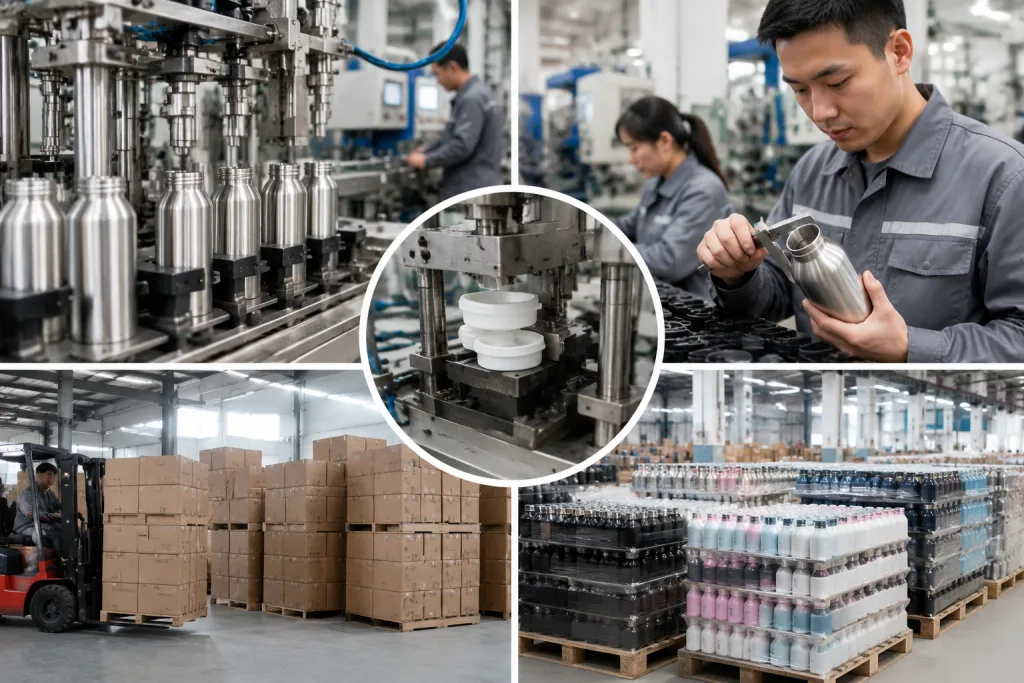
For procurement managers and brand owners, the job is to separate sales talk from production data: steel grade with mill certificate, wall thickness checked by digital caliper, plastic resin named on the BOM, sealing system tested for leakage, coating matched to artwork, MOQ tied to line changeover, and output confirmed at 5,000 or 20,000 units. At our Zhejiang factory, standard drinkware runs at 300,000 units per month, with 30-45 days lead time depending on printing and packaging. China has plenty of factories; the difference is whether they can document the spec, not just talk about it. If a quote is cheap but skips resin grade and test reports, the math does not work.
What 304 Actually Means
Start with the steel. Everything else depends on it. 304 stainless steel means an 18/8 chromium-nickel alloy, normally used for the inner liner and sometimes the outer shell in double-wall bottles. For 304 stainless steel plastic water bottle wholesale, treat “304” as the floor, not the headline claim. Ask exactly where the 304 sits: inner liner only, both walls, or a small insert around the mouth. On our line, the production drawing must show metal thickness in millimeters, such as 0.50 mm ±0.03 mm, not lazy wording like “premium steel.”
For cold and hot drinkware, the working range is usually 0.4 mm to 0.6 mm for the inner body. Below 0.35 mm, QC pulled the sample after the expanding die left light ripples near the shoulder, and dent resistance was poor. Above 0.7 mm, the math does not work for most retail programs: weight climbs, carton freight climbs, and the buyer still compares it with a cheaper bottle on the shelf. A 500 ml bottle in 304 with a PP lid often lands around 260-360 grams depending on the wall structure. If your program is for bulk drinkware or wholesale drinkware, that weight affects shipping cost and hand-feel.
Do not confuse 304 with a polished surface. The finish can be brushed, powder coated, painted, or sublimated, but the steel grade stays the same. For EU buyers, ask for food-contact documentation and metal composition traceability by batch. We have seen this go sideways when a PO said “304 body” and the buyer flagged it at inspection because only the inner liner was 304. A supplier in Zhejiang that cannot show coil source, thickness tolerance, and weld-line control is not ready for serious drinkware wholesale work.
Plastic Parts Decide Leakage
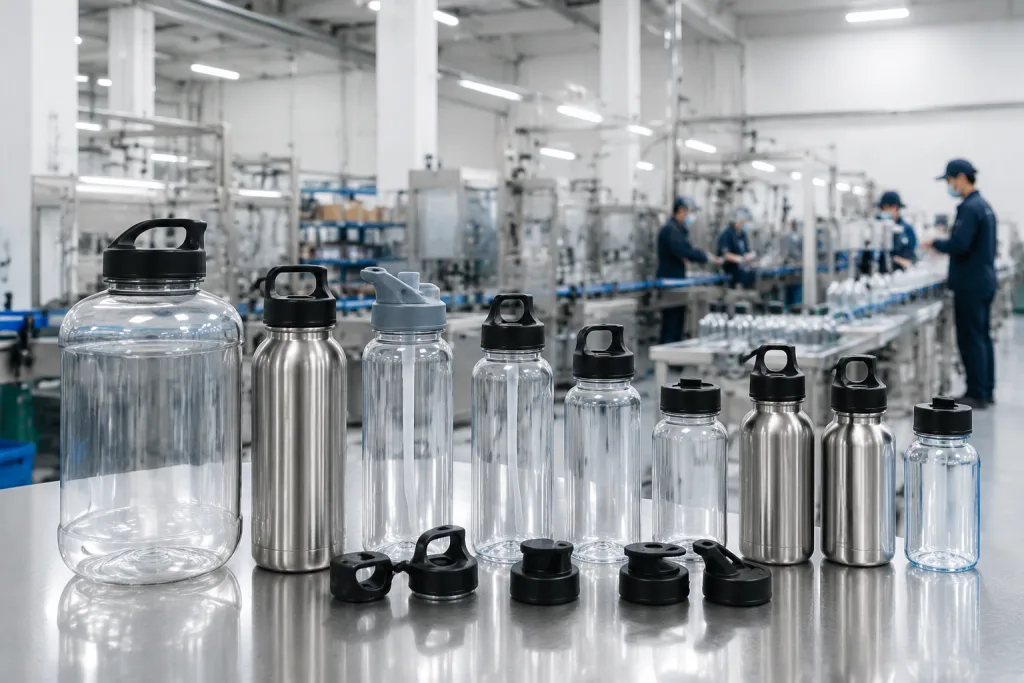
The “plastic bottle” part is where we see wholesale canteen projects fail first. Caps, buttons, straws, spouts, and handle pieces usually run PP, ABS, Tritan, or silicone, and QC checks them with a thread gauge before the body even matters. PP keeps the SKU practical for daily use; Tritan looks clearer and feels more premium, but it pushes unit cost up by roughly 15-30%. For a bulk canteen or canteen wholesale order, the lid structure often matters more than the bottle body. The buyer flagged this twice last season after the cup passed the drop test but leaked from the push button.
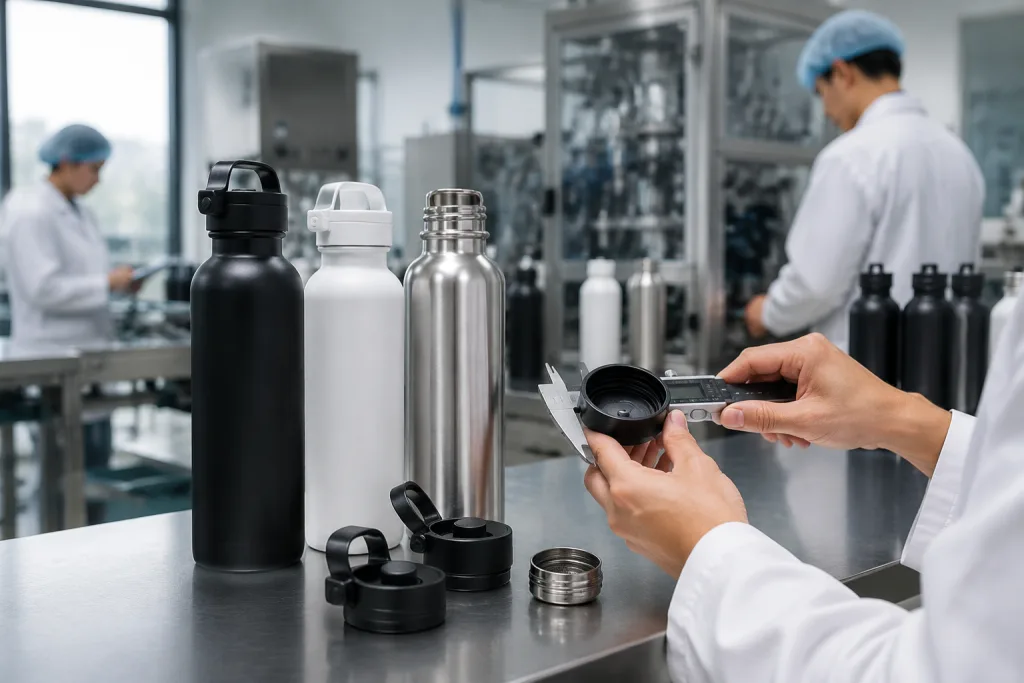
Check thread engagement, gasket design, and the load on the hinge or flip mechanism. Simple point. A weak cap can look fine on a gold sample and still fail after 200-300 open-close cycles on the line. For a sports model or the best wholesale drink bottle positioning, specify a silicone sealing ring with compression, not a simple friction fit. The ring thickness is often 1.5-2.5 mm depending on the closure geometry, and we measure it with a digital caliper because 0.3 mm can change the leak result. Asking only for the cheapest lid is the wrong question to ask.
If the bottle includes a straw, confirm the straw material and hardness. Silicone straws feel soft on the mouth, but they can hold coffee or juice flavor after 24 hours; PP straws are stiffer and cheaper to mold. For wholesale drinkware, the cheaper lid is often false economy. A leak claim costs more than a 6-cent gasket upgrade, and we have seen one PO with “silicon ring” typed wrong, then the supplier shipped a lower-grade gasket because nobody locked the spec sheet. QC pulled the sample. It failed the inverted shake test in 40 seconds.
- Ask for lid cycle test: 500-1,000 cycles minimum for commercial programs.
- Ask for hot-water leak test at 90°C and inverted shake test.
- Confirm all plastic parts are food-grade and color-matched by Pantone or physical sample.
Size And Capacity Drive Cost
Capacity looks simple on a spec sheet. On the line, it changes forming depth, trimming loss, lid fit, and carton loading. A 350 ml compact bottle packs tighter and ships cheaper than a 750 ml model; our packing table usually shows 24 pcs per carton for 500 ml, but only 12 or 18 pcs once the body diameter passes 80 mm. In 304 stainless steel plastic water bottle wholesale, the common sizes are 350 ml, 500 ml, 600 ml, 750 ml, and 1,000 ml. Let the sales channel choose the size, not some leftover mold sitting in the tool room. For Europe, 500 ml and 750 ml sell cleanly in retail and promo orders. For North America, 20 oz and 32 oz equivalents are easier for buyers to place on shelf strips and Amazon-style listings. We have seen this go sideways when a PO says “750 ml” but the artwork dieline was made for 24 oz.
Buyers often miss the carton math. Capacity changes steel usage, yes, but it also changes how the bottle sits inside the master carton, how thick the EPE divider needs to be, and whether the carton passes a 10 kg drop test. A 500 ml bottle may ship 24 pcs per master carton; a bulk growler or beer growler bulk format may only fit 12 pcs because of body diameter and protective dividers. That changes freight cost per unit by 8-18% depending on route. If you are comparing growler wholesale or beer growler wholesale bulk offers, check carton dimensions and net weight before you compare ex-works price. The lowest unit price can lose the order after the forwarder measures the carton.
For standard drinkware wholesale programs, we quote by size tier because tooling time, welding length, polishing area, and coating coverage all move with the body. A 1,000 ml bottle can cost 20-35% more than a 500 ml version even when the lid looks identical. QC pulled one 1,000 ml sample last month because the shoulder wrinkle was 1.2 mm deeper than the approved sample after deep drawing. Small detail. Big rejection risk. Do not force one SKU to cover every use case unless the channel plan is clear, such as gym retail for 1,000 ml and office gifting for 500 ml.
Print, Coating, And Branding
Decoration sells the sample photo; the print line protects or kills the margin. For bulk drinkware, we run silk screen, pad print, UV print, laser engraving, or powder coat with logo masking. On a curved 304 stainless body, laser engraving holds up well after 500 rubs on our alcohol abrasion test, but it gives you metal color only. For retail shelves, powder coating with one- or two-color print often wins because the bottle reads from 2 meters away. QC pulled one matte black sample last month because the logo sat 3 mm off-center; the buyer flagged it before we released the PP sample. Check the method before you lock the PO: silkscreen vs laser engraving guide.
For drinkware bulk orders, single-color silk screen on a round bottle is still the cheapest clean option, adding about USD 0.06-0.18 per piece depending on coverage and setup. Full-color UV print can add USD 0.20-0.60. Short answer: don’t cover everything. If you are building a premium canteen wholesale line or a corporate gift program, full-body artwork often creates more reject risk than brand value, especially around the bottle shoulder where the fixture leaves less tolerance. We’ve seen this go sideways on a 3,000 pcs order when the PO said “logo height 45 mm” but the artwork file was named “40mm_final.ai.” A clean bottle with logo placement within ±1 mm often sells better than a busy design.
Check coating thickness before you approve color. A good powder coat commonly sits around 60-90 microns, measured with a coating thickness gauge after curing. Too thin and cartons rub through during transit; too thick and the finish chips at the shoulder or base edge after the drop test. Zhejiang factories doing high-volume custom work should quote Pantone matching, sample lead time of 5-7 days, and a mass production proof before the main run starts. The math doesn’t work if the supplier skips this step and you discover shade drift after 8,000 pcs are packed.
Compliance You Should Request
Compliance is not a brochure line. It is a document set. For Europe, ask for REACH on the plastic lid, straw, coating, and any color masterbatch that contacts hands or mouth; ask for LFGB when your retail chain requires it. For the US market, 6 out of 10 importers we deal with still request CPSIA-related declarations for child-targeted colors or small-cap designs, even when the PO says “adult bottle.” If the bottle uses 304 stainless food-contact surfaces, request migration testing aligned with relevant FDA expectations and a third-party lab report with the exact item code shown. QC checks this against the golden sample label; one buyer flagged a report last year because the lab sheet said “WB-750” while the PO typed “W8-750.” Small typo. Big delay.
For wholesale growler, beer tumbler bulk, or alcohol flask bulk programs, compliance matters more because the bottle may see 40% ABV alcohol, hot filling at 60°C, or pressure change in transport. Alcohol flask wholesale bulk orders should confirm seal compatibility with ethanol-based liquids. Some gasket compounds swell from 2.0 mm to 2.4 mm after soaking, while others harden and stop sealing. We have seen this go sideways: after 90 days on shelf, complaint rates moved from under 0.3% to 2.1% because the supplier used a cheaper silicone mix. The math doesn't work.
Ask for a supplier quality plan covering incoming material inspection, line-side leak testing, and final AQL with defect photos attached. A practical AQL standard might be 2.5 for major defects and 4.0 for minor defects, but the exact number should match your channel risk. If you ship into Amazon or retail distribution, insist on carton drop test from 76 cm and barcode verification with a handheld scanner before packing. For bulk canteen and wholesale drinkware shipments, that is basic discipline, not an upgrade. On our line, QC pulled the sample after 500 pcs when one cap torque read 6 kgf·cm below spec, and that is the kind of finding you want before the container closes.
MOQ, Lead Time, And Pricing
Let’s talk numbers. Sourcing without them wastes time. In Zhejiang, we usually quote MOQ at 1,000-3,000 pcs per SKU and per color for a custom 304 bottle with plastic lid, based on mold status and print process. If the buyer asks for 4 lid colors, a new carry handle, or a soft-touch strap, MOQ often moves to 5,000 pcs because the injection line has to run the color in full batches. For standard stock shapes, some factories will accept 300-500 pcs, but the math gets ugly below 500 pcs. Last month QC pulled a pre-production sample where the PO said “matte black,” but the Pantone code was for gloss black; that one typo delayed approval by 3 days.
FOB China pricing for a basic 500 ml 304 bottle with PP lid often starts around USD 1.35-2.10 in larger runs. Add powder coating, laser logo, premium packaging, or a Tritan lid, and the quote may sit at USD 2.40-4.80. Beer growler wholesale bulk or bulk growler units cost more because the body is larger, the carton needs stronger 5-ply material, and we run a tighter leak test on the sealing area. Alcohol flask wholesale bulk programs use less stainless, so the material side looks cheaper, but the finish rejects can eat the saving if the curved surface shows scratches under the inspection lamp. We’ve seen this go sideways when a buyer compares only steel weight and ignores the packing and leak-test labor.
Lead time is usually 30-45 days after sample approval and deposit. Custom color, printed carton, or FNSKU labeling for Amazon adds 5-10 extra days, especially when the carton artwork needs a barcode scan test before mass printing. A factory in China claiming 10-day mass production on a custom 304 project is holding stock or cutting steps. Wrong question to ask. For serious drinkware wholesale orders, I would rather see 300,000 units monthly capacity, a dated production schedule, and clear slots for polishing, coating, assembly, and final AQL 2.5 inspection than a quick promise over WeChat.
Buying For Channel And Use Case
The right spec starts with the sales channel. A promo bulk canteen for a 5,000 pcs trade-show order is not built like a retail 304 insulated bottle for an outdoor shop at USD 12.90 shelf price. Corporate gifting needs tighter cosmetic control; we run AQL 2.5 but ask QC to pull extra samples under the 600 mm light box because small dents near the logo get flagged fast. E-commerce needs 1.2 m drop-tested cartons, readable barcode labels, and lower unit weight to keep courier charges under control. For hotels or event programs, canteen bulk pricing often beats premium decoration. The math doesn’t work if the buyer pays for laser engraving nobody checks after the event.
Think by use case, not by catalog photo. For a beer tumbler wholesale bulk line, the lid has to handle 50 dishwasher cycles and a few drops onto tile; last month QC pulled a sample where the slider cracked after the third impact. For a wholesale growler used in beverage resale, neck geometry and cap sealing matter more than a 60 mm logo area. For alcohol flask in bulk, check cap retention and finish wear, because scratched edges on metal flasks look cheap after one pocket test. A good wholesale drink bottle for a gift box can go sideways in bar resale.
Use a spec sheet with capacity in ml and oz; steel grade such as 304 stainless; body thickness in mm; lid and gasket material; finish and logo process; carton pack with kg and CBM; test standards; target FOB. Real factories in Zhejiang answer these line by line. We ship from Hangzhou/Ningbo, and our merchandiser will still catch a PO typo like “350 ml” on page one and “500 ml” on page three before the line opens the hydraulic press. If a supplier keeps saying “high quality” and “best price” without those details, keep looking.
Send your spec sheet, get a real quote
We can review steel grade, lid structure, MOQ, and lead time in one pass, then quote a workable China FOB price without guesswork.
Frequently asked questions
What is a realistic MOQ for 304 stainless steel plastic water bottle wholesale?
For a custom 304 stainless steel plastic water bottle wholesale order, 1,000-3,000 pcs per SKU is realistic in China. If you add custom color lids, printed packaging, or special tooling, MOQ can move to 5,000 pcs. Stock shapes may go lower, but the unit price usually rises 10-25% below 500 pcs. Ask whether the MOQ is per design, per color, or per logo version, because factories in Zhejiang often split these differently.
How much should I budget per unit FOB China?
For a basic 500 ml bottle with 304 inner steel and a PP lid, FOB China often lands around USD 1.35-2.10 in volume. Add powder coating, laser engraving, or a Tritan lid and you may see USD 2.40-4.80. Larger items like bulk growler or beer growler wholesale bulk models can cost more due to size and packaging. Always ask for pricing tied to 5,000 pcs, not just a one-off sample quote.
What documents should I request before placing a PO?
Ask for food-contact declarations, REACH for plastic and coating parts, and LFGB if your EU customer requires it. For wholesale drinkware or wholesale canteen projects, request a spec sheet, final artwork proof, carton dimensions, and a test report for leak resistance. If the bottle is for Amazon, ask for FNSKU labeling support and carton barcode verification. A good supplier will also share AQL inspection terms before production starts.
How do I check if the lid will leak in real use?
Use three checks: inverted hot-water test at around 90°C, shake test, and cycle test. I would want at least 500 cycles for commercial projects, and 1,000 cycles if the bottle is going into retail or e-commerce. Confirm the gasket material, usually silicone, and make sure the thread engagement is deep enough. For alcohol flask wholesale bulk or beer tumbler bulk items, ask whether the seal has been tested with the intended liquid type.
Is 304 always the best choice for wholesale drinkware?
For most drinkware wholesale applications, yes, 304 is the practical standard because it balances corrosion resistance, cost, and manufacturability. It is usually the right choice for a bulk canteen, wholesale growler, or the best wholesale drink bottle program. If the buyer demands extra corrosion resistance or special chemical exposure, 316 may be considered, but it raises cost. In most Zhejiang factory programs, 304 is the best value unless your spec says otherwise.