Key Takeaways
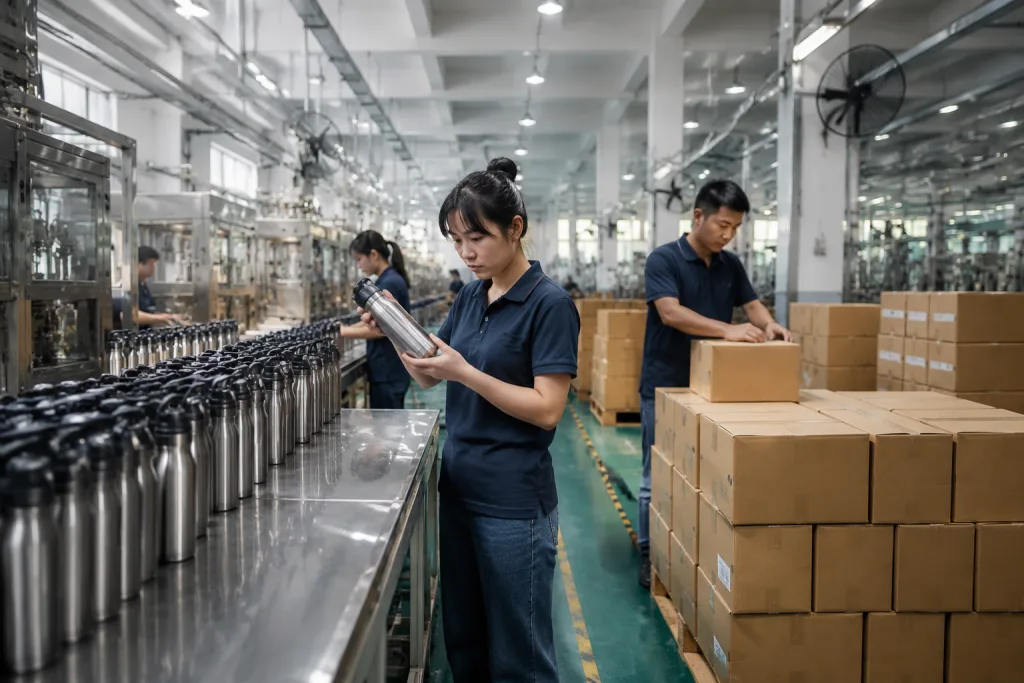
- For private label, a realistic MOQ is 1,000-3,000 units per color for existing molds and 5,000+ units for new shape tooling
- 304 stainless steel should be confirmed by material certificate and spot-tested when the order value justifies it
- Plastic lids, straws, handles, and spouts need separate PP, Tritan, silicone, or ABS specifications
- AQL 2.5/4.0 inspection and 30-45 day production lead time are normal for repeat custom drinkware orders
A 304 stainless steel plastic water bottle private label project looks easy until the deposit is due and your team still has to sign off drawings, PP lid parts, powder coating, carton marks, and LFGB or FDA test items. Photos lie. The bigger risk is ordering 5,000 units that pass a phone-screen check but miss your retail margin, food-contact file, or distributor delivery date. We have seen QC pull a pre-production sample with a 0.4 mm lid gap; the buyer thought it was cosmetic, but the leak test said otherwise.
In our Zhejiang factory work with European and North American buyers, clean projects usually start with four locked decisions: body construction, plastic component specification, decoration method, and inspection standard. Ask for a FOB China price before those are fixed, and the math gets messy fast. One supplier quotes a 304 stainless inner wall with PP cap, another assumes cheaper lid hardware, and a third leaves carton drop-test requirements out of the price. We run into this every month. A recent PO even had “matte black” in the artwork file and “gloss black” on the carton mark sheet, which is exactly how canteen suppliers, canteen vendors, and every canteen manufacturer end up quoting different bottles.
Start with the product architecture
The phrase 304 stainless steel plastic water bottle private label means a 304 stainless bottle body with plastic working parts: lid, carry loop, straw, flip cap, bumper, handle, or inner gasket housing. Define this build first. On our costing sheet, a 750 ml body may move only USD 0.08 with steel thickness, while a new flip-lid mold can add USD 1,200-2,800 before one carton ships. Price gaps often sit in plastic tooling, lid assembly, and leak testing, not just the steel shell.
For the bottle body, most buyers choose single-wall 304 stainless steel for lightweight sports use or double-wall vacuum 304 stainless steel for insulation. Single-wall bodies may use 0.5-0.6 mm sheet before forming. Vacuum bottles often use an inner wall around 0.4 mm and outer wall around 0.5 mm, depending on capacity and shape. Go too thin and the math doesn't work: QC pulled a 600 ml sample last season with a 0.38 mm outer wall, and 7 pieces out of 80 showed shoulder dents after a 1.2 m carton drop test.
Plastic parts are where 6 out of 10 private label projects get messy. PP works for simple lids and keeps cost down. Tritan fits a clear flip lid or visible straw section. Silicone belongs on gaskets, soft straws, and anti-slip pads. ABS may show up in hard handles or decorative shells, but confirm food-contact exposure before approval; we had one buyer flag an ABS button sitting inside the drinking path, and the line had to change the lid insert before pre-production sample sign-off.
If you are a canteen distributor building a long-term line, ask your canteen factory for an exploded product drawing. The drawing should show every part, material, color, and whether the part contacts drinking water. We run this as a one-page BOM plus a marked 2D drawing, down to gasket diameter in mm and Pantone color for the carry loop. A proper canteen supplier in China should provide it before mass production. Without it, you are comparing vague samples, not engineering choices.
Pick the private label level
Private label does not always mean a new mold. For first orders, we usually run an existing bottle mold with your logo, selected powder-coat color, matched lid, retail box, and barcode. In our Hangzhou, Zhejiang production network, an existing-mold program usually starts at 1,000-3,000 units per color, with sample approval in 7-12 days and mass production around 30-45 days after deposit and artwork approval. Small detail, big delay: last month a PO had Pantone 186C typed as 168C, and the line held the color plate until the buyer confirmed by email.
A deeper private label program changes the cap, handle, silicone bumper, body curve, or capacity. That is where tooling cost appears. A simple plastic lid insert may need USD 800-2,500 in tooling. A new cap assembly can be USD 3,000-8,000. A new stainless steel body shape can cost more and usually needs 5,000-10,000 units to make sense. If a canteen vendor promises a fully custom canteen at 500 units with no tooling, this is the wrong question to ask; they are almost always changing decoration only. We have seen this go sideways when QC pulled the sample and the new lid rocked 0.6 mm on the thread gauge.
There are three practical levels:
- Logo private label: laser, silk screen, or pad print on an existing bottle, with logo size checked in mm before mass printing. Best for testing one market or one retailer without locking cash into tooling.
- Color and packaging private label: custom powder coating, box, insert, carton marks, FNSKU or retailer labels, with carton artwork checked against the shipping mark sheet. Best for distributor drinkware programs where the buyer wants shelf-ready cartons and clean warehouse scans.
- Structural private label: new lid, new capacity, new mold, or retail-exclusive silhouette, with 3D files, hand samples, and fit testing before the mold is cut. Best after you prove monthly demand and can carry spare lids, gaskets, and bumpers.
Customized drinkware is not automatically better than standard customizable drinkware. A customized canteen with new tooling ties up cash and creates spare-part responsibility; the math does not work if you sell 800 units and then need to stock 300 replacement caps. A canteen customizable from current molds lets you test colors and sales channels faster. We run this way for buyers who want speed, because changing powder color and carton marks is easier than fixing a bad mold after the first container ships.
Set compliance before price talks
About 7 out of 10 new buyers ask for the lowest FOB Ningbo or FOB Shanghai price first. This is the wrong question to ask. Compliance decides material selection, coating, paperwork, and lab cost before our quoting sheet even reaches the line. If you sell in the EU, confirm LFGB or EU food-contact requirements, REACH for coatings and plastic parts, and BSCI or Sedex if your retailer asks for social audit files. For the United States, set FDA food-contact declarations, California Proposition 65 screening, CPSIA for children’s use, and ASTM-related performance tests where they apply. Last week a PO came in with “Prop 65” typed as “Pro 65”; QC still stopped the sample until the buyer confirmed the exact market.
304 stainless steel is the standard choice for food-contact inner surfaces because it gives a workable balance between corrosion resistance and cost. Some factories quote 201 stainless steel to cut USD 0.18 to USD 0.35 per bottle. Polished 201 and 304 look close under shop lights, but they are not the same material. If your specification says 304, require a material certificate from the steel supplier and consider third-party verification for large orders. For repeat programs above USD 30,000, spot-checking metal composition with a PMI gun is cheap insurance; we have seen 2 coils fail before stamping even started.
Plastic parts need the same discipline. The lid is not a decoration when the consumer drinks through it every day. Ask for resin type, color masterbatch status, silicone hardness if used, and whether recycled plastic is included. We run silicone seals at 50 to 60 Shore A on most flip lids, checked with a durometer before assembly. Recycled content supports a sustainability claim, but the math does not work if food-contact traceability is missing or the lab asks for migration data you never budgeted.
A professional canteen manufacturer should not resist written standards. “All food grade” is not a specification. Good canteen manufacturers in Zhejiang or elsewhere in China can state the test plan, sample quantity, lab name, and who pays for testing before you issue the purchase order. For one 5,000 pcs private-label order, we normally pull pre-production samples, mass-production samples, and final random samples under AQL 2.5; if the buyer flags the coating or lid smell after shipment, the cost is no longer just a lab fee.
Choose decoration that survives use
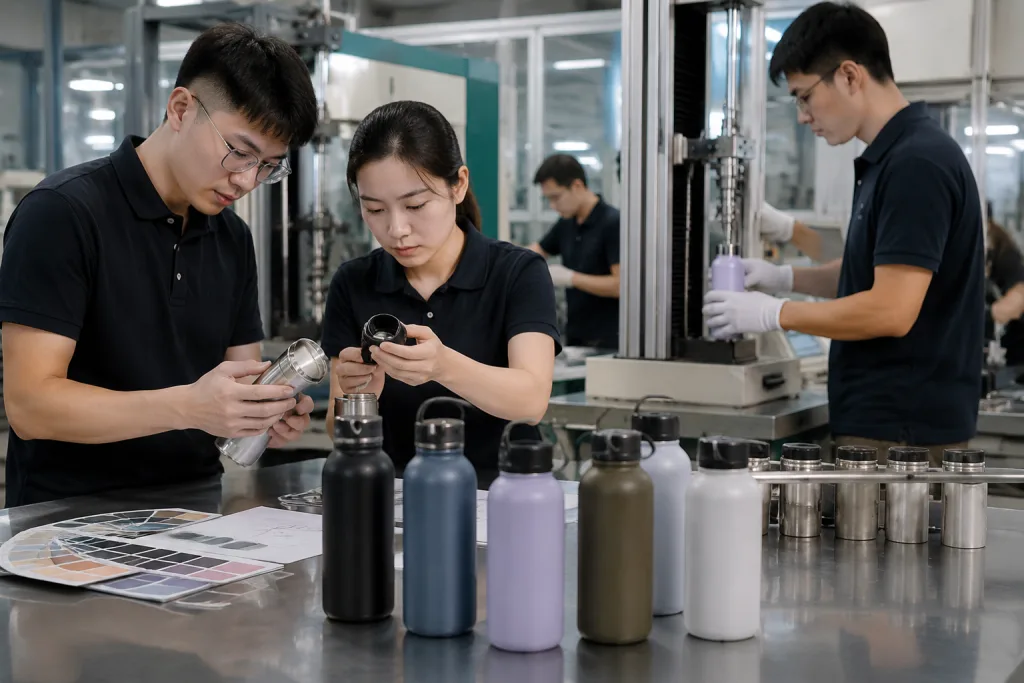
Decoration is where private label bottles either look retail-ready or come back as claim emails. On a 304 stainless steel bottle with PP or Tritan plastic parts, we usually quote laser engraving, silk screen printing, pad printing, heat transfer, water transfer, UV printing, or powder coating with the logo added after curing. The wrong question is “which one looks best?” Ask where the logo sits, how the bottle is packed, and how the customer washes it. Last month QC pulled 32pcs from a 1,200pcs trial order because the lid logo rubbed against the inner carton divider.
Laser engraving holds well on powder-coated stainless steel and leaves a clean permanent mark, but it will not match Pantone 186C or any other exact brand color. Silk screen printing works for one- or two-color logos; we see screen fees around USD 30-80 per color, then the unit cost drops once the AI file and jig are locked. Pad printing is better for curved lids, push buttons, or a 12mm logo area on plastic. Heat transfer and UV printing carry richer artwork, but test them with a 500g rub weight and 20 dishwasher cycles before you open a 10,000pcs PO.
Powder coating sells well because it gives grip and looks good on shelf. We run most coating thickness at 60-90 microns, then check adhesion with a cross-hatch cutter and 3M tape. If the buyer wants “dishwasher safe” printed on the insert card, verbal approval is not enough. Do the cycle test. Bright orange, matte cream, metallic blue, and gradient artwork do not age the same, and we have seen this go sideways when the buyer approved only one color chip under office lighting.
For canteen promotional orders, speed and logo clarity often beat lifetime durability; a 7-day logo sample can matter more than a 3-year coating story. For distributor canteen programs, repeat-batch control matters more because batch one and batch three sit together in the same warehouse. Keep one signed golden sample in China and one in your office, with the color code, logo size in mm, and PO number written on the label. Color drift causes arguments. One buyer flagged a 1.5mm logo shift after reorder, and the math did not work once 48 cartons had already landed in Rotterdam.
Build packaging around the channel
Packaging is not a decoration item we fix at the end. It decides damage rate, warehouse handling, retail shelf impression, and the chance of a 1-star review when the cap arrives scratched. We have seen the same 750 ml 304 stainless bottle pass AQL 2.5 in our QC room, then fail in transit because the buyer copied supermarket packaging for Amazon FBA. Wrong question. Ask where the bottle will be handled first: courier belt, retail shelf, or gift desk.
For e-commerce, build the pack from the drop test backward. We run a common export setup as one bottle in a polybag or paper sleeve, then a color box or kraft box, then a 5-layer K=A master carton. For heavier double-wall bottles or a custom growler above 1 L, add dividers or 3 mm reinforced corners; QC pulled one 1.2 L sample last month with a dented shoulder after a 76 cm corner drop. Master carton gross weight should stay below 15-18 kg for warehouse handling. FNSKU labels, suffocation warnings, carton barcodes, and country-of-origin marks must be placed before shipment if your 3PL will not relabel.
For retail distributors, packaging has to sell without wasting cube. A window box looks good on a shelf, but the PET window can crack, and it adds empty space around the bottle. A full-color box improves shelf value but adds plate setup time and minimum print quantities; our usual MOQ for custom box printing starts around 1,000 pcs per artwork. Kraft packaging cuts cost and fits outdoor or sustainable positioning, but print control matters. If the Pantone ink runs 8% light on the flexo proof, the buyer will flag it as cheap-looking.
If you are buying from canteen suppliers for 3 or 4 markets, prepare a packaging matrix before artwork starts. List language, barcode, importer address, recycling marks, warning text, and carton marking for each destination. This matters when one distributor growler order goes to Canada and another goes to Germany; we once saw a PO typo put the German EAN on 600 Canada cartons. A capable canteen vendor will follow the matrix line by line. An unorganized one will mix cartons, and the math does not work after the container has sailed.
Control quality with measurable checks
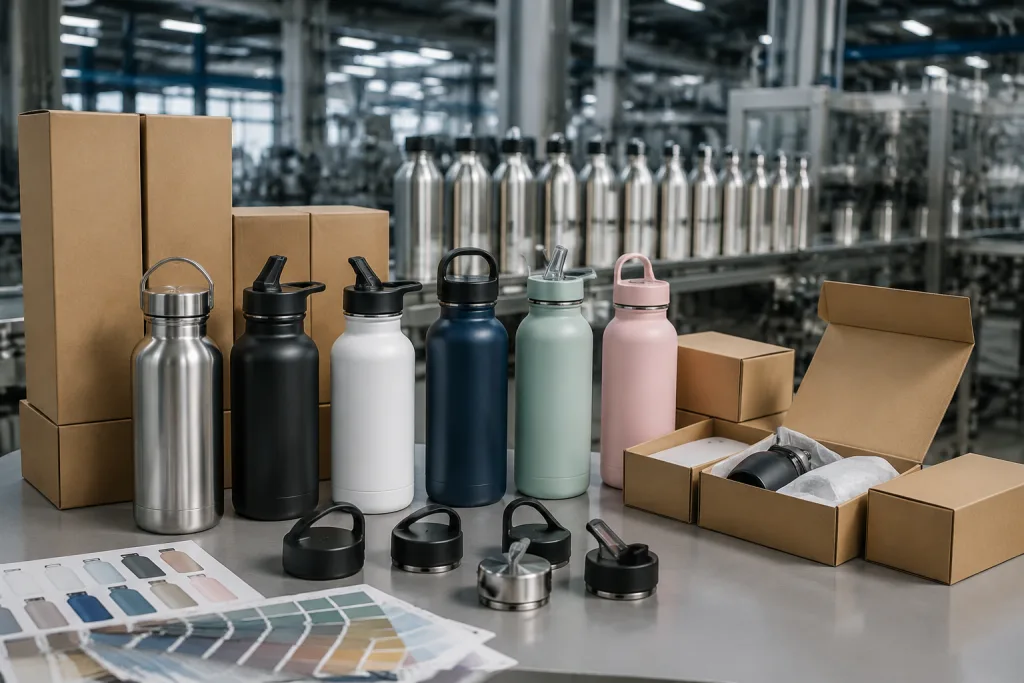
Quality control has to live in numbers. “Good quality” is not a spec. For drinkware, we run AQL 2.5 for major defects and AQL 4.0 for minor defects, with critical defects at zero. Critical defects mean leakage, sharp edges, wrong material, contamination, broken welds, and unsafe plastic parts. Major defects cover coating peel, obvious dents, poor logo registration, lid malfunction, and capacity outside the agreed tolerance.
The line checks are straightforward. Vacuum insulation test for double-wall bottles. Leak test with inverted filled bottles. Lid open-close cycle test. Coating adhesion test. Rub test on printing. Salt spray where relevant. Carton drop test. Capacity must be checked by water fill, not by a catalog name. A “750 ml” bottle needs both usable capacity and brimful capacity on paper, because the buyer flagged it on a PO before and the math did not work.
At BottleForge Industrial in Zhejiang, our drinkware lines can ship about 450,000 units per month across stainless bottles, tumblers, and related canteen customized programs, but that number means nothing if QC is booked late. For a 10,000-unit order, we tell buyers to schedule final random inspection 3-5 days before loading. If the goods fail, you still need time to sort, rework, or replace cartons before vessel cutoff. We have seen this go sideways on a 0.8 mm lid gasket and a simple typo on the carton mark.
For the first run with canteen vendors in China, do not waive inspection to save USD 200-400. The math does not work. A third-party report with photos, defect counts, carton measurements, and weight checks gives you hard leverage before final balance payment. QC pulled the sample, found a loose cap torque on 12 pieces out of 300, and that report saved a dispute at the bank release stage.
Compare suppliers on total landed risk
The cheapest unit price usually hides cost in tooling, testing, weak cartons, slow replies, or a missed vessel cut-off. We had one PO where the buyer wrote “750ml” in the email and “720ml” on the PO; the line stopped for a day while QC checked the drawing. Ask each supplier to quote the same spec: capacity, steel grade, wall thickness, lid material, coating, logo method, packaging, test requirement, MOQ, lead time, Incoterm, and payment term. If those inputs differ, the prices do not compare.
FOB China is still the cleanest basis for a lot of B2B buyers because you control freight and destination charges through your forwarder. EXW can look cheaper, but it pushes local handling and export work onto you; on a 10,000-piece order, the math often breaks once the trucking and customs broker fees land. DDP works for a 200-piece trial, but for regular distributor shipments you need to know the duty code, freight rate, and who takes customs risk.
Communication is a supplier metric. A solid canteen manufacturer sends drawings, tolerance notes, sample photos, and a production date; a weak factory sends catalog shots and says “no problem.” QC pulled a sample last month and found a 1.2 mm lid gap, which would have caused leaks after a few wash cycles. For custom growler or customizable growler projects, spare lids and gaskets need to be quoted upfront. A 2% spare gasket pack saves us a lot of after-sales headaches.
If you are building a private label line, choose a canteen supplier that can grow with you: an MOQ low enough for market testing, output steady enough for repeat orders, and sales staff who will tell you when your target price clashes with compliance or durability. We run into buyers who ask for premium print, 304 stainless, and a rock-bottom quote; that is the wrong question to ask. Pick the factory that can hold the spec on the line and ship again without drama.
Send your bottle brief for a practical factory quote
Share capacity, lid type, logo, packaging, target market, and quantity. We will respond with MOQ, FOB pricing, lead time, and compliance notes.
Frequently asked questions
What MOQ should I expect for a 304 stainless steel plastic water bottle private label order?
For an existing stainless steel bottle mold with your logo and standard lid, expect 1,000-3,000 units per color. If you need custom powder coating, custom box printing, and a logo, 3,000 units is more realistic because coating and packaging setup need efficiency. A new plastic lid or handle usually pushes the MOQ to 5,000 units or more, plus tooling. A fully customized canteen body shape can require 10,000 units to justify tooling and sampling work. If a supplier offers 300 units with full customization, check whether they are only applying a logo to stock goods.
How do I verify the bottle is really 304 stainless steel?
Start by writing 304 stainless steel into the purchase order, approved drawing, and material specification. Ask the factory for the steel mill certificate showing grade, heat number, and chemical composition. For higher-value orders, use a third-party lab or inspection company to perform metal composition testing on random samples from mass production. Handheld PMI testing can quickly identify whether the material is consistent with 304. Do not rely only on magnet tests; formed stainless steel can show slight magnetic response after processing. For orders above USD 30,000, the cost of verification is small compared with the risk of receiving 201 stainless steel.
Which logo method is best for private label drinkware?
For long-term durability, laser engraving on powder-coated stainless steel is usually the safest choice. It will not match Pantone colors, but it resists rubbing and daily use. Silk screen printing is better when you need a colored logo and the design is simple, usually one to two colors. Pad printing works well on plastic lids, buttons, and curved small surfaces. UV printing and heat transfer are useful for full-color artwork, but you should test adhesion, rub resistance, and dishwasher exposure before approving mass production. For a distributor canteen line, keep the decoration method consistent across repeat batches.
What lead time should I plan for China production?
For an existing mold with standard materials, plan 7-12 days for pre-production samples and 30-45 days for mass production after deposit, artwork approval, and packaging confirmation. Add 5-10 days if you need custom color matching, special coating, or printed retail boxes. New plastic tooling can add 20-35 days before final sample approval. Sea freight to North America or Europe may add 25-45 days depending on port pair and season. If your retail launch date is fixed, work backward and include inspection, rework buffer, export booking, and customs clearance time.
Can one supplier handle bottles, growlers, and canteen promotional items?
Yes, but check whether the supplier is a real production partner or only a trading catalog source. Stainless bottles, a customized growler, and canteen promotional items may use different forming lines, coating lines, and lid suppliers. A capable China supplier should provide drawings, material lists, MOQ by item, shared packaging options, and one quality standard across the program. For a mixed order, carton marking and SKU control become important. Ask for separate FNSKU or barcode handling, spare-part pricing, and AQL inspection by SKU. This prevents your distributor growler and bottle cartons from being mixed during loading.