Key Takeaways
- A 500 ml 304 stainless thermos usually lands at USD 3.20-6.80 FOB China before freight and duty
- Practical custom thermos MOQ starts at 1,000 pcs for stock colors and 3,000 pcs for custom powder coating
- Normal lead time is 25-35 days after artwork approval, or 40-55 days for new molds and packaging
- AQL 2.5/4.0 inspection and 24-hour vacuum retention testing catch most costly distributor claims
If you sell outdoor gear or promotional products, a stainless thermos looks simple until you quote it. Two 500 ml bottles can land USD 1.20 apart because the line uses different steel grade, vacuum yield, lid structure, powder coating, logo method, carton spec, and inspection level. We have had QC pull a sample with a 0.38 mm inner wall when the buyer approved 0.40 mm. Small gap. Big argument.
For 304 stainless steel insulated water bottle wholesale, a catalog price is the wrong place to stop. You need to know what changes the FOB cost, where MOQ breaks actually save money, and whether your customized thermos order ships in 32 days or slips to 45 days before it leaves China. BottleForge runs thermos factory production in Zhejiang, with typical output around 450,000 units/month across stainless vacuum drinkware lines; on our side, one typo on a PO, like “matte black” instead of “sand black,” can hold the carton artwork and delay the whole batch.
What the base bottle really costs
For 304 stainless steel insulated water bottle wholesale, the base bottle usually takes 55-70% of your FOB price. On our line, a standard 500 ml double-wall vacuum bottle with inner 304 stainless steel, outer 201 or 304 stainless steel, PP lid, silicone seal, and powder coating normally quotes at USD 3.20 to USD 4.80 FOB Ningbo or Shanghai at 3,000 pcs. If you specify 304 stainless steel for both inner and outer walls, add USD 0.25-0.55 per unit, depending on the steel price that week in China. Check the spec sheet. Last month a buyer flagged a PO typo that said “304 outer” while the approved sample was 201 outer, and the price gap was USD 0.38 per bottle.
Wall thickness matters. Around 6 out of 10 outdoor retailers we speak with ask for a “heavy feel,” but steel is not free. A typical inner wall is 0.35-0.40 mm, and a typical outer wall is 0.45-0.50 mm. Moving the outer wall to 0.55 mm may add USD 0.18-0.35 per bottle and push the carton weight up. For promotional thermos projects, the math doesn't work if that extra weight raises air freight more than it improves shelf feel. QC will also check thickness with a digital micrometer after cutting a sample bottle, so don’t treat 0.55 mm as a marketing line only.
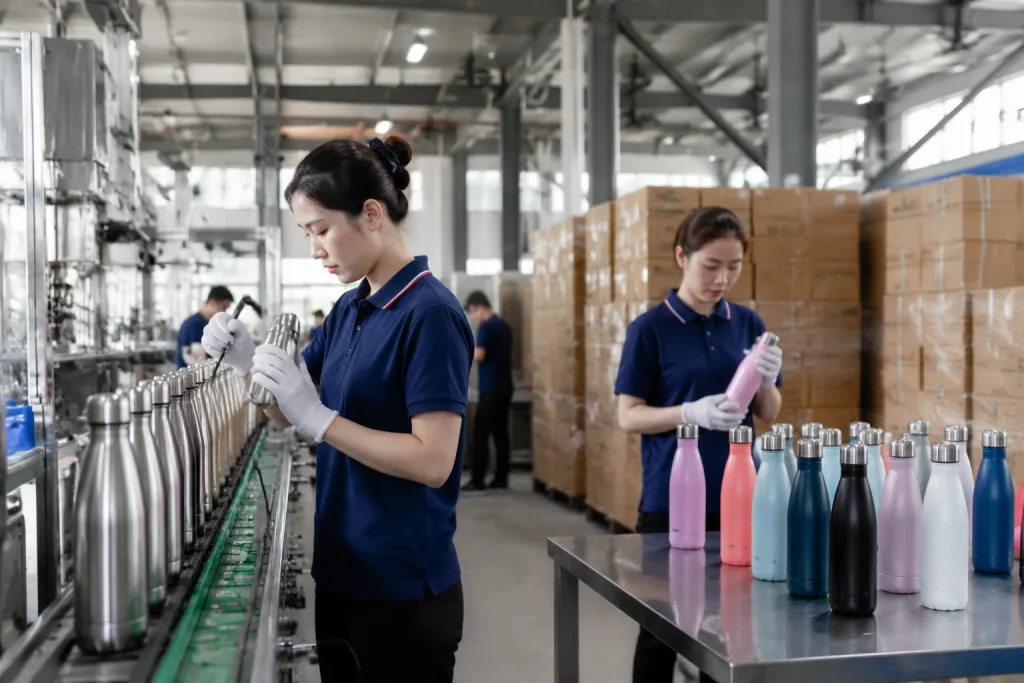
Vacuum performance is another hidden cost. A reliable factory thermos line rejects bottles with poor vacuum before coating, and we run that check before powder goes on because repainting a failed body is just wasted labor. Better yield control costs money, but it cuts returns. For a 500 ml bottle, reasonable performance is hot water above 60°C after 6 hours when tested from 95°C start at 20°C room temperature. If a thermos supplier promises big heat-retention numbers without stating the test method, ask for the lab setup before you accept the quote; we’ve seen this go sideways when the buyer tested with a different lid torque and 22°C room temperature.
MOQ tiers that change your quote
MOQ is a sales policy, but the quote starts on the factory floor: stainless coil buying, coating line setup, logo jig time, and carton plate charges. At BottleForge in Hangzhou, Zhejiang, we run 1,000 pcs as the normal starting point for a stock bottle shape, stock color, and one-position laser logo. The line likes it. For a trial distributor thermos order or a budget-controlled campaign, 1,000 pcs keeps the setup simple; our laser operator can finish a one-side logo with the standard rotary fixture instead of opening a new screen or coating test panel.
At 3,000 pcs, the math works better. Custom powder coating, silicone color matching, and printed retail boxes stop feeling like penalty items because the setup cost is spread across enough bottles. For thermos bulk orders of 5,000-10,000 pcs, unit price can drop by 6-14% compared with 1,000 pcs. Most of that saving comes from lower coating loss, fewer logo changeovers, and carton printing plates shared over more units. QC pulled one 3,000 pcs sample run last month because the Pantone cap color was 1.5 mm off at the silicone ring joint; small issue, but it would have been expensive on a 1,000 pcs rush order.
- 1,000 pcs: stock shape with stock color; laser logo or simple silk screen; plain carton with sticker label if the buyer does not need shelf-ready packing.
- 3,000 pcs: custom color by Pantone with a lab dip panel; retail box printing; one or two logo positions with steadier cost because the setup is no longer eating the margin.
- 5,000 pcs: customized thermos program with two to four colors; printed master cartons; insert cards and barcode labels checked against the PO before packing.
- 10,000 pcs and above: stronger negotiation on 304 stainless steel and lids; better control of packaging lead time; earlier booking for AQL 2.5 inspection scheduling.
Be careful with low MOQ claims from thermos suppliers. A 300 pcs order with a custom coating color is the wrong question to ask if color control matters. Someone is mixing your job with another customer’s color, hiding the coating setup fee in the unit price, or accepting loose shade tolerance. We have seen this go sideways: the buyer flagged a matte black batch because the reorder looked charcoal under D65 light. For outdoor retail, that risk does not pay.
Decoration and packaging price adders
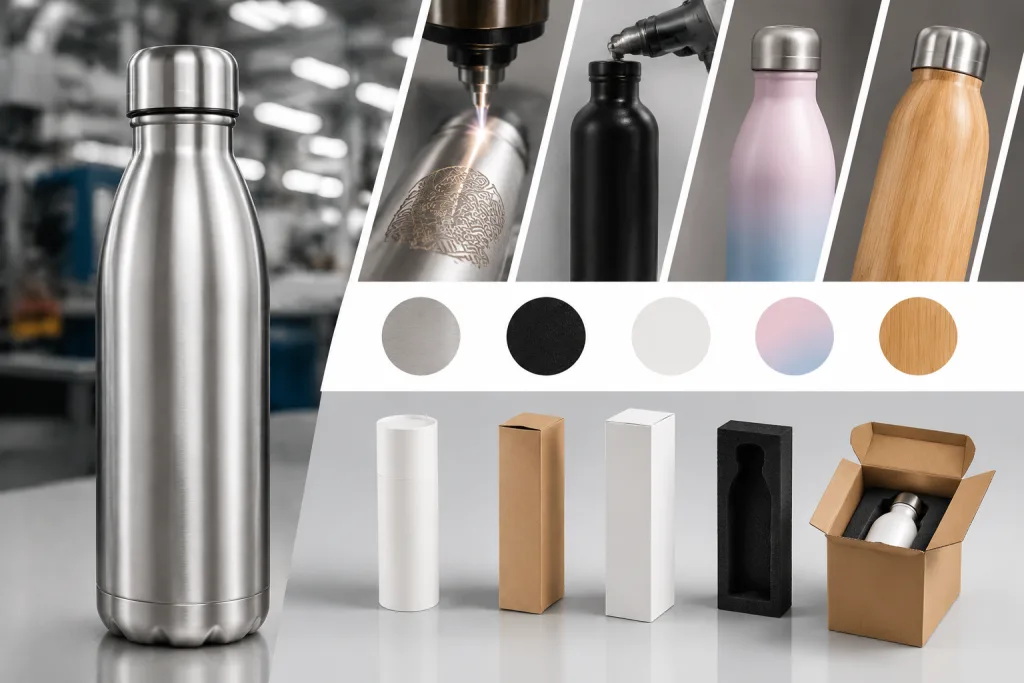
A custom thermos often gets quoted low because the logo line is priced after the bottle is already agreed. That is where mistakes start. Laser engraving is steady, clean, and a good fit for outdoor brands; on stainless or powder-coated bottles, one-position laser usually adds USD 0.08-0.25 per unit. We run a 20W fiber laser on the line, and QC checks logo height with a 0.5 mm tolerance gauge. Silk screen printing may cost USD 0.06-0.18 per color per position, but setup waste climbs fast if the bottle has a tapered body or rough coating. We have seen a buyer flag a 1.2 mm logo drift on a cone-shaped 750 ml bottle, and the math did not work after reprinting.
For a promotional thermos with a large wraparound logo, heat transfer or water transfer can work, but budget USD 0.30-0.90 per unit depending on coverage. Full-color UV printing looks good for short promotional programs, but abrasion resistance must be proven before we open mass production. Ask for 3M tape test, cross-hatch adhesion, and a 50-cycle rub test before mass production; QC pulled the sample last month after the red ink lifted at cycle 32. Short run? Test first.
Packaging can change your landed cost more than expected. A plain white box may add USD 0.12-0.22. A 350 gsm printed retail box with insert can add USD 0.28-0.55. If you need hang tags, instruction sheets, suffocation warning polybags, FNSKU labels, or Amazon carton marks, allow another USD 0.03-0.12 per unit. For North American outdoor retailers, we normally recommend ISTA-style drop testing on export cartons: 1 corner, 3 edges, and 6 faces from 76 cm for cartons under 10 kg. We also check carton weight on a 30 kg platform scale, because a carton marked 9.8 kg but packed at 10.6 kg can fail the buyer’s warehouse rule.
Thermos custom work is not just “put a logo on it.” That is the wrong question to ask. A usable costing sheet separates bottle, lid, coating, logo, individual packaging, master carton, spare parts, testing, and inland transport. Our merchandiser also records PO typos, like “matte balck” instead of “matte black,” before the artwork file goes to the print room. This format makes supplier thermos quotes easier to compare and stops small adders from hiding inside the unit price.
Lead time from artwork to vessel
A realistic lead time protects your selling season. For a stock-shape customizable thermos, we usually run 3-5 days for artwork and sample confirmation, 7-10 days for a pre-production sample if color matching is needed, 18-25 days for mass production, and 3-5 days for final inspection and export loading. That gives you 25-35 days after approval for most thermos manufacturer orders. Simple math. Last month QC pulled 32 logo samples because the Pantone chip on the PO said 186C, but the buyer’s PDF showed 185C.
New mold projects are different. If you want a unique lid, special handle, proprietary body shape, or unusual capacity, add 20-35 days for 3D drawing, CNC prototype, mold adjustment, and pilot run. A new plastic lid mold can cost USD 1,500-5,000. A stainless body mold set may run USD 3,000-9,000 depending on complexity. For about 7 out of 10 promotional brands we quote, the better move is color, logo, lid strap, and packaging change; the math does not work on a full new mold unless the order repeats. On the line, even a 0.4 mm change on the lid thread can cause leakage after the vacuum test.
Shipping time depends on destination and service. From Zhejiang to Ningbo port is usually 1 day by truck. Sea freight to Los Angeles is often 14-22 days port-to-port, while Rotterdam or Hamburg is commonly 30-40 days. Add customs clearance, port congestion, and domestic trucking. If your distributor thermos delivery date is fixed, do not schedule mass production to finish one week before launch. Build a 10-14 day buffer for inspections, carton relabeling, or shipping delays. We ship cartons at around 13-16 kg each for 500 ml bottles, and one wrong Amazon FNSKU label can hold the whole pallet.
Fast orders fail when artwork, color chips, barcode rules, and carton marks arrive late. The factory cannot compress every step without increasing defects; we have seen this go sideways when carton marks arrived 2 days after packing started.
Compliance and inspection costs
For Europe and North America, buyers expect 304 stainless steel, and they still ask for clean paperwork before they release the deposit. For food contact, our customers usually request LFGB or EU 1935/2004 testing in Europe, FDA food-contact documentation in the United States, and sometimes California Proposition 65 screening. If the bottle is for children, ASTM and CPSIA-related requirements may apply. For social compliance, larger retailers often ask the manufacturers thermos supply chain for BSCI, Sedex, or ISO 9001 documentation. We have seen a PO held for 9 days because the buyer typed “EU 1934/2004” instead of EU 1935/2004, so our merchandiser had to get the test lab and sourcing office aligned before production could move.
Third-party lab testing is cheap compared with a failed launch. A standard stainless bottle food-contact test package may cost USD 250-800 depending on market and material count. If your lid includes painted plastic, silicone, straw, or rubberized grip, the lab may treat each contact material as a separate item. Do not assume an old report covers your customized thermos after you change coating, lid resin, or colorant. QC pulled a black PP lid sample last month where the Pantone colorant changed from the approved file, and the buyer flagged it before carton sealing.
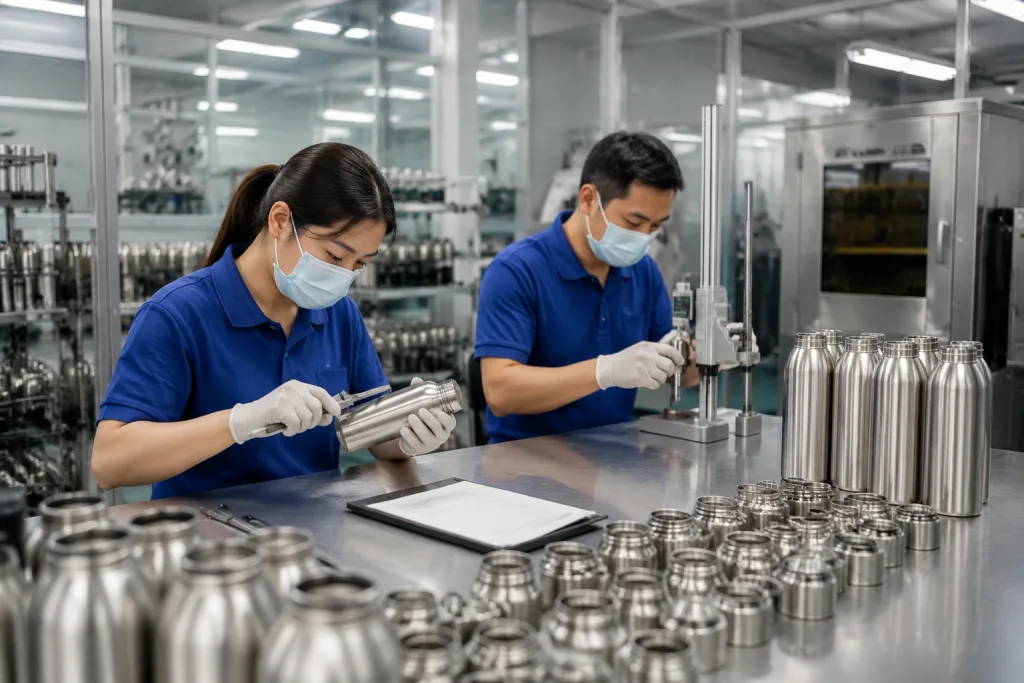
Inspection should be written into the purchase order, not discussed after the goods are packed. A common AQL level is Critical 0, Major 2.5, Minor 4.0 under ISO 2859-1. For vacuum bottles, add functional checks: leak test, lid torque, coating adhesion, logo position, capacity, carton drop, and heat retention sampling. At our China facility, the line runs 100% vacuum leak screening before packing, using a vacuum tester and water bath check, then final inspection samples are pulled from finished cartons. For a 12,000 pcs order, that usually means inspectors open cartons across different pallet positions, not just the neat cartons near the door.
A thermos vendor who resists inspection is not saving you money. This is the wrong question to ask. One shipment of leaky lids can cost more than the inspection fee, especially when your customer is an outdoor retailer with chargeback rules. We have seen this go sideways: 3% lid seepage after a carton drop test, a USD 310 inspection fee skipped, and a buyer claim that wiped out the margin on the whole container.
Choosing the right factory partner
China has 300+ stainless thermos makers, but a smaller group is built for export programs. A trading company fits a 5-SKU mixed trial order; a manufacturer thermos project with custom coating, barcode labeling, and retailer compliance needs the factory to control the line. Ask who owns the vacuum line, who runs powder coating, and where final packing is done. We check this with simple questions: vacuum leak tester model, coating oven length, and whether the carton drop test is done before or after the goods leave the workshop.
For outdoor retailers, the lid system matters as much as the bottle body. Ask for hinge cycle testing numbers, silicone hardness in Shore A, spare gasket policy, and replacement lids at 1-3% of shipment quantity. QC pulled one sample last year where the flip lid passed visual inspection, then cracked at the hinge after 2,000 open-close cycles. For promotional brands, ask how the factory controls repeat-order color. A good thermos factory keeps approved color panels, golden samples, and batch records with the powder lot number. Without those records, your second order can miss the first shade by a full Delta E point, and the buyer will flag it.
When comparing thermos distributors, thermos suppliers, or a direct thermos supplier, send the same RFQ sheet every time. List capacity and steel grade first, then wall thickness, coating, lid type, logo size, packaging, test standard, MOQ, Incoterm, and target delivery date. The cheapest quote is often cheap because one field is blank. We see this go sideways on POs: the buyer writes “500 ml matte black,” but the factory quotes single-wall 201 stainless instead of 304 stainless vacuum insulation. A proper suppliers thermos quote should state payment terms and sample charge, then mass production lead time, carton dimensions, gross weight, and HS code.
BottleForge is based in Zhejiang, China, close to stainless forming, coating, packaging, and Ningbo port resources. That cluster matters. It cuts material response time from about 12 days to 3-5 days when a lid insert, color powder, or printed sleeve needs correction. If QC finds a 0.3 mm mouth-roundness issue on Tuesday, we can pull the forming vendor in before the weekend, not after the container has already reached Ningbo port.
Send your thermos RFQ before locking your launch date
Share capacity, logo, MOQ, packaging, and target market. We will return a practical FOB quote with lead time and compliance notes.
Frequently asked questions
What is a realistic wholesale price for a 304 stainless steel insulated bottle?
For a 500 ml double-wall vacuum bottle, a realistic FOB China range is USD 3.20-6.80 at 3,000 pcs. The lower end usually means a stock shape, simple lid, stock color, and one laser logo. The higher end may include full 304 inner and outer steel, heavier wall thickness, custom powder coating, retail box, and stronger heat retention. A 750 ml or 1,000 ml bottle usually adds USD 0.45-1.50 depending on body diameter and lid design. Always compare quotes with the same Incoterm, carton spec, logo method, and inspection requirement.
Can I start with 500 pcs for a custom thermos order?
It is possible only if you use an existing bottle shape, stock color, and simple logo decoration. For true customization, 500 pcs is usually inefficient because coating setup, logo tooling, and packaging printing are spread over too few units. A practical starting MOQ is 1,000 pcs for stock color with laser engraving, and 3,000 pcs for Pantone powder coating or printed retail box. If your budget is limited, start with 1,000 pcs in two stock colors and keep the lid, box, and carton standard.
How long should I allow for a promotional thermos campaign?
For a stock-shape promotional thermos with approved artwork, allow 25-35 days for production after deposit and sample approval. Add 14-22 days for sea freight to the US West Coast or 30-40 days to major European ports. If you need a new lid mold, custom box, third-party testing, or retailer pre-approval, plan 55-75 days before the goods are ready to ship. Air freight can save time, but stainless bottles are heavy; it can add USD 1.20-3.50 per unit on many 500 ml projects.
Is 304 stainless steel required for both inner and outer walls?
The inner wall should be 304 stainless steel because it contacts drinks. The outer wall may be 201 or 304 depending on budget and positioning. Full 304 construction improves corrosion resistance, especially for coastal outdoor markets, but it usually adds USD 0.25-0.55 per unit on a 500 ml bottle. For high-end outdoor retail, full 304 is easier to defend. For short-term promotional campaigns, 304 inner and 201 outer can be acceptable if coating quality, salt spray resistance, and food-contact documents are clear.
What files and details do you need to quote thermos bulk orders?
Send capacity, target shape, steel requirement, lid style, coating color, logo artwork in AI or PDF, logo size, packaging type, order quantity, destination port, and required compliance tests. If you have a target retail price, share it. For thermos bulk quotes, we also need barcode or FNSKU rules, carton mark requirements, and whether the order ships to a warehouse, distributor, or Amazon-style fulfillment center. With complete details, a factory can usually return a useful FOB quote within 24-48 hours instead of sending a vague catalog range.