Key Takeaways
- Realistic MOQ starts at 1,000 pcs for stock-shape logo orders and 5,000 pcs for private mold work
- A 500 ml 304 double-wall bottle usually lands at USD 3.20-6.80 FOB Ningbo or Shanghai depending on finish
- Logo-ready samples take 7-12 days; mass production usually takes 30-45 days after deposit and approval
- Inspection should use AQL 2.5/4.0 with vacuum retention, coating adhesion, and carton drop checks
If you sell outdoor gear or run promotional drinkware programs, bottle photos are the easy part. The harder call is whether a 304 stainless steel insulated water bottle supplier is giving you a factory thermos price or a trading-company quote that breaks after the buyer flags a Pantone mismatch on the first artwork proof.
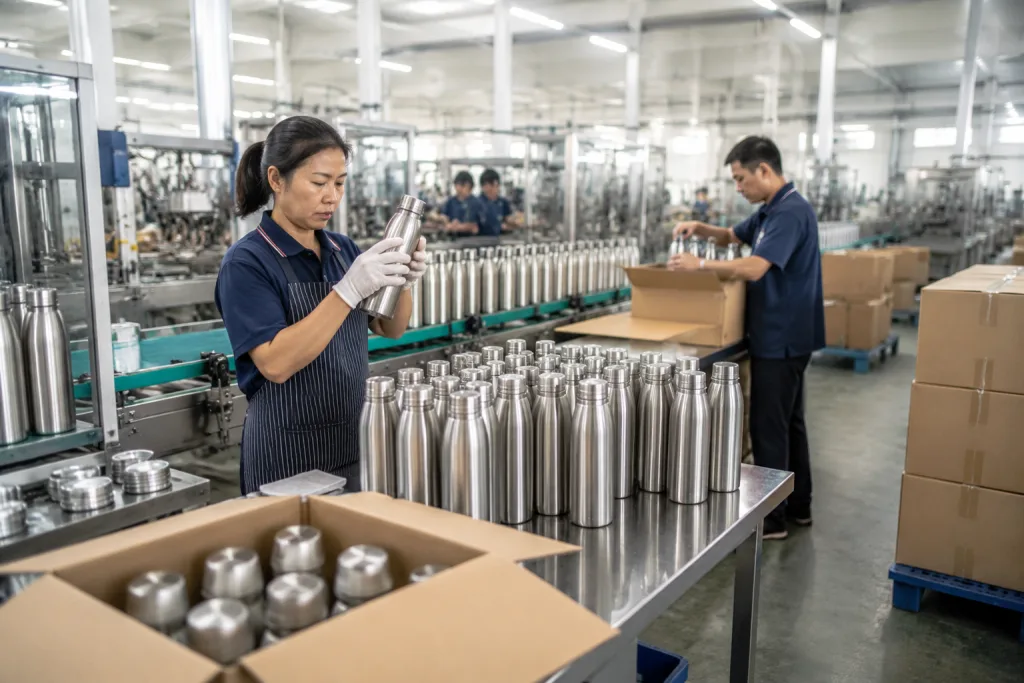
At BottleForge Industrial in Hangzhou, Zhejiang, we quote custom thermos projects from the BOM up: 304 stainless steel grade, 0.45 mm or 0.50 mm wall thickness, vacuum draw process, lid mold, coating type, logo method, packaging spec, carton weight limit, and AQL 2.5 inspection level. We run a Zhejiang production network with about 450,000 stainless bottles per month, but the math still depends on MOQ discipline and sampling decisions; we have seen 3,000 pcs jobs slip from 12 days to 18 days because the PO listed a matte black body while the approved sample was powder-coated navy.
Start With The Real Bottle Spec
A stainless thermos quote only means something when the spec is nailed down. We get RFQs every week that say “premium 500 ml bottle,” then the buyer wonders why 10 suppliers send 10 different prices. The numbers are not equal. One factory may run 0.40 mm inner wall 304 steel, another cuts it to 0.35 mm, and a cheaper quote may hide 201 stainless on the outer shell. For food-contact inner walls, call out 304 stainless steel, usually 18/8 grade, with LFGB or FDA food-contact paperwork for your market. QC pulled one sample last month with a 201 outer shell after the PO said “SS bottle” only. Too loose.
For a normal custom thermos, we define the shell first: capacity, diameter, height, mouth opening, inner wall gauge, outer wall gauge, lid material, silicone grade, and coating. A 500 ml outdoor bottle often uses 0.40 mm inner 304 stainless and 0.50 mm outer stainless; heavy-duty models may move closer to 0.60 mm outer wall. That changes dent resistance and carton weight fast. On the line, our caliper check is 3 points around the body before polishing, because a 0.10 mm wall change can move the finished bottle by 18–25 g and push freight math the wrong way.
Insulation claims go sideways when the words are loose. A realistic factory thermos target for a 500 ml double-wall vacuum bottle is 6 hours above 65°C when filled with 95°C water at 20°C ambient temperature. Some lab setups show better numbers, but your purchase order should name the test method, fill temperature, ambient temperature, and pass line. We run the hot-water test with a probe thermometer and log the start time on the inspection sheet; one buyer once wrote “keeps hot all day” on the PO, and that is the wrong line to approve.
For promotional thermos programs, logo area and unit cost often drive the spec. For outdoor retail, leak testing, powder coating, and lid durability carry more weight. Both are valid. Just do not ask a thermos vendor for the cheapest customizable thermos and then expect retail-grade coating, copper lining, gift box, spare gasket, and 1.0% defect allowance. We’ve seen this go sideways at 3,000 pcs MOQ: the buyer flagged coating chips at AQL 2.5, but the approved sample had basic spray paint, not outdoor powder coating.
FOB Cost Drivers Buyers Miss
For a 304 stainless bottle, FOB is usually decided by 6 cost lines we check on the costing sheet: steel weight in grams, lid mold parts, surface finish, logo process, packing spec, order quantity. For a 500 ml stock-shape bottle, a plain powder-coated manufacturer thermos may quote around USD 3.20-4.20 FOB China at 3,000 pcs. Add a push-button lid with 2 silicone seals, handle loop, copper-lined vacuum layer, retail color box, then the same volume can move to USD 4.80-6.80. We run this math on a 0.01 g scale and a lid BOM, not by guessing from a photo.
Steel is the base cost. A heavier body may add USD 0.25-0.70 per unit, usually when the buyer asks for a “premium hand feel” but does not give a target body weight. Copper lining for better heat retention can add about USD 0.15-0.35. A more complicated lid can add USD 0.30-1.20 because it includes injection tooling, PP or Tritan parts, silicone rings, assembly labor, then 100% leak testing on the line. Do not price the lid like a spare accessory. We have seen this go sideways: QC pulled 32 samples from a 3,000 pcs lot, and 4 lids failed the inverted leak test after 10 minutes.
Finish cost moves fast. Single-color powder coating is usually efficient at thermos bulk quantities because the line can hold one color for 6-8 hours without gun cleaning. Gradient coating may add USD 0.25-0.60. Rubber paint feels good in hand, but it needs tighter abrasion testing with a 500 g load. Metallic paint looks strong in a showroom and still fails if the curing window is cut from 18 minutes to 12 minutes. For outdoor retailers, we normally recommend powder coating with cross-hatch adhesion testing and 3M tape pull checks.
Logo cost depends on the method and the artwork file, not just the logo size. One-color silkscreen may add USD 0.05-0.12. Laser engraving is often USD 0.10-0.25 depending on logo size and bottle curvature, and curved bottles need a slower rotary jig speed. Full-wrap heat transfer or water transfer can add USD 0.35-0.90 and needs more sampling time, usually 5 days vs 2 days for a small laser logo. A thermos promotional order may accept one 35 mm logo; a retail customized thermos line may need four-color packaging, barcode labels, carton marks for each SKU, and we have had buyers flag one wrong digit in the PO barcode before mass packing.
Cheap quotes usually hide one of 5 things: thinner steel, a basic lid, weak coating, skipped inspection, or a packaging spec that will not survive export cartons. The math doesn't work otherwise.
MOQ Tiers That Actually Work
MOQ is not a penalty. It is the point where setup time, material buying, coating changeover, logo fixtures, and QC labor stop eating the order margin. We run 304 stainless steel insulated water bottle orders in Zhejiang, China, and 500 pcs sometimes works for a trial if the buyer accepts stock colors sitting in our powder room. For a real custom logo job, 1,000 pcs is the practical starting point. Below that, the math usually fails after we make the silk-screen plate, adjust the rotary jig, and pull 12 pcs for pre-production inspection.
For most supplier thermos programs, the tiers look like this:
- 500-999 pcs: workable for stock inventory or sample-market tests, usually 2-3 available colors, higher unit price, often USD 0.30-0.80 more per bottle because the line still needs setup and carton labels.
- 1,000-2,999 pcs: practical MOQ for logo customization, one or two colors, standard carton packing, 25-35 day production after approval. QC normally checks logo position with a 0.5 mm tolerance card before bulk packing.
- 3,000-9,999 pcs: better coating efficiency and component buying, steadier FOB pricing, suitable for outdoor retailers testing 2-4 SKUs. At this level, we can usually lock lid, straw, and gasket purchasing in one batch.
- 10,000+ pcs: good range for distributor thermos programs, annual promotional campaigns, and thermos distributors who need price protection. We often split shipment by PO line if the buyer needs 3 warehouse marks.
- 5,000-20,000 pcs per shape: typical range for private mold or new lid development, depending on complexity. A new flip lid may need CNC samples first, then T0 mold testing before we quote mass delivery.
For thermos custom work, split colorways carefully. A 6,000 pcs order divided into six colors is not the same job as 6,000 pcs in two colors. Coating factories charge by line setup, powder change, cleaning time, and defect sorting. We have seen this go sideways: the buyer wanted 8 matte colors, then QC pulled the sample and found orange peel on 3 colors after the second bake. If you are a promotional brand, fewer colors with stronger logo execution usually beat too many colors with weak MOQ per SKU.
For distributors thermos planning, ask for tiered pricing at 1,000, 3,000, 5,000, and 10,000 pcs. A serious thermos manufacturer should explain where the price breaks come from: cup body, lid set, coating loss, packing, inspection time. If the supplier drops 18% between tiers without a BOM reason, ask what changed. We once saw a PO typo where 304 stainless became 201 stainless in the attachment, and the buyer flagged it only after the PI was issued.
Sampling Cost And Approval Timing
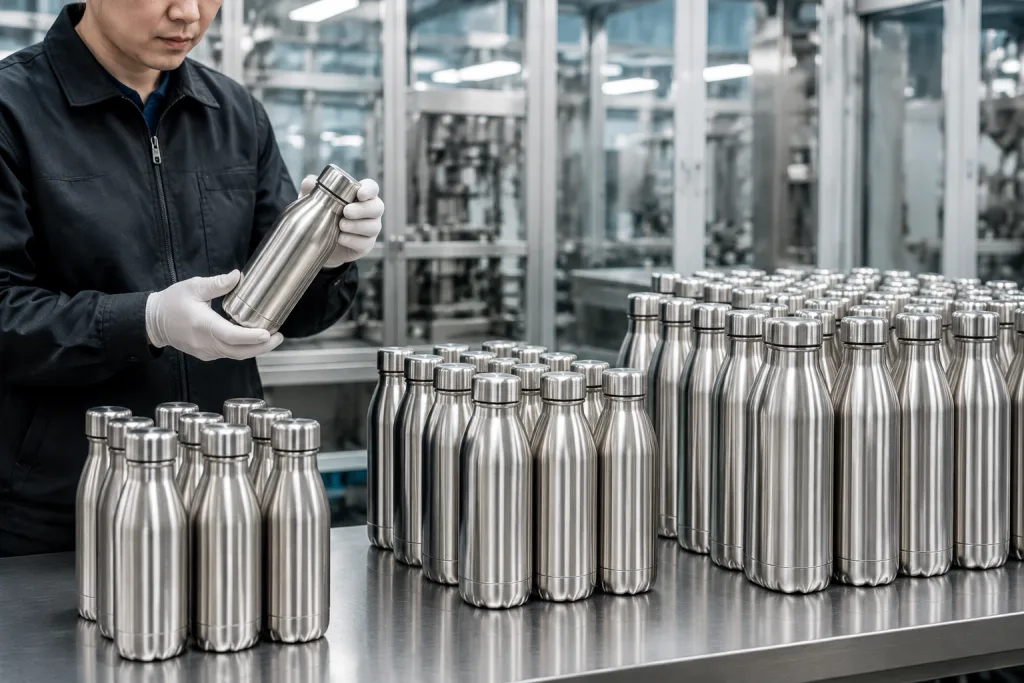
Sampling is where we save weeks or burn them. A plain stock bottle from our Hangzhou showroom normally leaves in 3-5 days after the courier label is confirmed. A logo sample for a custom thermos takes 7-12 days after we approve the AI or PDF vector file; last month one PO had the logo size typed as 45 cm instead of 45 mm, and QC pulled the sample before laser marking. A new color match runs 10-15 days because powder coating or paint panels need curing, D65 light-box checking, and one or two tweaks against the Pantone chip.
Sample cost is simple enough. Existing blank samples usually run USD 10-30 per piece plus courier. Laser logo samples run USD 30-80, depending on logo size and whether we need one-side or wraparound positioning on the rotary jig. Full custom packaging samples can add USD 50-150 based on print method and box structure. If you are developing a thermos customizable retail line, budget USD 200-500 for a proper round covering bottle, lid, finish, logo, and packaging; under that, the math does not work unless you accept shortcuts.
The approval pack needs more than clean photos. Ask for bottle weight, capacity check, leak test result, coating sample, logo placement drawing, packaging dieline, carton layout, and barcode position. We run the leak check with water at room temperature, then lay the bottle on its side for 30 minutes; if the silicone gasket sits 0.4 mm proud, the buyer will flag it later. For Amazon or retailer routing, send FNSKU or EAN/UPC placement early. Changing label position after cartons are printed is a stupid way to lose 5 days.
Private mold work takes longer. A new lid 3D print may take 5-8 days. Aluminum prototype tooling or CNC samples may take 12-20 days. Production steel tooling can take 25-45 days. If a thermos manufacturers quote says “new mold ready in 10 days” for a complex flip lid, be careful. We have seen this go sideways: injection tooling, silicone gasket fit, button spring force, and leak performance all need bench testing before the line can run.
Mass Production Lead-Time Map
For a standard custom thermos built on an existing body and lid, plan 30-45 days after deposit, sample sign-off, and packaging approval. In peak export months before September and before Chinese New Year, we add 7-15 days. The line feels it first: coating booths, lid injection machines, and carton suppliers all hit capacity, and a 500 ml bottle with a 75 mm mouth finish still has to wait its turn.
A workable production map is simple. Material buying and incoming QC take 3-7 days; tube forming, laser welding, and polishing take 7-12 days; vacuum pumping and insulation checks take 3-5 days; coating takes 5-8 days; logo printing or engraving takes 3-6 days; assembly and leak testing take 3-5 days; final inspection, packing, and warehouse release take 2-4 days. We run some steps in parallel, but never cleanly. QC pulled the sample twice on one 304 stainless job because the seam polish missed spec at the shoulder.
For thermos bulk orders above 20,000 pcs, 40-55 days is still normal because line balancing starts to bite. That is the wrong question to ask if the buyer only wants a date; the real issue is whether artwork and packaging are frozen before deposit. We have seen this go sideways on PO line 4 when the logo file was updated three times, the carton mark had a typo, and the buyer switched from matte black to gradient blue after we had already booked the print slot.
Shipping time is separate. FOB Ningbo or Shanghai means the supplier handles export through vessel loading, not final delivery. Sea freight to major European ports usually takes 28-40 days port-to-port. West Coast North America is often 16-25 days; East Coast is 30-40 days. Air freight works for urgent distributor replenishment, but a 480 g stainless bottle moves by chargeable weight, and the math does not work if the buyer waits until the last week.
Quality Checks Worth Paying For
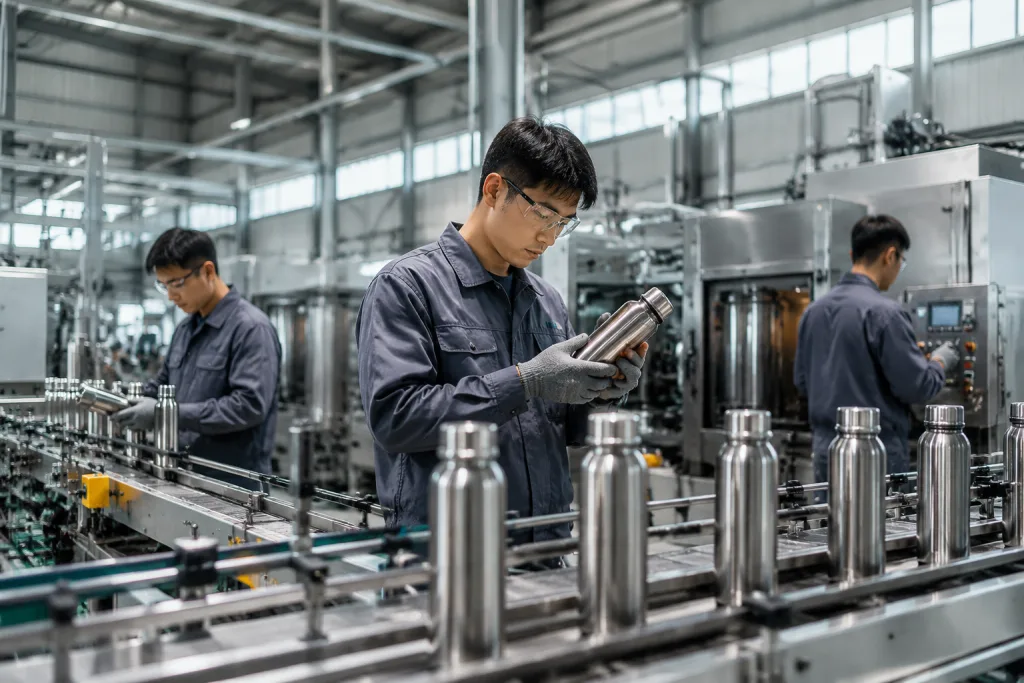
Drinkware defects are visible, emotional, and expensive. A buyer may forgive 300 late pens; they will not forgive 48 leaking bottles soaking backpacks in a school order. For a manufacturer thermos program, we run QC at incoming sheet and tube material, on the line, and at final inspection. Final inspection alone is too late. Last March, QC pulled the sample after assembly and found the leak came from a 0.25 mm gasket mismatch, not from the welding station.
Use AQL 2.5 for major defects and 4.0 for minor defects unless your retailer requires stricter limits. Major defects include leakage, poor vacuum retention, sharp edges, wrong material, wrong logo, serious coating peel, contaminated inner wall, and barcode errors. Minor defects include small dust points under 0.3 mm, light scratches within the signed limit sample, or slight carton scuffs. For kids or outdoor retail channels, confirm ASTM, CPSIA where relevant, REACH, LFGB, or FDA requirements before production; we have seen one PO list “LFGB” in the email subject but “FDA only” in the attachment, and the buyer flagged it after deposit.
Factory tests should include 100% leak testing for assembled bottles, vacuum retention sampling, coating adhesion, salt spray where applicable, lid torque or open-close cycle checks, capacity checks, and carton drop tests. For powder coating, we run cross-hatch adhesion with a 3M 600 tape pull and alcohol rub checks after curing. For silicone parts, ask whether food-grade silicone is used and whether spare gasket supply is available, normally 1% spare gaskets per carton is cheap insurance. A thermos supplier that cannot discuss 55 Shore A gasket hardness or ±0.15 mm lid fit tolerance is not ready for serious export programs.
Third-party inspection makes sense for new suppliers thermos orders above USD 10,000. It usually costs USD 250-450 per man-day in China and can stop a container-level mistake before loading. For repeat thermos distributors, a mixed model works: factory QC on every order, third-party inspection for first production, new colors, new lids, and high-risk holiday campaigns. We have seen this go sideways when buyers skip inspection to save USD 320, then spend 18 days sorting cartons because one barcode digit was wrong on 6,000 retail boxes.
Payment, Risk, And Reorder Control
Most China stainless bottle factories we work with run 30% deposit and 70% balance before shipment. For repeat buyers moving steady volume, say 5,000-20,000 pcs per PO, payment terms can open up after 2 or 3 clean shipments. New buyers should plan on standard T/T. If you buy through a thermos vendor instead of a direct thermos factory, get clear answers on tooling ownership, QC file control, and who can reproduce the same SKU next season. We have seen this go sideways when a PO listed “matte black” but the vendor never wrote the powder code; QC pulled the sample and the finish was 8 gloss points off on the meter.
For outdoor retailers, reorder consistency matters more than saving USD 0.08 on the first order. That is the wrong question to ask if the second shipment lands with a different lid gasket. Keep a signed golden sample, Pantone or powder code, logo file version, packaging dieline, carton spec, and inspection report, with each file named by SKU and revision date. If you run a thermos distributor program across 4 or 6 regions, assign SKU codes by capacity, color, lid type, and packaging language. Small detail. Big headache. It stops a 750 ml black bottle for Canada from being packed with a French-only insert intended for Europe, which we have caught during carton opening inspection with a barcode scanner at the packing line.
Tooling ownership should be written into the order before the deposit is wired. If you pay for a private lid or body mold, the agreement should state mold cost, maintenance responsibility, expected mold life, storage location in Zhejiang or elsewhere in China, and whether the supplier can use the mold for other customers. For most stainless bodies, private mold cost can range from USD 1,500-8,000. A complex lid tool can run USD 3,000-15,000 depending on cavities and moving parts. Ask for the mold number too; on our floor it is engraved on the tool plate, and that number belongs in the PI, mold receipt, and reorder file.
A good 304 stainless steel insulated water bottle supplier will push you to make decisions early because it protects both sides. Lock the spec, test the sample, approve packaging, set AQL, then let the line run without daily design changes. The math does not work if artwork changes after powder coating has started; 3,000 pcs may already be through curing oven at 190°C before the buyer flags the logo size. That is how a bulk thermos order stays on cost and ships on the booked vessel instead of slipping from 12 days to 18 days.
Get a costed stainless thermos quote
Send capacity, quantity, logo method, packaging, and target market. We will return FOB pricing, MOQ, sample timing, and production lead time.
Frequently asked questions
What is a realistic MOQ for custom 304 stainless thermos bottles?
For an existing bottle shape with your logo, 1,000 pcs is the practical MOQ. We can sometimes handle 500 pcs using stock colors, but the unit price is usually USD 0.30-0.80 higher because setup costs are spread across fewer bottles. For custom color plus logo, plan 1,000-3,000 pcs. For private mold body or lid development, the real MOQ is usually 5,000-20,000 pcs per shape. If you need six colors, do not divide MOQ too thinly. A 6,000 pcs order in two colors runs better than 6,000 pcs split across six colors because coating line changeover creates waste and delays.
How much should a 500 ml 304 insulated water bottle cost FOB China?
A standard 500 ml 304 double-wall insulated bottle usually costs USD 3.20-6.80 FOB Ningbo or Shanghai. The low end assumes an existing shape, simple screw lid, one-color powder coating, and standard export carton. The higher end may include copper lining, heavier wall thickness, retail color box, laser logo, handle lid, or better coating. If you see USD 2.30 for a 500 ml custom thermos, check the inner steel grade, wall thickness, lid material, vacuum test, and packaging. The quote may be based on thinner metal, 201 outer steel, weak paint, or no meaningful inspection.
How long does production take after we approve the sample?
For an existing stainless thermos with logo and standard packaging, mass production normally takes 30-45 days after deposit and final approval. Add 7-15 days during peak China export periods or before Chinese New Year. New colors usually add sample time before production, often 10-15 days for matching and approval. Private mold projects are longer: 25-45 days for tooling is common before production even starts. Sea freight is separate. From China to Europe, port-to-port shipping often takes 28-40 days. To North America, estimate 16-40 days depending on coast and routing.
Which logo method is best for outdoor retail bottles?
For outdoor retail, laser engraving is the safest long-term option because it does not peel and works well on powder coating. It usually adds USD 0.10-0.25 per unit depending on logo size. Silkscreen is cheaper, often USD 0.05-0.12, and works for promotional thermos orders, but abrasion resistance depends on ink and curing. Heat transfer or full-wrap graphics look stronger on shelf but can add USD 0.35-0.90 and need tighter inspection. If bottles will be clipped to packs, dropped, or washed often, choose powder coating plus laser logo unless your brand design requires full-color decoration.
What inspections should we require before shipment?
Use AQL 2.5 for major defects and 4.0 for minor defects as a baseline. Require 100% leak testing during assembly, plus sampled vacuum retention checks, coating adhesion, logo position, barcode scan, capacity, lid fit, and carton drop testing. For EU programs, confirm REACH and LFGB where applicable. For North America, FDA food-contact expectations are common, and ASTM or CPSIA may apply for children’s products. A third-party final inspection in China usually costs USD 250-450 per man-day. For a first order above USD 10,000, that is cheap insurance compared with reworking leaking bottles after arrival.