Key Takeaways
- A realistic private label MOQ is 1,000-3,000 pcs per color depending on coating and lid tooling
- 304 stainless steel should be used on the inner wall, with 201 or 304 outer wall depending on price target
- Powder coating usually adds USD 0.35-0.80 per pc versus plain stainless finish
- Plan 30-45 days mass production after sample approval, not after first inquiry
A 304 stainless steel insulated water bottle private label project looks simple until you approve the wrong lid, under-spec the powder coating, or find out the master carton misses your distributor’s pallet rule by 8 mm. It happens. Outdoor retailers and promo brands often start with capacity and color, but the expensive calls are lower down the line: steel grade, vacuum test result, logo process, compliance file, and packing layout. Last month QC pulled a sample with a lid gasket seated 0.6 mm off center; the bottle looked fine on the desk, then leaked in the tilt test.
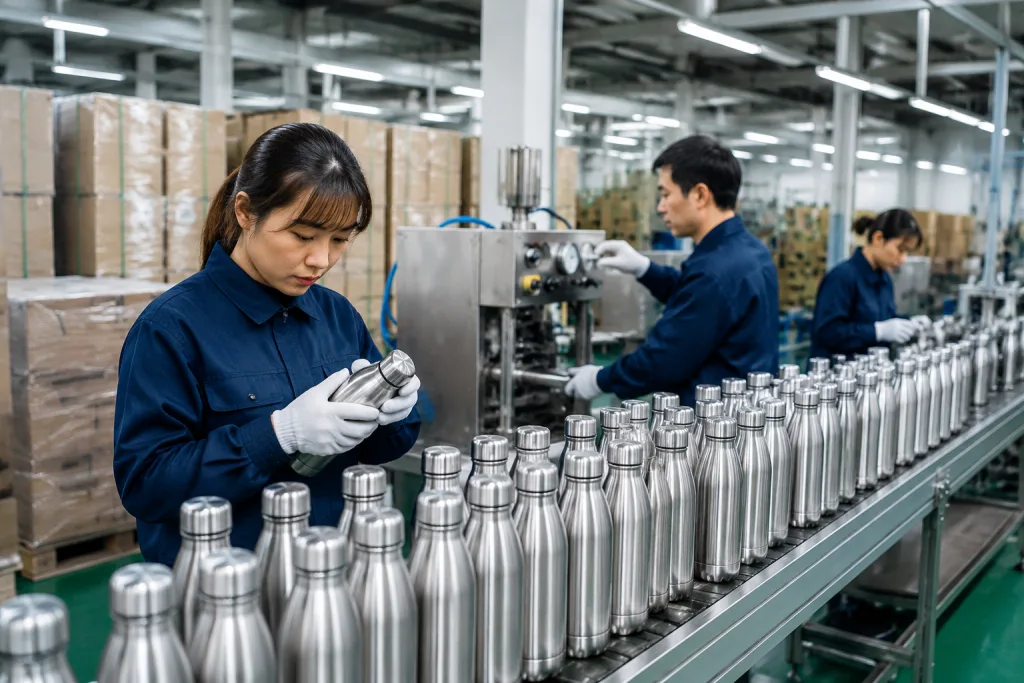
At our factory in Zhejiang, China, we see this every season. Buyers ask for a custom thermos fast, then lose 12 to 20 days because artwork, sample testing, or FNSKU labels were not fixed before sampling. The wrong question is “how fast can you ship?” Ask what must be locked before the line runs. We run the pre-production check with a digital caliper, coating thickness gauge, and carton drop layout before quoting a serious private label order.
Start with the use case
The first decision is not the logo. It is where the bottle will be used. An outdoor retailer needs a bottle that can take trail packs, car cup holders, wet gloves, and the 8 dishwasher runs the end user will do after ignoring your hand-wash icon. We see it. A promotional thermos for a 90-day campaign may only need a sharp logo, clean packaging, and a stable 6-month shelf life before the cartons leave the client’s warehouse; last month QC pulled 12 pcs from a pre-shipment lot because the gift-box barcode was 2 mm too close to the fold line.
For a 304 stainless steel insulated water bottle private label order, define three working conditions before you compare any manufacturer thermos quote. This is where buyers save money, not by squeezing another USD 0.03 after the mold is open. On our line, the engineer checks these points against the sample sheet before we run the first 50 pilot pcs:
- Capacity: 500 ml and 750 ml are the safest retail sizes. 1,000 ml works for outdoor and worksite channels but increases freight cost by 15-25% per selling unit; we normally see carton weight move from about 9 kg to 12 kg for the same 24 pcs packing plan.
- Lid type: screw lid gives the lowest leakage risk. Flip lid sells well for sports, but needs tighter silicone fit and 3,000-cycle open-close testing, because one loose hinge pin will turn into a returns problem.
- Carry method: handle lid, paracord loop, straw lid, or carabiner changes mold cost, carton size, and perceived value. The buyer sees a handle; the factory sees another injection mold, a new PE bag size, and sometimes 6 mm extra carton height.
If you sell through outdoor retail, I would avoid ultra-light walls below 0.40 mm on the inner tank. Wrong question: “How light can we make it?” The better question is whether it survives drop testing and ocean freight vibration after 35 days in a container. We have seen thin inner tanks arrive with small vacuum loss marks near the bottom seam. A practical build is 0.40-0.45 mm SUS304 inner wall and 0.50 mm outer wall. For a promotional brand buying thermos bulk, you can accept a price-driven outer wall if the inner wall remains food-contact grade 304.
Do not ask for “best quality” only. Ask the thermos factory for wall thickness, lid material, silicone grade, leak test method, and vacuum retention test time; our standard check is hot water at 95°C, then temperature reading after 6 hours with a probe thermometer.
Choose the steel specification carefully
Most buyers write “304 stainless” on the RFQ as if it covers the whole bottle. It doesn’t. We see 7 out of 10 first-time POs miss the outer shell grade. In China, a common build is SUS304 inner liner with 201 stainless steel outer shell to keep the FOB price down. That can pass for a powder-coated bottle, since the outer shell is not in direct food contact. For a premium outdoor line, write 304 inner and 304 outer on the spec sheet before sampling. QC will check it with an XRF gun, not by eye.
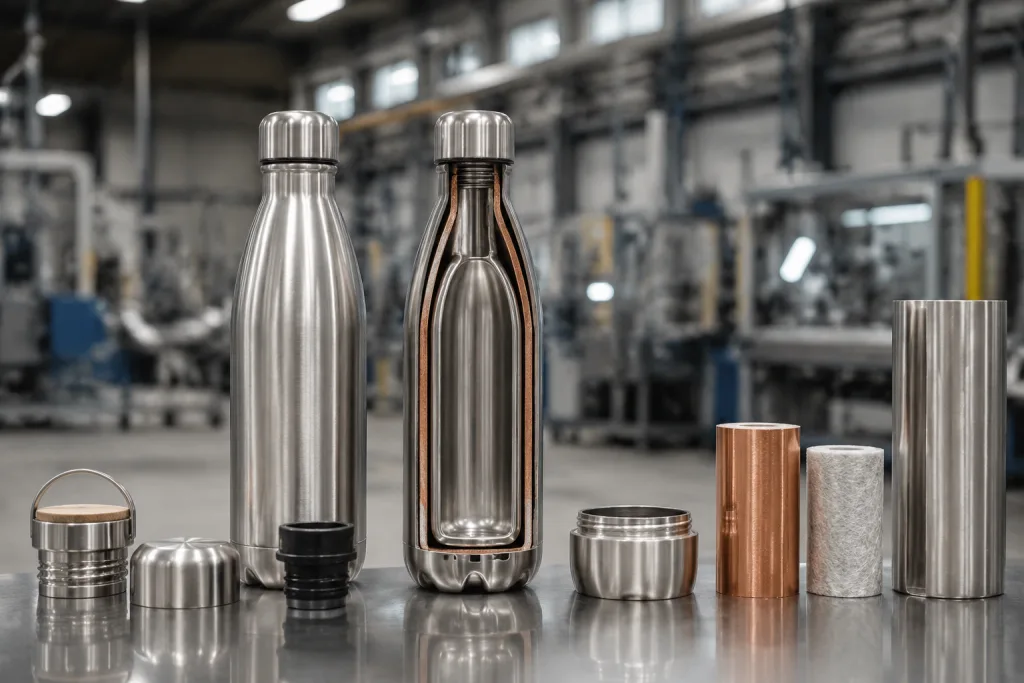
The price gap is real. On a 750 ml customized thermos, 304 inner plus 201 outer may quote around USD 3.60-4.40 FOB Ningbo at 3,000 pcs, depending on lid and finish. Full 304 construction may add USD 0.25-0.55 per pc. Copper plating inside the vacuum layer can improve heat retention, usually adding USD 0.15-0.30 per pc. We run the vacuum line with a heat-retention check after sealing; if the buyer asks for 12-hour data but expects 24-hour claims on the gift box, the math doesn’t work.
Ask your thermos manufacturer for material test reports tied to the steel coil batch, not just a generic certificate. For European buyers, the normal compliance set includes LFGB or EU food-contact testing, REACH screening for coatings if requested, and migration tests for plastic lid components. For North America, we often see FDA food-contact expectations, California Proposition 65 screening, plus ASTM-style physical tests from larger retailers. One buyer flagged a report last season because the coil number on the MTC was one digit different from the PO; small typo, big delay.
A professional thermos supplier in Zhejiang should be able to talk through these details without hiding behind “food grade, no problem.” Ask for the inner wall grade, outer shell grade, lid plastic type, and silicone hardness in Shore A. Short question. Good filter. If the vendor cannot answer, QC pulled the sample too late or the sales team never checked with the line, and you are not ready to place a private label order.
Balance insulation and durability
Vacuum insulation claims are easy to print and hard to compare. The wrong question is “How many hours?” unless the quote shows the test method. In our lab, QC fills the bottle with 95°C water, locks the lid, then records temperature after 6, 12, and 24 hours in a 20°C room with a probe thermometer. A 750 ml double-wall vacuum bottle with a good lid may keep water above 65°C after 12 hours and above 45°C after 24 hours. Cold retention causes fewer arguments, but QC still checks condensation around the lid seam after the bottle sits on the stainless bench for 2 hours.
Durability depends on more than the vacuum body. For a distributor thermos program, I would review these parts before approving the golden sample, because we have seen orders go sideways over a 0.3 mm thread mismatch:
- Thread fit: no cross-threading after 300 open-close cycles.
- Silicone ring: removable for cleaning, but not loose during daily use.
- Drop resistance: 80-100 cm drop test on filled bottle, at least on bottom and side.
- Coating adhesion: cross-cut tape test, especially on matte powder coating.
- Leakage: inverted test for 30 minutes plus shaking test for flip or straw lids.
Outdoor retailers should be careful with complex lids. Nice on the shelf. Risky after shipment. Straw lids with bite valves and push-button lids with small springs sell well, but they also bring more warranty claims when sand, coffee residue, or a loose silicone plug gets into the mechanism. A simple screw cap with a 6 mm carry handle often performs better for thermos distributors who care about repeat orders, not only first-order sell-in; one buyer flagged this after 37 returns from a camping chain.
BottleForge Industrial runs about 450,000 stainless drinkware units per month in Zhejiang, China, with inline vacuum checks and final AQL inspection. For insulated bottles, we normally recommend AQL 2.5 for major defects and AQL 4.0 for minor defects unless your retailer manual requires stricter inspection. On the line, QC pulled one sample last week for a pinhole weld mark near the bottom cup, and the carton was held before packing.
Decide decoration before pricing
Decoration can move the real cost of a custom thermos by 8-20%, and new buyers often miss it in the first RFQ. The same 500 ml bottle can sit as a low-cost supplier thermos item or a premium private label SKU once you change coating, logo method, insert card, and gift box. Decide this before you compare thermos custom quotes. Otherwise, we end up pricing different bottles; last month one PO even listed “matte balck,” and QC pulled the sample because the buyer expected soft-touch powder, not standard matte.
Laser engraving is durable and clean on powder coating or bare stainless steel. We run it with a fiber laser, and the line checks logo position with a 0.5 mm tolerance jig before packing. It works well for outdoor retail because it does not peel after backpack rub tests. The usual logo setup fee is USD 30-80, and unit cost is often USD 0.08-0.20 depending on logo size and position. Silkscreen printing costs less for one-color promotional thermos orders, roughly USD 0.05-0.12 per print position, but scratch resistance is weaker unless you add a clear coat or bake process.
Powder coating is the main option for a customizable thermos. It gives better grip and a retail shelf look, with fewer complaints about fingerprints than glossy spray paint. Standard matte black, white, navy, and olive are easier to control; our coating room checks color against the Pantone card under a D65 light box before mass production. Custom Pantone powder usually requires 1,000-3,000 pcs per color and may add 7-10 days for powder matching. Spray painting can save around USD 0.10-0.18 per bottle on some orders, but for hard outdoor use the math doesn't work.
If your brand needs full-wrap graphics, ask about heat transfer or water transfer, then test adhesion carefully. These options look strong in photos and campaign mockups, but we have seen this go sideways when bottles rub against zippers, keys, or rough fabric inside backpacks. For a thermos promotional campaign with a 30-60 day use cycle, full-wrap can be acceptable. For outdoor retail, I would specify powder coating plus laser logo, and I would ask the supplier to send 3 scratched test samples before approving bulk production.
Set MOQ, price, and terms
MOQ is the line where a private label bottle order either works or dies. For a stock-shape 304 stainless steel insulated water bottle private label order, a realistic MOQ from a China thermos factory is 1,000 pcs for laser logo on an existing color, 2,000-3,000 pcs for custom powder color, and 5,000 pcs or more if you need a new lid mold or body modification. A new plastic lid mold can cost USD 2,000-8,000 depending on complexity. Last month our tooling room checked one flip-lid drawing at 0.35 mm tolerance, and the buyer flagged the mold fee before the bottle price.
FOB pricing depends on steel thickness, lid parts, coating loss, packaging, and inspection requirement. As a working range, a 500 ml custom thermos may land at USD 2.80-4.20 FOB Ningbo, while a 750 ml bottle usually sits around USD 3.40-5.20. A premium 1,000 ml outdoor model with handle lid, full 304 construction, copper lining, and powder coating can move above USD 6.00. These are factory ranges, not landed costs. We run the quote off the BOM, not guesswork; one extra EVA pouch or 5-layer export carton can change the number by USD 0.18-0.45 per pc.
For payment terms, about 9 out of 10 thermos suppliers in China request 30% deposit and 70% balance before shipment. If you are a repeat buyer with stable volume, you can negotiate after 2-3 clean orders. For first orders, pushing for credit is the wrong question to ask. Lock the spec sheet, approved sample, inspection standard, and shipment date first. QC pulled the sample only after the PO matched the artwork file; we have seen orders go sideways from one typo like “matte black” on the PO and “gloss black” on the carton mark.
Lead time usually runs 7-12 days for pre-production samples after artwork confirmation, then 30-45 days for mass production after sample approval and deposit. Peak season before summer and Q4 promotions can stretch this by 10-15 days. If your retail launch is fixed, do not wait until the final packaging design is perfect before starting bottle sampling. Start the bottle first. The line can test vacuum performance, coating adhesion, and lid fit while your designer is still adjusting the color box dieline by 2 mm.
Control packaging and compliance
Packaging is not decoration. It decides damage rate, warehouse handling, barcode reads, and whether your thermos distributors can receive goods without relabeling at the dock. We run the packing trial on the line with a 60 mm tape gun, a carton scale, and the actual barcode scanner, not a PDF mockup. A basic bulk thermos packing uses one polybag, white box, and export carton. Retail programs often need a color box with 350 gsm paper, instruction sheet, spare gasket in a small PE bag, hang tag, carton marks, and pallet layout.
For promotional brands, master carton efficiency changes the landed cost. A 750 ml bottle packed in a color box may fit 24 pcs per carton, with carton gross weight around 12-15 kg depending on bottle weight. If the carton passes 16 kg, warehouse pushback starts. If it is too large, LCL freight and courier costs eat the margin fast. Ask your thermos manufacturer for carton dimensions before you approve final pricing; we have seen buyers approve a unit price, then lose USD 0.42 per bottle because the carton CBM was checked too late.
If you sell online or ship to North American fulfillment centers, set FNSKU, suffocation warning, country of origin, and scannable outer carton labels before mass packing. Simple rule: scan one inner box and one master carton before the first pallet is wrapped. For EU retail, check language requirements for care instructions and recycling marks. For outdoor retailers, buyers often request BSCI audit status, ISO 9001 quality system documents, and restricted substance declarations. One buyer flagged a PO typo where “Made in China” was missing from the color box artwork; fixing it after printing would have scrapped 8,000 boxes.
A final random inspection should include appearance, logo position, capacity check, leak test, coating adhesion, carton drop, barcode scan, and packing count. QC pulled the sample with a 3M tape test on the powder coating and a 1.2 m carton drop before sealing the shipment. For a first customized thermos order, do not skip third-party inspection to save USD 250-350. This is the wrong place to cut cost. That fee is small compared with rejected pallets in Rotterdam, Hamburg, Los Angeles, or Toronto.
How to compare supplier quotes
Ask three thermos factories for a price and you will usually get three different products on paper. One quotes a 201 outer shell, one quotes full 304 stainless, one cuts the body by 0.08 mm, and one changes the lid seal from silicone to TPE. Same photo. Different bottle. Put every quote back into one comparison sheet before you talk price.
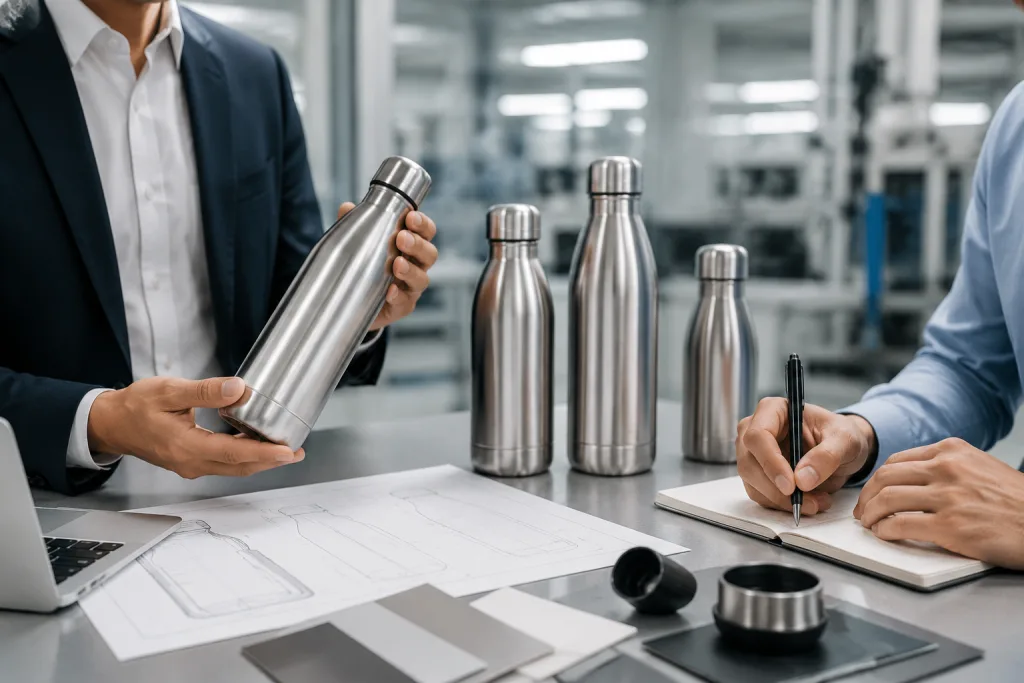
Send a one-page RFQ with capacity, inner and outer steel grade, target wall thickness in mm, lid drawing or reference sample, coating, logo method, packaging, test requirements, MOQ, delivery term, and destination market. We run this as a line-by-line confirmation; QC once pulled a 500 ml sample that measured 0.38 mm on the outer wall against a buyer’s 0.45 mm spec. Ask each thermos supplier to mark every exception. If they dodge the answer, that is already an answer.
I would score a thermos vendor on five points: whether the spec is clear, how fast the sample arrives, how they prevent defects, whether export documents are clean, and how they answer when the buyer pushes back. Cheap FOB can be the wrong question to ask. A USD 0.18 saving disappears fast if 6% of lids leak in the upside-down test, cartons fail a 12 kg stacking check, or your distributor has to relabel 3,000 units by hand because the PO said “matte black” and the carton mark printed “mate black.”
For outdoor retailers and promotional brands, a good supplier thermos relationship should feel boring: stable samples, 35-day production that does not turn into 52 days, inspection reports without drama, and no quiet material switch. Boring is good. If your launch date is fixed, tell the factory the real date and the penalty risk. A serious Zhejiang factory can block coating, assembly, AQL 2.5 inspection, and vessel booking around that schedule; a weak factory will say yes to every date until the line is already late.
Send your thermos spec for a factory quote
Share capacity, logo, color, market, and target MOQ. We will respond with a practical FOB quote and production timeline.
Frequently asked questions
What is the normal MOQ for a private label stainless thermos?
For an existing bottle shape, expect 1,000 pcs for a simple laser logo on a stock color. If you need a custom Pantone powder coating, MOQ is usually 2,000-3,000 pcs per color because powder setup and color loss are real costs. New lid tooling normally starts around 5,000 pcs, with mold charges from USD 2,000 to USD 8,000. If a thermos factory accepts 300 pcs with custom color, check whether they are using spray paint, leftover powder, or charging a much higher unit price.
Is 304 stainless steel required on both inner and outer walls?
For food safety, the inner wall should be 304 stainless steel because it contacts water, coffee, or tea. The outer wall can be 201 or 304 depending on your price and positioning. Many China factories quote 304 inner plus 201 outer for mid-market orders. Full 304 construction is better for premium outdoor retail and may add USD 0.25-0.55 per bottle on a 750 ml model. Put the steel grade in the purchase order and request batch material reports, not just a general “food grade” statement.
Which logo method is best for outdoor retail bottles?
For outdoor retail, laser engraving on powder coating is usually the safest choice. It resists scratching better than standard silkscreen and looks clean after heavy use. Silkscreen is fine for one-color promotional thermos orders where cost matters more than long-term abrasion. Laser cost is often USD 0.08-0.20 per unit, while silkscreen may be USD 0.05-0.12 per position. If you need full-wrap artwork, test adhesion and rub resistance before approving mass production, especially on curved 750 ml and 1,000 ml bottles.
How long does a custom thermos order take from China?
A practical timeline is 7-12 days for pre-production samples after artwork approval, then 30-45 days for mass production after deposit and sample sign-off. Custom powder colors can add 7-10 days. Ocean freight to Europe or North America may add 25-40 days depending on port and season. If you need retailer testing, add another 5-15 working days. The biggest delays usually come from late artwork, unclear packaging, or changing the lid after sample approval.
What defects should I inspect before shipment?
Inspect leakage, vacuum performance, coating scratches, logo position, dents, lid fit, silicone ring installation, odor, capacity, carton strength, barcode scan, and packing count. For a first order, use AQL 2.5 for major defects and AQL 4.0 for minor defects unless your retailer requires stricter limits. A 30-minute inverted leak test should be included, plus random heat retention checks using hot water. Third-party inspection usually costs USD 250-350 per man-day in China and is worth it for first private label shipments.