Key Takeaways
- Existing 304 stainless thermos models usually start at 1,000 pcs MOQ, while new mold projects often need 5,000-10,000 pcs
- A 500 ml custom thermos commonly lands at USD 3.20-6.80 FOB China depending on gauge, lid, finish, and packaging
- Sampling takes 7-12 days for stock molds and 20-35 days when new tooling or special lids are involved
- Mass production is normally 25-40 days after deposit and artwork approval, but Q4 should be booked 10-15 days earlier
Buying for an outdoor retail line or a promo campaign? The hard part is not finding a 304 stainless steel insulated water bottle manufacturer. It is getting a quote that survives logo printing, lid selection, color box packing, AQL 2.5 inspection, and sea freight. We have seen a USD 0.28 cheaper bottle lose money after the buyer changed from silk print to laser engraving and added a spare straw set. The math doesn't work if those details are left until the PO stage.
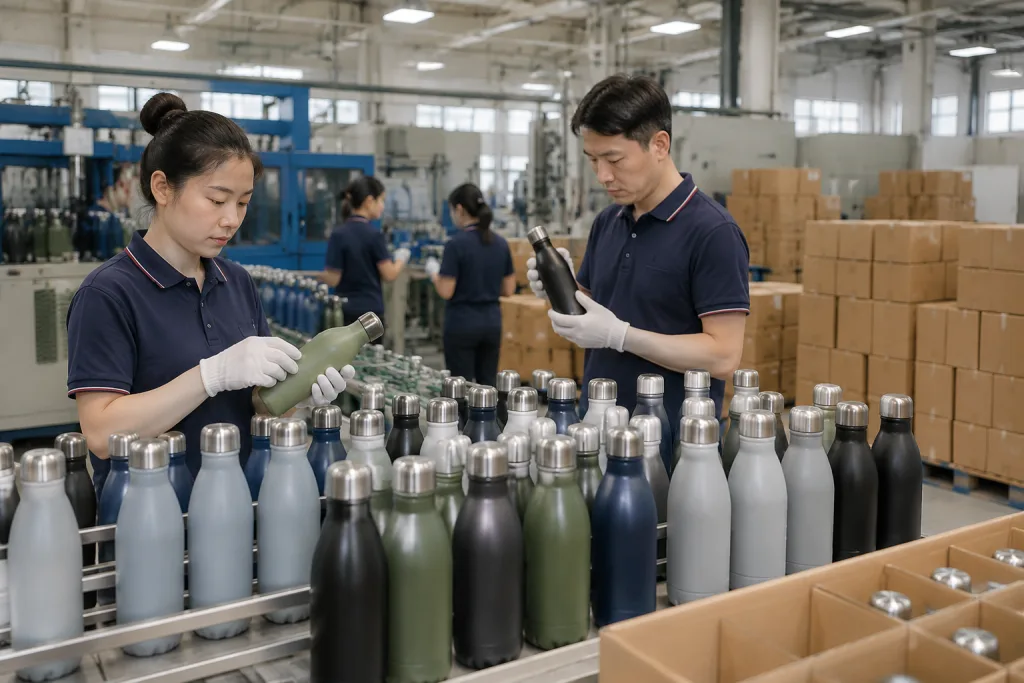
BottleForge Industrial is based in Hangzhou, Zhejiang, and we run stainless vacuum bottle production for export buyers in Europe and North America. Our normal production capacity is about 420,000 units per month, with typical MOQ starting at 1,000 pieces per SKU for existing molds. On the line, QC pulled 32 samples from a recent 1,000-piece SKU run to check coating adhesion, lid fit, and vacuum retention before carton sealing. Below is the cost and lead-time breakdown we use with serious buyers.
Where the FOB price really moves
For a 304 stainless steel insulated water bottle manufacturer, the bottle body is only one line in the FOB price. Last month, 2 buyers sent us 500 ml thermos quotes and asked why one factory was at USD 3.35 while another was at USD 5.90. QC pulled the sample, measured the shell with a Mitutoyo caliper, and the answer was not mysterious: wall thickness, vacuum hold, lid mold, coating finish, and carton packing were not the same.
A practical range for an existing 500 ml double-wall 304 stainless steel bottle is USD 3.20-6.80 FOB Ningbo or Shanghai, assuming 1,000-5,000 pieces. A simple powder-coated promotional thermos with one-color logo and standard white box stays near the lower half. A retail-ready outdoor bottle with 0.5 mm outer wall, copper lining, powder coating, leak-proof carry lid, barcode label, and color gift box moves toward the higher end. The math does not work if the buyer asks for a USD 3.60 bottle, then adds a 4C gift box, spare straw, and drop-test carton after the PO is signed.
- Material: Inner 304 stainless steel is standard for food contact. Outer wall can be 201 or 304; outdoor retailers normally pick 304/304 because the product page reads cleaner and the buyer can defend the higher shelf price.
- Gauge: 0.4 mm body material is common. Moving to 0.5 mm gives better dent resistance, but we see about 18-25 g extra weight on a 500 ml body and the steel cost moves.
- Vacuum: Copper plating can improve heat retention by roughly 10-20%, depending on bottle geometry. On the line, we check this after vacuuming with an 85°C hot-water test, not by guessing from the catalog photo.
- Lid: A basic screw cap is cheap. A straw lid, chug lid, flip lid, or handle lid can add USD 0.25-1.20 per unit, and a new silicone color can trigger a 3,000 pcs MOQ from the gasket supplier.
If a thermos supplier gives one flat price without these points, you are not comparing the same product. Ask for the material grade, wall thickness, lid material, packaging, AQL level, and Incoterm in writing before you quote your retail or promotional customer. We have seen this go sideways: one PO said “304 bottle,” but the approved sample had 304 inner and 201 outer, so the buyer flagged it during pre-shipment inspection.
MOQ tiers for retail and promotional orders
MOQ is not just a factory preference. It follows our 304 stainless steel coil purchase, powder coating line changeover, silk-screen logo setup, lid stock, and carton MOQ from the print shop. On the Hangzhou line, one color change on matte powder coating takes about 45 minutes, plus a 2 kg powder purge before QC checks the first 20 bottles. We can sometimes run 500 pieces for a repeat stock bottle in one color, but that is the wrong planning number for most buyers. For stable pricing and a lead time closer to 28 days instead of 38 days, use 1,000 pieces per SKU as the working MOQ.
For existing molds, a normal MOQ structure looks like this: 1,000 pieces for a custom thermos with one logo and one body color; 2,000-3,000 pieces if you need two or three colors in the same model, with each color packed under a separate SKU sticker; 3,000-5,000 pieces for retail packaging with printed gift box and custom insert, because the box factory usually asks for 3,000 sheets before they set the plate. If you need a customized thermos with an exclusive body shape or private lid, the economic MOQ is usually 5,000-10,000 pieces because tooling, leak testing, and trial production must be absorbed. QC pulled the sample last month for a private lid project because the silicone ring was 0.4 mm too loose. Small gap. Big leak risk.
Promotional thermos buyers sometimes ask for 300 pieces with four colors, individual names, and rush delivery. We hear this often before trade shows. Technically, small runs are possible through digital printing or laser engraving, but the unit cost climbs fast. A USD 4.20 bottle can become USD 6.50 before freight because the logo setup, packing labor, and color sorting are spread across too few units. The math does not work for every project. For a giveaway campaign, that may still pass internal approval; for an outdoor retailer building a margin-based product line, it usually gets flagged by the buyer after the first landed-cost sheet.
Our advice is blunt: if you cannot order 1,000 pieces per SKU, keep the design simple, use an existing bottle, and do not ask for custom carton printing.
This is how we keep the manufacturer thermos project small without making it messy. One PO typo, like “mat black” instead of “matte black,” can already cost a half day of confirmation before the line starts.
Logo and finish cost ranges
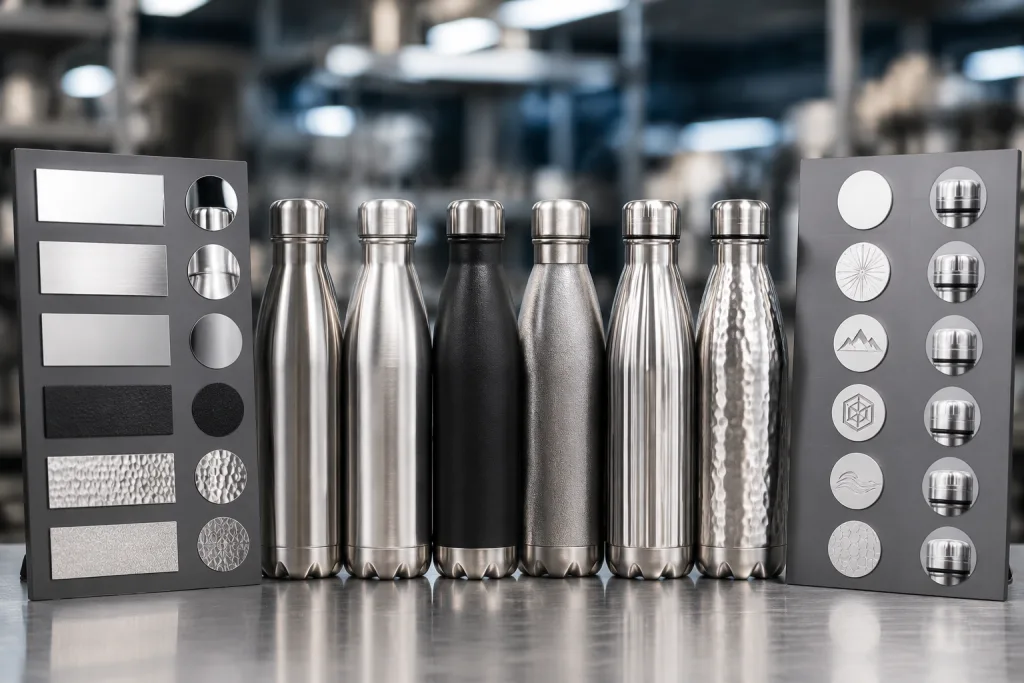
“Customizable thermos” is a loose word. In our quoting sheet, we separate it into silkscreen, laser, heat transfer, water transfer, spray paint, and powder coat because each one changes the MOQ, reject rate, and packing date. Outdoor retailers usually care about shelf rub, carton vibration, and trail scratches; we test that with 3M tape, a 500g rub test, and a quick drop check on the coated sample. Promo buyers often care more about the event date. Fair enough. The wrong question is “which finish looks best?” The better question is which problem hurts more: shipping 12 days late, seeing the logo scratch at QC, or adding USD 0.30 to every bottle.
Silkscreen printing is the cheapest choice for a simple logo. A one-color logo usually adds USD 0.08-0.18 per unit, with a screen charge of roughly USD 30-60 per color. We run it on a curved jig, and QC pulled the sample last month because a 0.25 mm line in the buyer’s icon filled in after printing. Small text is where this goes sideways. Laser engraving usually adds USD 0.15-0.35 per unit. It looks clean on powder-coated bottles because the beam cuts through the coating and shows the stainless steel underneath.
Full-wrap heat transfer or water transfer can add USD 0.45-1.20 per unit. Use these for lifestyle graphics, camo, gradients, or retail collections where the bottle has to sell from 2 meters away on a shelf. The line needs slower handling here; one operator checks the seam by eye before the bottle goes into the curing rack. Powder coating costs more than spray painting, but the math works better for outdoor retail because abrasion claims eat margin fast. For outdoor retail, powder coating is usually worth the extra USD 0.20-0.50 per bottle.
Color matching has its own cost. For a standard factory color, there is no special color setup. For a Pantone-matched powder coat, expect a minimum of 1,000-2,000 pieces per color and a setup or powder surcharge if the color is not already in the line. A good thermos vendor should send a color chip or pre-production sample before mass coating; we normally check it under a D65 light box, not beside a window at 5 p.m. Zhejiang factories like ours can run tight color control, but approval must happen before the coating line starts, not after 30,000 units are finished.
Sampling, tooling, and approval timing
Lead time trouble usually starts before production, not on the line. A buyer spends seven days approving artwork, then asks us to pull the stainless thermos order back on schedule. Sometimes we can. Often the math doesn't work, because the powder coating booth, vacuum test station, lid assembly table, and carton packing slot are already booked against other export orders in China. Last month QC pulled a sample at 9:40 a.m. and the buyer flagged a 1.5 mm logo shift; that one comment cost two more approval days.
For an existing stainless thermos mold, a logo sample normally takes 7-12 days after artwork confirmation. If you need a custom color powder-coated sample, plan 10-18 days because the sample room must prepare surface treatment, bake the coating panel, and match it under a D65 light box, not just print a logo on a stock bottle. If you need a new lid, a modified handle, or a new bottle shape, prototype and tooling work usually takes 20-35 days before you even approve the final sample. We run these as sample-room jobs, not mass line jobs.
Tooling cost varies widely. A minor silicone part mold may be USD 300-800. A plastic lid mold can be USD 2,000-8,000 depending on structure, thread accuracy, moving parts, and whether a straw valve is included; the buyer often only sees “lid,” but our mold master is checking sealing ribs, hinge clearance, and 0.1 mm thread fit. A new stainless steel body mold can run from USD 3,000 to more than USD 12,000. For private projects, we normally confirm tooling exclusivity, ownership, and expected annual order volume before cutting steel.
Buyers should also budget time for compliance samples. If your market needs LFGB, REACH, FDA food contact confirmation, or California Proposition 65 screening, send the sample to the lab before mass production where possible. Lab testing can add 5-12 working days. For children’s bottles, ASTM-related checks and small-parts review may be needed depending on the design and sales channel; we have seen this go sideways when a straw cap passed leak testing but failed a pull test on the small silicone plug.
Mass production schedule you can use
A usable production schedule for a custom thermos order starts after three boxes are ticked: deposit received, artwork approved, and final sample or specification approved. Before that, the line is not booked. From that point, our normal mass production lead time in Zhejiang is 25-40 days for 1,000-20,000 pieces using existing molds. Larger distributor thermos orders of 30,000-80,000 pieces usually need 40-60 days, especially with 3-5 body colors, color box packing, and barcode stickers. We run the schedule from the signed PI, not from the first WhatsApp inquiry.
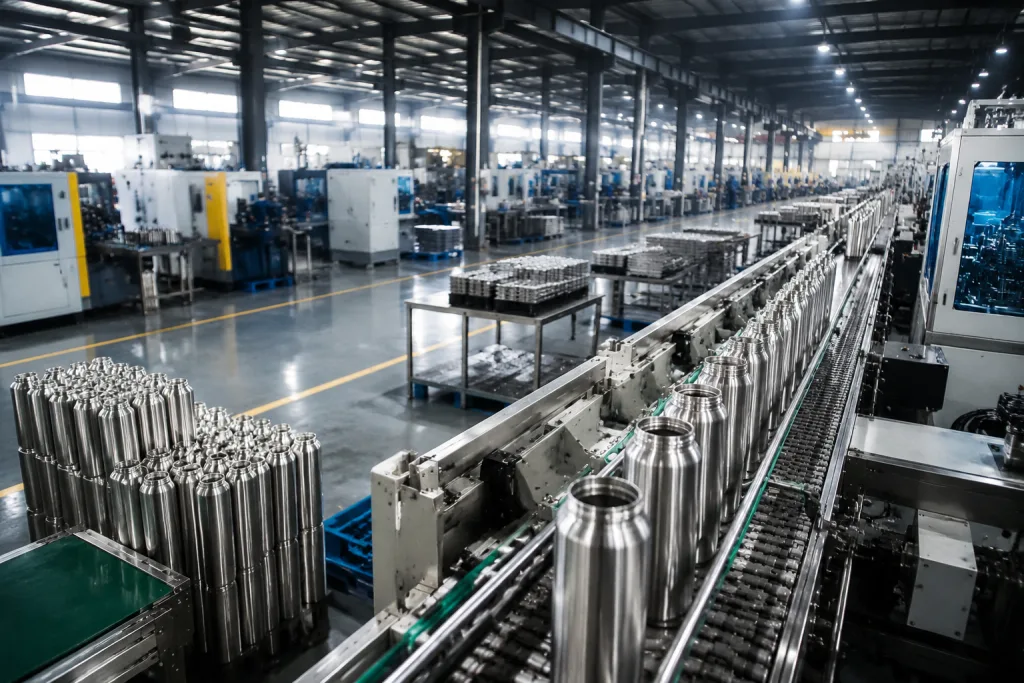
The internal sequence matters. Stainless forming and welding takes 3-7 days depending on volume; our forming team checks mouth roundness with a 0.02 mm caliper before the body moves forward. Vacuum insulation and temperature testing take another 3-6 days. Surface treatment, including polishing, spraying, or powder coating, takes 5-10 days. Logo decoration takes 3-8 days, and laser engraving is faster than full-wrap heat transfer on most jobs. Final assembly, leak testing, AQL inspection, carton packing, and pallet preparation take 4-8 days. These steps overlap, but squeezing all of them into 12 days when the real plan needs 18 days is how we’ve seen this go sideways.
For quality control, around 80% of our European and North American buyers use AQL 2.5 for major defects and AQL 4.0 for minor defects. Critical defects such as leakage, sharp edges, wrong material, or severe coating failure should be treated with zero tolerance. A distributor thermos program going into retail chains should not skip pre-shipment inspection just to save USD 250-400; the math doesn't work if one retailer rejects a pallet. QC pulled the sample last month and found two lid gaskets installed upside down, plus a carton mark typo where the PO said “Matte Black” but the outer carton printed “Matt Black.” That is cheap to fix before loading, expensive after the goods leave China.
Shipping adds another layer. From Ningbo or Shanghai, sea freight to Europe often takes 28-40 days port to port. To the US West Coast, plan around 18-28 days; to the US East Coast, 30-45 days. Add customs clearance and inland delivery, usually 3-9 days if the forwarder has clean documents and the HS code matches the invoice. If your shelf date is fixed, work backward from that date, not from the factory production date. This is the wrong question to ask: “Can you finish faster?” Ask where the bottleneck sits: coating booth, logo room, inspection slot, or vessel booking.
Packaging, FBA, and distributor details
Packaging is a quiet cost driver. We see it on the packing table before buyers see it on the invoice. A bulk thermos in a plain white box usually needs only a 5-layer master carton with carton marks. A retail bottle is different: color box, instruction sheet, care card, hang tag, EAN or UPC label, pallet label, sometimes a PDQ display tray. Each piece looks harmless, but the total often adds USD 0.25-0.90 per unit. Last month QC pulled 12 color boxes because the PO said “matte black” and the artwork file said “matt black”; that typo stopped the line for 40 minutes.
For Amazon or marketplace programs, we run FNSKU labels, suffocation warnings on polybags, drop-test resistant cartons, and carton weight control. Keep master cartons under 15 kg. That is not theory; our warehouse team flags anything above 15 kg because one 18 kg carton split at the tape seam during a 76 cm drop test. If the bottle has a straw lid or spare gasket, fix the parts inside the box with a small PE bag or paper insert, or the consumer thinks the set is short. We have seen this go sideways in reviews.
Outdoor distributor thermos programs often ask for mixed SKUs in one container: 500 ml, 750 ml, and 1,000 ml bottles across three colors. That works, but confirm carton dimensions early with the factory packing drawing, not after mass production. The math changes fast. A tall 1,000 ml stainless thermos may cut container loading compared with a 500 ml bottle because the carton height jumps from 265 mm to 335 mm. Saving USD 0.10 on the bottle is the wrong question to ask if you lose 8% loading efficiency in a container.
For promotional thermos orders, packaging depends on how the bottle reaches the user. If staff hand it out at an event, a simple white box or kraft box is enough in most cases. If we ship to individual recipients, use stronger packaging and run a drop test before sealing the production spec. A good thermos suppliers quote should state packaging clearly: individual box type, master carton quantity, gross weight, carton size, and whether barcode or FNSKU application is included. We also add MOQ for custom cartons, usually 1,000 pcs, because carton factories in Hangzhou will not print 200 boxes without charging a painful setup fee.
How to compare factory quotes fairly
Send the same spec sheet to every thermos factory you ask for pricing. A photo and a target price are not enough. We see this go sideways at RFQ stage: one buyer sent us only a lifestyle image, then QC pulled the sample and found 0.42 mm inner wall instead of the 0.50 mm they expected. Cost changes with steel grade, volume, lid structure, coating, logo size, packaging, compliance, and inspection terms. If one supplier’s thermos quote is 20% cheaper, check what they removed.
A workable request should list capacity in ml, 304/304 or 304/201 steel requirement, wall thickness target, lid material, thermal performance target, logo method, Pantone color, packaging, order quantity by color, Incoterm, delivery deadline, and required audits such as BSCI or ISO 9001. For example, “750 ml, 304 stainless inside, powder coating, 1-color silk print, 3,000 pcs per color, FOB Ningbo” lets the line calculate material and setup time properly. BottleForge Industrial can support BSCI-audited production partners and standard export documentation for Europe and North America. From Hangzhou, Zhejiang, we run close to coating shops, carton suppliers, and Ningbo/Shanghai freight routes, so a 12-carton trial shipment does not get treated like a mystery job.
Ask for the quote in a format that separates bottle price, decoration cost, packaging cost, testing cost, tooling cost, and freight estimate. This is the right way to cut cost. If the target price is missed by USD 0.38, the math shows whether the lid mold, the EVA insert, or the 5-color retail box is causing the problem. We had one PO where “2,000 pcs total” was typed, but the buyer meant 2,000 pcs per color across 4 colors; that typo changed the setup cost and carton label plan. Maybe 750 ml should move from 2,000 pieces to 3,000 pieces to reduce per-unit setup cost.
The best thermos supplier is not always the cheapest. Cheapest is often the wrong question to ask. For a customized thermos program, you want a factory thermos partner that tells you where the risk is before the deposit is paid. If the finish can scratch, if the lid may fail a 1.2 m drop test, or if your deadline is 18 days but ocean freight needs 32 days to Los Angeles, you need that answer early. The buyer flagged it once; fixing it after mass production is painful.
Send your thermos spec for a grounded quote
Share capacity, lid, logo, quantity, packaging, and deadline. We will return FOB pricing, MOQ, sampling time, and production risk points.
Frequently asked questions
What is the normal MOQ for a custom 304 stainless thermos?
For existing molds, plan on 1,000 pieces per SKU as a practical MOQ. That usually allows one body color, one logo position, and standard packaging. If you need several Pantone colors, printed gift boxes, or a special lid combination, 2,000-3,000 pieces is more realistic. For a fully customized thermos body or private lid mold, the economic MOQ is usually 5,000-10,000 pieces because tooling, trial production, and QC setup must be spread across enough units. Very small promotional runs can be done, but the unit price often rises by USD 1.00-2.50.
How much does a 500 ml 304 stainless steel insulated bottle cost?
A standard 500 ml 304 stainless steel insulated bottle usually ranges from USD 3.20-6.80 FOB China for 1,000-5,000 pieces. The low end assumes an existing mold, simple screw lid, one-color logo, and white box. The upper range may include 304 inner and outer walls, 0.5 mm steel, copper lining, powder coating, laser logo, leak-proof handle lid, and retail color box. Testing, tooling, and freight are usually quoted separately. If a price is far below this range, check whether the outer wall is 201 stainless, the gauge is lighter, or packaging has been excluded.
Can you make a thermos for outdoor retailers, not just giveaways?
Yes, but the specification should be stronger than a basic promotional thermos. For outdoor retail, we normally suggest 304 inner and 304 outer stainless steel, powder coating, reliable leak-proof lid structure, and carton packaging that can survive warehouse handling. A 0.5 mm outer wall is worth considering for larger bottles because dent resistance matters in retail returns. You should also define heat retention, such as keeping water above 60°C after 6-12 hours depending on capacity and test conditions. Retail programs also need barcode accuracy, carton marks, AQL inspection, and consistent color matching.
What lead time should we expect before a seasonal launch?
For an existing model with a logo, allow 7-12 days for sampling and 25-40 days for mass production after deposit and approval. Add 28-40 days for sea freight to many European ports or 18-45 days to North America depending on coast and route. That means a safe plan is usually 70-100 days from artwork approval to warehouse arrival. If you need a new mold, custom lid, or lab testing, add another 20-35 days. For Q4 and pre-summer outdoor launches, book production 10-15 days earlier because coating lines and vessel space tighten.
Which certifications should a thermos manufacturer provide?
For Europe, ask about LFGB, REACH, and relevant food contact declarations for stainless steel, silicone, plastic lids, coatings, and inks. For North America, FDA food contact compliance is commonly requested, and some buyers ask for California Proposition 65 screening. Children’s bottles may require additional ASTM-related review depending on design and age grading. Factory-level documents can include BSCI, ISO 9001, or social compliance reports, but product testing still depends on the exact material and production batch. Budget 5-12 working days for third-party lab testing if current reports do not match your exact item.