Key Takeaways
- A realistic custom stainless thermos MOQ starts at 1,000 units per color for powder coating
- 304 stainless steel is usually correct for inner and outer walls, but gaskets, paint, and lids need separate compliance checks
- A standard production lead time is 30-45 days after artwork and pre-production sample approval
- Use AQL inspection, carton drop testing, and vacuum retention checks before paying the 70% balance
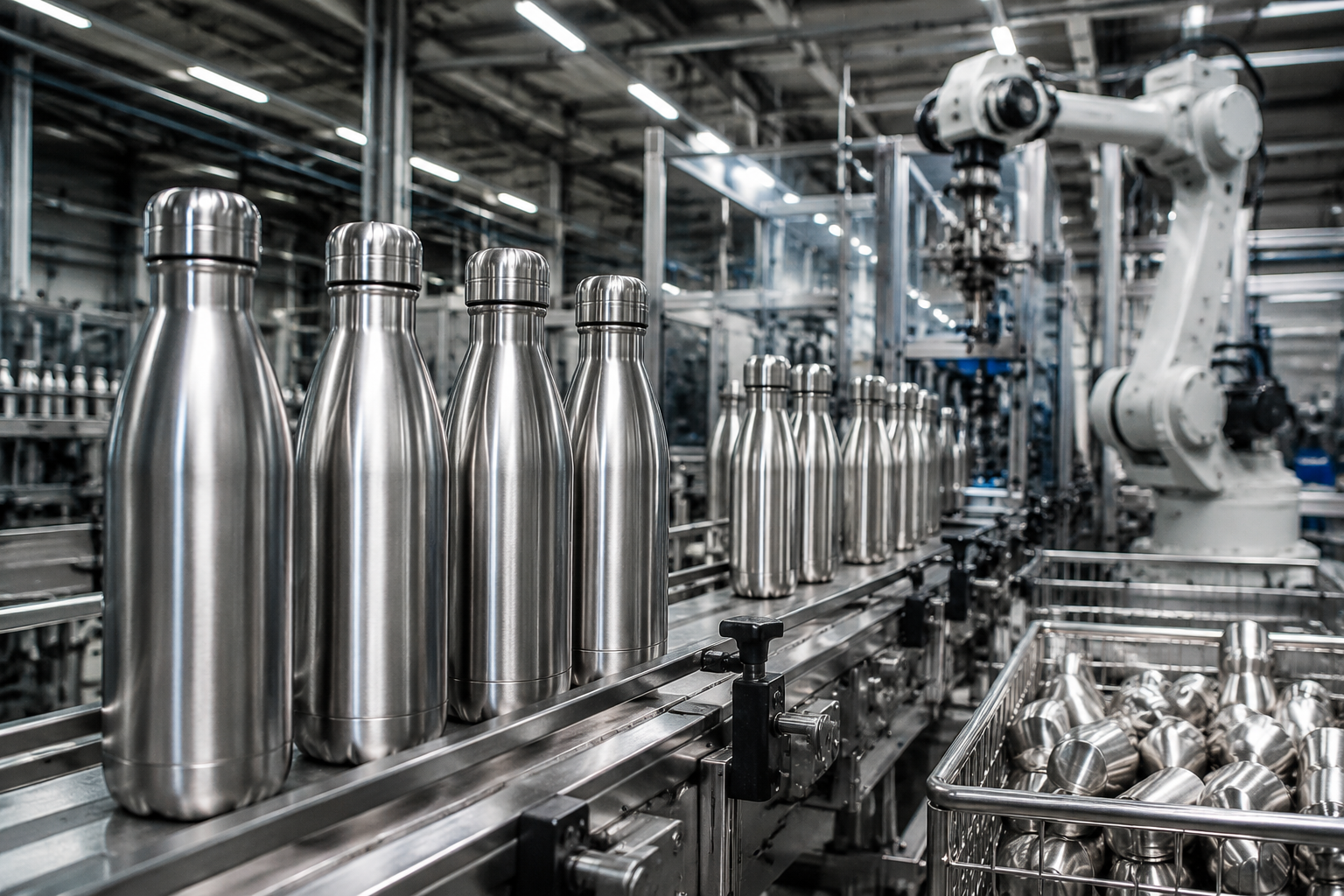
If you sell outdoor gear or run promotional drinkware programs, the hard part is not finding a shiny bottle photo. The hard part is knowing whether a 304 stainless steel insulated water bottle factory will keep the powder coat within ±0.2 mm at the lip, hold the laser logo 12 mm below the shoulder, pass carton drop tests, and still ship on the promised ETD after your bulk thermos order hits the line.
We manufacture in Hangzhou, Zhejiang, and export from China to Europe and North America every month. A typical custom thermos project looks simple on the PO: 500 ml, powder coating, laser logo, gift box, 3,000 pcs. On the floor, the details bite. QC pulled the sample last month because the logo file said Pantone 186C, while the PO had a typo showing 168C; that kind of miss turns a clean distributor thermos order into a claims file fast. This checklist is the one we wish more new importers used before paying a deposit.
What does 304 actually cover?
Buyers usually ask the right first question: “When you say 304, which parts are 304?” A proper 304 stainless steel insulated water bottle factory should answer it straight. On the bottles we run in Hangzhou, the inner liner and outer shell are SUS304, usually 0.4 mm to 0.6 mm wall thickness before stretching on the hydraulic press. Thin saves weight. It also brings trouble. On one 750 ml outdoor bottle, the buyer pushed for 0.35 mm outer shell, then QC pulled 23 dented samples from a 200 pcs carton-drop check.
The vacuum layer sits between the two stainless walls. No foam inside. If a cheap factory thermos quote comes in 18% under the market and the sales rep cannot explain vacuum brazing, copper lining, or heat retention testing, slow down. The math does not work. A 500 ml bottle should normally keep water above 55°C after 12 hours when tested from 95°C initial fill at 20°C room temperature, depending on mouth diameter and cap structure. We test with a digital probe through a drilled test cap, and wide-mouth caps usually lose heat faster than narrow-mouth screw caps.
304 does not make the whole product compliant by itself. This is where we have seen orders go sideways after the PO says “304 bottle” but says nothing about the lid resin or gasket standard. You still need to check:
- Lid plastic: commonly PP, Tritan, or AS, with food-contact documentation matched to the exact material grade on the BOM.
- Sealing parts: silicone gaskets should be LFGB or FDA grade for your target market, and we check gasket flash with a 0.2 mm feeler gauge during incoming QC.
- Coating: powder coating or spray paint should pass adhesion and heavy metal screening; a 3M tape cross-cut test catches weak coating before mass packing.
- Packaging: inks, polybags, and labels may matter for retailer rules in the EU and US, including suffocation warnings when the polybag opening is over 5 inches.
For Europe, ask about REACH and LFGB where relevant. For the US, ask for FDA food-contact support and, for kids or promotional programs, whether ASTM-related testing applies. A stainless thermos supplier who only sends a generic “304 certificate” is not giving you enough to protect your brand. We had one PO typo last year that said “S/S304 inner only”; the buyer flagged it before deposit, and that saved 22 days of rework versus finding it after pre-production samples.
Which customization is worth paying for?
A customizable thermos can stay clean, or it can turn into a reject machine. We’ve had buyers ask for five decoration methods on one 304 stainless bottle because the sales deck looked “premium”; on the line, that means five chances for dust, misalignment, weak adhesion, or color drift. QC pulled 17 scratched samples from a 600-piece pilot run last May after the silicone jig left rub marks near the shoulder. The best thermos custom plan is the one that still looks right after carton rubbing, warehouse handling, and the first dishwasher complaint from an end user.
Laser engraving is still the safest logo method on stainless steel and powder-coated bottles. It cuts a clean permanent mark, and we run it comfortably from 300 to 5,000 units, though plenty of factories keep official MOQ at 1,000 units per SKU. Silk screen printing costs less for one-color logos on smooth bottles, but the artwork has to be tight; a 0.3 mm line can fill in fast if the mesh and ink viscosity are wrong. Heat-transfer printing fits full-color promotional thermos projects, but curved bodies punish lazy setup. The math doesn’t work if the buyer saves USD 0.12 and then flags peeling labels in the first shipment.
Here is the plain checklist before approving a customized thermos:
- Logo file in AI, PDF, or CDR vector format, not a 72 dpi JPG pulled from a website.
- Logo size confirmed in millimeters, for example 45 mm wide on a 500 ml bottle, checked with a caliper on the sample.
- Pantone color confirmed for coating and print, with tolerance accepted before mass production; we usually write the Pantone code on the sealed sample bag.
- Decoration position measured from bottle base or centerline, not “looks centered,” because 4 mm off-center shows fast on a straight tumbler body.
- One signed pre-production sample kept by the factory and one by you, with the PO number and SKU written the same way on both labels.
For a promotional thermos campaign, budget pressure is real. But shaving USD 0.08 by choosing a weak print can cost more when 3% of users complain after one month, especially if the carton mark has a retailer chargeback code on it. We’ve seen this go sideways: one PO had “matte balck” typed in the finish column, the buyer approved the sample photo too quickly, and 2,400 bottles had to be re-sorted under AQL 2.5. For a distributor thermos line, I would rather ship two solid colors with better coating adhesion than six flashy finishes that come back as claims.
What MOQ and price are realistic?
“What is your MOQ?” is the wrong question to ask. Ask this instead: “What is the MOQ by bottle shape, Pantone color, logo process, and box type?” At our Zhejiang facility, we run 1,000 units per color for powder coating, 500 units for laser logo on stock color when inventory is on the rack, and 3,000 units when the job needs a special lid color or private mold component. Last month QC pulled a 500 ml sample after coating because the buyer’s PO said matte black, but the artwork file showed Pantone 426C.
FOB Ningbo or FOB Shanghai pricing moves with steel cost, coating choice, lid parts, and carton spec. As a working range, a 500 ml double-wall 304 stainless bottle with powder coating and laser logo often falls around USD 3.20-5.80 FOB China for B2B quantities. A heavier 750 ml outdoor model with handle lid, thicker base, and retail box may sit around USD 5.50-8.50. If a quote lands far below this, ask what was cut: 0.40 mm wall becomes 0.35 mm, coating drops from outdoor powder to cheaper paint, vacuum test changes from 100% to spot check, or the carton board loses 2 kg burst strength.
Cheap first quotes often move cost into claims, rework, air freight, or your customer service inbox.
Capacity matters too. Our current stainless bottle lines can handle about 450,000 units/month across standard thermos factory models, with practical lead time of 30-45 days after deposit and sample approval. Peak season before summer retail launches or Q4 promotional programs can add 7-15 days. Book the slot early. We’ve seen this go sideways when a buyer approved artwork on May 6, then asked for July 1 delivery after the powder coating line was already full.
Payment terms are usually 30% deposit and 70% before shipment after inspection. For repeat buyers, we can discuss staged shipments or LC terms, but new supplier thermos relationships need clean discipline on samples, signed approvals, and QC gates. Our packing team will not release cartons if the shipping mark on the master carton differs from the PI by one digit; it sounds small, but it delays loading at 8 p.m. fast.
How should you audit quality?
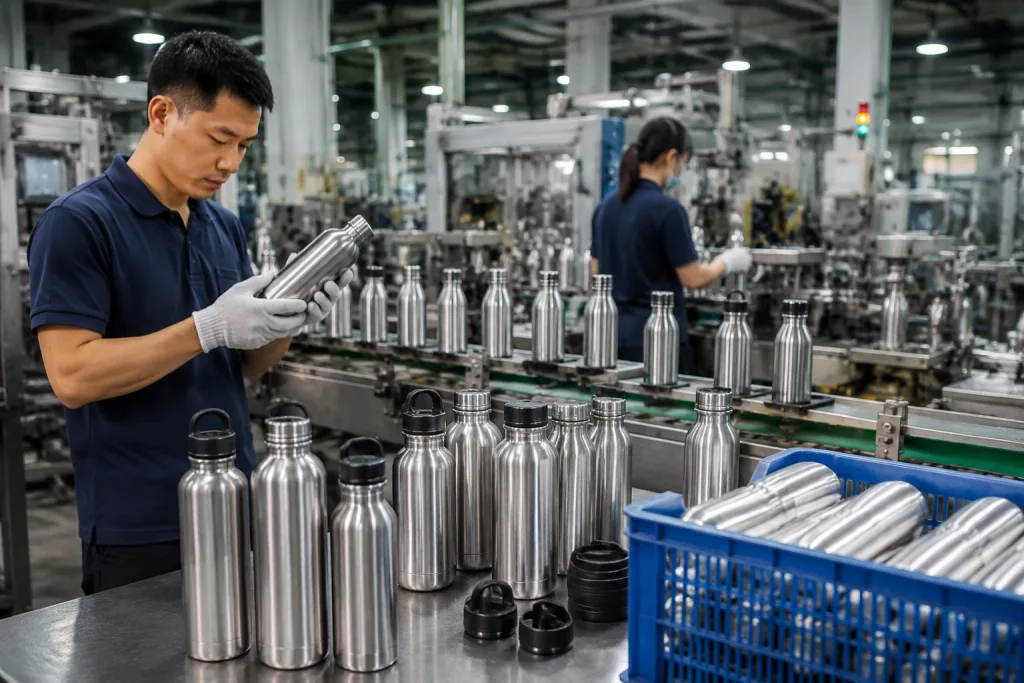
A factory visit helps, but a checklist audit beats a polite showroom tour. If you cannot fly to China, ask for a live video walk-through of the forming area, polishing line, coating line, vacuum test station, assembly benches, and finished goods warehouse. Ask them to show the date on a phone and open 3 random cartons on camera. A real 304 stainless steel insulated water bottle factory should be comfortable showing normal production, including scratched worktables, jigs, pressure gauges, and operators moving semi-finished shells down the line.
For quality control, use AQL instead of “please check carefully.” That sentence on a PO means almost nothing. A typical inspection level for drinkware is General Inspection Level II, with AQL 2.5 for major defects and 4.0 for minor defects. Critical defects, such as leaking, sharp metal edges, unsafe odor, or wrong material, should be zero tolerance. For a 5,000-unit order, a third-party inspector may sample 200 units depending on the inspection table. We have seen buyers push for a 20-piece check to save inspection cost; the math does not work, because the top carton usually looks clean while leaking cups hide in the middle pallets.
Your inspection checklist should include:
- Vacuum performance: hot water retention test on sampled units for 6-12 hours, with starting temperature, room temperature, and final temperature recorded.
- Leakage: inverted and shake test after filling to marked capacity, then check the cap thread and silicone ring for water marks.
- Coating adhesion: cross-cut tape test on powder-coated bodies, using a 1 mm or 2 mm cutter depending on coating thickness.
- Logo accuracy: size, position, color, and missing strokes, checked against the approved artwork file, not a photo from WeChat.
- Carton strength: 5-ply export carton for heavy thermos bulk orders when needed, especially if one master carton is over 15 kg.
- Drop test: ISTA-style carton drop sequence for retail or e-commerce shipments, with corner, edge, and face drops recorded by photo.
If you sell through outdoor retailers, dent resistance and cap durability matter more than showroom gloss. QC pulled the sample for one hiking bottle order after the handle pin bent at 18 kg pull force, even though the powder coating looked perfect. If you sell promotional giveaways, logo consistency across all cartons matters more than a premium lid. Tell your thermos supplier which failure would hurt you most. The QC plan should match the sales channel, not the factory’s easiest test sheet.
What packaging fits your channel?
Packaging is where 3 out of 10 custom thermos projects quietly lose money. A bottle can pass AQL 2.5 and still land with crushed gift boxes because the master carton was costed for a spreadsheet, not a truck ride. For North America and Europe, most buyers choose bulk pack, white box, color box, or retail-ready packaging. Same bottle. Different risk.
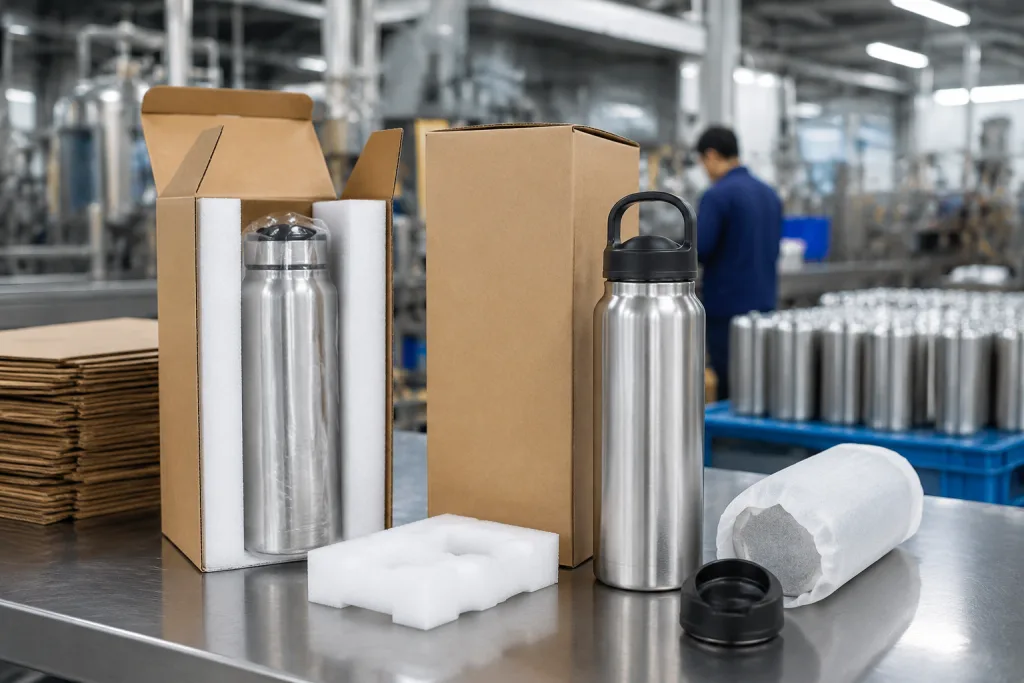
Bulk pack is the lowest-cost choice for corporate giveaways where the distributor repacks locally. We run it with polybags or corrugated dividers when powder coating is easy to rub; QC once pulled a black 500 ml sample with silver scuff marks after a 1.2 m carton drop test. A white box gives better protection and works well for promotional brands. A color box fits outdoor retail, but the artwork needs barcode placement, country-of-origin text, recycling marks, and multilingual claims if the buyer’s market asks for them. If you sell online, add FNSKU labeling or outer carton labels based on your fulfillment route.
As a rough FOB China packaging guide, a plain white box may add USD 0.12-0.25 per unit, while a printed retail box may add USD 0.25-0.60 depending on paperboard grade and print quantity. The buyer flagged this last month: 300 gsm paper looked fine on screen, then bowed at the window cut after packing. Molded pulp inserts cost more than simple corrugated dividers, but they hold the bottle tighter and look better for sustainable drinkware positioning. The math doesn’t work if the insert saves USD 0.03 but creates loose movement inside the carton.
Ask your thermos vendor for carton dimensions and gross weight before you approve the order. We check this on a platform scale beside the packing line, not after the container is booked. A 24-piece carton for 500 ml bottles may look efficient, but if gross weight exceeds 14-16 kg, manual handling damage rises. For distributor thermos programs shipping across several warehouses, I prefer slightly smaller cartons with cleaner stacking. Freight cost matters, but damaged retail boxes are also freight cost, just disguised as returns.
How do you manage compliance?
Talk compliance before artwork approval. Not after production. A manufacturer thermos quote without testing assumptions is not a complete quote; we usually mark the test scope in the RFQ sheet beside capacity, finish, and lid type. For the EU, you may need LFGB food-contact testing, REACH screening for powder coating, silicone, and plastic parts, plus packaging waste documentation depending on the importer. For the US, FDA food-contact expectations, California Proposition 65 review, and retailer chemical limits can apply. Canada and the UK often ask close questions, but the forms and pass/fail wording are not always the same.
Do not assume one report covers all models. A report for a 350 ml tumbler does not automatically cover your 750 ml outdoor bottle with a flip lid and matte paint; QC pulled one sample last month where the lid PP grade changed after the buyer approved the body. If the inner wall, lid plastic, silicone gasket, or coating changes, the compliance basis may change. For a customized thermos line, group testing can cut cost, but the grouping needs logic: same material from the same supplier, processed on the same line.
Documentation you should request from thermos manufacturers includes a material declaration, food-contact test reports, coating information, BSCI or social audit status if your retailer requires it, and ISO 9001 documentation if available. Ask for file names and report numbers, not just “we have it” in an email; we have seen a PO typed as “LFGB for all colors” when only the black powder coat had been checked. BSCI is not a product safety certificate; it speaks to social compliance. ISO 9001 is not proof that your bottle will not leak; it supports process management. Keep these categories separate.
Our factory in Zhejiang, China typically prepares compliance files during sampling so you can show your buyer before final PO. We run this together with sample inspection: capacity check, lid fit, 24-hour leak test, and coating thickness reading in microns. For new outdoor retailers, this avoids a common problem: the commercial team approves design, then the compliance team blocks shipment 14 days before ETD. The math doesn't work at that point. Changing the lid material after cartons are printed is a bad way to save USD 0.08 per piece.
What should your RFQ include?
A clear RFQ saves hours; tough negotiation only helps after the specs are fixed. If you send “quote 500 ml bottle with logo,” each supplier’s thermos reply will be built on different guesses. We saw this last Tuesday: the PO said “500ml black bottle,” no lid code, and QC pulled the sample with the wrong push-button cap. Cheap won the spreadsheet because one quote quietly removed the parts you forgot to name.
For a quote a thermos factory can stand behind, give the capacity, fixed bottle dimensions, target weight, SUS304 inner and outer material, lid type, coating finish, logo method, packaging, compliance market, annual forecast, first order quantity, delivery deadline, and Incoterm. If you want FOB Ningbo, write FOB Ningbo. If you need DDP to a US warehouse, say it early; the math changes when duty code, importer responsibility, and trucking to ZIP code 91761 are included. Our line books powder-coating racks by color, so a missing Pantone can push sampling from 7 days to 12 days.
Here is the RFQ checklist we ask buyers to paste into the first email; our merchandiser copies these fields straight into the sample sheet before tooling or laser artwork starts:
- Product: 500 ml double-wall vacuum bottle, SUS304 inner and outer.
- Finish: matte black powder coating, Pantone reference if custom, with coating thickness target if your brand has one.
- Logo: laser engraving, 45 mm wide, one side, with AI or PDF artwork and position from bottle bottom in mm.
- Packaging: individual white box, 24 pieces per master carton, with carton marks if Amazon or retail warehouse needs them.
- Testing: LFGB, REACH, leak test, vacuum retention, AQL inspection, plus the test temperature and holding time you expect.
- Quantity: 2,000 units first order, 20,000 units annual forecast, with split colors shown line by line.
- Trade term: FOB Ningbo, shipment by sea, target ETD within 45 days, with forwarder contact if already assigned.
This format lets a thermos supplier quote without playing games. It also helps you compare factory thermos options without rewarding vague answers. If a supplier cannot confirm wall thickness, coating process, sample timing, or inspection plan, do not ask why the price is low; that is the wrong question. Ask what was removed. We have seen this go sideways when a quote used 0.38 mm outer steel instead of 0.50 mm, and the buyer only found it after AQL 2.5 inspection rejected dented bodies.
Send your stainless thermos RFQ for factory review
Share quantity, artwork, market, and delivery date. We will reply with MOQ, FOB China pricing, sample timing, and practical QC notes.
Frequently asked questions
Can I order 500 custom thermos bottles for a market test?
Yes, but only if you accept limits. For stock colors with laser engraving, 500 units is often possible. For custom powder coating, special lid colors, or retail color boxes, 1,000 units per color is more realistic because coating line setup, Pantone matching, and packaging printing have minimum batch costs. If you need only 300-500 pieces for an outdoor retailer presentation, use stock bodies and simple laser logos. Do not open private molds or custom coating at that stage unless your confirmed rollout is at least 3,000-5,000 units.
How long does a customized thermos sample take?
A stock-shape sample with laser logo usually takes 5-7 working days after artwork approval. A powder-coated sample in a custom Pantone color normally takes 10-15 working days because the coating must be mixed, sprayed, cured, and checked. A new lid or body mold can take 25-45 days depending on complexity. For production, plan 30-45 days after deposit and signed pre-production sample. If your launch depends on a fixed retail delivery window, add 10 days for inspection, booking, and export paperwork from China.
Is 316 stainless steel better than 304 for insulated bottles?
316 stainless steel has stronger corrosion resistance, especially against chlorides, but most insulated water bottles use 304 because it is food-safe, durable, and cost-effective. For normal water, tea, coffee, and outdoor use, 304 is usually the right specification. Switching to 316 can add roughly USD 0.30-0.80 per unit depending on bottle size and steel market conditions. If your product is positioned for marine use, saltwater environments, or high-acid beverages, ask for 316 pricing. For most promotional thermos and outdoor retail programs, invest the extra budget in lid quality and coating adhesion first.
Can you ship directly to distributor warehouses or FBA-style locations?
Yes, but packaging and labeling must be planned from the start. For distributor warehouses, we can apply carton marks, PO numbers, SKU labels, and pallet labels. For e-commerce or FBA-style routing, you may need FNSKU labels, suffocation warnings on polybags, carton weight limits, and scannable barcodes. A common setup is individual white box, barcode on box, 12 or 24 units per carton, and master carton under 15 kg gross weight. Share the warehouse routing guide before production, not after cartons are sealed.
What defects should I treat as critical in inspection?
Critical defects should include leakage, sharp metal burrs, wrong stainless steel grade, unsafe odor, broken lids, missing gaskets, and serious contamination inside the bottle. These should be accepted at 0 defects in inspection. Major defects usually include obvious dents, poor coating adhesion, wrong logo position over 2-3 mm tolerance, color mismatch, or heat retention failure. Minor defects include small cosmetic marks within an agreed size limit. For a 3,000-unit order, use AQL General Level II with 2.5 major and 4.0 minor, plus specific functional tests on sampled bottles.