Key Takeaways
- Specify inner 304 stainless steel, 0.40-0.50 mm body wall, and 12-24 hour thermal test targets before sampling
- For powder coating, approve color on metal panels, not only Pantone paper chips
- Use AQL 2.5 for major defects and AQL 4.0 for minor defects on bulk thermos inspections
- Plan 30-45 days production after artwork approval for most customized thermos orders
A 304 stainless steel insulated water bottle custom project usually fails in small, boring places: a lid gasket that shrinks 0.4 mm after hot-water testing, a powder coat that chips at the rim, a carton that cannot survive a 1.2 m drop, or a logo that looks fine on the sample but prints weak on 5,000 units. QC pulled a black matte sample last month because the laser logo looked sharp at 1 meter but washed out under warehouse lights.
If you buy for outdoor retail or promotional brands, the pretty catalog answer is the wrong question to ask. You need to know where a custom thermos order breaks down before you pay the 30% deposit. From our Hangzhou, Zhejiang production base in China, BottleForge runs stainless thermos lines at about 420,000 units/month, with typical MOQ from 1,000 units per color for standard models. We run calipers on mouth diameter, check vacuum loss after 24 hours, and still see buyers flag PO typos like “304 stainess” that can slow artwork approval by 2 days.
Vacuum failure is the expensive defect
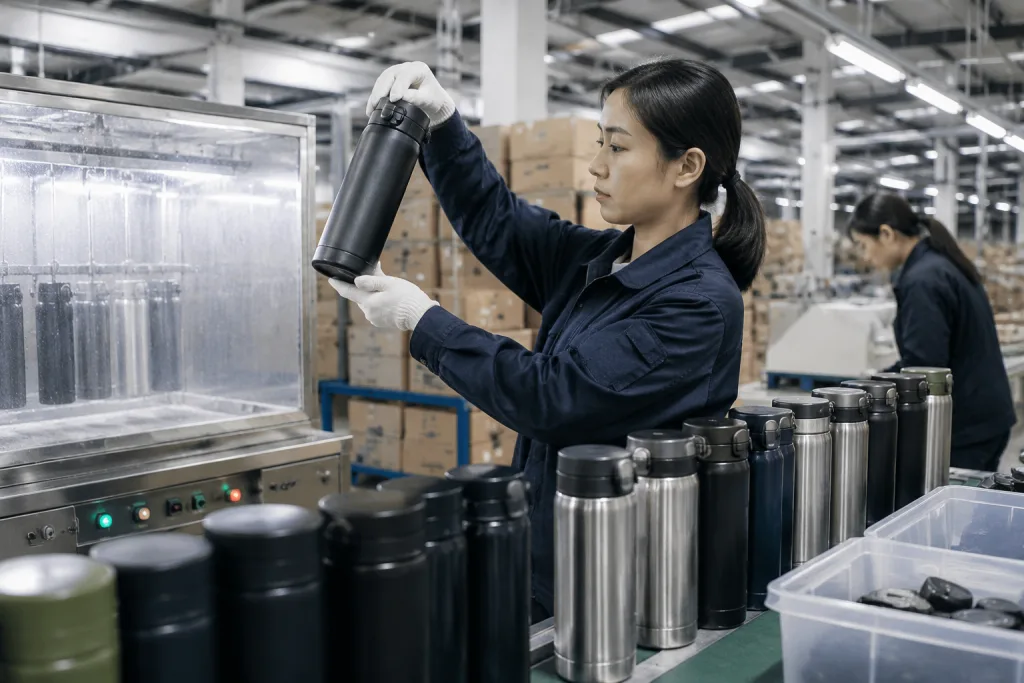
The main promise of a 304 stainless steel insulated water bottle custom order is insulation. If that fails, the rest is packaging. A bottle can look clean, pass logo inspection, and still drop temperature like a single-wall cup when the vacuum layer gets hurt during welding, polishing, or packing. We have seen QC pull a sample from carton 7, probe it after 12 hours, and find the water down at 42°C.
For a 500 ml to 750 ml custom thermos, write the thermal test into the PO. We run hot water at 95°C, room temperature at 20-25°C, with water still above 55-60°C after 12 hours for standard models. Premium structures should hold above 68°C at 12 hours. Do not accept “keeps hot all day.” That line causes arguments later. Ask the thermos manufacturer to test each production batch, not just the pre-production sample, and keep a simple log with bottle code, test time, and probe reading.
The usual trouble comes from shells rolled too thin, copper plating that is patchy near the shoulder, weak bottom sealing after vacuuming, or impact marks from the packing table. We check the base weld under a 10x lamp because tiny pinholes do not show in product photos. For outdoor retailers, this defect is painful because returns show up 18 to 30 days later, after the user takes the bottle on a hike or leaves it in a cold car. The math doesn't work if you save USD 0.18 on structure and pay for replacement stock.
- Spec inner material: food-contact 304 stainless steel, often marked as 18/8, and ask QC to verify the material report against the production batch card.
- Define wall thickness: 0.40-0.50 mm is common for retail thermos bottles; thinner saves cost but dents easier, especially around the lower body during carton drop testing.
- Require batch testing: record at least 5-10 units per 1,000 units for thermal retention, with readings taken by probe thermometer rather than guessed by hand touch.
A serious thermos factory in China should be able to show its vacuum test equipment, leak-check station, and temperature log sheet. Finished goods photos are not enough.
Rust complaints usually start with vague steel
“Stainless” is not a material specification. It is a family. For a customized thermos used in outdoor, gym, or promotional channels, write 304 stainless steel for the inner liner and all food-contact areas on the PO. We run PMI spot checks with an XRF gun on incoming coil; 201 and 304 do not read the same. Some buyers accept 201 stainless steel on the outer shell to save cost, but the drinking side is the wrong place to bargain.
Rust complaints usually start in 3 places: wrong material, iron dust from polishing or cutting, and misuse like salty soup or chlorine cleaner left inside overnight. QC pulled one sample last year with orange pinpoints near the mouth thread after it sat beside carbon-steel grinding dust for 2 days. You cannot control every end user. You can remove the avoidable risk on the line.
Ask your supplier thermos partner for incoming material records and food-contact compliance for your market. For Europe, buyers usually request LFGB, REACH, and EU food contact declarations; for North America, 7 out of 10 promotional accounts we ship ask for FDA food-contact conformity, and children’s items bring in relevant CPSIA or ASTM checks. These documents do not replace production QC, but they make the thermos supplier prove where the steel came from before mass production starts.
Do not accept “304 style” or “SUS-like” wording. Put “inner liner: SUS304 / 18/8 stainless steel” in the quotation, sample approval sheet, and purchase order. If the PO says “stainless steel” only, the math does not work when a claim arrives.
For a distributor thermos program, add a basic salt spray check for coated outer surfaces if the bottle will be sold through marine, ski, or camping channels. We normally ask the lab for a 24-hour or 48-hour check, then QC tapes the sprayed sample beside the golden sample. It costs less to test early than to explain orange dots on retail shelves in month three.
Lids leak when drawings are too polite
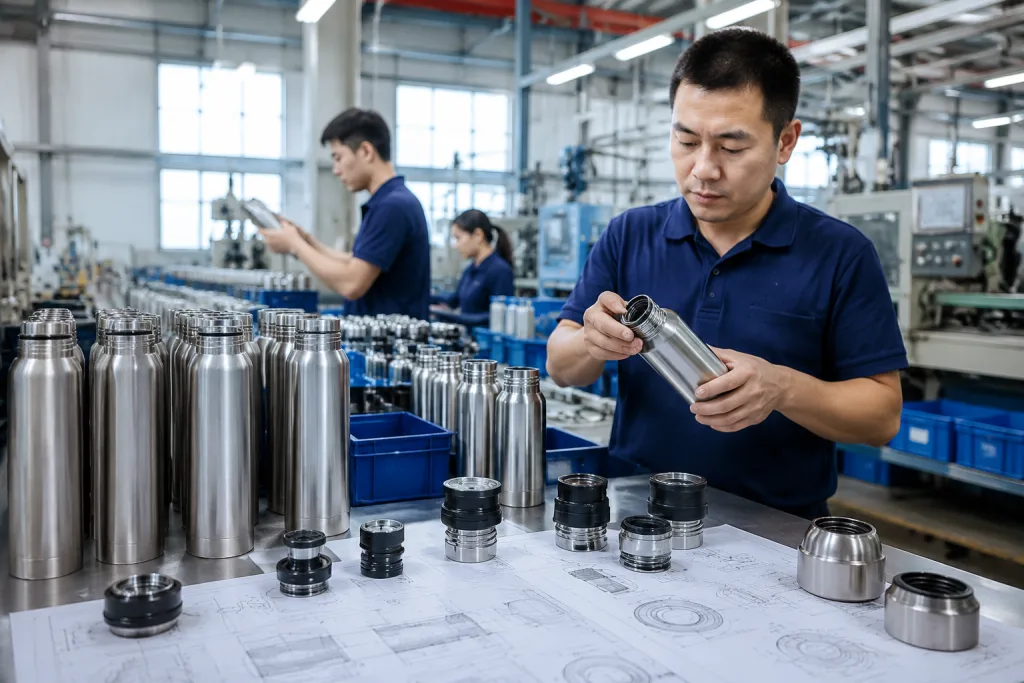
About 7 in 10 thermos custom disputes we see are not about the 304 stainless steel body. They start at the lid. Threads, silicone gaskets, hinge pins, and drinking spouts all carry tolerance risk; on our line, QC once pulled 200 pcs because the hinge pin sat 0.3 mm proud and stopped the cap from closing flat. “Leakproof lid” on a drawing is too polite. It does not protect you.
For promotional thermos projects, buyers often pick the cheaper lid because the campaign budget is already squeezed. Fair enough. But test that exact lid design on the exact bottle body before you approve PP samples. A lid borrowed from another model may look fine during sampling, then leak after mass production shifts by 0.2 mm. We run thread gauges, gasket hardness checks, and cap torque checks for this reason; the math does not work if the cap needs 18 kgf·cm to seal but the user only tightens it to 10 kgf·cm.
Write the leak test like a factory instruction, not a wish. We normally suggest filling the bottle with water, tightening the lid to standard torque, laying it horizontally for 30 minutes, then inverting it for another 30 minutes. For flip lids or straw lids, add a 10-20 second shake test. If the bottle is sold as a bag-safe travel bottle, put it inside a polybag or wrap it with paper towel, because a 1 ml leak is easy to miss on a stainless bench but obvious on white paper.
- Gasket material: food-grade silicone, commonly 50-60 Shore A hardness; ask the supplier to record the durometer reading, not just write “silicone” on the spec sheet.
- Spare parts: request 1-2% spare gaskets or lids for distributor after-sales support; we ship them in a marked inner bag so the warehouse does not treat them as loose defects.
- Assembly check: confirm workers install every gasket before packing, with an in-line visual check under the packing lamp, not during random rework after QC flags wet cartons.
A customizable thermos with three lid options looks good in a sales deck, but it triples the lid drawings, carton marks, and AQL 2.5 inspection points. Keep the lid menu narrow if your launch date is fixed. We have seen this go sideways when a PO had “straw lid” typed on one page and “flip lid” on the artwork approval.
Coating failures show up after shipping
Powder coating and spray painting look clean in the sample room; electroplating and matte finishes get judged in the container. We’ve seen failures show up as 1–2 mm chips on the top rim, sleeve scratches from loose dividers, batch color drift after the second spray run, or poor adhesion where the degreasing tank missed oil near the shoulder.
For a 304 stainless steel insulated water bottle custom order, approve color on the same metal surface and finish, not on a Pantone paper card alone. Powder coat absorbs light differently from ink. A black PP lid can make a dark body read warmer under 6500K light, and the buyer will flag it. If your retail buyer is strict, approve one physical golden sample, then keep one sealed at the factory thermos line and one in your office.
Adhesion needs checking before mass production. Not after 18,000 pcs are packed. A simple cross-hatch tape test is common, but for outdoor retail we run a 3M tape pull, 95% alcohol rub test, and abrasion check around the logo print. If the bottle uses a carabiner, handle, or silicone boot, QC should pull the sample and rub every contact point for 30 cycles because transit rubbing is where we’ve seen this go sideways.
Carton packing is part of finish quality. For thermos bulk shipments, a white box with 0.5 mm paper dividers can pass for giveaways, but retail units need real separation. We usually spec individual polybag or tissue wrap, then an egg-crate divider or molded tray for premium finishes. For heavier stainless bottles, use export carton burst strength around 200 lb/in²; thin K=K cartons look cheaper on the PO, but the math doesn’t work after a 9 kg carton hits a wet warehouse floor.
FOB Ningbo or FOB Shanghai from Zhejiang, China is normal. The ocean does not care about your deadline or your coating. Pack accordingly, and give the line 2 extra days for a coating hold test if the finish is new.
Logo methods fail in different ways
A custom logo is the point where a manufacturer thermos project turns into your brand’s SKU. It is also where loose assumptions create ugly bulk results. We see this on the line every month: a logo approved on a flat PDF looks crooked once wrapped around a 73 mm curved bottle body. Laser engraving, silk screen printing, heat transfer, UV printing, and embossing each fail in its own way, so the wrong question is “which logo method is best?” Ask which method matches your coating, artwork, order quantity, and retail channel.
Laser engraving is durable and clean, especially on powder-coated bottles where the laser burns off the coating and shows the stainless steel underneath. No color magic here. You normally get the exposed metal tone, not a full-color mark. Silk screen printing works well for one or two colors, but curved bottles need the right jig and artwork compensation; our print master checks this with a 0.3 mm line gauge before mass production. Fine lines under 0.3 mm can break, fill in, or disappear after curing. UV printing supports full-color graphics, but adhesion must be tested on the exact coating, not on “similar black powder coat” from last season.
For a promotional thermos, 6 out of 10 buyers send a small vector file and expect it to fit every bottle size. It does not. A 70 mm wide logo on a 500 ml bottle can look balanced, while the same mark on a 1,000 ml bottle looks small and cheap. We’ve seen this go sideways when the PO said “same logo as sample” but the bulk order changed from 500 ml to 750 ml. Ask for a placement drawing with dimensions from the bottom and centerline.
- Minimum line width: keep screen print lines at 0.3 mm or thicker, and check small text after the first curing pass.
- Logo tolerance: allow ±1.5-2.0 mm placement variation on curved bodies, even with a fixed bottle jig.
- Barcode and FNSKU: test scan after printing if selling through fulfillment channels; QC should scan 20 pcs from the pre-production run.
Good thermos manufacturers will push back on bad artwork. That is not being difficult. It is how we avoid 8,000 units with a beautiful but unreadable logo, especially when QC pulled the sample and the buyer flagged the FNSKU as “looks fine” before anyone scanned it.
Cartons, audits, and lead times matter
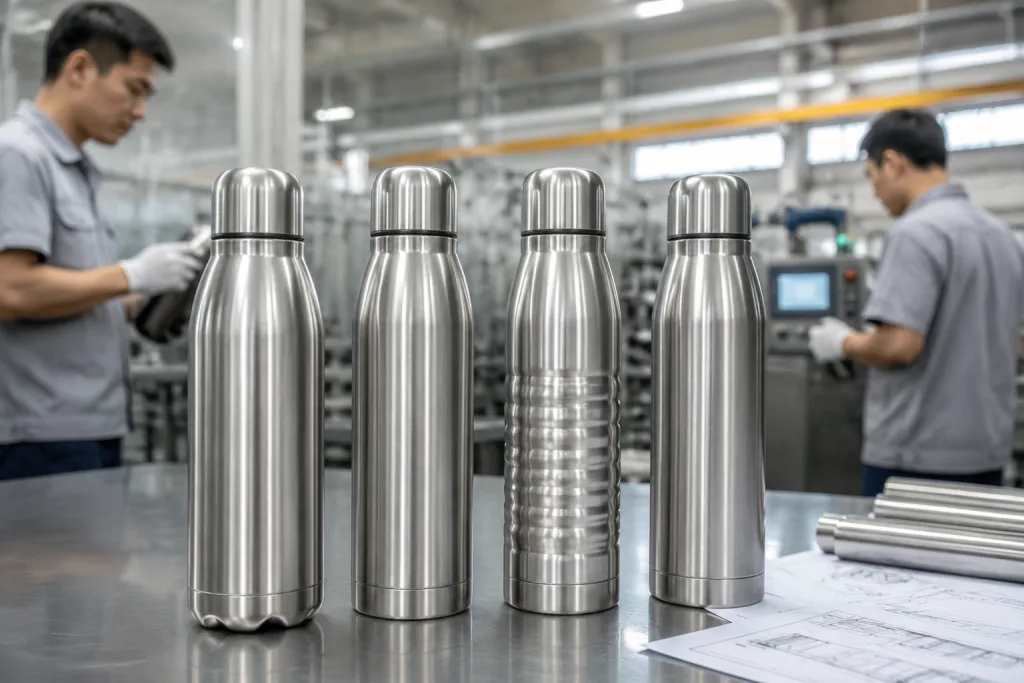
About 7 out of 10 new thermos distributors treat packing and compliance as paperwork after the product is approved. Bad call. A distributor thermos program can pass sample review and still fail when the 5-ply carton crushes on a corner, the master carton comes in at 23 kg, or the factory cannot send the audit PDF your retailer asks for by 5 p.m. QC pulled one sample last year with perfect vacuum performance, then flagged a split inner carton after a 76 cm drop test.
Start with the sales channel. Outdoor retailers often ask for BSCI, ISO 9001, product test reports, carton drop tests, and country-of-origin marking printed at 3 mm minimum height. Promotional brands care more about logo position, event date, and carton labeling by campaign code. If the shipment goes to Amazon or another fulfillment warehouse, lock FNSKU labels, carton labels, suffocation warnings, and case pack quantity before the packing line starts; we have seen a PO typo turn “24 pcs/carton” into “12 pcs/carton,” and the buyer flagged it at inbound.
For most stainless thermos custom orders at BottleForge in Zhejiang, MOQ starts from 1,000 units per color for stock molds and 3,000-5,000 units for deeper customization such as new lids, special coating, or exclusive shapes. Normal lead time is 30-45 days after deposit, artwork approval, and golden sample confirmation. New tooling can add 20-35 days. The clock starts after files are clean, not after a WeChat message saying “logo almost final”; on the line, a missing Pantone code can cost 2 days while the spray shop waits.
Use third-party inspection when the order is large or the channel gives no room for mistakes. AQL 2.5 for major defects and AQL 4.0 for minor defects is common for drinkware. Define critical defects separately: leaks, sharp edges, wrong material, unreadable compliance marks, and severe coating peel should not be treated like a small scratch. The math doesn’t work if a $0.08 inspection catch prevents 600 leaking lids from reaching a retail warehouse; we run water-leak checks with inverted bottles for 30 minutes before random cartons are sealed.
A thermos vendor that gives you the lowest FOB price but avoids written specs is not cheaper. It is pushing the cost to your returns department. We’ve seen this go sideways: no carton burst strength on the PI, no lid torque range in the QC sheet, then 18 cartons rejected at destination for crushed corners.
Send your thermos spec before sampling starts
Share capacity, lid type, logo method, packaging, target price, and delivery date. We will flag the risky parts before quoting.
Frequently asked questions
What is the normal MOQ for a 304 stainless steel insulated water bottle custom order?
For standard BottleForge models, MOQ is usually 1,000 units per color with one logo method. If you need a special powder coat, custom lid color, retail box, or multiple logo positions, the practical MOQ often moves to 2,000-3,000 units. A fully customized thermos with new tooling, exclusive shape, or special cap structure usually starts around 3,000-5,000 units because tooling setup, testing, and line changeover become real costs. For promotional thermos campaigns, mixing colors below MOQ can be possible, but expect a higher unit price and longer setup time. Ask for the MOQ by model, color, lid, and packaging, not just a single number.
How much should a custom stainless thermos cost FOB China?
For a 500 ml to 750 ml 304 stainless steel vacuum bottle, a realistic FOB China range is often USD 3.20-6.80 depending on wall thickness, lid complexity, coating, logo method, and packaging. A basic single-color screen print and white box sits near the lower end. Powder coating, laser engraving, retail gift box, handle lid, or ceramic inner coating can push the price up by USD 0.40-1.50 per unit. Very cheap quotes usually remove something: thinner steel, weaker carton, lower-grade lid, or no real testing. Compare quotations using the same specification sheet, not only the same photo.
Is 304 stainless steel enough for outdoor retail bottles?
Yes, 304 stainless steel is the standard choice for most insulated water bottles used in outdoor retail and promotional markets. It has good corrosion resistance for water, tea, coffee, and normal daily use. For aggressive salt exposure or special chemical environments, 316 stainless steel may be considered, but it increases cost and is not necessary for most drinkware. The bigger issue is whether the inner liner is actually 304, whether polishing contamination is controlled, and whether the lid materials are food-grade. Ask for material declarations and batch QC records. Also write “inner liner SUS304 / 18/8 stainless steel” into the purchase order.
Which logo method is best for a customizable thermos?
For outdoor retail, laser engraving on powder coat is usually the most durable and professional-looking option. It resists washing, abrasion, and sunlight better than many printed marks. For promotional campaigns needing full-color artwork, UV printing or heat transfer can work, but you should run adhesion and rub tests before bulk production. Silk screen printing is cost-effective for simple one-color or two-color logos, especially on larger quantities above 1,000 units. The best method depends on the finish, logo size, color count, and expected use. Always approve a physical logo sample on the actual bottle finish before authorizing mass production.
How do I inspect a thermos bulk order before shipment?
Use a written inspection checklist and an AQL sampling plan. For drinkware, many buyers use AQL 2.5 for major defects and AQL 4.0 for minor defects, with critical defects set at zero tolerance. Check leak performance, vacuum insulation, lid assembly, coating adhesion, logo position, barcode scanning, carton strength, and quantity per carton. Pull samples from finished cartons, not from a prepared table. For a 5,000-unit order, inspection usually takes one full day depending on test depth. If the order is going to outdoor retail or a strict distributor warehouse, a third-party pre-shipment inspection is a sensible cost.