Key Takeaways
- For most 304 stainless steel insulated water bottle bulk projects, 500-1,000 pcs per color is the practical MOQ
- 0.4-0.5 mm inner 304 stainless steel is standard for retail-grade vacuum bottles
- Powder coating adds about USD 0.35-0.75 per unit versus plain stainless finish
- AQL 2.5/4.0 inspection and 100% leak testing should be written into the PO
If you buy a 304 stainless steel insulated water bottle bulk order for an outdoor retail line or a promotional campaign, the product photo is the easy part. The hard part is locking the body shape, steel thickness, lid structure, coating, logo method, and carton setup before one factory thermos sample becomes 5,000 units sitting on a pallet with no cheap fix. We run calipers on the mouth diameter and wall thickness at sample stage for a reason; a 0.3 mm mismatch on the lid thread can turn into leaking complaints fast.
From our Hangzhou, Zhejiang office, we see two buyer patterns: brands that over-specify until the margin dies, and buyers that under-specify, then get returns for leakage, weak heat retention, or chipped coating. China can make solid customized thermos products, but “premium” is the wrong word to put on a PO. Give the factory a comparison sheet with target capacity, coating, logo position, carton drop requirement, and AQL 2.5 inspection level; last month QC pulled the sample because the buyer asked for matte black but the approved sample was closer to charcoal gray under the light box.
The head-to-head spec view
A custom thermos is a set of trade-offs, not one fixed product. For outdoor retail, we test against backpack side pockets, 73-78 mm car cup holders, and cold-weather handling with gloves on. For promo jobs, the same supplier thermos usually gets squeezed on unit price, logo size, and the event ship date. Different jobs. We’ve seen this go sideways when a buyer approves a nice 1000 ml sample, then the sales team complains it will not fit their office gift cartons.
This is the spec comparison we run with new buyers when they ask for a 304 stainless steel insulated water bottle bulk quotation. QC pulled the sample on one recent matte black order because the Pantone looked right under office light, then shifted under the line’s D65 light box.
| Spec choice | Outdoor retail fit | Promotional fit | What to watch |
|---|---|---|---|
| 500 ml / 17 oz | Fits day packs and kids' outdoor sets; usually around 70 mm body diameter | Works for office gifts where carton weight matters | Lower perceived value than 750 ml; buyers often push back on shelf price |
| 750 ml / 25 oz | Best all-round retail SKU; we run this size most often on the line | Freight cost climbs because fewer pieces fit per master carton | Needs cup holder check by market; the buyer flagged this twice on US orders |
| 1000 ml / 34 oz | Strong for hiking and camping; better for hydration claims | Too large for giveaways when the event bag is small | Higher dent risk if wall is thin; check the base after drop test |
| Powder coating | Best grip and wider color choice; good for wet hands | Best for brand matching when Pantone control is written on the PO | Needs cross-hatch adhesion test; 3M tape will show weak curing fast |
| Laser engraving | Premium and permanent; no ink rub-off after packing abrasion | Higher setup time, so the math does not work well for tiny rush orders | Looks subtle on light colors; ask for a photo from 30 cm distance |
| Silkscreen logo | Works for large graphics when the artwork has clean edges | Cost-effective for campaigns; good at 500 pcs per color | Pantone shift on matte coating; check the first 20 pcs before full print |
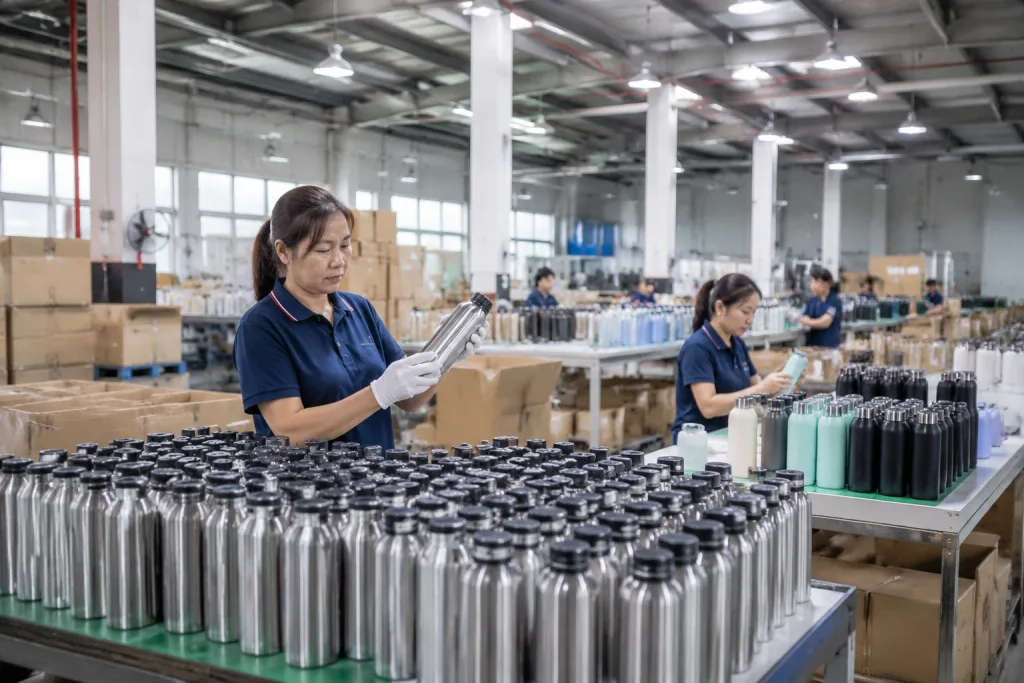
At BottleForge Industrial in Zhejiang, our typical output for stainless vacuum bottles is 300,000 units/month across shared lines, with standard custom thermos MOQ starting at 500 pcs per color and 1,000 pcs per shape for new color coating. Normal lead time is 25-35 days after deposit and artwork approval, not including sea freight from China. On the factory floor, the bottleneck is often not welding; it is coating changeover, color card approval, and a PO typo like “Mat Black” instead of “Matt Black” that stops the artwork file for half a day.
304 steel versus cheaper alternatives
On a manufacturer thermos quotation, “stainless steel” is too loose. Write 304 stainless steel for the inner wall on the RFQ and PO, because that surface touches drinking water, tea, electrolyte drinks, and acidic beverages. 304 stainless steel contains roughly 18% chromium and 8% nickel, so it resists corrosion better than 201 stainless steel. We see around 30% of budget promo inquiries ask for “304 bottle” first, then the spec sheet shows 201 outer and 304 inner after QC asks. That can work for some promotional thermos orders, but it must be declared, not hidden in a footnote.
For outdoor retail, we usually quote 304 inner and 304 outer when the bottle is sold as a long-life product. If the project is a lower-cost thermos promotional campaign with a 90-day usage expectation, 304 inner and 201 outer can save about USD 0.20-0.45 per unit depending on size and steel market pricing. The safety risk is not the main issue. The real headache is rust spotting on scratched outer surfaces, especially in coastal markets or after dishwasher misuse; last year a buyer in Chile flagged 17 bottles with orange dots near the bottom radius after a salt-spray check. The math does not work if those units come back as complaints.
Wall thickness matters as much as steel grade. A common retail-grade build is 0.4 mm inner wall and 0.5 mm outer wall, checked here with a digital thickness gauge before vacuum welding. Going down to 0.35 mm cuts cost and weight, but dent resistance drops fast when the line runs deep-draw forming. Going up to 0.6 mm makes the bottle feel solid, but it raises material cost, forming difficulty, and shipping weight. For a 750 ml distributor thermos, that difference can affect carton gross weight by 8-12%.
Do not approve a thermos supplier based only on “304” in an email. Ask for material certificates, production batch traceability, and a pre-shipment report showing wall thickness and magnet checks; QC pulled the sample should mean an actual gauge reading, not a copied photo from last month.
Vacuum performance by real use case
Factories usually quote heat retention from a clean lab test: 95°C water, cap locked, room at about 20°C, then readings at 6, 12, or 24 hours. Fair test. Not real life. On a trail, the cap gets opened, tossed in a backpack, and sometimes cross-threaded by a user wearing gloves. We run the same baseline test with a digital probe through the test rack, because it still gives buyers a clean way to compare thermos manufacturers before arguing about artwork, cartons, or lid upgrades.
For a 304 stainless steel insulated water bottle bulk order, a solid 750 ml bottle should stay above 60°C after 12 hours when the vacuum gap is stable and the silicone gasket sits flat in the lid groove. Better builds can hold above 68°C after 12 hours. Cold is easier. Iced water often stays below 10°C for 18-24 hours, but the result changes fast if someone opens the bottle 8 times at a summer event. QC pulled one 750 ml sample last month because the lid gasket was 0.3 mm too thin; the heat test failed before the body showed any problem.
The real choice is body shape against heat loss. A narrow-mouth bottle loses less heat at the opening and fits winter sports, camping, and commuter coffee programs. A wide-mouth bottle is easier to wash, accepts 30 mm ice cubes, and sells better in outdoor retail displays, but the cap has to work harder. Straw lids are convenient for gym and cycling buyers, yet they bring more small parts and more leak points than a screw cap. We’ve seen this go sideways when a buyer picked a good-looking straw lid and then flagged 2 leaking samples during pre-shipment inspection.
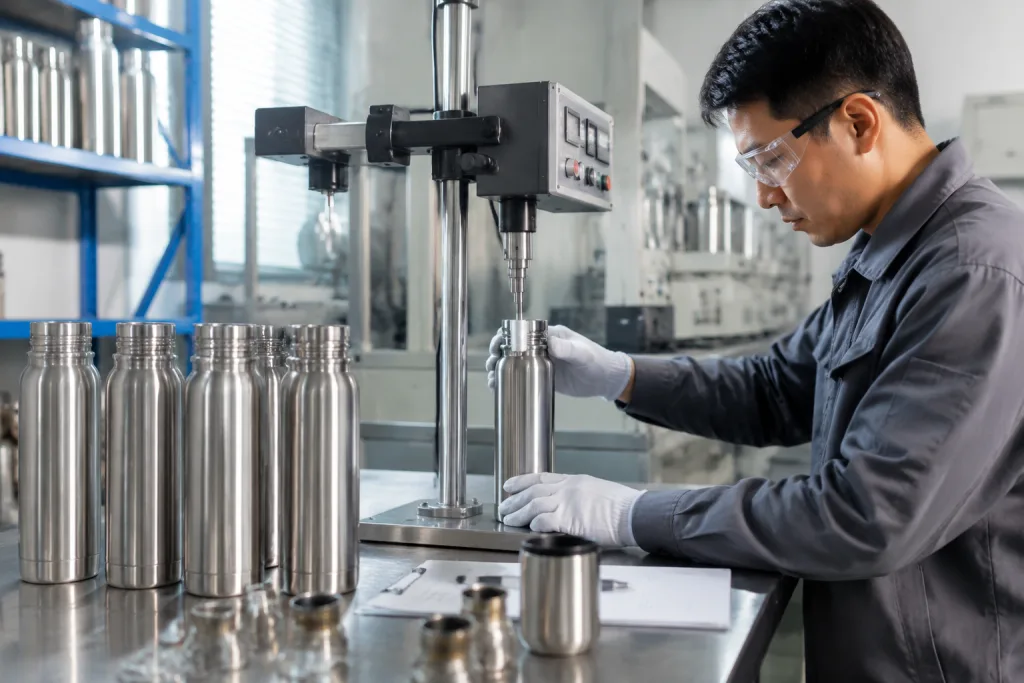
If your brand sells to outdoor shops, chasing the cheapest lid is the wrong question to ask. The math doesn’t work after returns, freight claims, and 1-star reviews. We run 100% air-pressure or water leak checks on production, then sample destructive testing during QC. For buyers using AQL, we suggest AQL 2.5 for major defects and 4.0 for minor defects, with critical defects such as leakage set at zero tolerance. On the line, a cap that saves USD 0.06 can cost a full carton if the inspector finds water inside the polybag.
Logo and finish trade-offs
A customizable thermos lives or dies by finish quality. Buyers usually chase the logo first. Wrong question. The coating under that logo decides whether the bottle still looks sellable after 90 days in a backpack or cup holder. We run four main finishes on the line: powder coating for outdoor retail, spray painting for price-driven promo orders, plain brushed 304 stainless for corporate gifts, and rubberized soft-touch when the buyer wants a warmer hand feel. Powder coating is our safest default for outdoor retail because it gives grip, stable color, and better abrasion resistance. Spray painting can cut the unit price, but the math does not work if the buyer rejects cartons later for scratches; last month QC pulled 32 samples from a blue spray-painted lot and found edge marks around the bottom ring.
Typical powder coating thickness is 60-90 microns. Too thin and the bottle chips. Too thick and the lid threads or bottom boot fit starts to drift by 0.2-0.4 mm, which is enough to make assembly ugly. We use cross-hatch adhesion testing, 3M tape pull testing, and sample drop checks from about 1 meter onto a controlled surface. No magic here. A bottle can still dent if it hits rock or concrete on the corner, but weak coating fails before the dent even shows; we have seen black matte coating flake near the laser logo after only 6 tape pulls.
Logo methods have different costs. Laser engraving is durable and clean, usually adding USD 0.20-0.50 per unit depending on logo size and machine time; a 35 mm wide logo takes less time than a full-wrap mark. Silkscreen printing works well for large one-color logos and can be cheaper for 1,000+ units, especially when we keep the jig set for the same bottle body. Heat transfer or 3D UV printing is the better route for full-color artwork, but approve physical samples first because colors shift on curved matte surfaces. The buyer flagged this once on a Pantone 186C mark that looked too dark after curing.
For a thermos custom project, send vector artwork, Pantone codes, logo size in millimeters, and placement measured from the bottle base or shoulder. “Put logo in the middle” is not a production instruction. We need 55 mm from the base, 30 mm wide, front side opposite the seam, or something equally clear. A good thermos vendor should return a dieline or 2D mockup before sampling; if the PO says “logo same as picture” and the picture is a low-res JPG, we’ve seen this go sideways.
MOQ, pricing, and shipping math
Bulk thermos pricing comes down to 304 stainless steel spec, capacity, lid parts, coating, logo method, packaging, and inspection level. For FOB China budgeting, a 500 ml 304 inner vacuum bottle usually sits around USD 3.20-5.20 per unit for common custom builds. A 750 ml retail-grade bottle is closer to USD 4.20-7.50. A 1000 ml heavy outdoor bottle with powder coating, carry handle lid, and individual kraft box can reach USD 6.50-10.50. Not a promise. We run the first costing from the BOM, then QC checks wall thickness with a digital caliper because 0.1 mm more steel changes the math fast.
MOQ is where buyers get caught. Existing mold, standard lid, and stock coating color: 500 pcs per color can work. New Pantone powder coating: expect 1,000 pcs per color because the coating line loses material during gun cleaning and color change. New mold, custom lid, or special bottom shape: tooling can run from USD 800 to USD 5,000+, with 45-60 days added for development. We have seen this go sideways when a buyer approves a 2D lid drawing but forgets the silicone gasket hardness; the sample leaks at 45 degrees, and the clock resets.
Shipping changes the real comparison. A 750 ml bottle in an individual box usually fits 24 pcs per export carton, around 13-16 kg gross weight depending on wall thickness. For Amazon FBA or distributor thermos programs, carton size, barcode placement, FNSKU labels, and drop-test packaging need to be fixed before mass production. Air freight can eat the margin. Sea freight is slower but normal for thermos bulk orders; 12 days vs 18 days on production lead time matters less if the vessel schedule slips one week at Ningbo. From Zhejiang or nearby Ningbo/Shanghai ports, we ship under FOB, CIF, DDP, or buyer-nominated forwarder terms.
Compare quotations line by line. One supplier’s thermos offer may include individual boxes, desiccant, and spare gaskets; another may quote only bulk pack. A USD 0.18 cheaper bottle can become more expensive after packaging corrections. This is the wrong place to chase the lowest unit price; last month the buyer flagged a PO typo on “white box” versus “color box,” and the repack cost was higher than the original saving.

Compliance buyers should not skip
Outdoor retailers and promo brands both ask for compliance, but the file set changes by market. For Europe, we usually prepare LFGB food contact testing, REACH screening for powder coating and PP/Tritan lid parts, plus packaging waste paperwork if the buyer sells through retail chains. For North America, the request is usually FDA food-contact compliance, California Prop 65 review, and CPSIA when the bottle is sold as a kids item. If the cap has a flip straw or small silicone plug, the buyer’s QA team often asks about ASTM-related performance or small-parts risk; last month QC pulled a kids' cap sample because the straw valve measured 6.8 mm loose after a 5 kg pull test.
A thermos manufacturer can send test reports. Read them line by line. Is the report tied to the same 304 stainless steel, same coating code, same plastic lid, and same silicone gasket? Is it less than 12-24 months old? Does the lab accreditation match what your retailer accepts? We have seen this go sideways when a buyer flagged a “stainless bottle” report that covered a black powder coating, while the actual PO called for Pantone 7527C spray finish and a clear AS lid. Generic paperwork is better than an empty folder, but it will not protect you when the retailer asks for SKU-level documents.
Factory audits are another layer. BSCI, Sedex, ISO 9001, and social compliance audits are common requests, especially when the order is headed to chain stores. Not every good factory holds every audit, and an audited factory can still ship bottles with weak weld polishing or loose cartons. Before paying deposit on 10,000+ units with a new thermos supplier, ask for audit status, recent QC records, and photos from the production line; we run laser-weld checks at the inner tank station with a 0.02 mm feeler gauge when a buyer pushes for leak-risk control.
For quality control, your purchase order should name the inspection standard, defect categories, acceptable tolerances, and packaging requirements. Put it in writing. Leakage is critical; wrong logo position over 2 mm is usually major; tiny dust under coating outside the logo area can be minor if it is under 0.3 mm and not visible at 30 cm. The math does not work if these points are argued after packing, because reopening 120 master cartons for AQL 2.5 recheck costs time and carton strength. We once saw a PO typo list “matte balck” while the artwork said glossy black, and the buyer flagged it only after the first-line sample came off the spray booth.
Which bottle fits your channel
If you sell through outdoor retailers, spec the bottle for repeat use and fewer returns: 304 inner and outer, 0.5 mm outer wall, powder coating, a screw or chug lid we have already run through leak testing, silicone gasket with spare parts plan, plus individual retail box. A 750 ml wide-mouth bottle is the safer first SKU; we see buyers reorder it more often than narrow-mouth styles because ice loading is easy. Add 500 ml for day packs. Add 1000 ml for camping kits or jobsite hydration. QC pulled the sample on one 750 ml order after the cap had 1.2 mm side play, and the retailer flagged it before they even asked about FOB cost.
If you are a promotional brand, the job changes. You need thermos customized with fast logo approval, clean Pantone matching, event-ready packaging, and a ship date that does not move after the PO lands. A 500 ml or 600 ml bottle with 304 inner wall, 201 or 304 outer wall, standard screw lid, and one-color print usually hits the right price without feeling cheap. For client gifts above USD 8 landed target, we run powder coating and laser engraving. For 20,000 pcs mass giveaways, skip the fancy straw lid unless you can allow 7 extra days for lid testing; we have seen that go sideways when the event date is fixed.
If you are a distributor thermos buyer carrying inventory, do not launch with too many colors. Three colors across two capacities is easier to control than eight colors in one size, and the math gets ugly once each color needs its own MOQ. Color split also slows the line because powder rooms need cleaning between shades; one matte black to cream change can cost us 40 minutes. Keep lid compatibility across SKUs when possible. Shared spare gaskets and caps make after-sales easier when a dealer emails a photo instead of the original PO number.
A good suppliers thermos relationship is not built on the first low quote. It is built on stable samples, clear 2D drawings, realistic lead time, and production photos before final inspection. Zhejiang has the supply chain depth for strong stainless bottles, but the buyer still needs to lock the product tightly: steel grade, wall thickness, lid drawing, coating code, carton drop-test requirement, and AQL 2.5 inspection level if that is your standard. One buyer once sent a PO with “304 outer” typed as “204 outer”; catching that before tooling saved more than another week arguing over USD 0.05.
Send your thermos spec sheet for review
We will check capacity, steel grade, lid, coating, logo method, MOQ, and FOB pricing before you commit to mass production.
Frequently asked questions
What MOQ should I expect for a 304 stainless steel insulated water bottle bulk order?
For an existing bottle mold with standard lid and common color, 500 pcs per color is often possible. For a custom Pantone powder coating, plan on 1,000 pcs per color because the coating line has setup and cleaning loss. If you need a new lid, new body shape, or private mold, the MOQ may rise to 3,000-5,000 pcs and tooling can add USD 800-5,000+. For promotional thermos deadlines, keep the first order simple: existing mold, standard cap, one logo position, and 1-3 colors. That keeps sampling to about 7-10 days and mass production around 25-35 days after approval.
Is 304 inner and 201 outer acceptable for a customized thermos?
It can be acceptable for some promotional projects if the bottle is accurately described and the outer surface is well coated. The drinking surface should be 304 stainless steel because it has better corrosion resistance for water, tea, and acidic drinks. A 201 outer wall can reduce cost by roughly USD 0.20-0.45 per unit, depending on capacity and steel prices. For outdoor retail, we normally recommend 304 inner and 304 outer, especially for 750 ml and 1000 ml bottles sold as durable gear. Scratches on a 201 outer body can show rust spots faster in wet or coastal environments.
Which logo method is best for a thermos promotional campaign?
For a one-color logo on 500-2,000 pcs, silkscreen printing is usually the most cost-effective and gives strong visibility. Laser engraving costs more, often around USD 0.20-0.50 per unit, but it is permanent and looks more premium on powder coating or brushed stainless steel. Full-color heat transfer or UV printing works for detailed artwork, but you should approve a physical sample because curved bottle surfaces can distort colors and edges. Send vector artwork, Pantone references, logo size in millimeters, and exact placement. Do not rely only on a digital mockup for final approval.
How do I check if a thermos factory has good vacuum performance?
Ask for the factory’s heat retention test method, not just the final claim. A practical test uses water around 95°C, room temperature around 20°C, a sealed bottle, and measurements at 6, 12, and 24 hours. A good 750 ml vacuum bottle should often stay above 60°C after 12 hours under controlled conditions. Also ask whether the factory performs 100% leak testing and vacuum checks during production. For your own QC, pull random samples during pre-shipment inspection and run a simple 12-hour hot water test. If 2-3 samples fail badly, do not treat it as a paperwork issue.
What packaging should distributors thermos buyers request?
For retail or distributor stock, request an individual kraft or color box, polybag or tissue protection if required, desiccant for sea freight, and 5-ply export cartons. A 750 ml bottle commonly packs 24 pcs per carton, with gross weight around 13-16 kg depending on wall thickness and box design. If you sell online, specify barcode labels, FNSKU placement, master carton markings, and drop-test requirements before production. For promotional bulk handouts, divider packaging may reduce unit cost, but it gives less protection and a weaker unboxing experience. Confirm carton dimensions early because they affect pallet loading and freight cost.