Key Takeaways
- For gym use, 304 stainless with 0.5 mm wall thickness is the safest baseline; thinner than 0.4 mm usually feels cheap and dents faster.
- Most custom orders from China start at 1,000 pcs per SKU, with 25-35 days lead time after sample approval.
- FOB pricing for a non-insulated 304 bottle usually lands around USD 2.10-3.20, while insulated styles often move to USD 3.80-6.50.
- Ask for REACH, LFGB, FDA, ISO 9001, and AQL 2.5/4.0 records before you approve a bulk gym water bottle program.
If you are buying for a gym chain or fitness brand, the bottle has to handle sweat, 1.2 m drop checks, dishwashers, and members who refill it 3 times before dinner. 304 stainless is the safe starting point. A 304 stainless steel gym water bottle supplier should still prove wall thickness, salt-spray results, and lid fit with a caliper reading, not just write “304” on the quotation sheet.
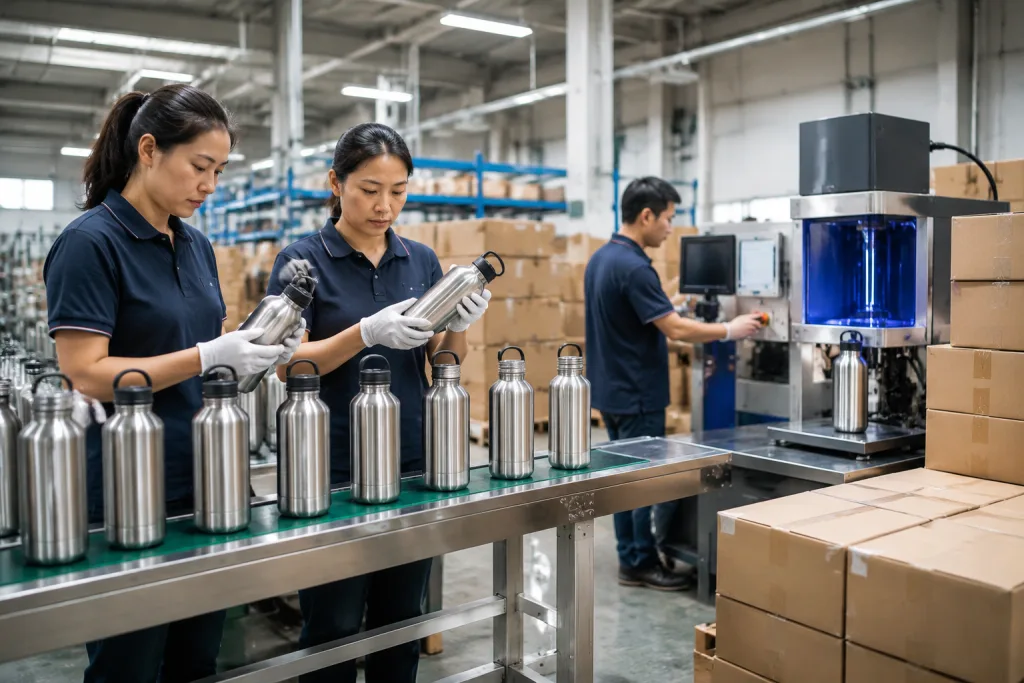
The steel is not where most programs fail. We have seen this go sideways on weak flip lids, 0.38 mm walls sold as 0.45 mm, uneven laser welding, and logos that rubbed off after 12 locker-room washes. At our Hangzhou, Zhejiang factory, we run 300,000 units per month, and QC pulled 47 samples last month for lid torque and mouth-thread burr checks. If you buy on price only, the math does not work. A bulk fitness water bottle, bulk shaker bottle, or custom sports water bottle should be matched to the workout use, packing method, MOQ, and complaint risk, not judged from one clean catalog photo.
304 vs cheaper steel, side by side
When a buyer asks for a 304 stainless steel gym water bottle supplier, they are usually trying to cut 3 kinds of after-sales trouble: rust dots near the mouth, odor after protein drinks, and dents from wet gym bags. Good instinct. The wrong question is “is it stainless?” We ask for the steel grade, wall thickness, and salt-spray result first; QC pulled one cheaper steel sample last year with brown spots after 24 hours in our salt-spray cabinet.
| Option | Best use | Weak point | Typical FOB |
|---|---|---|---|
| 304 single-wall | Gym floors, class studios, giveaways | No thermal retention | USD 2.10-3.20 |
| 304 insulated | Premium retail, corporate programs | Heavier, higher MOQ | USD 3.80-6.50 |
| 304 shaker with insert | Protein and supplement brands | Not a true hot-cold bottle | USD 2.30-4.10 |
| Tritan body with steel cap | Light promotional runs | Less premium feel | USD 1.60-2.80 |
For most bulk sports water bottle programs, 304 single-wall is the line’s workhorse. It is lighter than insulated and cheaper to ship; a 10,000 pcs order usually saves about 420 kg in carton weight compared with a double-wall build, depending on capacity and lid design. For retail, choose insulated only if the shelf claim needs cold water through a workday. For a distributor sports water bottle program, we usually run one workhorse SKU and one premium SKU, not 6 mixed bodies with 4 lids. The math does not work. MOQ gets messy, spare caps pile up, and the buyer flags margin loss before the second PO.
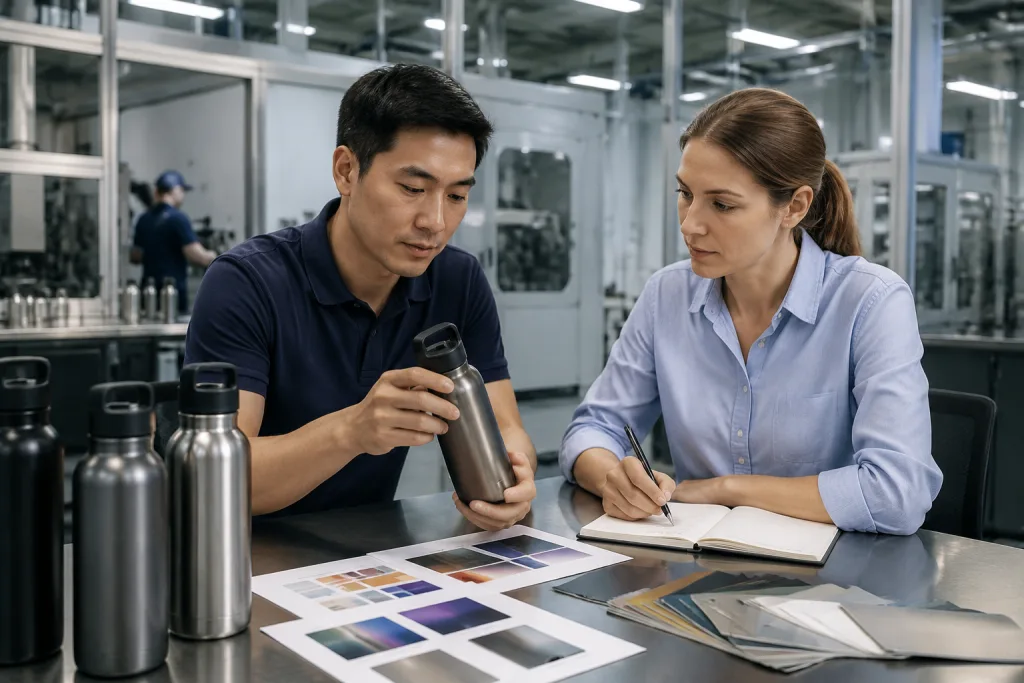
If your order needs a custom gym water bottle with a specific finish, lock the material first, then the cap, then the logo. Too many buyers start with a matte gradient render and a big logo, then find out the cheaper steel scratches under the 3M tape test or the cap thread misses by 0.3 mm. Pretty sample, bad production. We have seen this go sideways.
Which bottle format fits your channel
The right format depends on the channel, not the catalog page. A gym chain, a supplement brand, and a distributor fitness water bottle order all fail in different ways if the bottle is chosen only by photo. We saw one PO last month marked “750 ml gym bottel,” with no cap type, no carton limit, and no use case. That is the wrong question to ask.
Gym floor and class studios: A 500-750 ml single-wall 304 bottle is the cleanest answer for most gym water bottle promotions. It is simple to hand out at reception and stacks neatly at 48 pcs/carton; on our line, that packout stays under 10.5 kg, so warehouse staff do not complain. For a custom sports water bottle for members, we run a 52-58 mm mouth if the buyer wants ice cubes and brush cleaning.
Protein and recovery brands: A bulk shaker bottle needs a flip lid that snaps hard and a gasket that survives repeated opening. The insert or mixing ball must stay seated after shaking; QC pulled the sample on one custom shaker bottle project because the ball rattled loose after a 1.2 m drop test. A custom logo shaker bottle sells on the print, but repeat orders come from the lid.
Retail and gifting: A customizable sports water bottle or customized fitness water bottle deserves a better finish than basic spray paint. For retail shelves, we quote powder coat with a 25-35 μm coating check, or a gradient finish when the buyer accepts the extra setup cost. One EU buyer flagged the polybag packout as “too promo,” so the custom made shaker bottle look moved to a color box with barcode sticker and insert card.
If you sell into more than one channel, do not force one SKU to carry the whole range. We’ve seen this go sideways: the distributor wants a shaker cap and 24 pcs/master carton, while the gym chain wants a plain screw cap that fits locker-room use. A branded retail line can still share the same 304 base body, then change the cap spec, finish code, and packout instruction on the BOM. The math works better, and dead stock stays lower.
Specs that make or break a PO
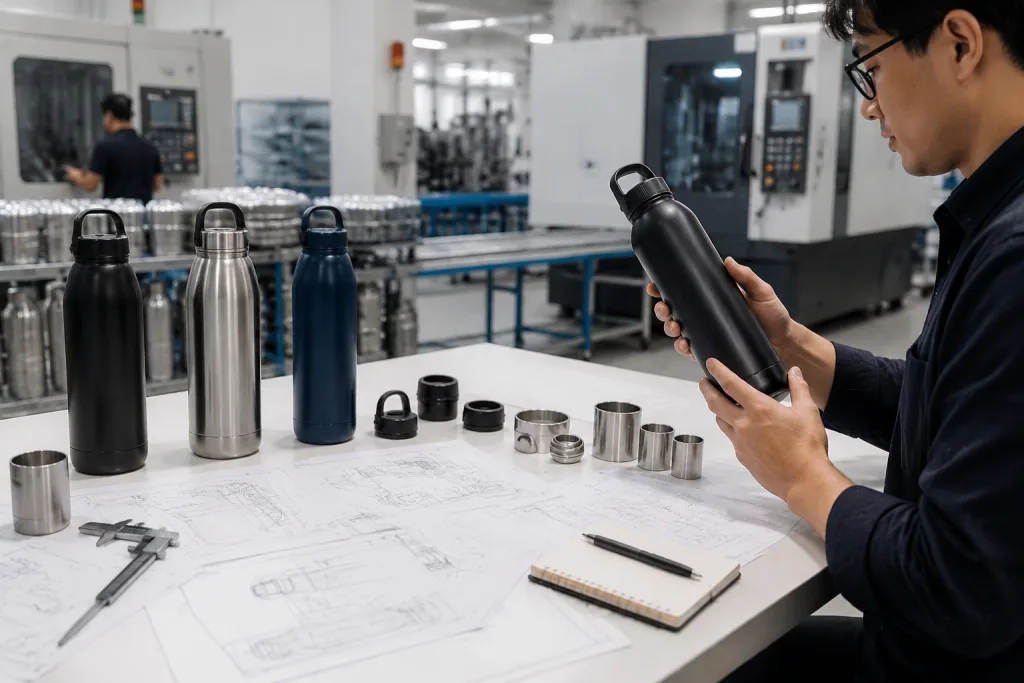
Most sourcing fights start the same way: the sample passed, then the production lot drifted. We see it on the line all the time. If you want the PO to hold, write the spec like the buyer will push back on every blank line. Steel grade, wall thickness, gasket compound, and finish all need numbers, not hand-waving.
- Material: 304 stainless steel for the bottle body; ask for heat numbers or mill certs if you are buying 5,000 pcs or more.
- Wall thickness: 0.4-0.6 mm is the usable band for a gym bottle. Under 0.4 mm, dent complaints start fast.
- Lid seal: Silicone gasket with leak testing at 30-45 degrees tilt and a 1 m drop check.
- Finish: Powder coat for grip, brushed steel for an industrial look, or spray finish when the buyer is chasing cost.
- Carton packout: Inner box plus master carton if you sell through retail or Amazon FBA.
For Europe, ask for REACH and LFGB on contact materials. For North America, request FDA food-contact paperwork and make sure the factory can keep the file straight. AQL 2.5 for critical defects and AQL 4.0 for major defects is a normal starting point for drinkware. If the supplier cannot show incoming inspection logs, welding checks, or seal test records, the math does not work.
There is a real gap between a bulk fitness water bottle and a bulk sports water bottle. The first gets judged by the member who uses it every day; the second gets judged by freight cost and sell-through. If you need a customizable gym water bottle line for chain stores, keep the spec tight enough that the third shipment still matches the first one. We have seen that go sideways when the PO says one thing and the carton label says another.
Pricing, MOQ, and lead times
Price is where a deal gets pinned down or falls apart. A 304 stainless steel gym water bottle supplier in Zhejiang or anywhere else in China should quote by body structure, lid, print method, and packing. If the number comes back as one flat line with no breakdown, the math does not work.
For a basic single-wall bottle, bulk pricing usually lands at USD 2.10-3.20 FOB. A shaker-style build with lid tooling and insert usually runs USD 2.30-4.10. Double-wall vacuum styles sit around USD 3.80-6.50, depending on finish and carton spec. Simple one-color logo printing adds about USD 0.08-0.35 per piece; special effects need a separate quote. We had a buyer flag a PO typo once - they wrote 500 pcs but wanted 5,000, and that changes the whole quote.
MOQ is where a lot of first-time buyers get a surprise. A serious China factory will often start custom runs at 1,000 pcs per SKU and 500 pcs per color if the tooling already exists. For new cap tooling, plan on 3,000 pcs or pay a tooling fee. Sample lead time is usually 5-7 days; QC pulled the sample, checked the cap thread with a caliper, and sent it back only if the fit was off. Mass production for a standard custom gym water bottle is often 25-35 days after approval, but new molds, odd packaging, or a 3-layer coating can push it out.
If you are comparing distributors fitness water bottle options, lower MOQ often hides a higher unit cost. A cheap quote with no carton spec, no test data, and no spare parts plan gets ugly on the first reorder. We run into this all the time - the buyer wants the lowest number, then the line gets stuck because the box is undersized by 12 mm. Lock the structure first, then negotiate on repeat volume.
Logo methods that survive gym use
Branding is where a lot of custom gym water bottle jobs go sideways. The render looks clean, then the logo starts fading, scratching, or chipping after 300 hand washes. On 304 stainless steel, we compare decoration the same way we compare bottle walls: by use-case, not by how it looks on a screen. QC pulled the sample on our line and ran a tape test; that tells you more than a mockup ever will.
| Method | Best for | Durability | Typical setup |
|---|---|---|---|
| Silkscreen | 1-2 color brand marks | Good if handled gently | USD 25-60 per color |
| Laser engraving | Premium logo on 304 steel | Very high | Low setup, higher machine time |
| Heat transfer | Full-color artwork | Moderate | Higher decoration cost |
| Debossed cap mark | Custom logo shaker bottle lids | High | Needs mold-ready cap design |
For a custom logo shaker bottle, laser engraving is usually the safest pick because there is no ink layer to peel. For a retail custom sports water bottle, silkscreen works when the brand wants a strong color hit and the bottle will not get scrubbed every day. If your order is a customized fitness water bottle for gym chains, I would push back on full-wrap artwork unless the coating system has already passed abrasion testing. We have seen that go sideways fast.
One detail buyers miss: logo placement changes cost. Curved bodies, narrow necks, and double-wall shells all add setup time. A solid supplier will show the artwork area in millimeters and call out the distortion before production. The buyer flagged a 2 mm typo on a PO once, and that tiny mistake changed the whole print position. That is the level of detail you want from China, not a vague promise that it will be fine.
How to qualify the supplier
Not every factory that claims sports bottles deserves your PO. If you are buying a custom shaker bottle or a customizable sports water bottle program, qualify the supplier the same way we run a packaging line: ask for proof, not a pretty sample from a trade show table.
Ask for factory proof: ISO 9001 certificate, BSCI audit if you need social compliance, and current photos or videos of the welding, polishing, and packing lines. A real Zhejiang plant should show the laser seam welder, the tube-polish station, and the packing bench without a staged setup. If they only send a showroom clip, the buyer should push back.
Ask for QC proof: Incoming material records, in-process leak test records, and final inspection reports. AQL 2.5/4.0 should be standard language. We check 50 pcs per lot on the line, and QC pulled one sample with a 2 mm dent near the base before it left. If they cannot explain color drift or dent rejection, they are guessing.
Ask for channel fit: If you are a distributor gym water bottle buyer, you need steady carton dimensions, repeatable decoration, and spare lids. If you are a retailer, you need barcode space, FNSKU room, and pack-out that survives fulfillment. If you are launching a custom fitness water bottle line, check that the supplier can hold your PMS targets across reorders. The wrong carton size costs freight; the math does not work.
The simplest test is this: send one drawing with capacity, finish, logo method, and carton target. A good factory in China will come back with questions about wall gauge, lid type, and compliance. A weak one sends a generic quote and misses a PO typo on the carton spec. That is how you save the first deposit.
Source your 304 sports bottle with fewer surprises
Send your target capacity, logo method, and carton spec. We will match the right custom fitness water bottle build to your channel and budget.
Frequently asked questions
What MOQ should I expect from a 304 stainless steel gym water bottle supplier?
For a normal custom run, expect 1,000 pcs per SKU as a practical MOQ. If you need a new lid mold, many factories in Zhejiang or elsewhere in China will ask for 3,000 pcs or a tooling charge. Stock-based runs can sometimes start at 300-500 pcs, but then you usually lose control over color, cap style, or packaging. For gym chains and fitness brands, I recommend planning around 1,000-3,000 pcs so you can keep unit cost sane and still test demand before a larger reorder.
Is 304 really better than 201 for a bulk gym water bottle?
Yes, for real gym use. 304 resists corrosion better when the bottle sees sweat, repeated washing, and occasional dishwasher exposure. 201 can save roughly USD 0.15-0.35 per piece on some builds, but the risk is higher staining and faster surface problems. If the bottle is a premium custom gym water bottle or a retail custom sports water bottle, 304 is the safer choice. If you are making a low-cost giveaway and the buyer accepts short life, 201 may look cheaper on paper, but it usually creates more service risk later.
Can I order a custom logo shaker bottle with different colors for each gym chain?
Yes, but do it in a controlled way. The best pattern is one base body, then separate cap colors or print colors per chain. For a custom logo shaker bottle, silkscreen usually supports 1-2 colors cleanly, while laser engraving gives you a durable mark with no ink. If you need a customized shaker bottle for several branches, ask for shared tooling and color runs of at least 500 pcs per color so you do not end up paying too much for small batches. A single tooling platform keeps your inventory cleaner across reorders.
What compliance documents should I ask for in Europe and North America?
For Europe, ask for REACH and LFGB test reports on food-contact parts. For North America, ask for FDA food-contact declarations and any relevant migration data. On the factory side, ISO 9001 and, if possible, BSCI help show process discipline. I would also request AQL inspection records, leak-test results, and material traceability for the 304 steel. If you are selling into retail or Amazon, keep carton dimensions, barcode placement, and FNSKU space in the file too. That saves you from relabeling costs later.
Should I choose insulated or single-wall for a distributor sports water bottle line?
For most distributor sports water bottle programs, single-wall 304 is the better volume play. It is lighter, usually cheaper at USD 2.10-3.20 FOB, and easier to ship in bulk. Insulated bottles make sense when the brand promise is premium or when the customer expects cold retention for 12-24 hours. The trade-off is weight, cost, and often higher MOQ. If you need both channels covered, I would build one single-wall SKU for volume and one insulated SKU for premium accounts instead of trying to force one bottle to do both.